
Carla K Meyer Ph D Nora Vines M




- Slides: 45
Carla K. Meyer, Ph. D. Nora Vines, M. A. Appalachian State University RE 4030 VOCABULARY
Warm Up Journal What types of words are the most important to focus on for instruction? Why should we focus our attention on them? Give 3 examples.
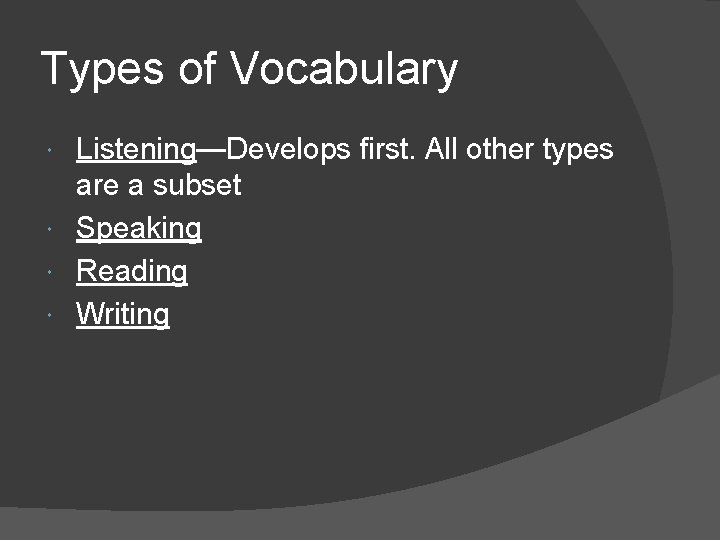
Types of Vocabulary Listening—Develops first. All other types are a subset Speaking Reading Writing
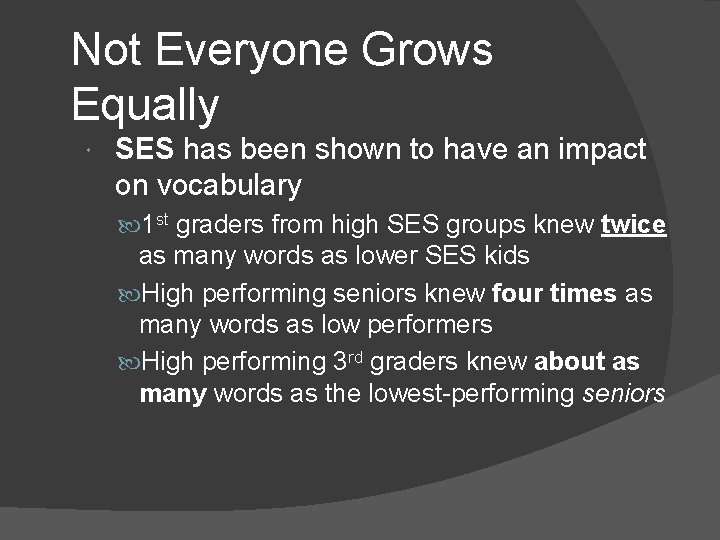
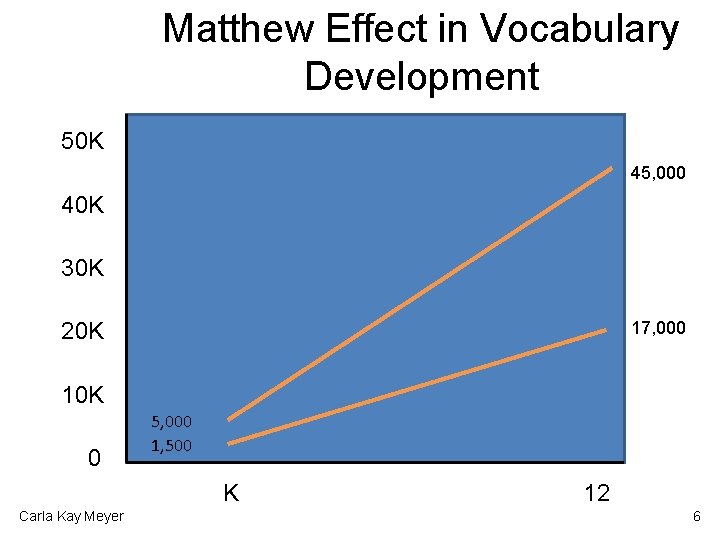
Not Everyone Grows Equally SES has been shown to have an impact on vocabulary 1 st graders from high SES groups knew twice as many words as lower SES kids High performing seniors knew four times as many words as low performers High performing 3 rd graders knew about as many words as the lowest-performing seniors
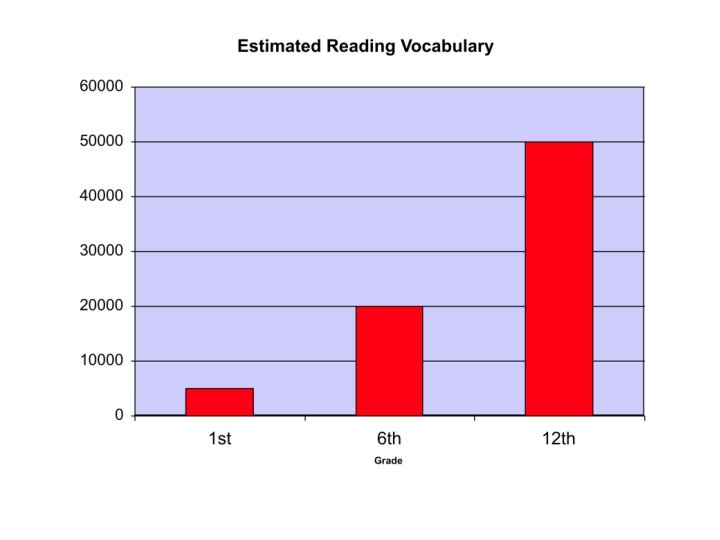
Matthew Effect in Vocabulary Development 50 K 45, 000 40 K 30 K 20 K 17, 000 10 K 0 5, 000 1, 500 K Carla Kay Meyer 12 6
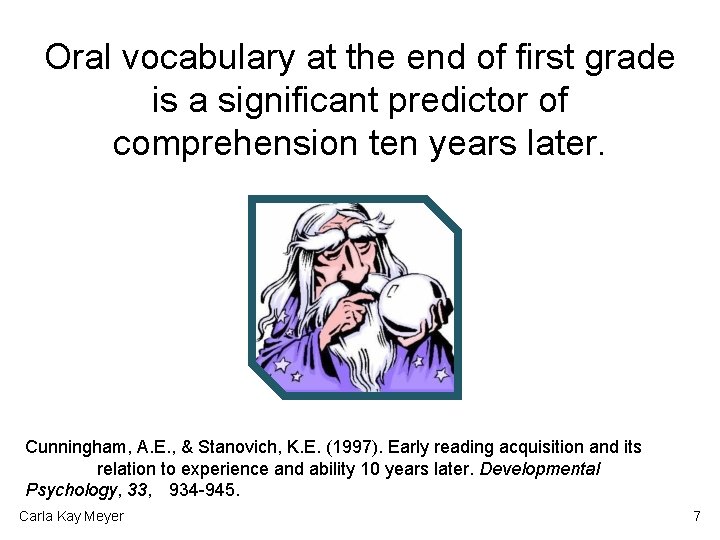
Oral vocabulary at the end of first grade is a significant predictor of comprehension ten years later. Cunningham, A. E. , & Stanovich, K. E. (1997). Early reading acquisition and its relation to experience and ability 10 years later. Developmental Psychology, 33, 934 -945. Carla Kay Meyer 7
8 8
How do students learn vocabulary? Initially through speech: Oral language exposure. Then, when reading begins, students begin learning from text.
But, learning from written context isn’t easy Only 5 -15% of unfamiliar words encountered when reading are learned!
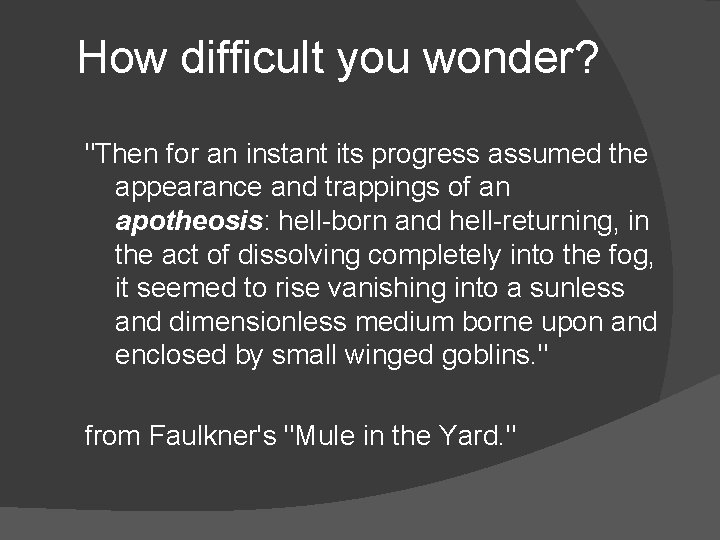
How difficult you wonder? "Then for an instant its progress assumed the appearance and trappings of an apotheosis: hell-born and hell-returning, in the act of dissolving completely into the fog, it seemed to rise vanishing into a sunless and dimensionless medium borne upon and enclosed by small winged goblins. " from Faulkner's "Mule in the Yard. "
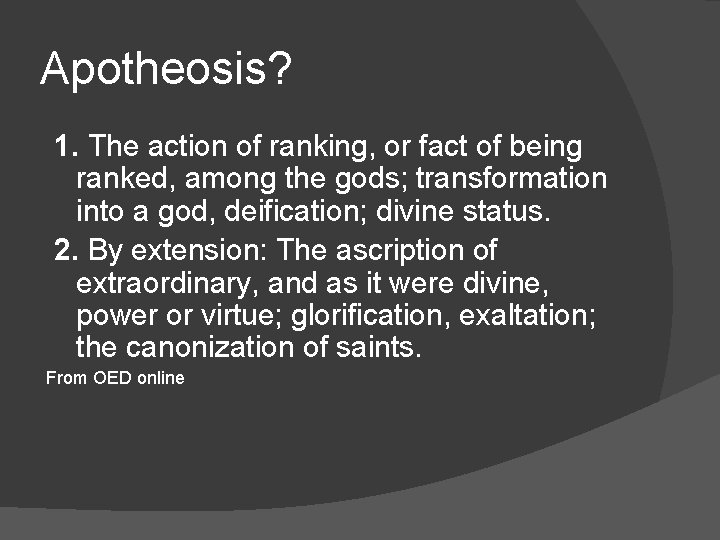
Apotheosis? 1. The action of ranking, or fact of being ranked, among the gods; transformation into a god, deification; divine status. 2. By extension: The ascription of extraordinary, and as it were divine, power or virtue; glorification, exaltation; the canonization of saints. From OED online
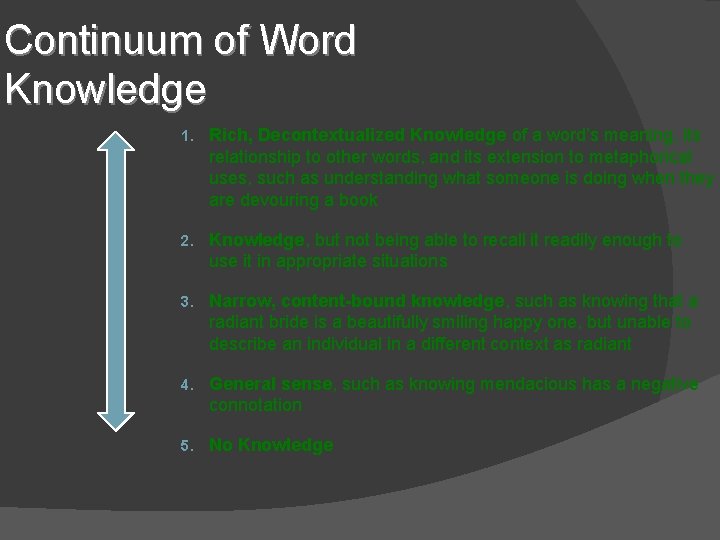
Continuum of Word Knowledge 1. Rich, Decontextualized Knowledge of a word’s meaning, its relationship to other words, and its extension to metaphorical uses, such as understanding what someone is doing when they are devouring a book 2. Knowledge, but not being able to recall it readily enough to use it in appropriate situations 3. Narrow, content-bound knowledge, such as knowing that a radiant bride is a beautifully smiling happy one, but unable to describe an individual in a different context as radiant 4. General sense, such as knowing mendacious has a negative connotation 5. No Knowledge
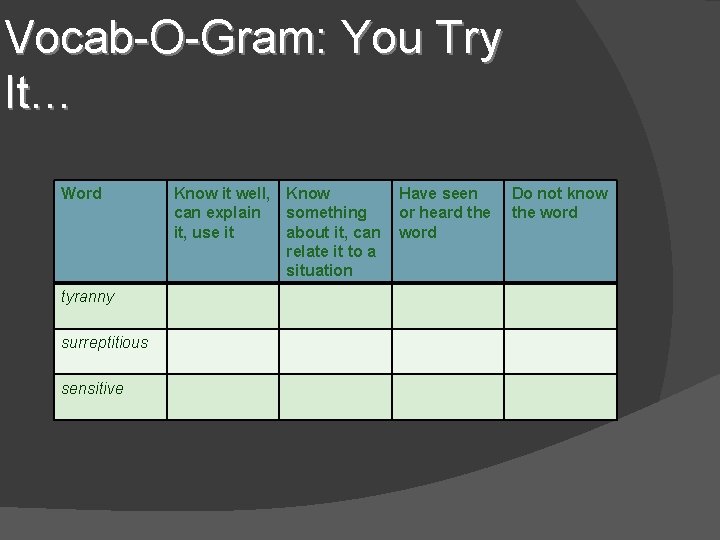
Vocab-O-Gram: You Try It… Word tyranny surreptitious sensitive Know it well, Know can explain something it, use it about it, can relate it to a situation Have seen or heard the word Do not know the word
Conditions of learning from context 1. Read widely enough to see lots of words. n 2. Wide reading best predictor of vocabulary Utilize inferencing skills to zero in on a word’s meaning.
Why Don’t We Just Rely On Context Learning? Still only 5 -15% of words learned through context. Lots of students don’t read widely. Lots of students don’t have good inferencing skills.
What do we do? Teach vocabulary that is the most helpful.
Teach all the words? Students are estimated to learn around 3, 000 -4, 000 words a year. If teachers taught them all, it would mean teaching about 20 words per day! How do you choose words to teach?
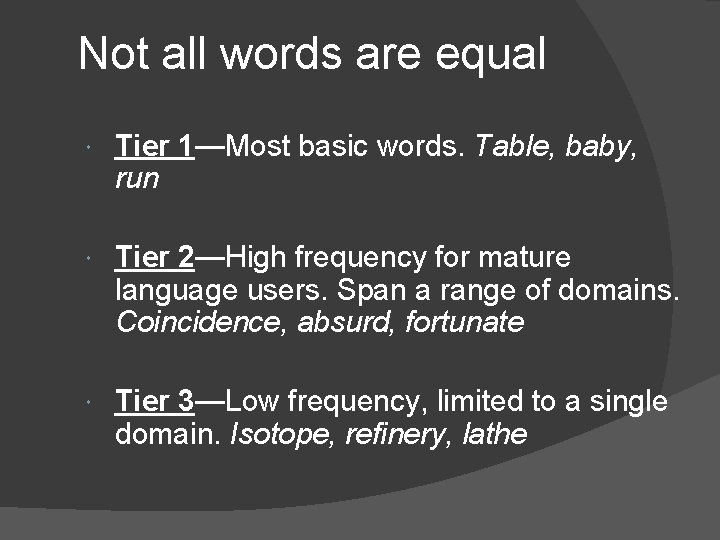
Not all words are equal Tier 1—Most basic words. Table, baby, run Tier 2—High frequency for mature language users. Span a range of domains. Coincidence, absurd, fortunate Tier 3—Low frequency, limited to a single domain. Isotope, refinery, lathe
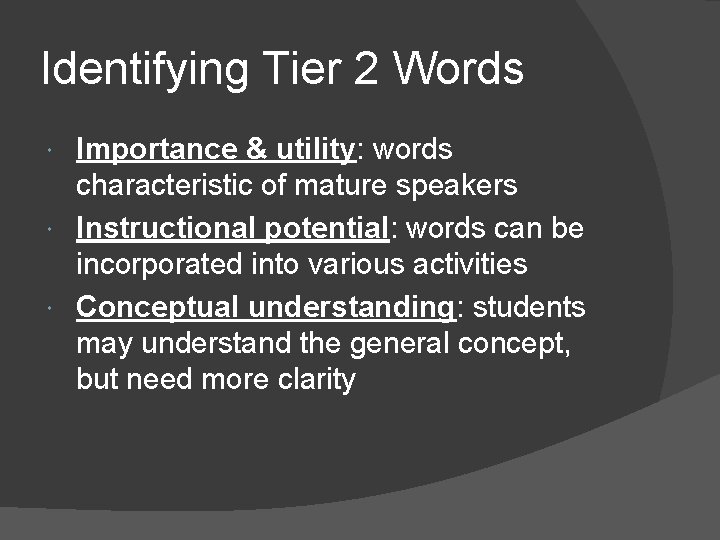
Identifying Tier 2 Words Importance & utility: words characteristic of mature speakers Instructional potential: words can be incorporated into various activities Conceptual understanding: students may understand the general concept, but need more clarity
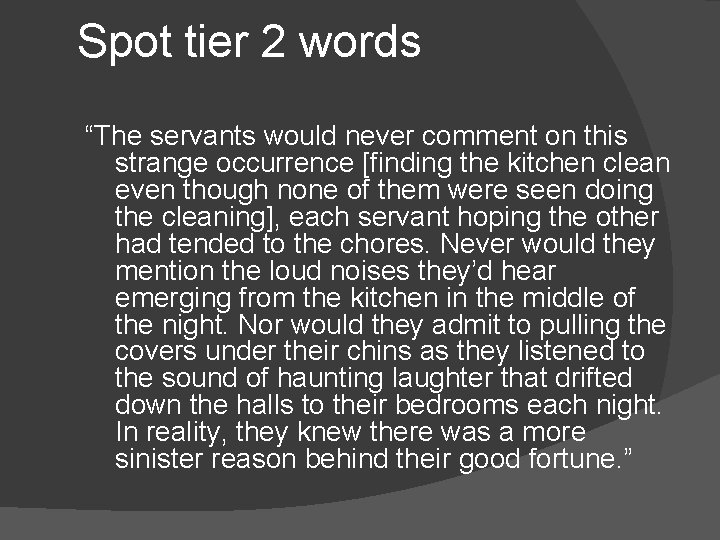
Spot tier 2 words “The servants would never comment on this strange occurrence [finding the kitchen clean even though none of them were seen doing the cleaning], each servant hoping the other had tended to the chores. Never would they mention the loud noises they’d hear emerging from the kitchen in the middle of the night. Nor would they admit to pulling the covers under their chins as they listened to the sound of haunting laughter that drifted down the halls to their bedrooms each night. In reality, they knew there was a more sinister reason behind their good fortune. ”
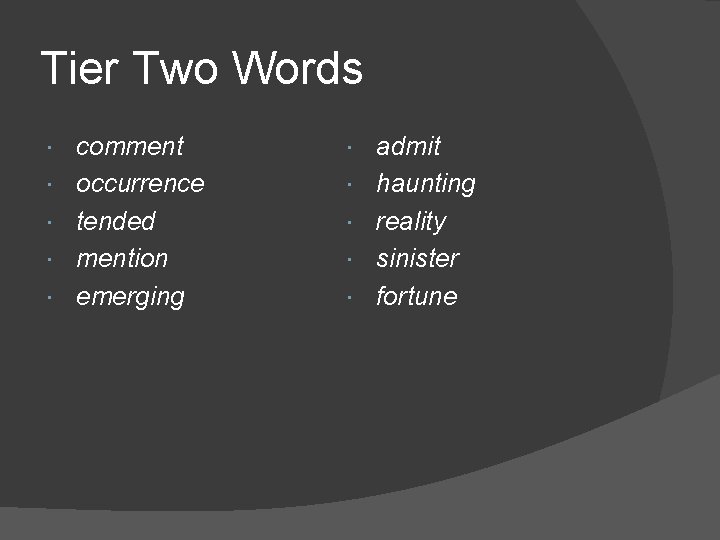
Tier Two Words comment occurrence tended mention emerging admit haunting reality sinister fortune
Now you try… Using the provided children’s book, work in your group to identify five tier two words. Share words with class.
How to teach vocabulary Introduce target words Contextualized introduction Explanation of meaning Provide multiple opportunities to interact with the word Encourage future use
Word Explanations Dictionary definitions don’t cut it Space constraints make for a weird dictionary style def·i·ni·tion: n 1. A statement conveying fundamental character. 2. A statement of the meaning of a word, phrase, or term, as in a dictionary entry.
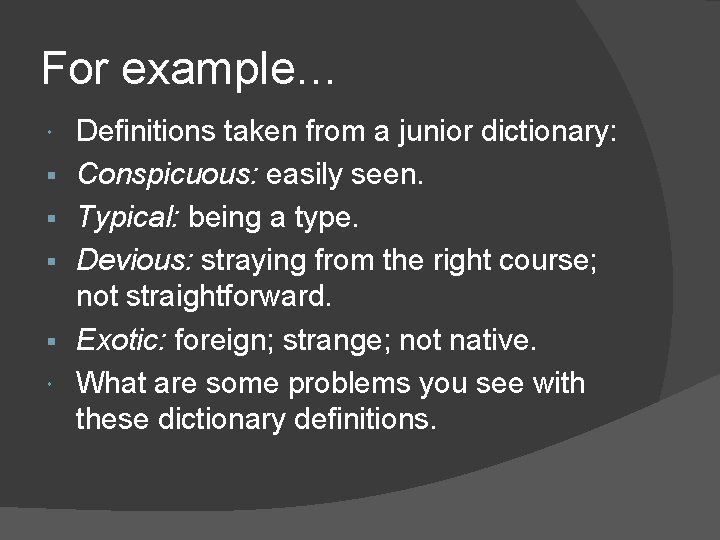
For example… § § Definitions taken from a junior dictionary: Conspicuous: easily seen. Typical: being a type. Devious: straying from the right course; not straightforward. Exotic: foreign; strange; not native. What are some problems you see with these dictionary definitions.
Student-friendly explanations Characterize the word & how it’s used Think about typical use Explain it in everyday language
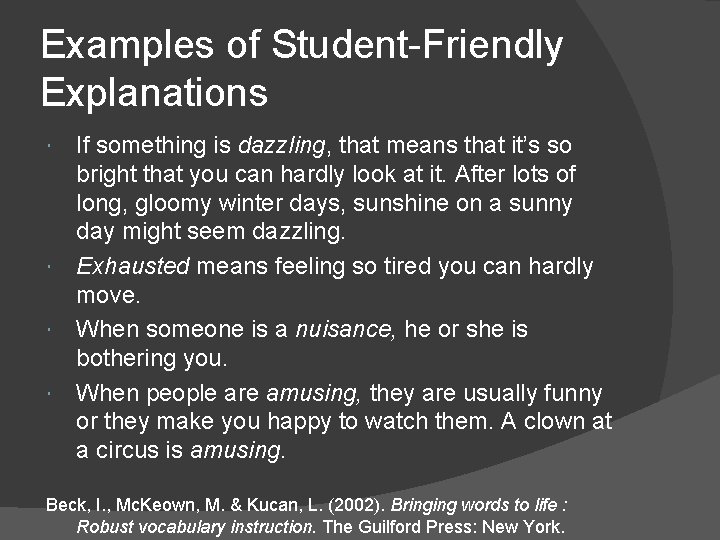
Examples of Student-Friendly Explanations If something is dazzling, that means that it’s so bright that you can hardly look at it. After lots of long, gloomy winter days, sunshine on a sunny day might seem dazzling. Exhausted means feeling so tired you can hardly move. When someone is a nuisance, he or she is bothering you. When people are amusing, they are usually funny or they make you happy to watch them. A clown at a circus is amusing. Beck, I. , Mc. Keown, M. & Kucan, L. (2002). Bringing words to life : Robust vocabulary instruction. The Guilford Press: New York.
Activity With your group create child friendly definitions for your tier two words. Share definitions with class.
Vocabulary for Older Students Tenets of good vocabulary instruction 1. Frequency of encounters with words 2. Richness of instruction 3. Extension of word use outside the classroom
Frequency of Words Upper elementary school Introduce about 10 words per week Daily vocabulary activities so that each word is the focus of attention 8 -10 times.
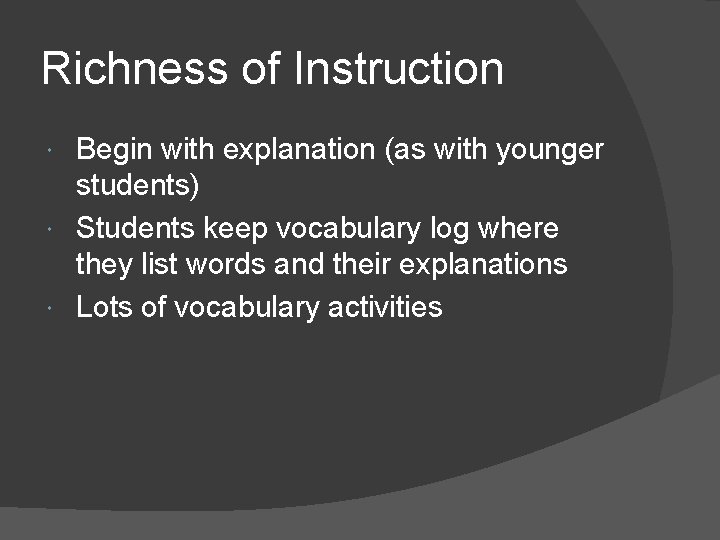
Richness of Instruction Begin with explanation (as with younger students) Students keep vocabulary log where they list words and their explanations Lots of vocabulary activities
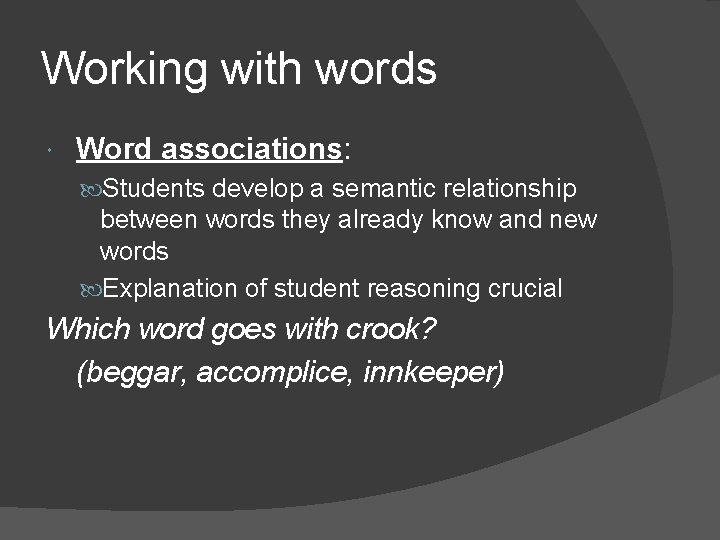
Working with words Word associations: Students develop a semantic relationship between words they already know and new words Explanation of student reasoning crucial Which word goes with crook? (beggar, accomplice, innkeeper)
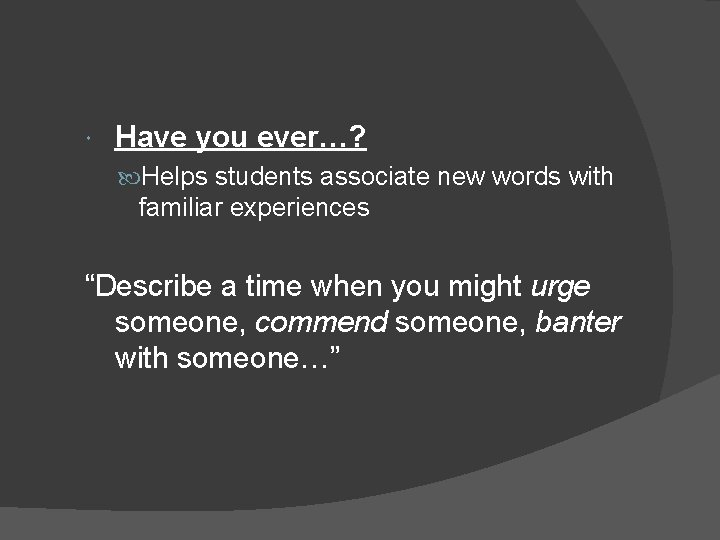
Have you ever…? Helps students associate new words with familiar experiences “Describe a time when you might urge someone, commend someone, banter with someone…”
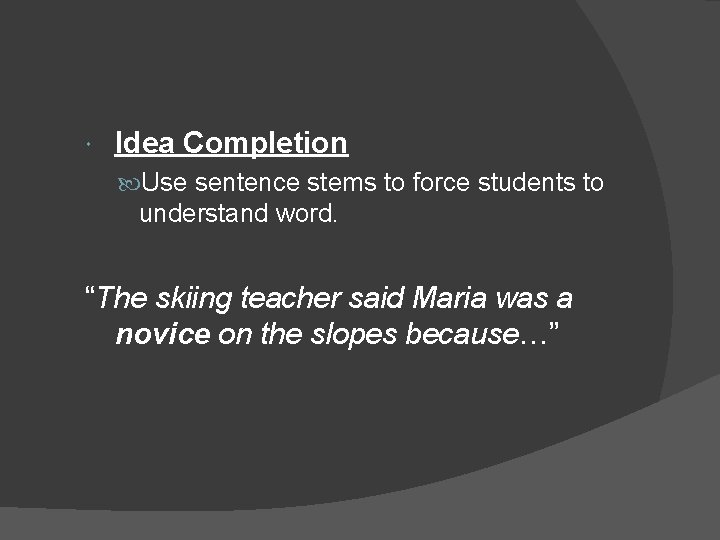
Idea Completion Use sentence stems to force students to understand word. “The skiing teacher said Maria was a novice on the slopes because…”
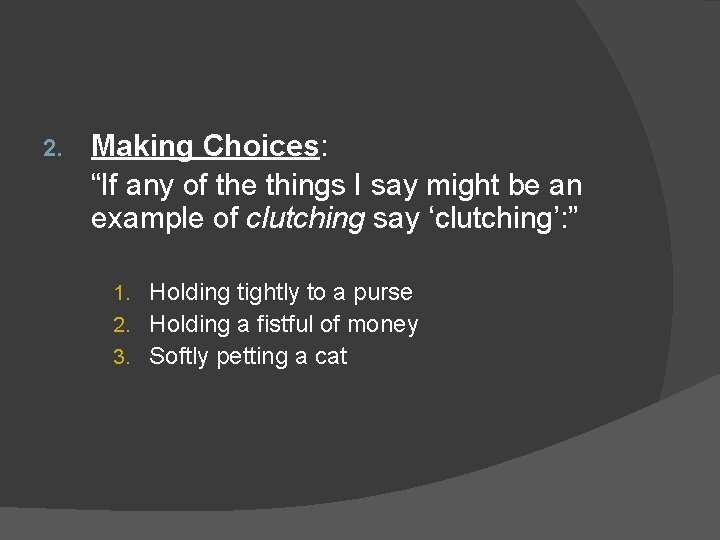
2. Making Choices: “If any of the things I say might be an example of clutching say ‘clutching’: ” 1. Holding tightly to a purse 2. Holding a fistful of money 3. Softly petting a cat
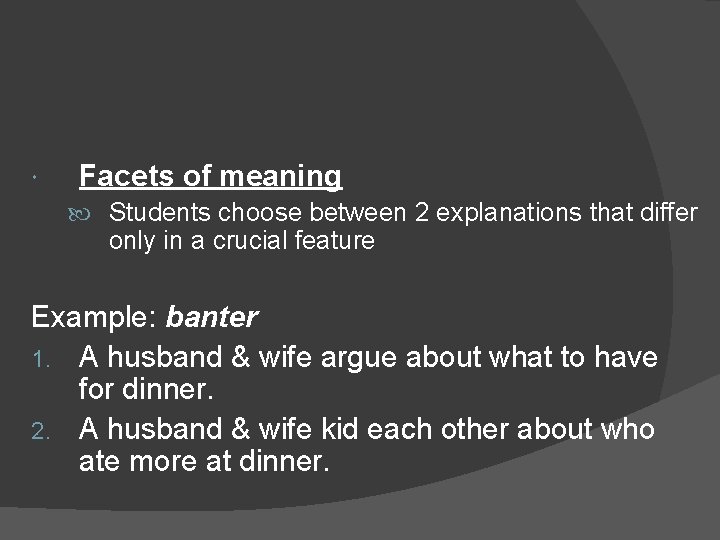
Facets of meaning Students choose between 2 explanations that differ only in a crucial feature Example: banter 1. A husband & wife argue about what to have for dinner. 2. A husband & wife kid each other about who ate more at dinner.
Relationships among words Also designed to push students to think of words outside of the context in which they were introduced. Example: “Could a virtuoso also be a rival? ”
Word Wizards Designed to encourage students to notice words and interact with them outside the classroom. Example: Students gain points if they bring evidence to class of encountering target words.
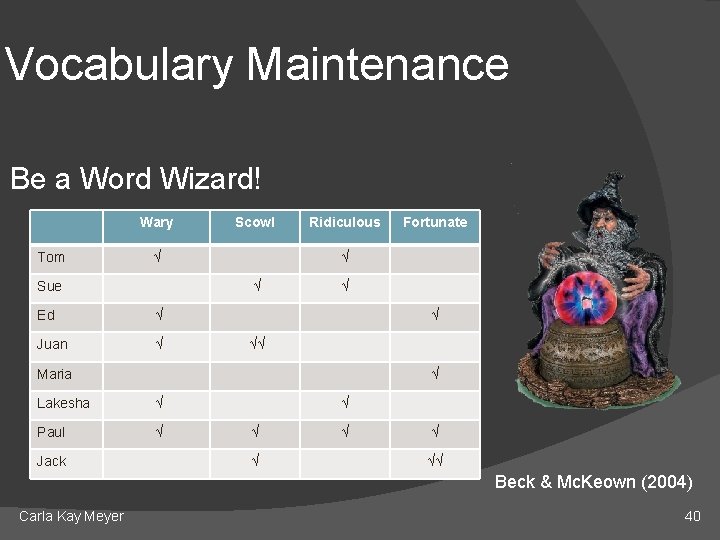
Vocabulary Maintenance Be a Word Wizard! Wary Tom Scowl √ Sue √ Juan √ √ √ √√ Maria √ Lakesha √ Paul √ Jack Fortunate √ √ Ed Ridiculous √ √ √√ Beck & Mc. Keown (2004) Carla Kay Meyer 40
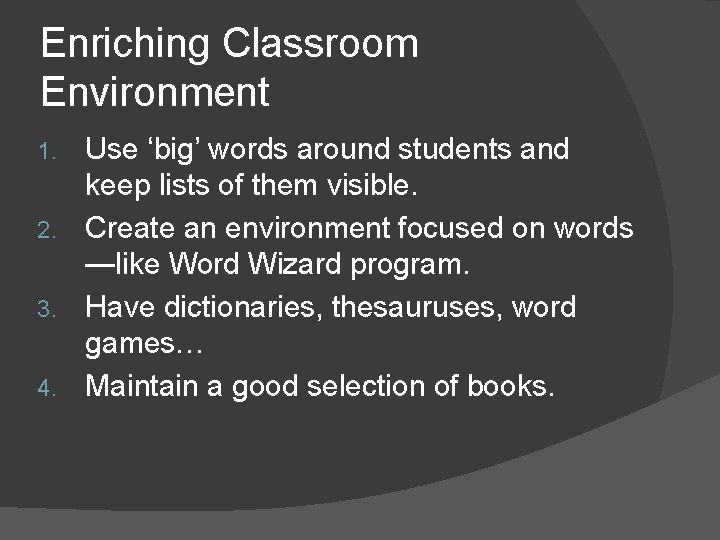
Enriching Classroom Environment Use ‘big’ words around students and keep lists of them visible. 2. Create an environment focused on words —like Word Wizard program. 3. Have dictionaries, thesauruses, word games… 4. Maintain a good selection of books. 1.
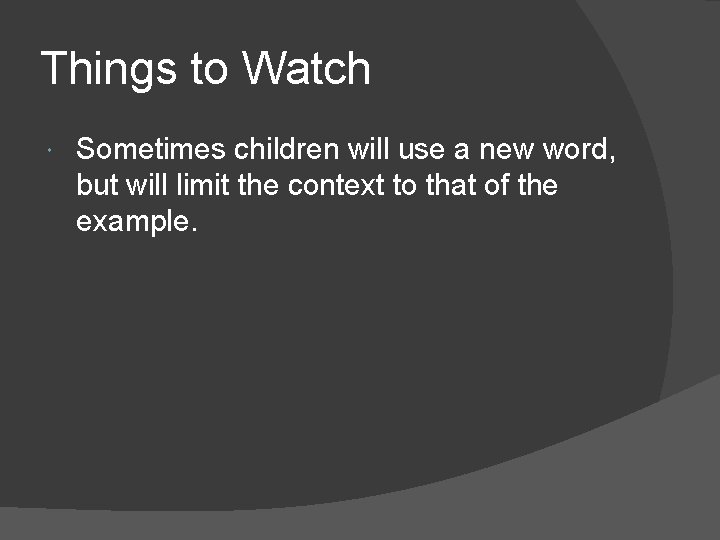
Things to Watch Sometimes children will use a new word, but will limit the context to that of the example.
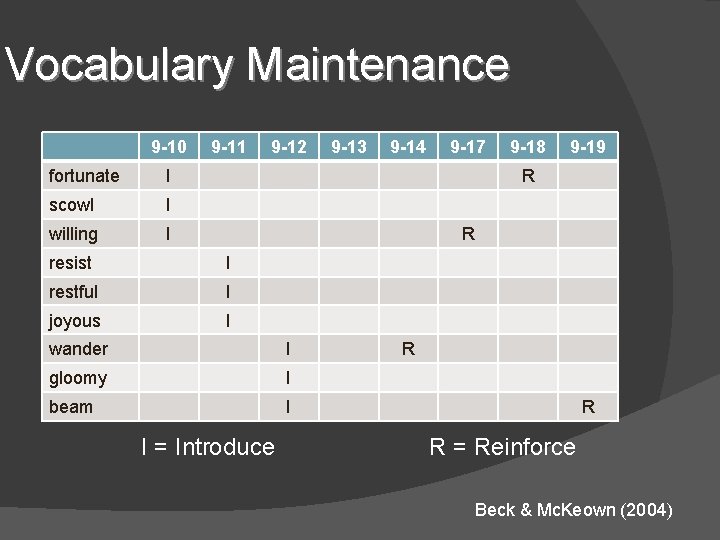
Vocabulary Maintenance 9 -10 fortunate I scowl I willing I 9 -11 9 -12 9 -13 9 -14 9 -17 9 -18 9 -19 R R resist I restful I joyous I wander I gloomy I beam I I = Introduce R R R = Reinforce Beck & Mc. Keown (2004)
Good Resource Beck, I. L. , Mc. Keown, M. G. , & Kucan, L. (2002). Bringing words to life: Robust vocabulary instruction. New York: Guilford Press. Beck, I. L. , Mc. Keown, M. G. , & Kucan, L. (2008). Creating Robust Vocabulary, New York: Guilford Press.
Word Wizard… Let’s practice with a new Literature Circle Role!