
Carl Perkins Act The Carl D Perkins Act









- Slides: 23
Carl Perkins Act The Carl D. Perkins Act is a federal education program that invests in secondary and postsecondary Career and Technical Education (CTE) programs. One of the purposes of the 2018 version of the Perkins Act is to develop more fully the academic knowledge and technical employability skills by increasing the employment opportunities for populations who are chronically unemployed or underemployed, including individuals with disabilities, individuals from economically disadvantaged families, out-of-workforce individuals, youth who are in, or have aged out of, the foster care system, and homeless individuals.
Grant distribution in NC • 66% of Perkins funds - Department of Public Instruction for secondary CTE programs. State Board of Education administers CTE in NC. • 34% of Perkins funds - NC Community College System (NCCCS) for postsecondary CTE programs, • Postsecondary funds are distributed 85% to colleges, 10% to leadership projects, and 5% for administration. Total amount distributed to NC Community Colleges in 2018 -19 was about $11 million. Funds are allocated based on each college’s number of Pell & BIA grant recipients enrolled in CTE Programs.
Carl D. Perkins • United States Representative from Kentucky • Served from 1949 to 1984 • Legacy of support to education and the underprivileged • Perkins Student Loan • Carl D. Perkins Career and Technical Education Act originally passed in 1984
History of the Perkins Act • 1984: Perkins I - vocational education improvement, special populations • 1990: Perkins II - integration of vocational and academic education • 1998: Perkins III - technology and workforce preparation • 2006: Perkins IV - career and technical education with increased academic preparation; preparation for high-wage, highskill occupations for tomorrow’s workforce through programs of study
2018 - Perkins V The Perkins Act was revised with the “Strengthening Career and Technical Education for the 21 st Century Act. ” This act changed the Perkins Act to what we now refer to as Perkins V. The revised law will go into effect July 1, 2019. The first year will be a transition year. Perkins V has closer alignment with the Workforce Innovation and Opportunity Act (WIOA) with emphasis on workforce preparation and Programs of Study to meet employer needs identified in a localneeds assessment.
Eliminating Barriers A major tenant of the Perkins Act is to promote equity and success in CTE for all students This includes students in “special populations, ” which Perkins V defines in nine specific categories.
Perkins V Special Populations (page 1) 1. Individuals with a disabilities Perkins V states – In general. The term ‘individual with a disability’ means an individual with any disability (as defined in section 3 of the Americans with Disabilities Act of 1990 (42 U. S. C. 12102)). From 42 U. S. C. 12102: The term `disability' means, with respect to an individual-A. a physical or mental impairment that substantially limits one or more of the major life activities of such individual; B. a record of such an impairment; or C. being regarded as having such an impairment.
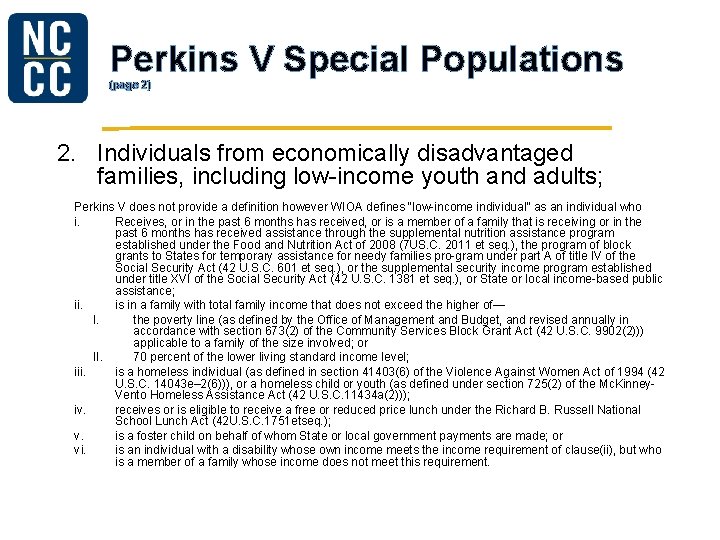
Perkins V Special Populations (page 2) 2. Individuals from economically disadvantaged families, including low-income youth and adults; Perkins V does not provide a definition however WIOA defines “low-income individual” as an individual who i. Receives, or in the past 6 months has received, or is a member of a family that is receiving or in the past 6 months has received assistance through the supplemental nutrition assistance program established under the Food and Nutrition Act of 2008 (7 US. C. 2011 et seq. ), the program of block grants to States for temporary assistance for needy families pro-gram under part A of title IV of the Social Security Act (42 U. S. C. 601 et seq. ), or the supplemental security income program established under title XVI of the Social Security Act (42 U. S. C. 1381 et seq. ), or State or local income-based public assistance; ii. is in a family with total family income that does not exceed the higher of— I. the poverty line (as defined by the Office of Management and Budget, and revised annually in accordance with section 673(2) of the Community Services Block Grant Act (42 U. S. C. 9902(2))) applicable to a family of the size involved; or II. 70 percent of the lower living standard income level; iii. is a homeless individual (as defined in section 41403(6) of the Violence Against Women Act of 1994 (42 U. S. C. 14043 e– 2(6))), or a homeless child or youth (as defined under section 725(2) of the Mc. Kinney. Vento Homeless Assistance Act (42 U. S. C. 11434 a(2))); iv. receives or is eligible to receive a free or reduced price lunch under the Richard B. Russell National School Lunch Act (42 U. S. C. 1751 etseq. ); v. is a foster child on behalf of whom State or local government payments are made; or vi. is an individual with a disability whose own income meets the income requirement of clause(ii), but who is a member of a family whose income does not meet this requirement.
Perkins V Special Populations (page 3) 3. Individuals preparing or non-traditional fields Perkins V states the term ‘non-traditional fields’ means occupations or fields of work, such as careers in computer science, technology, and other current and emerging high skill occupations, for which individuals from one gender comprise less than 25 percent of the individuals employed in each such occupation or field of work. 4. Single parents, including single pregnant women Perkins V does not provide a definition, however the Employment and Training Administration Advisory dated March 2, 2017 states an “individual who is parenting can be a mother or father, custodial or noncustodial. ” Link: https: //wdr. doleta. gov/directives/attach/TEGL_2116_Acc. pdf
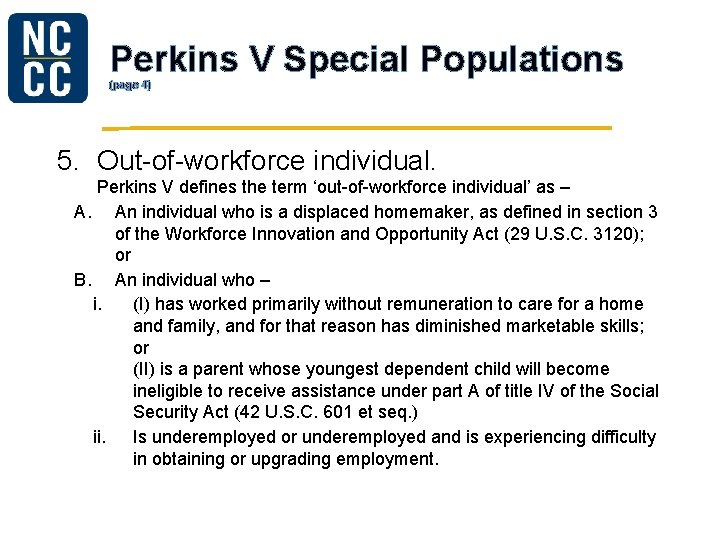
Perkins V Special Populations (page 4) 5. Out-of-workforce individual. Perkins V defines the term ‘out-of-workforce individual’ as – A. An individual who is a displaced homemaker, as defined in section 3 of the Workforce Innovation and Opportunity Act (29 U. S. C. 3120); or B. An individual who – i. (I) has worked primarily without remuneration to care for a home and family, and for that reason has diminished marketable skills; or (II) is a parent whose youngest dependent child will become ineligible to receive assistance under part A of title IV of the Social Security Act (42 U. S. C. 601 et seq. ) ii. Is underemployed or underemployed and is experiencing difficulty in obtaining or upgrading employment.
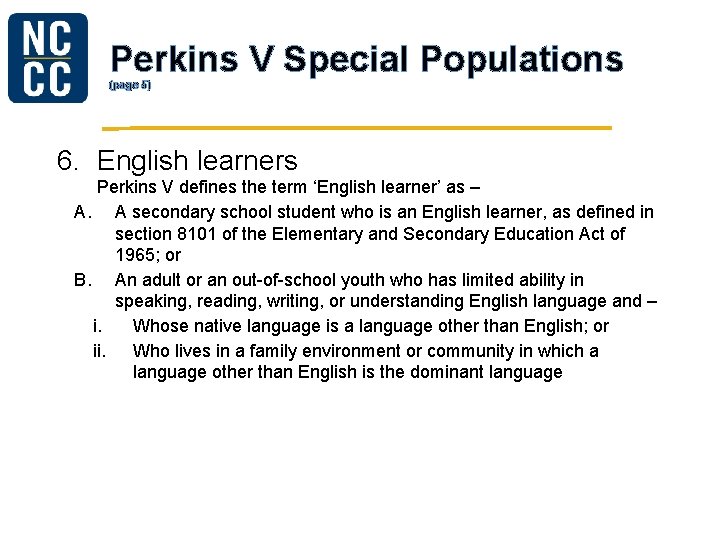
Perkins V Special Populations (page 5) 6. English learners Perkins V defines the term ‘English learner’ as – A. A secondary school student who is an English learner, as defined in section 8101 of the Elementary and Secondary Education Act of 1965; or B. An adult or an out-of-school youth who has limited ability in speaking, reading, writing, or understanding English language and – i. Whose native language is a language other than English; or ii. Who lives in a family environment or community in which a language other than English is the dominant language
Perkins V Special Populations (page 6) 7. Homeless individuals Perkins V refers to the definition in section 725 of the Mc. Kinney-Vento Homeless Assistance Act 1 (42 U. S. C. 11434 a), which states the term homeless children and youths' — A. means individuals who lack a fixed, regular, and adequate nighttime residence (within the meaning of section 103(a)(1)); and B. includes — i. children and youths who are sharing the housing of other persons due to loss of housing, economic hardship, or a similar reason; are living in motels, hotels, trailer parks, or camping grounds due to the lack of alternative adequate accommodations; are living in emergency or transitional shelters; are abandoned in hospitals; or are awaiting foster care placement; ii. children and youths who have a primary nighttime residence that is a public or private place not designed for or ordinarily used as a regular sleeping accommodation for human beings (within the meaning of section 103(a)(2)(C)); iii. children and youths who are living in cars, parks, public spaces, abandoned buildings, substandard housing, bus or train stations, or similar settings; and iv. migratory children (as such term is defined in section 1309 of the Elementary and Secondary Education Act of 1965) who qualify as homeless for the purposes of this subtitle because the children are living in circumstances described in clauses (i) through (iii). 1 The Mc. Kinney-Vento Act applies to children and youth age 21 and under, consistent with their eligibility for public education services under state and federal law. State laws vary, but generally provide access to all students until high school graduation or equivalent, or until age 18 (or over in some states).
Perkins V Special Populations (page 7) 8. Youth who are in or have aged out of the foster care system Perkins V does not provide a definition, however NC Gen. Stat. § 108 A-48 states the NC Department of Social Services may continue to provide benefits pursuant to this section to an individual who has reached age 18 and chosen to continue receiving foster care services until reaching age 21. Additionally Admin Code Tit 10 A, 70 B. 0102 states services may continue until age 21 if the individual is “enrolled in an institution that provides postsecondary or vocational education”. 9. Youth with a parent who – i. ii. is an active-duty member of the armed forces (as such term is defined in section 101(a)(4) of title 10, U. S. C. ); and is on active duty (as such term is defined in section 101(d)(1) of such title.
Special Populations 101 Video The following video was created by the California Perkins Joint Special Populations Advisory Committee. Link: http: //www. jspac. org/ Please note that this video is about Perkins IV. Perkins V has the same categories of special populations with the addition of homeless students, students who have aged out of foster care, and students with active-duty military parents. Video on special populations in Perkins IV Link: https: //www. youtube. com/watch? v=MH_bgk. Uka. MA
Perkins V Local Basic Grant Community Colleges develop a local application to use the basic grant funds, based on a comprehensive needs assessment, focusing on 6 required activities. Development of the needs assessment and application must include input from a variety of stakeholders, including representatives of special populations; and representatives of agencies serving out-of-school youth, homeless children and youth, and at-risk youth.
Plan for special populations The local application must describe how the community college will • Provide activities to prepare special populations for high-skill, high-wage, or in-demand industry sectors or occupations that will lead to self-sufficiency • Prepare CTE participants for non-traditional fields • Provide equal access for special populations to CTE courses, programs and programs of study • Ensure that members of special populations will not be discriminated against on the basis of their status as members of special populations.
Performance Indicators The Act requires continual meaningful progress toward improving the performance of students, including those with special populations. The performance of Perkins IV has been measured by six core indicators, which are reported for each college and the state. 1. 2. 3. 4. 5. 6. Technical Skill Attainment Credential, Certificate, or Degree Attainment Student Retention or Transfer Student Placement in Employment Nontraditional Participation Nontraditional Completion
Perkins IV Data Perkins data by community college as well as state summaries may be accessed on the NC Perkins Data Portal. link: https: //www. ncperkins. org/data/
Perkins V Indicators Perkins V reduces the postsecondary performance indicators to three (starting in 2020 -21) 1. The percentage of CTE concentrators who, during the second quarter after program completion, remain enrolled in postsecondary education, are in advanced training, military service, or a service program under the National and Community Service Act, are volunteers in the Peace Corps, or are placed or retained in employment 2. The percentage of CTE concentrators who received a recognized postsecondary credential during participation in or within one year of program completion 3. The percentage of CTE concentrators in CTE programs and programs of study that lead to gender nontraditional fields
Data disaggregation Perkins V requires state and local recipients to disaggregate performance indicator data by program or career cluster and by gender, race/ethnicity, each of the special population groups and migrant students (per section 1111(h)(1)(C)(ii) of ESEA of 1965) for every performance measure. Further, state and local recipients must report the actual levels of performance for each of the special population subgroups; and identify and quantify any disparities or gaps in performance on the levels of performance between any subgroup and the performance of all CTE concentrators. * This means community colleges will need to request data around special populations from its students.
Methods of Administration (MOA) The United States Office of Civil Rights oversees the MOA compliance programs of state agencies that administer Perkins grants. The purpose is to ensure that all students, regardless of race, color, national origin, sex, or disability, have equal access to high-quality career and technical education programs. The CTE Team at NCCCS conducts two college reviews per year. Colleges are monitored until all corrections are made. Additional information can be found on the US OCR website Link: https: //www 2. ed. gov/about/offices/list/ocr/frontpage/faq/rr/policyguidance/moa. html
Perkins/CTE State Staff NC Community College Perkins Link: https: //www. ncperkins. org/ Dr. Bob Witchger. B@nccommunitycolleges. edu Director, Career & Technical Education 919 -807 -7126 Dr. Tony R. Reggi Coordinator, Career & Technical Education Reggi. A@nccommunitycolleges. edu 919 -807 -7131 Patti Coultas Coordinator, Career & Technical Education Coultas. P@nccommunitycolleges. edu 919 -807 -7130 Chris Droessler Coordinator, Career & Technical Education Droessler. C@nccommunitycolleges. edu 919 -807 -7068 Darice Mc. Dougald. D@nccommunitycolleges. edu CTE Administrative Assistant 919 -807 -7219
Perkins Resources • Perkins V - one-page summary from Advance CTE Link: https: //cte. careertech. org/sites/default/files/Perkins. V_One-Pager_082418. pdf • Full text of the Carl D. Perkins Act of 2006 as amended in 2018 (Perkins V) Link: https: //cte. careertech. org/sites/default/files/Perkins. V_September 2018. pdf • National Alliance for Partnerships in Equity (NAPE) Link: https: //www. napequity. org/ • Association for Career and Technical Education (ACTE) Link: https: //www. acteonline. org/ • Advance CTE website Link: https: //careertech. org/