
CARIS 2012 Vertical surface processing from integrated MBES
CARIS 2012 Vertical surface processing from integrated MBES –lidar data Eli Leblanc, Mathieu Rondeau & Jean-Guy Nistad
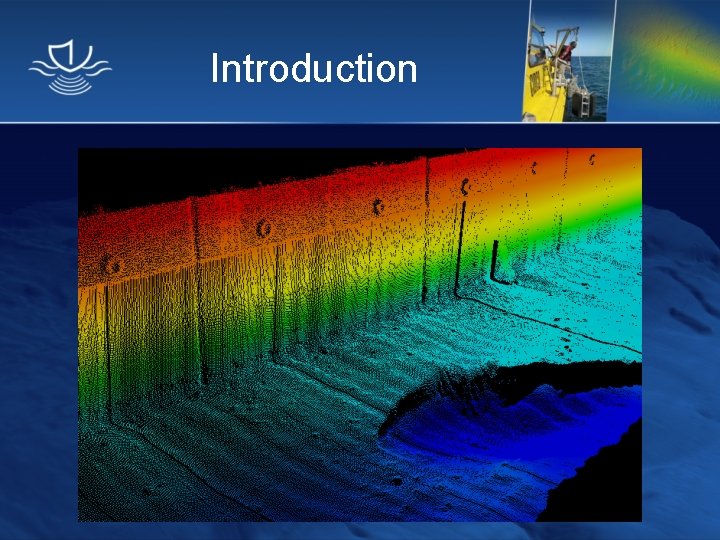
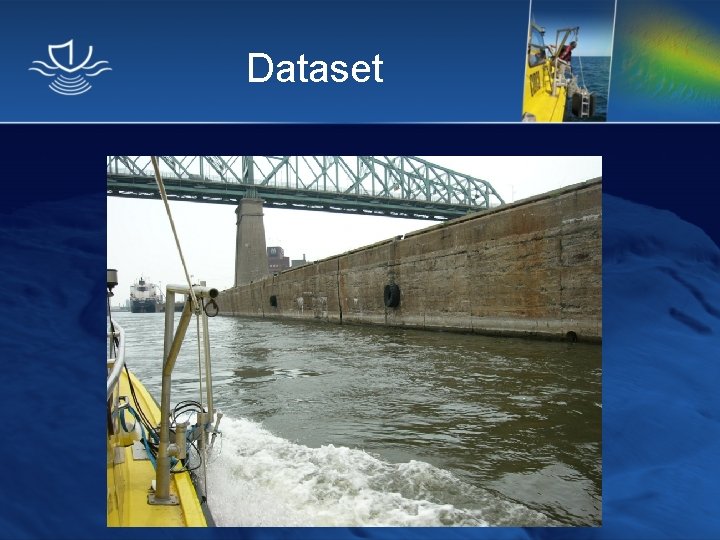
Introduction • In the last few years, CIDCO has been developing expertise in port infrastructure inspection – Current method: subjective and partial observations from divers – CIDCO method: objective, full coverage and efficient sonar-lidar 3 D dataset
Introduction
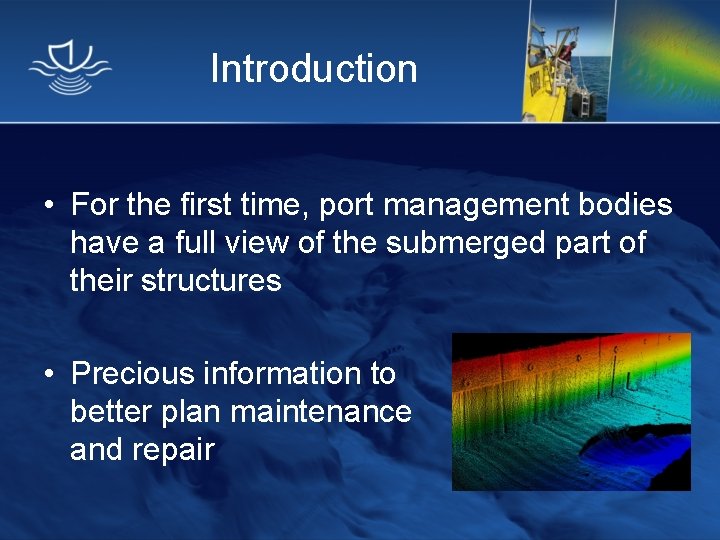
Introduction • For the first time, port management bodies have a full view of the submerged part of their structures • Precious information to better plan maintenance and repair
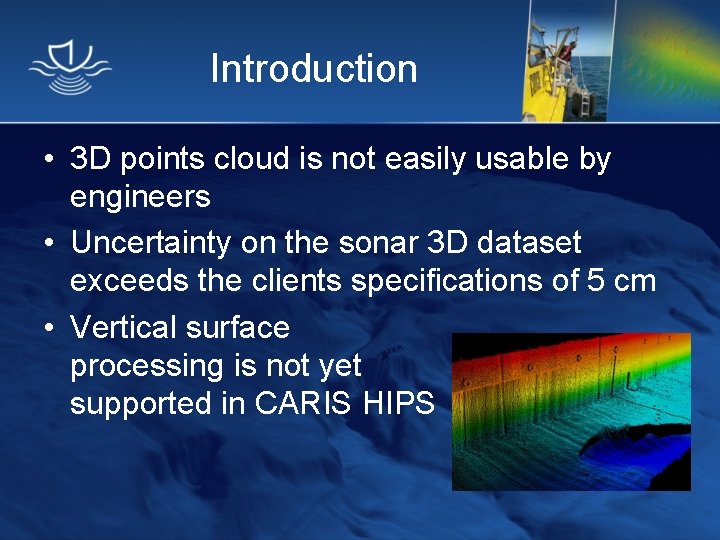
Introduction • 3 D points cloud is not easily usable by engineers • Uncertainty on the sonar 3 D dataset exceeds the clients specifications of 5 cm • Vertical surface processing is not yet supported in CARIS HIPS
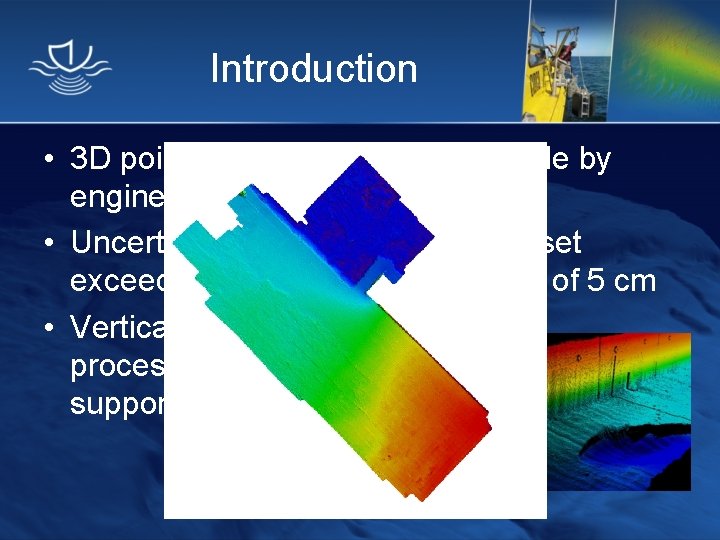
Introduction • 3 D points cloud is not easily usable by engineers • Uncertainty on the sonar 3 D dataset exceeds the clients specifications of 5 cm • Vertical surface processing is not yet supported in CARIS HIPS
Introduction • 3 solutions were tested 1) Vessel file roll bias (HIPS) 2) Inverse-distance WMA filter (HIPS-Matlab) 3) XTF files rotation (Matlab-HIPS)
Dataset • • Port of Montréal November 2011 30° tilted MBES Reson Seabat 7125 Data recorded in xtf format
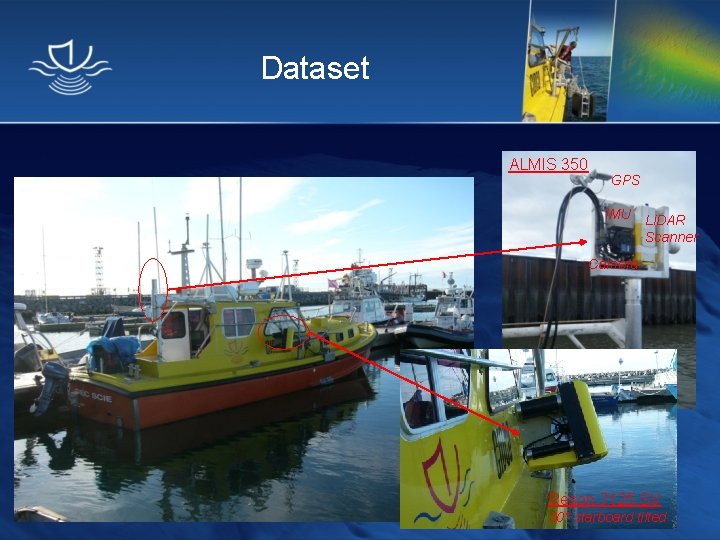
Dataset ALMIS 350 GPS IMU Li. DAR Scanner Camera Reson 7125 SV 30° starboard tilted
Dataset
1) Vessel file roll bias • 90° roll bias applied to the vessel file during merging → HIPS • BASE surface → HIPS
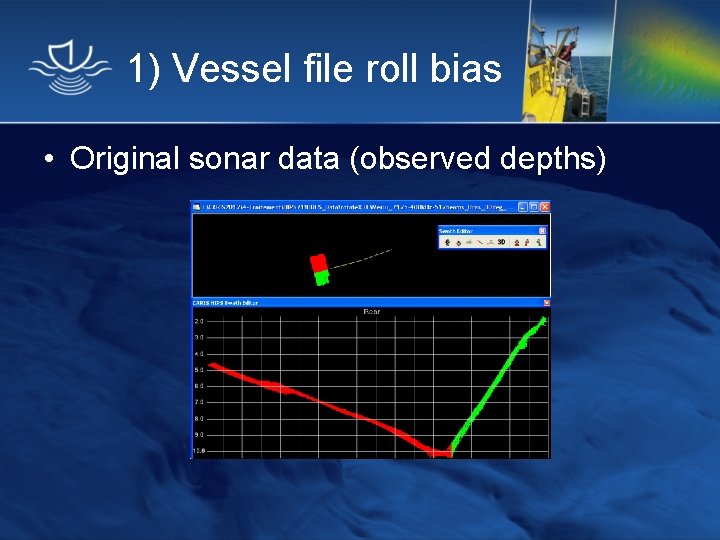
1) Vessel file roll bias • Original sonar data (observed depths)
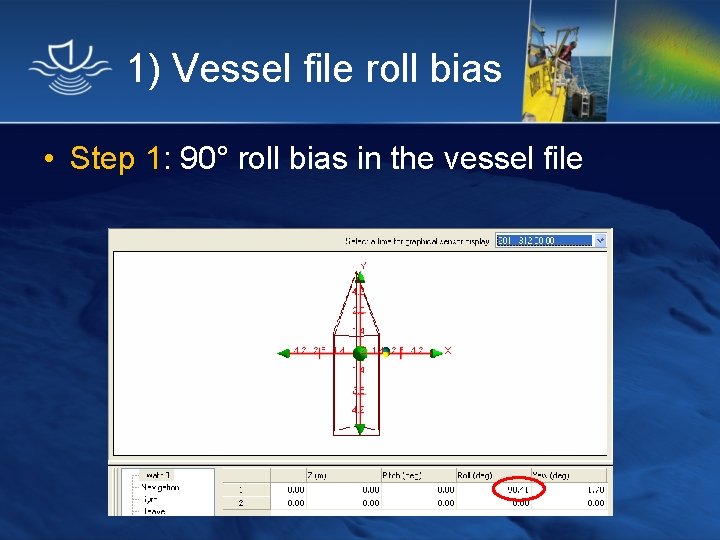
1) Vessel file roll bias • Step 1: 90° roll bias in the vessel file
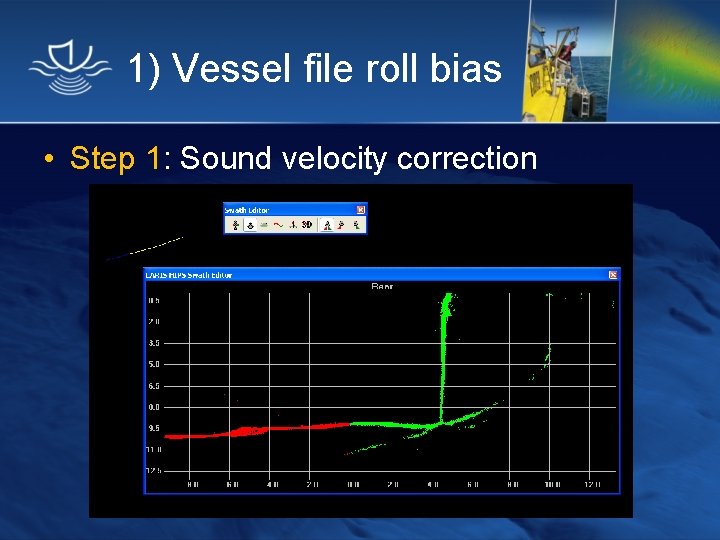
1) Vessel file roll bias • Step 1: Sound velocity correction
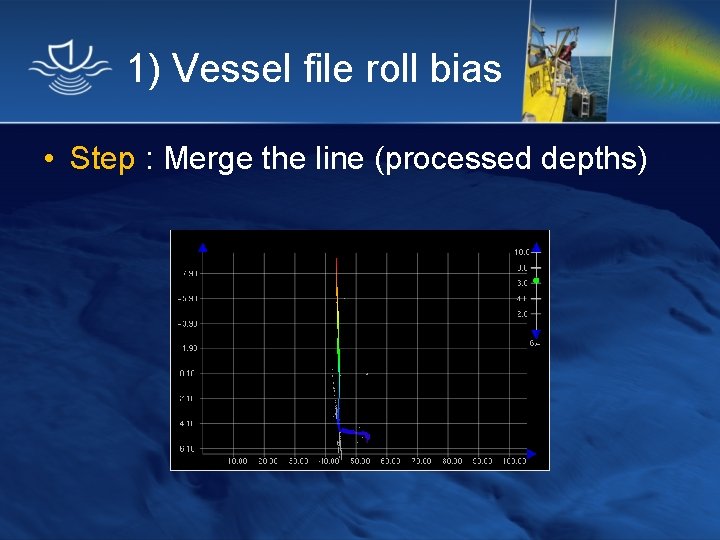
1) Vessel file roll bias • Step : Merge the line (processed depths)
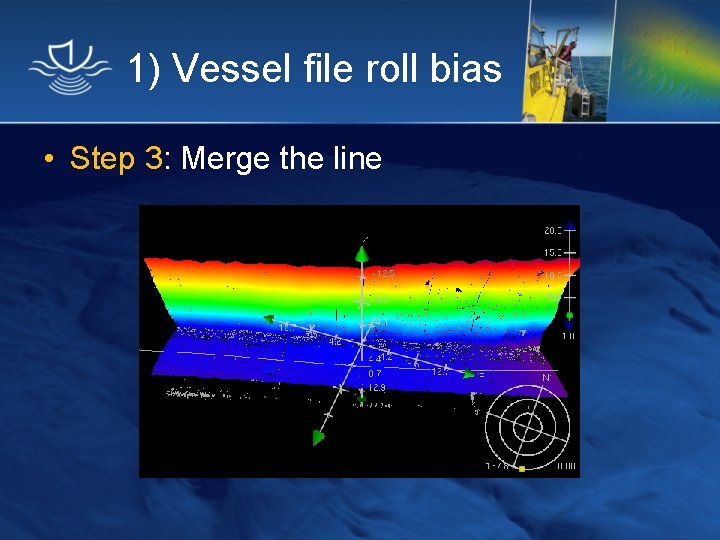
1) Vessel file roll bias • Step 3: Merge the line
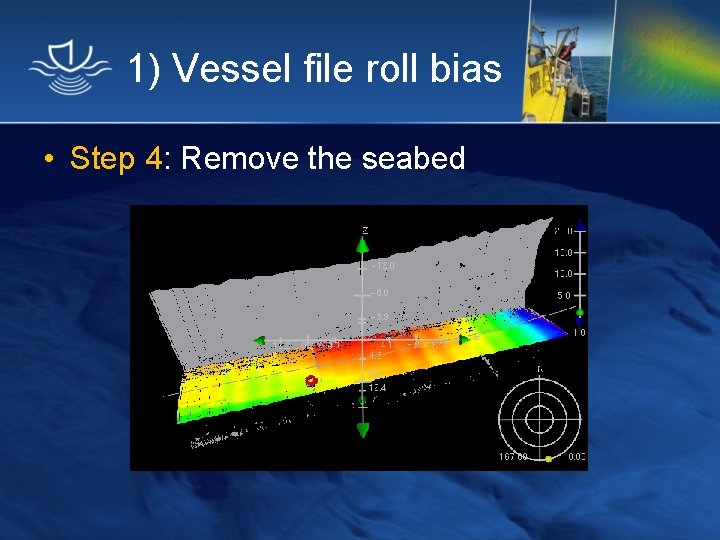
1) Vessel file roll bias • Step 4: Remove the seabed
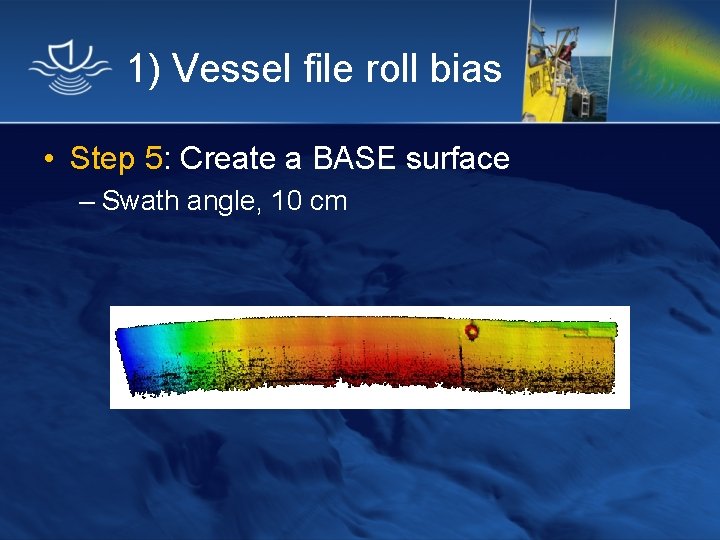
1) Vessel file roll bias • Step 5: Create a BASE surface – Swath angle, 10 cm
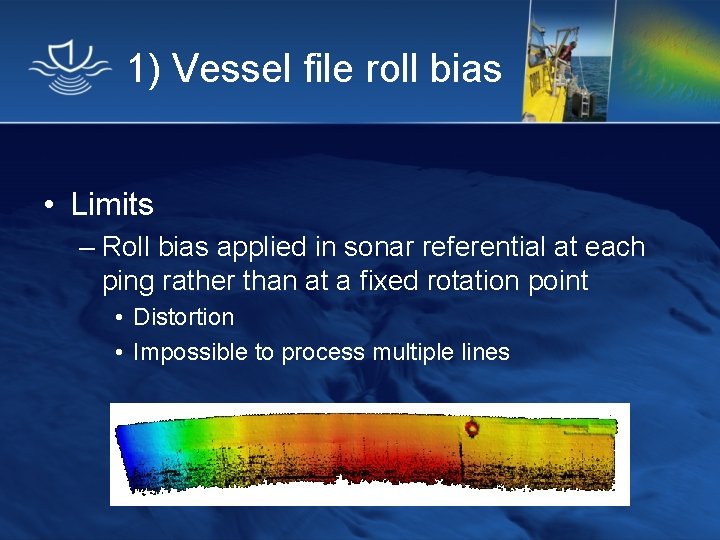
1) Vessel file roll bias • Limits – Roll bias applied in sonar referential at each ping rather than at a fixed rotation point • Distortion • Impossible to process multiple lines
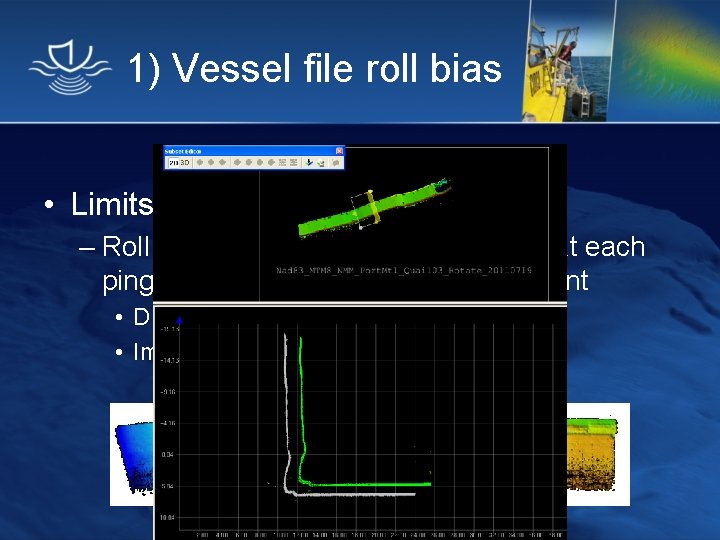
1) Vessel file roll bias • Limits – Roll bias applied in sonar referential at each ping rather than at a fixed rotation point • Distortion • Impossible to process multiple lines
2) Inverse-distance WMA filter • Data merging → HIPS • Filtering and surface meshing → Matlab
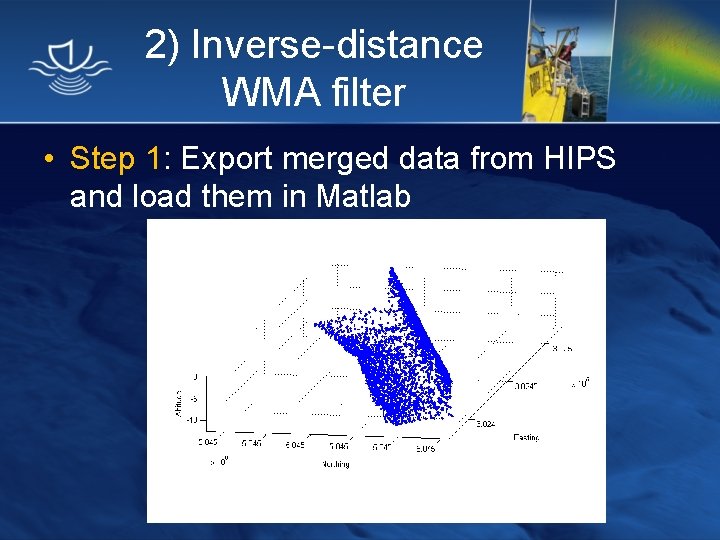
2) Inverse-distance WMA filter • Step 1: Export merged data from HIPS and load them in Matlab

2) Inverse-distance WMA filter • Step 2: Remove the seabed (depth threshold)
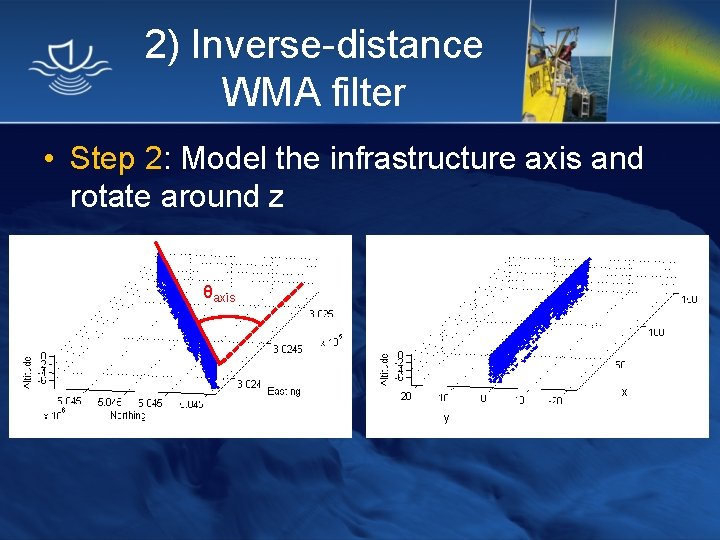
2) Inverse-distance WMA filter • Step 2: Model the infrastructure axis and rotate around z θaxis x y
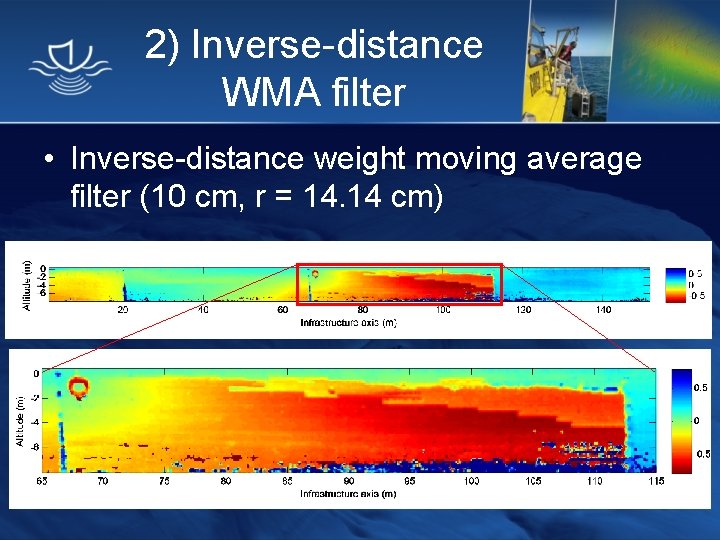
2) Inverse-distance WMA filter • Inverse-distance weight moving average filter (10 cm, r = 14. 14 cm)
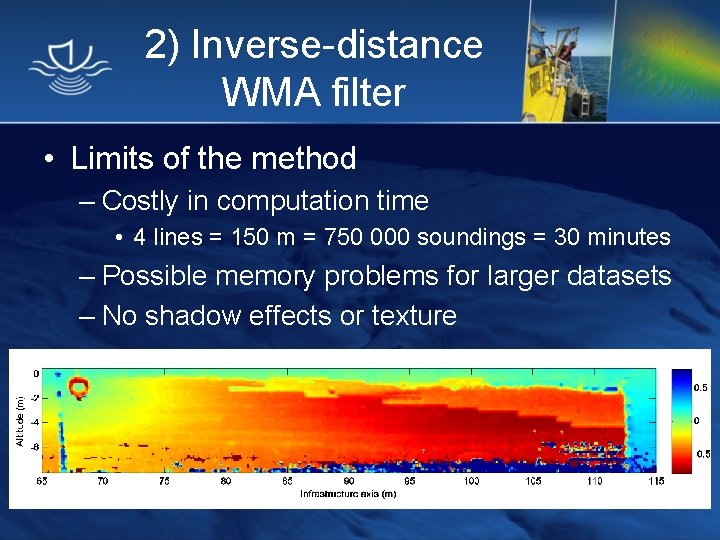
2) Inverse-distance WMA filter • Limits of the method – Costly in computation time • 4 lines = 150 m = 750 000 soundings = 30 minutes – Possible memory problems for larger datasets – No shadow effects or texture
3) XTF files rotation • 90° rotation applied on xtf files → Matlab • Data cleaning, merging and BASE surface → HIPS
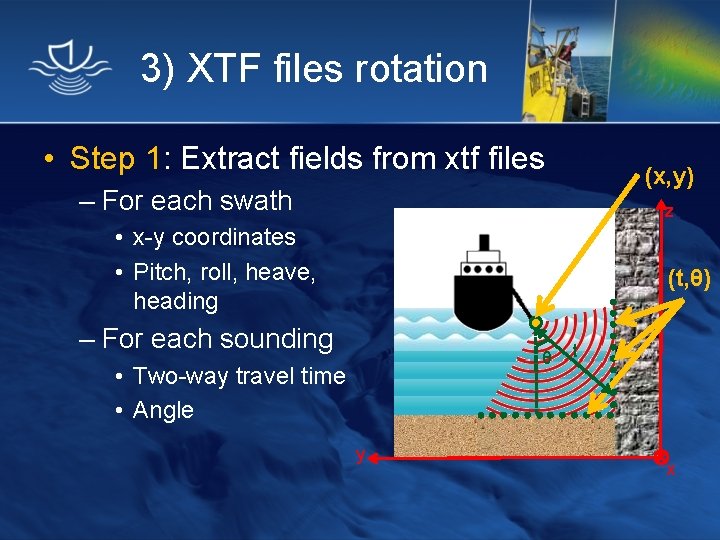
3) XTF files rotation • Step 1: Extract fields from xtf files (x, y) – For each swath z • x-y coordinates • Pitch, roll, heave, heading (t, θ) – For each sounding θ • Two-way travel time • Angle y t x
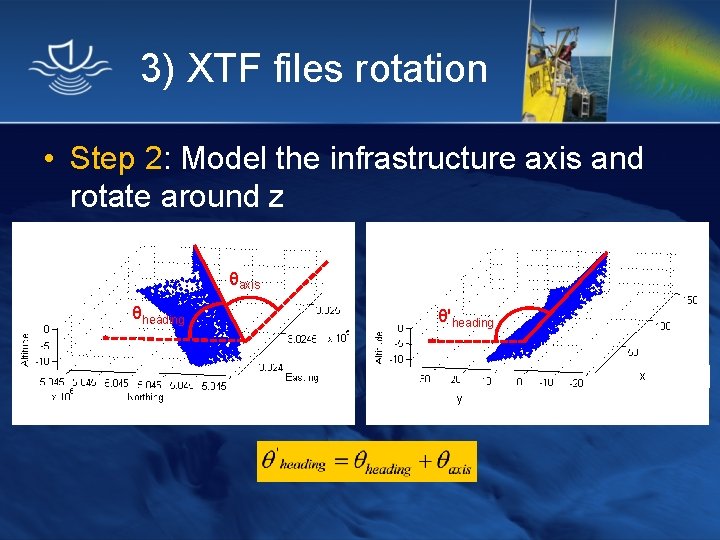
3) XTF files rotation • Step 2: Model the infrastructure axis and rotate around z θaxis θheading θ'heading x y
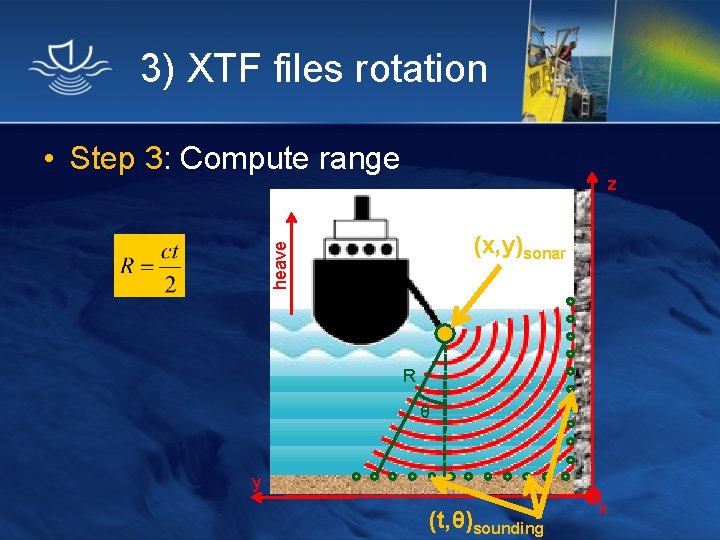
3) XTF files rotation • Step 3: Compute range z heave (x, y)sonar R θ y (t, θ)sounding x
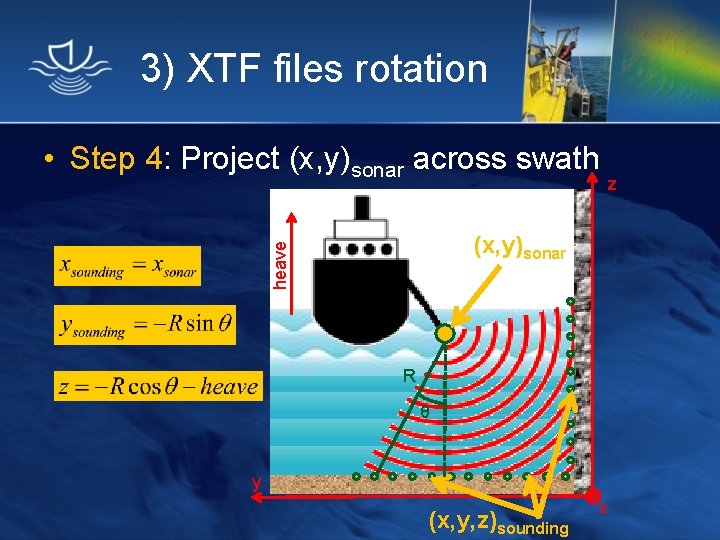
3) XTF files rotation • Step 4: Project (x, y)sonar across swath z heave (x, y)sonar R θ y (x, y, z)sounding x
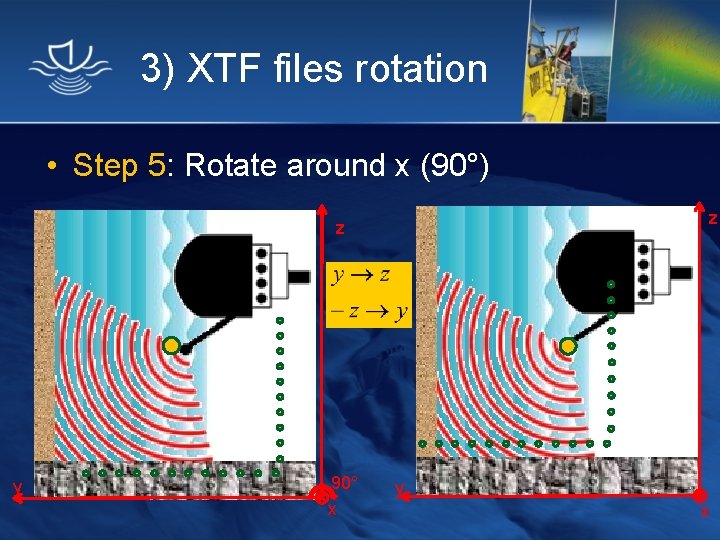
3) XTF files rotation • Step 5: Rotate around x (90°) z z y 90° x y x
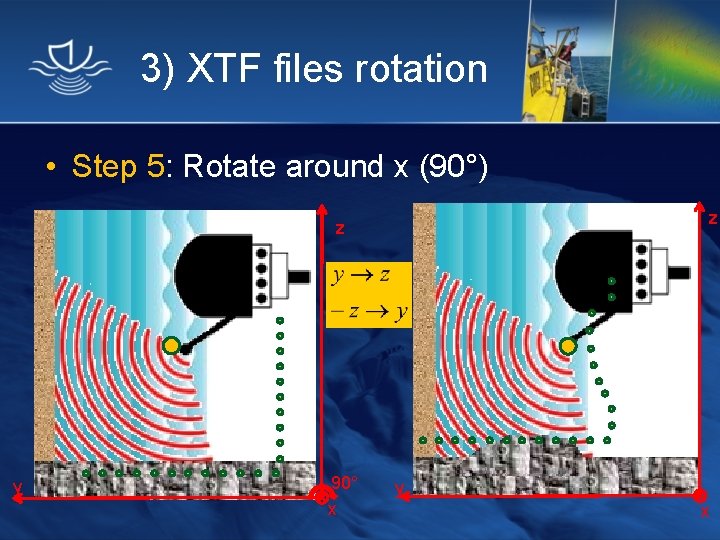
3) XTF files rotation • Step 5: Rotate around x (90°) z z y 90° x y x
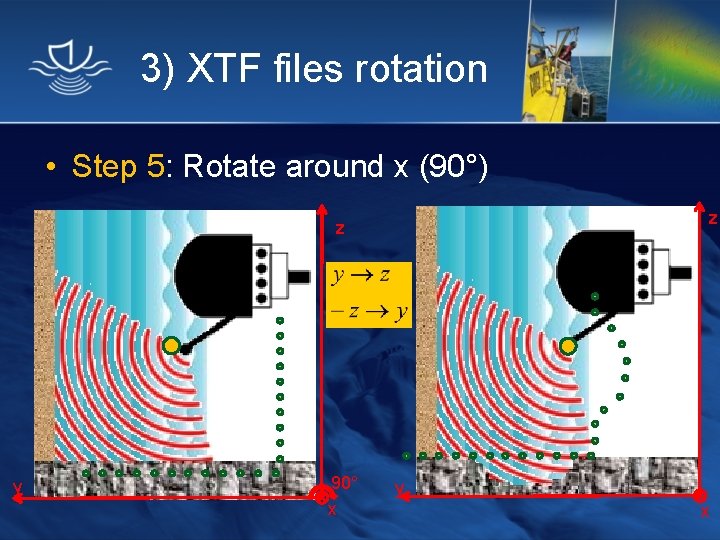
3) XTF files rotation • Step 5: Rotate around x (90°) z z y 90° x y x
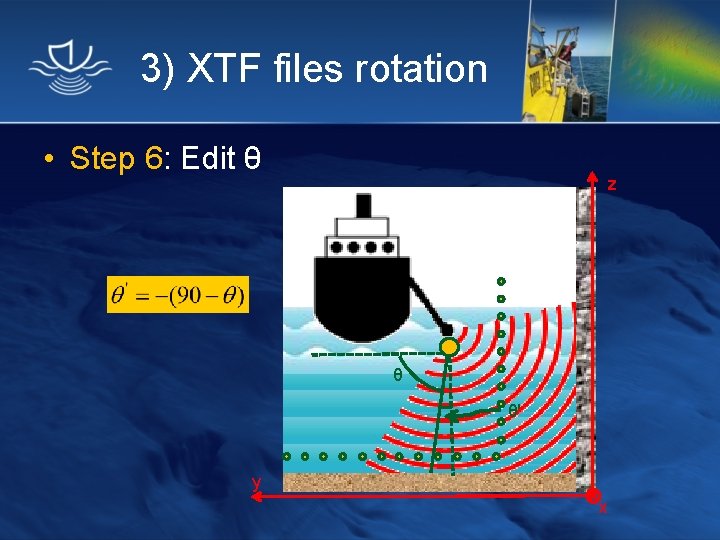
3) XTF files rotation • Step 6: Edit θ z θ θ' y x
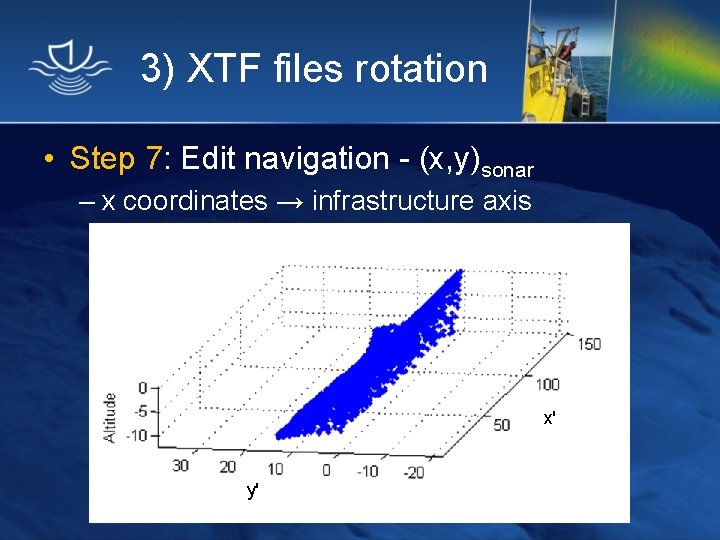
3) XTF files rotation • Step 7: Edit navigation - (x, y)sonar – x coordinates → infrastructure axis x' y'
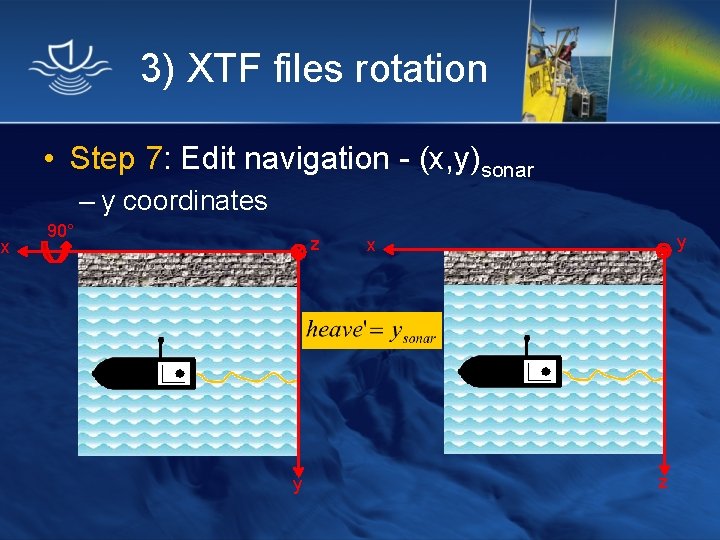
3) XTF files rotation • Step 7: Edit navigation - (x, y)sonar – y coordinates x 90° z y y x z
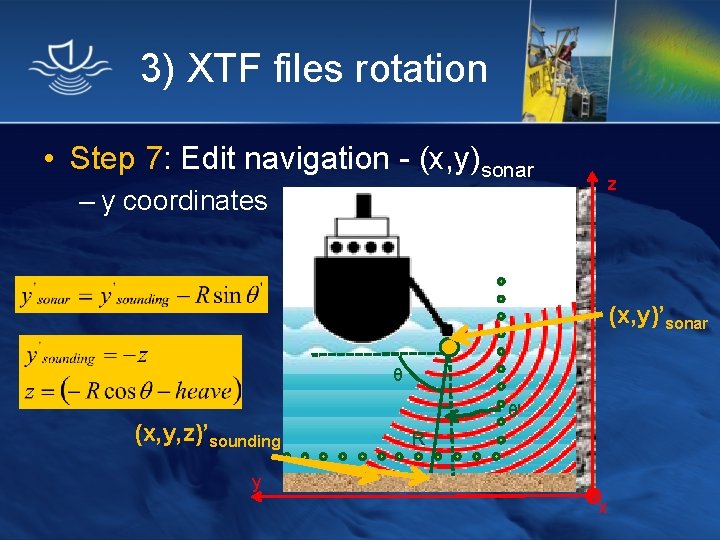
3) XTF files rotation • Step 7: Edit navigation - (x, y)sonar – y coordinates z (x, y)’sonar θ (x, y, z)’sounding θ' R y x
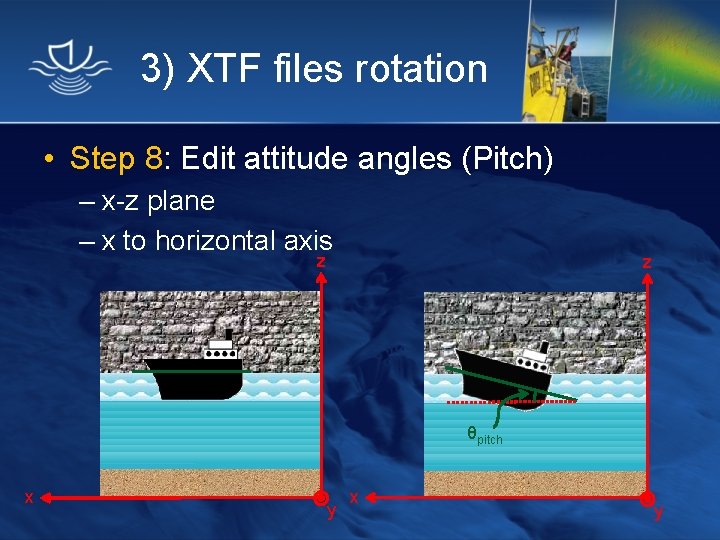
3) XTF files rotation • Step 8: Edit attitude angles (Pitch) – x-z plane – x to horizontal axis z z θpitch x y
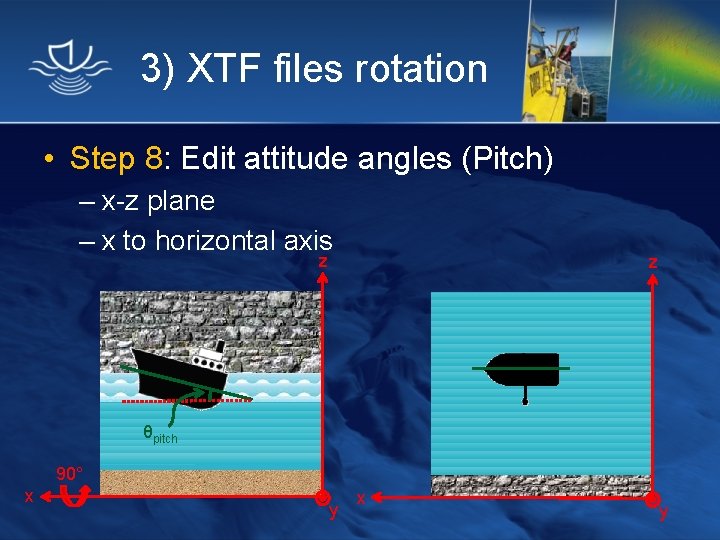
3) XTF files rotation • Step 8: Edit attitude angles (Pitch) – x-z plane – x to horizontal axis z z θpitch 90° x y
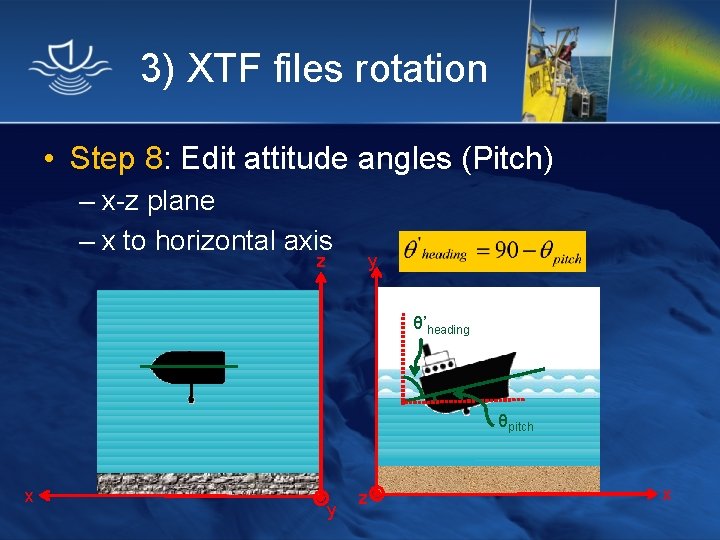
3) XTF files rotation • Step 8: Edit attitude angles (Pitch) – x-z plane – x to horizontal axis z y θ’heading θpitch x y z x
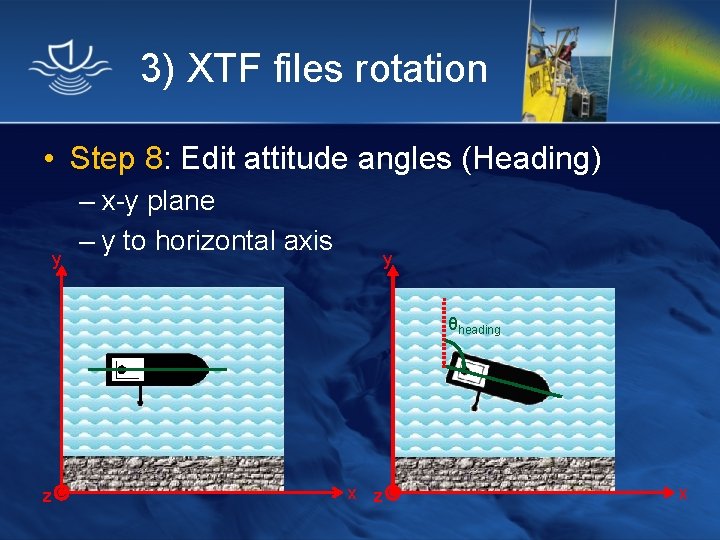
3) XTF files rotation • Step 8: Edit attitude angles (Heading) y – x-y plane – y to horizontal axis y θheading z x
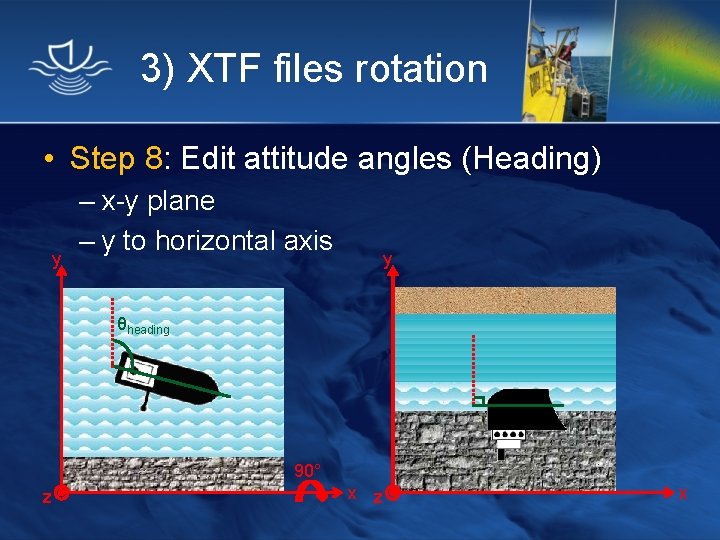
3) XTF files rotation • Step 8: Edit attitude angles (Heading) y – x-y plane – y to horizontal axis y θheading 90° z x
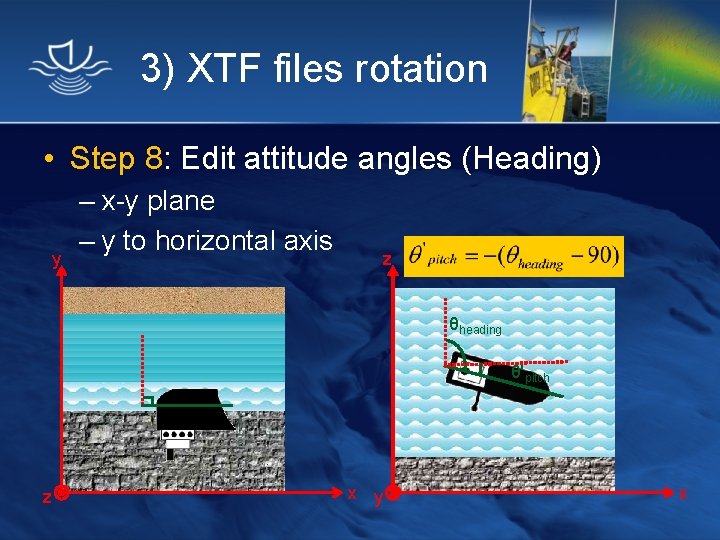
3) XTF files rotation • Step 8: Edit attitude angles (Heading) y – x-y plane – y to horizontal axis z θheading θ'pitch z x y x
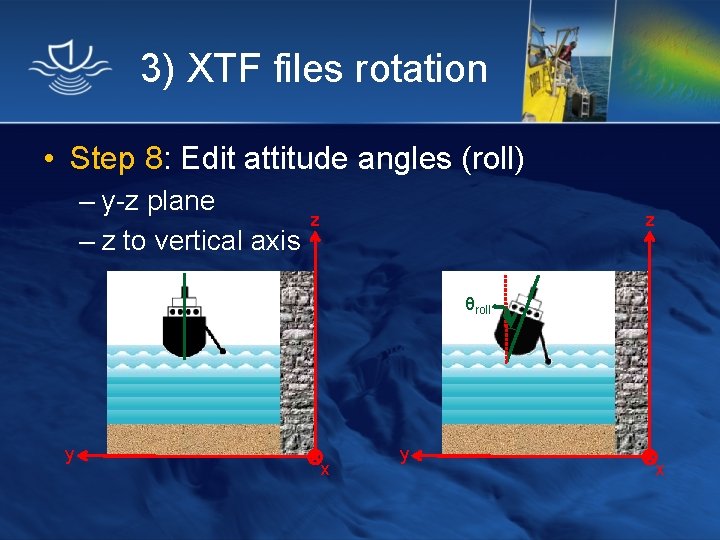
3) XTF files rotation • Step 8: Edit attitude angles (roll) – y-z plane – z to vertical axis z z θroll y x
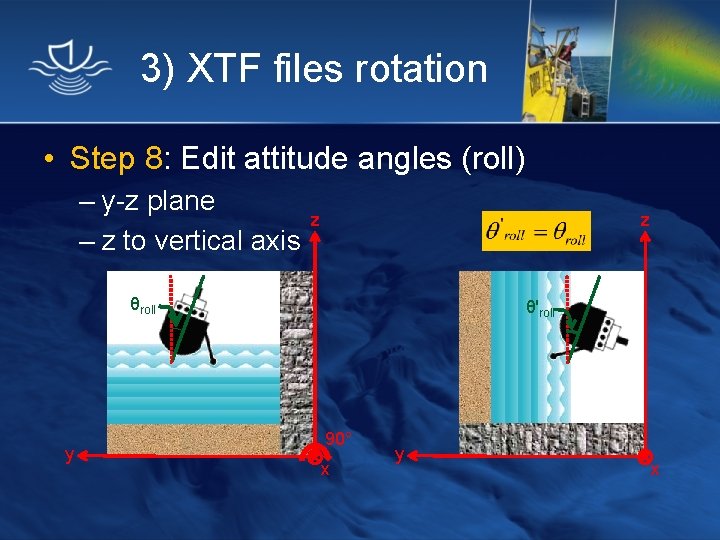
3) XTF files rotation • Step 8: Edit attitude angles (roll) – y-z plane – z to vertical axis z z θroll y θ'roll 90° x y x
3) XTF files rotation • Step 9: Edit fields to create new xtf files – For each swath • x-y coordinates • Pitch, heave, heading – For each sounding • Beam angle
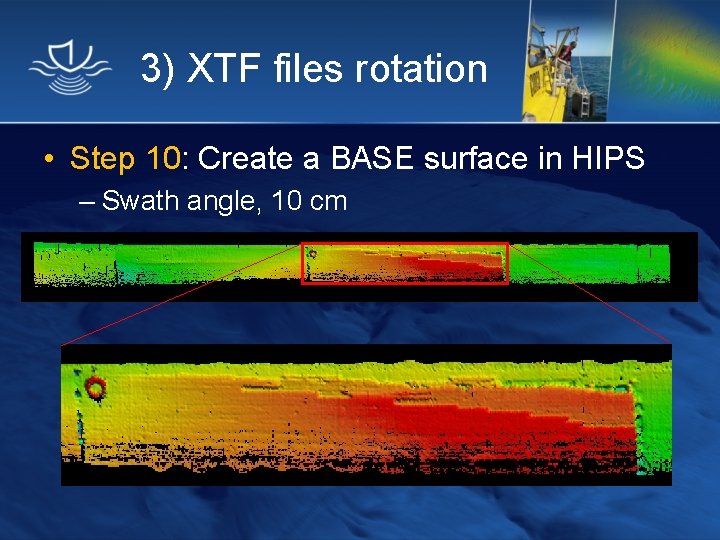
3) XTF files rotation • Step 10: Create a BASE surface in HIPS – Swath angle, 10 cm
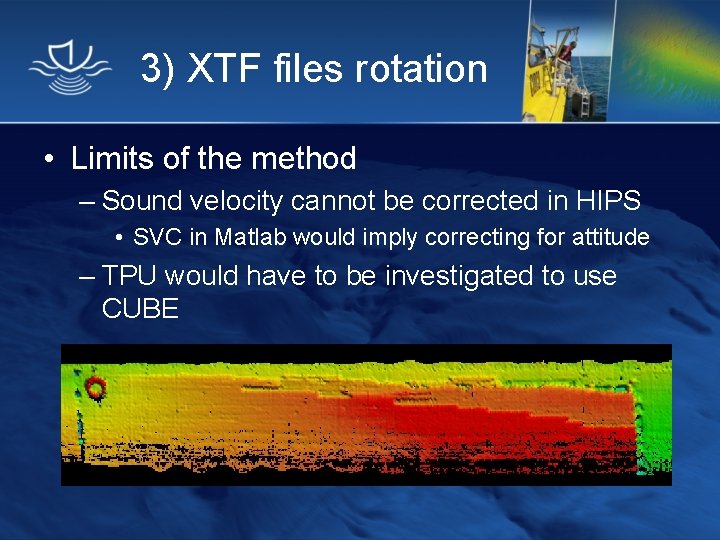
3) XTF files rotation • Limits of the method – Sound velocity cannot be corrected in HIPS • SVC in Matlab would imply correcting for attitude – TPU would have to be investigated to use CUBE
Discussion • Comparison of methods Method 90° roll bias WMA filter XTF rotation
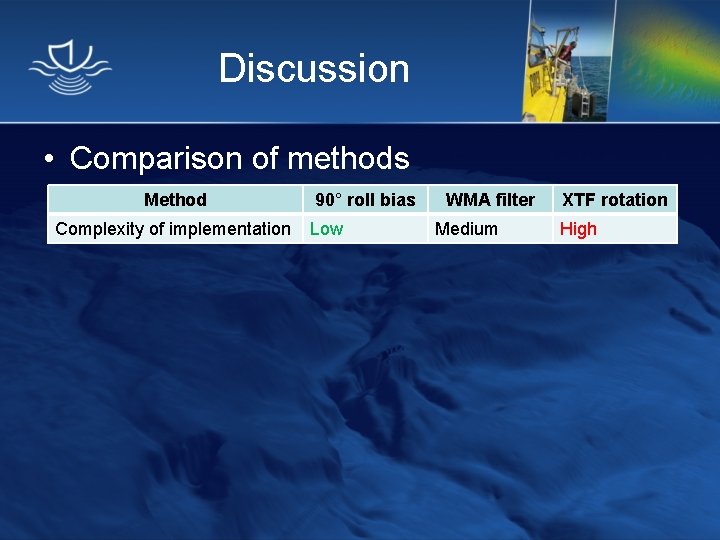
Discussion • Comparison of methods Method Complexity of implementation 90° roll bias Low WMA filter Medium XTF rotation High
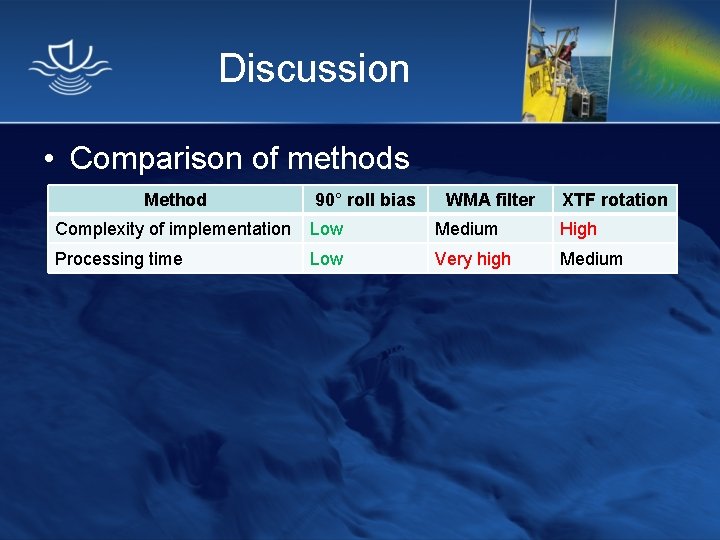
Discussion • Comparison of methods Method 90° roll bias WMA filter XTF rotation Complexity of implementation Low Medium High Processing time Low Very high Medium
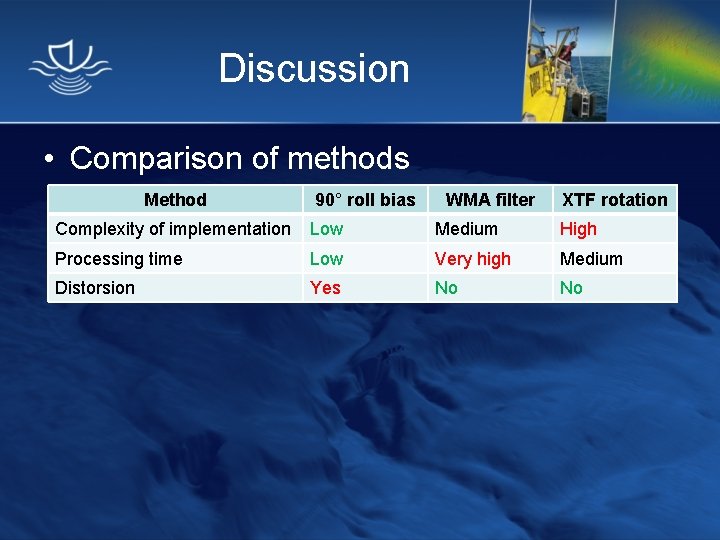
Discussion • Comparison of methods Method 90° roll bias WMA filter XTF rotation Complexity of implementation Low Medium High Processing time Low Very high Medium Distorsion Yes No No
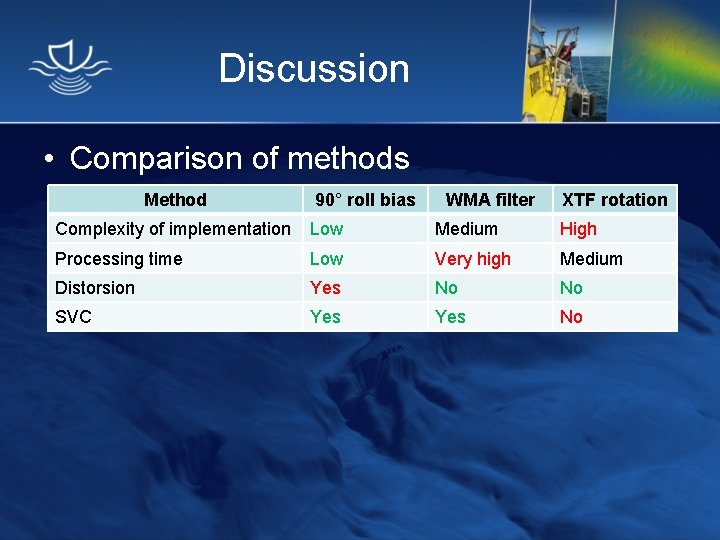
Discussion • Comparison of methods Method 90° roll bias WMA filter XTF rotation Complexity of implementation Low Medium High Processing time Low Very high Medium Distorsion Yes No No SVC Yes No
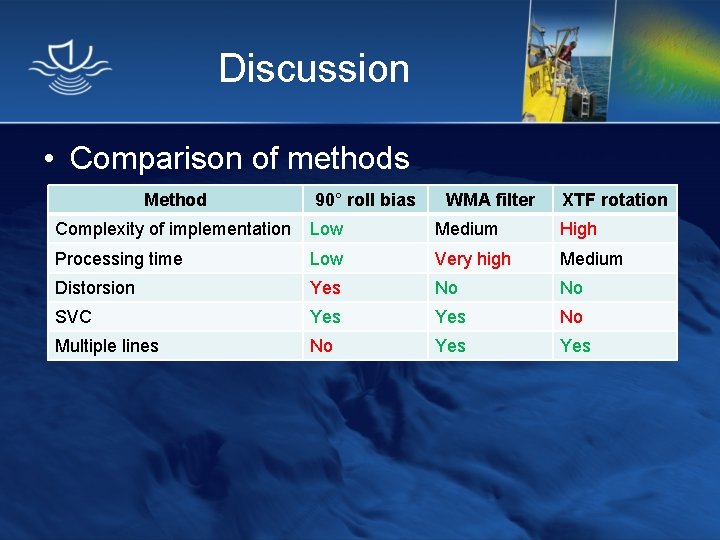
Discussion • Comparison of methods Method 90° roll bias WMA filter XTF rotation Complexity of implementation Low Medium High Processing time Low Very high Medium Distorsion Yes No No SVC Yes No Multiple lines No Yes
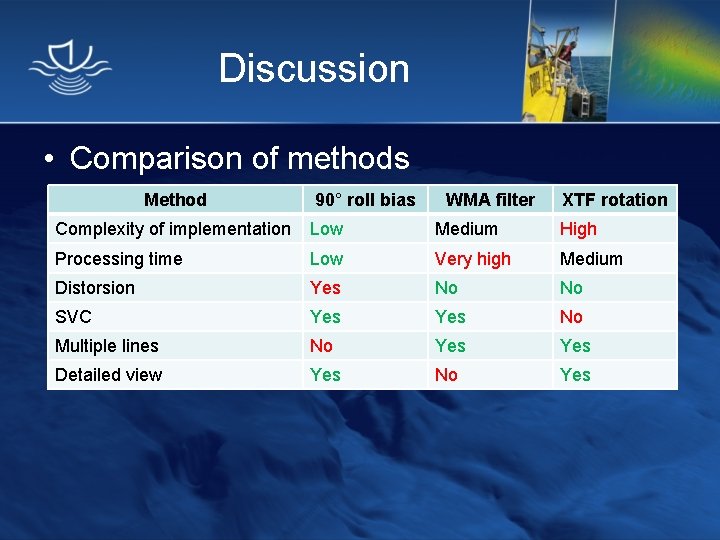
Discussion • Comparison of methods Method 90° roll bias WMA filter XTF rotation Complexity of implementation Low Medium High Processing time Low Very high Medium Distorsion Yes No No SVC Yes No Multiple lines No Yes Detailed view Yes No Yes
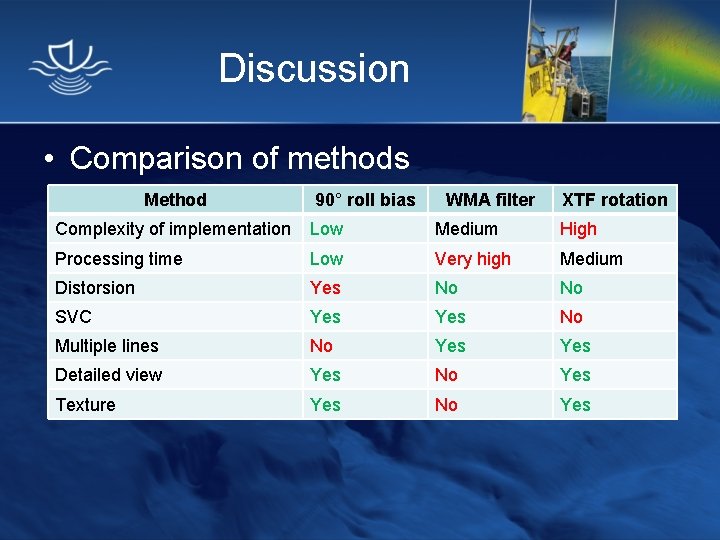
Discussion • Comparison of methods Method 90° roll bias WMA filter XTF rotation Complexity of implementation Low Medium High Processing time Low Very high Medium Distorsion Yes No No SVC Yes No Multiple lines No Yes Detailed view Yes No Yes Texture Yes No Yes
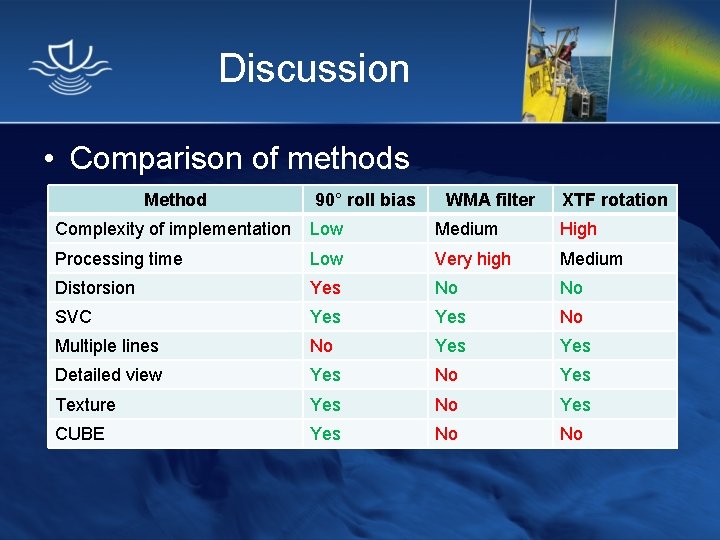
Discussion • Comparison of methods Method 90° roll bias WMA filter XTF rotation Complexity of implementation Low Medium High Processing time Low Very high Medium Distorsion Yes No No SVC Yes No Multiple lines No Yes Detailed view Yes No Yes Texture Yes No Yes CUBE Yes No No
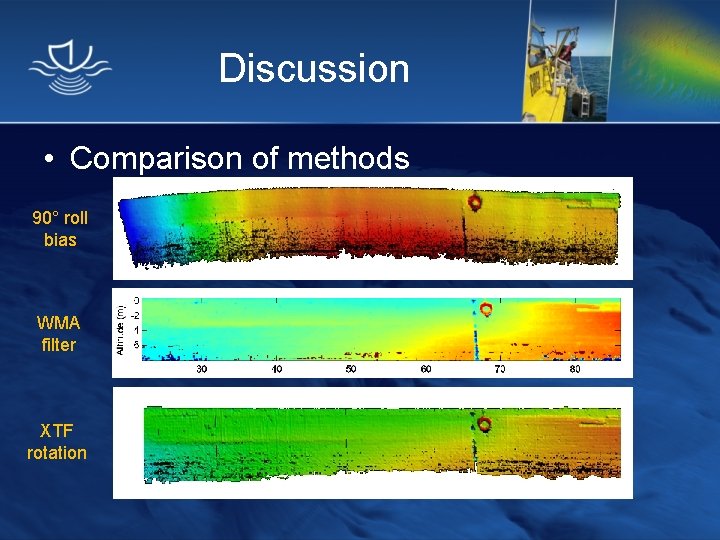
Discussion • Comparison of methods 90° roll bias WMA filter XTF rotation
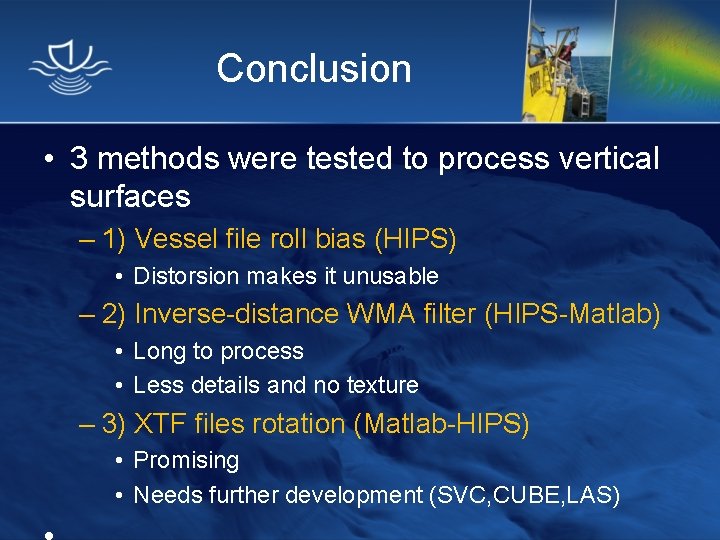
Conclusion • 3 methods were tested to process vertical surfaces – 1) Vessel file roll bias (HIPS) • Distorsion makes it unusable – 2) Inverse-distance WMA filter (HIPS-Matlab) • Long to process • Less details and no texture – 3) XTF files rotation (Matlab-HIPS) • Promising • Needs further development (SVC, CUBE, LAS)
Questions?
- Slides: 61