
Caring for the patient with learning disabilitiesautism in
Caring for the patient with learning disabilities/autism in the hospital setting To be viewed in conjunction with NMC Standards
Important • Please view in conjunction with the NMC standards for: The code: Standards of conduct, performance and ethics for nurses and midwives • In viewing this presentation; reading the NMC Standards of conduct; performance and ethics for nurses and midwives and submitting the form you will have completed your required training. • If you still have questions at the end of the presentation please contact the Hospital Liaison Nurse Specialist & LD Lead on: 01245 516 596 Mobile: 07766253732 Bleep: #6555 2241
Content The following presentation will cover: • • • • General Information about people with learning disabilities/autism The impact of having learning disabilities/autism Duty to promote disability equality Making reasonable adjustments Supporting effective & total communication Supporting admissions and discharges Preparing individuals for admissions or clinical interventions Clinical tools Supporting family or familiar carers Consenting to treatment: The 5 principles of the Mental Capacity Act (2005) Supporting people with learning disabilities/autism to consent to treatment Carrying out care or treatment in an individuals ‘best interests’ Involving specialist learning disability teams Using and creating accessible information Quality assurance (Essence of Care)
General information about people with learning disabilities/autism • Patients with learning disabilities/autism will need special consideration and reasonable adjustments made to ensure that they receive care and treatment which meets their specific needs and maintains their safety. • The National Patient Safety Agency (2004) and many other recent reports have all concluded that patients with learning disabilities/autism are particularly vulnerable when in acute hospital settings leading to varying degrees of patient harm as a result. • Frequently people with learning disabilities/autism have a number of complex needs. These may include impairments in functional skills, communication and an accumulation of sensory impairments; as a result an individual may be disorientated, confused or anxious in a setting which is unfamiliar. • In addition, individuals with multiple disabilities or complex health problems are likely to use health services on a regular and frequent basis.
The impact of having a learning disability/autism will often mean: • The person is more vulnerable to abusive situations • They will be less able to understand retain new or complex information • They will require that you use simple language and explain things that may be unfamiliar • They may be at greater risk of swallowing difficulties (dysphasia) • The person be less able to communicate pain or discomfort • They may rely on others to meet some or all of their basic needs and to maintain their safety. (Department of Health, 2001)
Duty to promote disability equality • • • The Disability Discrimination Act (1995) places a duty upon all service providers and public bodies to ensure that people with disabilities can access services on an equal and equitable basis (general duty). Service providers are required to make ‘reasonable adjustments’ to the way in which a service or function is carried out to enable disabled people to access services and support on an equal basis. The Act was amended in 2005 and now requires public bodies take steps to actively promote the rights of people with disabilities (specific duty). In order to achieve equality of access for people with learning disabilities services may need to provide more favourable support or treatment to disabled people in order to achieve the same outcomes (Disability Rights Commission, 2007). What reasonable adjustments are needed will depend upon an individual’s specific disability related needs. Therefore both timely and comprehensive assessments of individual’s disability related and safety needs is crucial to ensuring that people with disabilities or complex needs receive appropriate care and support.

Making Reasonable Adjustments • Consider offering extended or double appointments where this would assist to support effective communication • Consider offering a choice of appointment time, for example the first or last appointments may suit particularly anxious patients or those who find sitting in busy waiting areas difficult • Use the hospital passport to ensure that you have gathered information about a person’s safety and disability related needs • Consider using pictures or diagrams to enhance patients understanding of planned treatments/procedures or illness • Ensure that you have recorded individuals specific access needs and the names of family carers or community professionals who can provide support or additional information. • Review patient information leaflets and ensure that staff have access to easy read leaflets for patients with learning disabilities
Supporting effective & total communication • Communication impairments are commonly associated with learning disabilities; whether with regards to expressive communication or comprehension. • Total Communication is about using a number of communication methods together to support people with complex needs. • It is likely therefore that you will have to adapt your communication to meet the needs of people with learning disabilities. • This might include a mixture of speech, gesture and accessible written information or pictures.
Supporting admissions and discharges The Trust has a policy for people with learning disabilities & autism which is intended to ensure: • That any disability related support needs are identified prior to admission • That clinicians are supported to agree care or treatment plans and make any reasonable adjustments that are needed • That advice is sought from the Hospital Liaison Nurse Specialist or the persons main carer • That effective discharge plans are made in a safe and timely manner
Preparing individuals for admissions or clinical interventions Improved outcomes can be achieved for patients with learning disabilities/autism by effective planning and this will likely reduce the number of appointments missed. • Consideration should be given to what preparation a patient with complex needs might require in order to achieve good outcomes and a positive patient experience. • For example patients may be put at ease if supported to visit the ward or department ahead of their appointment or have the opportunity to see the equipment that will be used. • Patients with learning disabilities/autism are likely to have difficulty understanding abstract concepts or have limited understanding of the treatments being proposed. • Additionally, many individuals will require such preparation and information in order to make an informed decision and to consent to treatment.
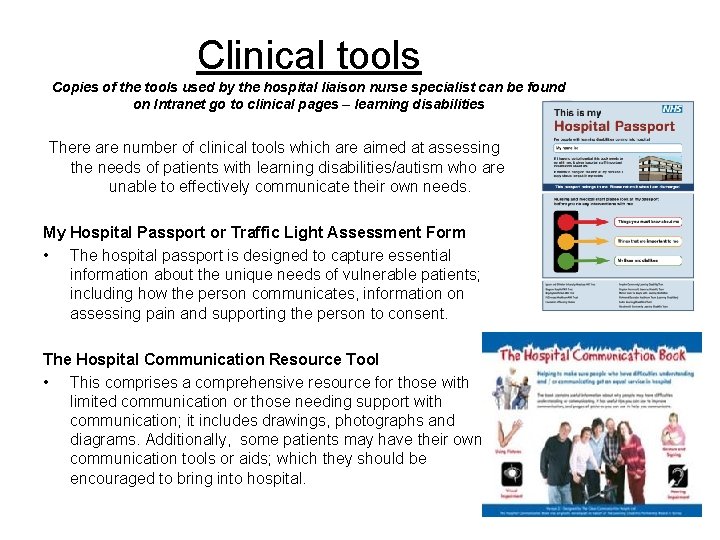
Clinical tools Copies of the tools used by the hospital liaison nurse specialist can be found on Intranet go to clinical pages – learning disabilities There are number of clinical tools which are aimed at assessing the needs of patients with learning disabilities/autism who are unable to effectively communicate their own needs. My Hospital Passport or Traffic Light Assessment Form • The hospital passport is designed to capture essential information about the unique needs of vulnerable patients; including how the person communicates, information on assessing pain and supporting the person to consent. The Hospital Communication Resource Tool • This comprises a comprehensive resource for those with limited communication or those needing support with communication; it includes drawings, photographs and diagrams. Additionally, some patients may have their own communication tools or aids; which they should be encouraged to bring into hospital.
Clinical tools contd: Dependency Assessment Tool • This scoring tool is used to identify any additional support and the level of support that may be required in order to provide safe care. It offers a framework to assist in deciding if an additional support is needed to reduce risk during a hospital stay and to identify the person or agency that is best able to provide that support. DISDAT Tool • The purpose of the Dis. DAT is to help observe and identify distress cues in people with learning disability/autism who have severely limited communication. It depends on the ability of others to recognize and translate many different non-verbal cues. The Dis. DAT supports improved communication about distress/pain identification with people (including health professionals) who do not know the person well. Rapid Risk Assessment Tool • The rapid risk assessment is designed to identify any risks to a patient with learning disabilities/autism whilst in an acute hospital setting. This includes both physical risks as well as risks to the effective outcome of the hospital stay
Supporting family or familiar carers The role of family or familiar carers is primarily to: • • • Familiar carers are an invaluable resource with regards to providing care that is appropriate to patients needs; in particular where individual patients are unable to communicate their needs adequately or consistently. A lack of clarity around the role of familiar carers can, however, compromise the continuity of care and patient safety. • • Facilitate effective communication, including supporting the patient to comprehend information Support the clinical team to agree a care plan which appropriately meets the patients specific needs Provide support emotional support; in particular during clinical investigations or treatment or advise clinical staff on best approaches Support the patient to make decisions (consent) relating to care and treatment Assist clinicians in making ‘best interest’ decisions; where the patient lacks the capacity to make a specific decision
Practical support for carers who remain with the person The Trust has a Carers policy which can be found on the Intranet • • It should not be assumed that family carers will remain with the patient during a hospital admission; however, where carers choose to stay it is essential that you agree any practical arrangements such as parking, breaks and refreshments. It would also be important that someone who knows the individual and their communication well must be present when ward rounds happen. Carers support organisations • It should be borne in mind that hospital admission and subsequent discharge home is likely to have an effect on family carers. What additional support or resources informal carers are likely to need should be considered and discussed as a part of effective discharge planning. Where appropriate carers should be signposted to carers support organisations for advice or support.
Consenting to treatment: 5 principles of the Mental Capacity Act (2005) • The Mental Capacity Act (2005) provides a legal framework for supporting individuals who may lack the capacity to make some decisions for themselves. • This may be due to a learning disability, mental health problem, brain injury, dementia, alcohol or drug misuse, side effects of medical treatment or any other illness or disability. 1. A presumption of capacity - every adult has the right to make his or her own decisions and must be assumed to have capacity to do so unless it is proved otherwise 2. The right for individuals to be supported to make their own decisions - people must be given all appropriate help before anyone concludes that they cannot make their own decisions 3. That individuals must retain the right to make what might be seen as eccentric or unwise decisions 4. Best interests - anything done for or on behalf of people without capacity must be in their best interests 5. Least restrictive intervention - anything done for or on behalf of people without capacity should be an option that is less restrictive.
The functional test of capacity (consent) The Mental Capacity Act adopts a functional approach with regards to assessing whether an individual has the capacity to make a specific decision: 1. Does the person have a general understanding of what decision they need to make and why? 2. Does the person have a general understanding of the likely consequences of making or not making this decision? 3. Can the person retain information in relation to the decision and to use and weigh‐up information relevant to the decision? 4. Can the person communicate their decision? If the person is unable to carry out one or more components then s/he cannot be considered to have capacity.
Supporting people with learning disabilities to consent to treatment Both the Mental Capacity Act (2005) and Disability Discrimination Act (1995) emphasise the importance of supporting and enhancing an individual’s ability to consent to care or treatment. In doing this it may be necessary to adapt the manner in which you convey information regarding the proposed care or treatment; for example by using simple language or accessible health information. It should also be borne in mind that individuals may require longer to process information and to come to a decision. Additionally, whilst you may have assessed that the person lacks the ability to make a decision at this time; you may consider if it is appropriate or safe to delay treatment to allow time for work to be done to enhance the individual’s ability (capacity) to make a decision regarding the proposed treatment/s.
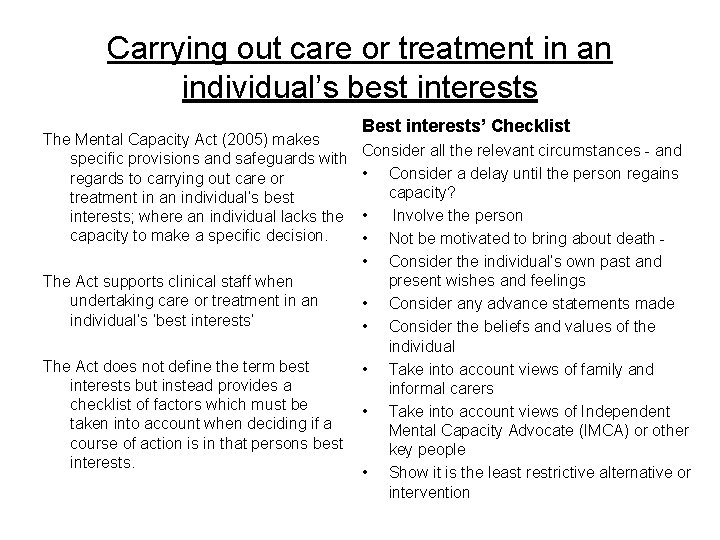
Carrying out care or treatment in an individual’s best interests The Mental Capacity Act (2005) makes specific provisions and safeguards with regards to carrying out care or treatment in an individual’s best interests; where an individual lacks the capacity to make a specific decision. The Act supports clinical staff when undertaking care or treatment in an individual’s ‘best interests’ The Act does not define the term best interests but instead provides a checklist of factors which must be taken into account when deciding if a course of action is in that persons best interests. Best interests’ Checklist Consider all the relevant circumstances - and • Consider a delay until the person regains capacity? • Involve the person • Not be motivated to bring about death • Consider the individual’s own past and present wishes and feelings • Consider any advance statements made • Consider the beliefs and values of the individual • Take into account views of family and informal carers • Take into account views of Independent Mental Capacity Advocate (IMCA) or other key people • Show it is the least restrictive alternative or intervention
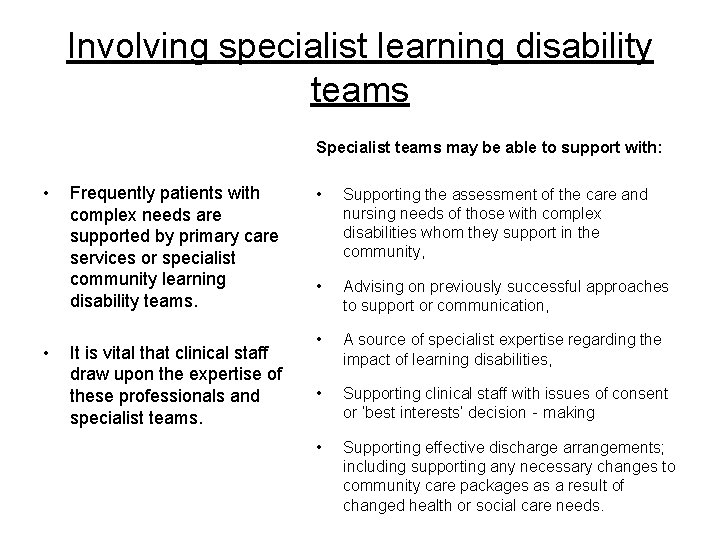
Involving specialist learning disability teams Specialist teams may be able to support with: • • Frequently patients with complex needs are supported by primary care services or specialist community learning disability teams. It is vital that clinical staff draw upon the expertise of these professionals and specialist teams. • Supporting the assessment of the care and nursing needs of those with complex disabilities whom they support in the community, • Advising on previously successful approaches to support or communication, • A source of specialist expertise regarding the impact of learning disabilities, • Supporting clinical staff with issues of consent or ‘best interests’ decision‐making • Supporting effective discharge arrangements; including supporting any necessary changes to community care packages as a result of changed health or social care needs.
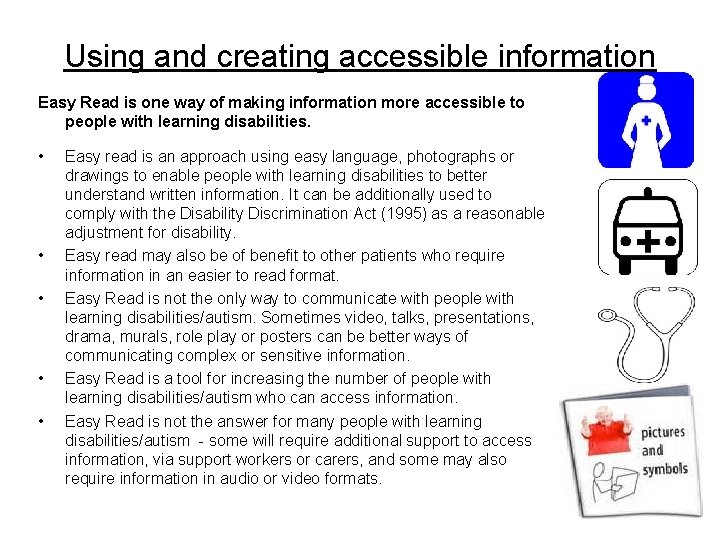
Using and creating accessible information Easy Read is one way of making information more accessible to people with learning disabilities. • • • Easy read is an approach using easy language, photographs or drawings to enable people with learning disabilities to better understand written information. It can be additionally used to comply with the Disability Discrimination Act (1995) as a reasonable adjustment for disability. Easy read may also be of benefit to other patients who require information in an easier to read format. Easy Read is not the only way to communicate with people with learning disabilities/autism. Sometimes video, talks, presentations, drama, murals, role play or posters can be better ways of communicating complex or sensitive information. Easy Read is a tool for increasing the number of people with learning disabilities/autism who can access information. Easy Read is not the answer for many people with learning disabilities/autism - some will require additional support to access information, via support workers or carers, and some may also require information in audio or video formats.
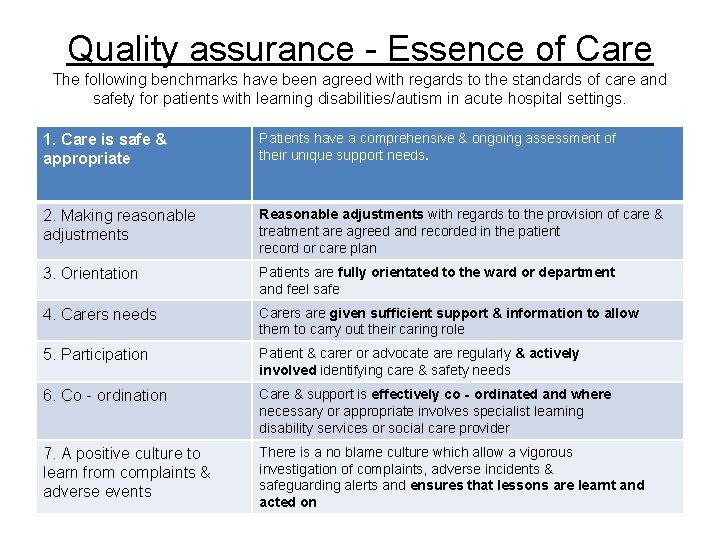
Quality assurance - Essence of Care The following benchmarks have been agreed with regards to the standards of care and safety for patients with learning disabilities/autism in acute hospital settings. 1. Care is safe & appropriate Patients have a comprehensive & ongoing assessment of their unique support needs. 2. Making reasonable adjustments Reasonable adjustments with regards to the provision of care & treatment are agreed and recorded in the patient record or care plan 3. Orientation Patients are fully orientated to the ward or department and feel safe 4. Carers needs Carers are given sufficient support & information to allow them to carry out their caring role 5. Participation Patient & carer or advocate are regularly & actively involved identifying care & safety needs 6. Co‐ordination Care & support is effectively co‐ordinated and where necessary or appropriate involves specialist learning disability services or social care provider 7. A positive culture to learn from complaints & adverse events There is a no blame culture which allow a vigorous investigation of complaints, adverse incidents & safeguarding alerts and ensures that lessons are learnt and acted on
Summary • This presentation has pulled together common issues surrounding caring for patients with learning disabilities/autism in the acute setting; & identifies the nurses role and responsibilities. • It must be recognised that all staff have a duty to comply with the law and all acts or omissions need to be fully and accurately recorded. • Adhering to Trust policies and NMC standards not only ensures a positive patient experience but will also reduce re-admissions; complaints and costs. If you require further help, support or advise please contact the Hospital Liaison Nurse Specialist 01245 516 596 Mobile: 07766253732 Bleep: #6555 2241
- Slides: 22