
Caring for Specific Extremity Injuries continued BRADY National
Caring for Specific Extremity Injuries continued BRADY National Ski Patrol, Outdoor Emergency Care, 5 th Ed. © 2012 by Pearson Education, Inc. , Upper Saddle River, NJ
Caring for Specific Extremity Injuries continued Copyright Edward Mc. Namara BRADY National Ski Patrol, Outdoor Emergency Care, 5 th Ed. © 2012 by Pearson Education, Inc. , Upper Saddle River, NJ
Caring for Specific Extremity Injuries continued BRADY National Ski Patrol, Outdoor Emergency Care, 5 th Ed. © 2012 by Pearson Education, Inc. , Upper Saddle River, NJ
Caring for Specific Extremity Injuries continued BRADY National Ski Patrol, Outdoor Emergency Care, 5 th Ed. © 2012 by Pearson Education, Inc. , Upper Saddle River, NJ
Caring for Specific Extremity Injuries l Lower Extremity Injuries ◦ Pelvic fracture • Pelvic binder with long spine board ◦ Proximal femur fracture l Long spine board l Full body vacuum splint l Double pole traction splint with tension BRADY National Ski Patrol, Outdoor Emergency Care, 5 th Ed. © 2012 by Pearson Education, Inc. , Upper Saddle River, NJ
Caring for Specific Extremity Injuries l Hip Dislocation ◦ Lift patient ◦ Stabilize in position found on long spine board ◦ Pad voids and under knees BRADY National Ski Patrol, Outdoor Emergency Care, 5 th Ed. © 2012 by Pearson Education, Inc. , Upper Saddle River, NJ
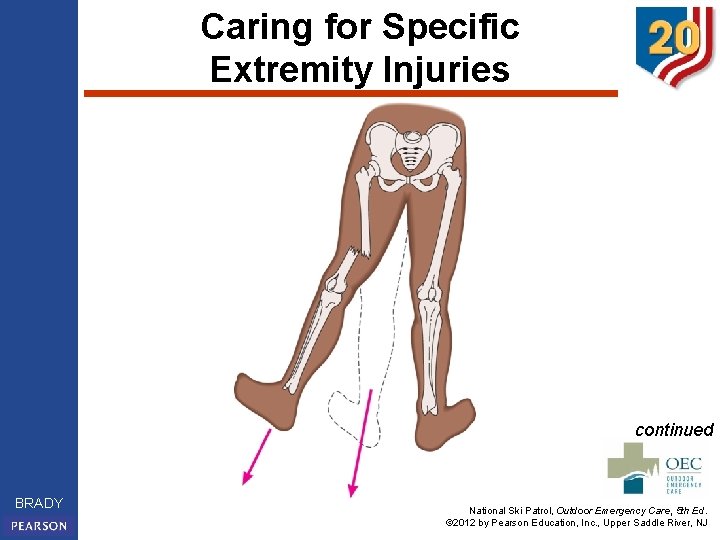
Caring for Specific Extremity Injuries l Lower Extremity Injuries ◦ Mid-shaft femur • Begin with manual stabilization and in-line traction • Traction splint with long spine board • If open, may use tension, not traction • Bone ends may retract continued BRADY National Ski Patrol, Outdoor Emergency Care, 5 th Ed. © 2012 by Pearson Education, Inc. , Upper Saddle River, NJ
Caring for Specific Extremity Injuries continued BRADY National Ski Patrol, Outdoor Emergency Care, 5 th Ed. © 2012 by Pearson Education, Inc. , Upper Saddle River, NJ
Caring for Specific Extremity Injuries l Lower Extremity Injuries ◦ If ‘load and go’ due to massive trauma, use only long spine board ◦ Boot removal based on local protocol continued BRADY National Ski Patrol, Outdoor Emergency Care, 5 th Ed. © 2012 by Pearson Education, Inc. , Upper Saddle River, NJ
Caring for Specific Extremity Injuries l Lower Extremity Injuries ◦ Distal femur • NO traction splint here – use rigid splint • May need to keep knee bent for comfort • If CMS compromise AND care is 2+ hours away, may attempt one axial alignment ◦ Knee • Splint in position found • If gross deformity and no distal pulse, may attempt 1 axial alignment BRADY National Ski Patrol, Outdoor Emergency Care, 5 th Ed. © 2012 by Pearson Education, Inc. , Upper Saddle River, NJ

Caring for Specific Extremity Injuries Copyright Edward Mc. Namara BRADY National Ski Patrol, Outdoor Emergency Care, 5 th Ed. © 2012 by Pearson Education, Inc. , Upper Saddle River, NJ
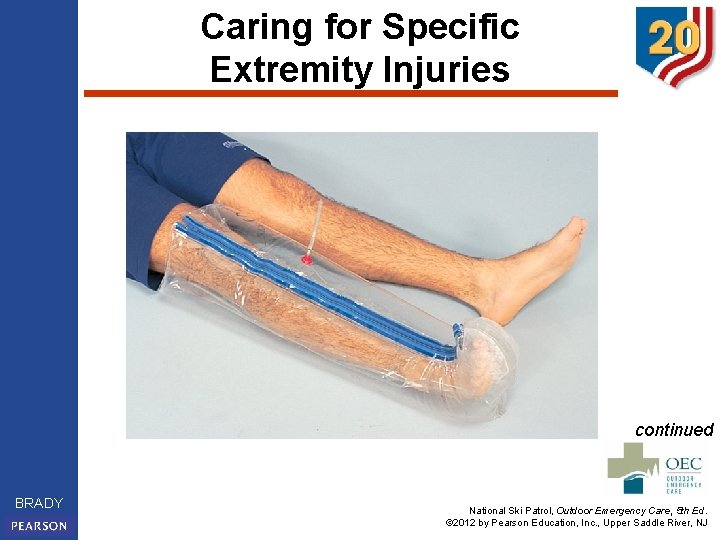
Caring for Specific Extremity Injuries l Lower Extremity Injuries ◦ Tib-fib • Control bleeding, bandage • May align • Rigid splint (may use air or vacuum also) ◦ Combined femur / tibia • Creates “floating knee” • Rigid splint over entire leg • Traction splint is alternative BRADY continued National Ski Patrol, Outdoor Emergency Care, 5 th Ed. © 2012 by Pearson Education, Inc. , Upper Saddle River, NJ
Caring for Specific Extremity Injuries continued BRADY National Ski Patrol, Outdoor Emergency Care, 5 th Ed. © 2012 by Pearson Education, Inc. , Upper Saddle River, NJ

Caring for Specific Extremity Injuries continued BRADY National Ski Patrol, Outdoor Emergency Care, 5 th Ed. © 2012 by Pearson Education, Inc. , Upper Saddle River, NJ
Caring for Specific Extremity Injuries l Lower Extremity Injuries ◦ Ankle • Splint in position found – match splint to injury type • If CMS compromise or bone appears ready to come through skin, may attempt one alignment ◦ Foot / toe • Match splint to injury type BRADY National Ski Patrol, Outdoor Emergency Care, 5 th Ed. © 2012 by Pearson Education, Inc. , Upper Saddle River, NJ
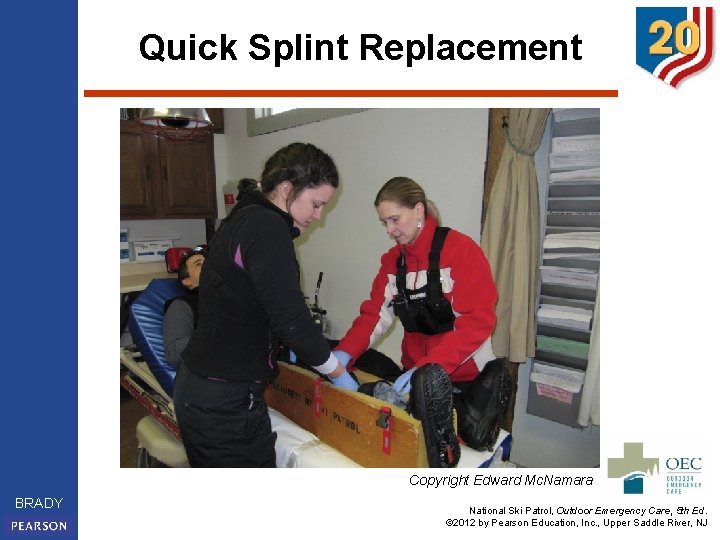
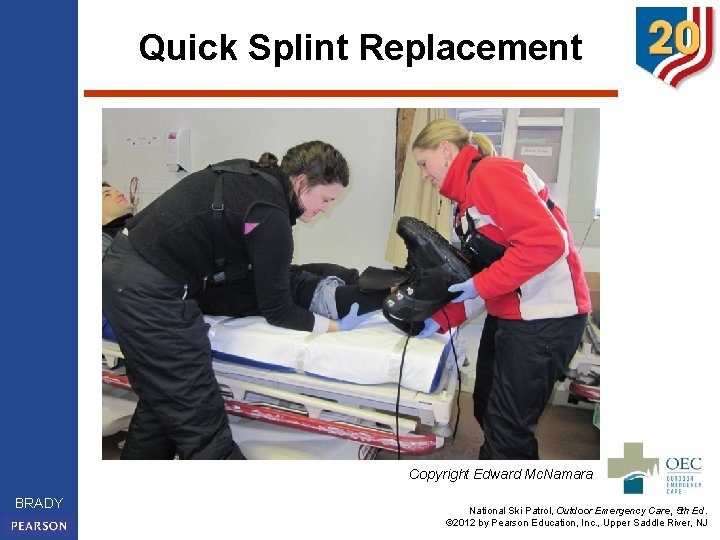
Quick Splint Replacement l Many quick splinted injuries are repackaged in the first aid area l Consider not replacing a quick splint if there are: ◦ ◦ BRADY Serious multiple injuries Very unstable fractures Bandaged open fractures Fractures accompanied by advancing shock National Ski Patrol, Outdoor Emergency Care, 5 th Ed. © 2012 by Pearson Education, Inc. , Upper Saddle River, NJ
Quick Splint Replacement Copyright Edward Mc. Namara BRADY National Ski Patrol, Outdoor Emergency Care, 5 th Ed. © 2012 by Pearson Education, Inc. , Upper Saddle River, NJ
Quick Splint Replacement Copyright Edward Mc. Namara BRADY National Ski Patrol, Outdoor Emergency Care, 5 th Ed. © 2012 by Pearson Education, Inc. , Upper Saddle River, NJ
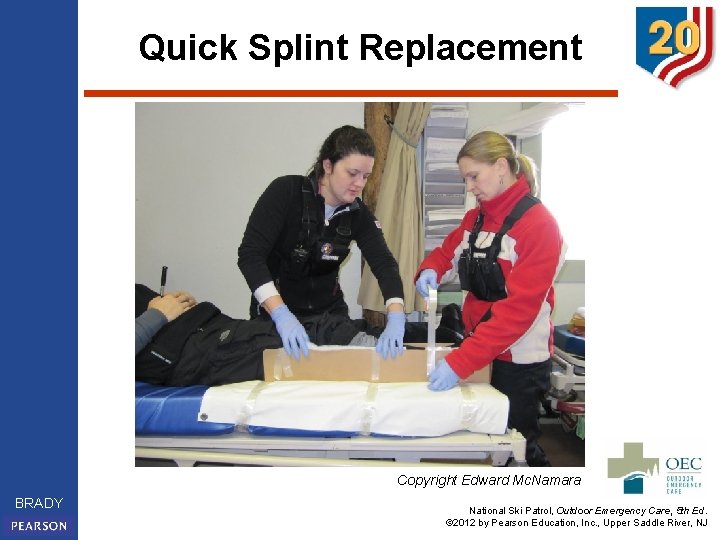
Quick Splint Replacement Copyright Edward Mc. Namara BRADY National Ski Patrol, Outdoor Emergency Care, 5 th Ed. © 2012 by Pearson Education, Inc. , Upper Saddle River, NJ
Boot Removal l Some controversy of when/if to remove boot ◦ On scene vs in aid room ◦ On or off with traction splint l Local BRADY protocols must be developed National Ski Patrol, Outdoor Emergency Care, 5 th Ed. © 2012 by Pearson Education, Inc. , Upper Saddle River, NJ
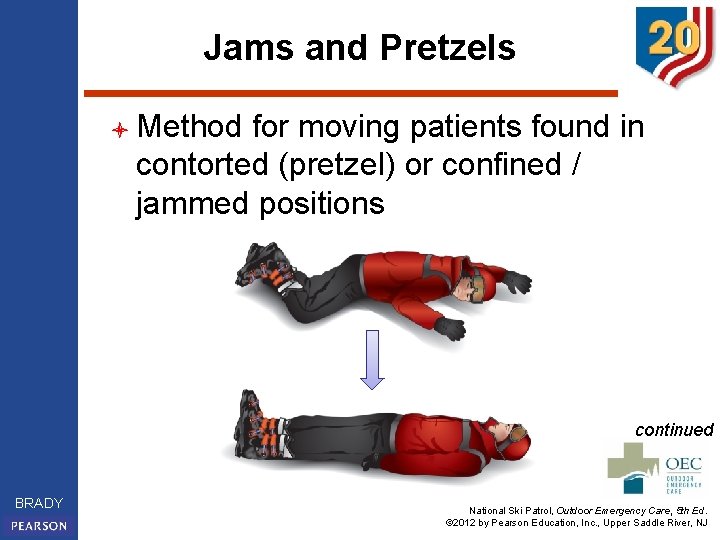
Jams and Pretzels l Method for moving patients found in contorted (pretzel) or confined / jammed positions continued BRADY National Ski Patrol, Outdoor Emergency Care, 5 th Ed. © 2012 by Pearson Education, Inc. , Upper Saddle River, NJ
Jams and Pretzels l Six ◦ ◦ ◦ basic anatomical positions Position 1 – supine, neutral, straight Position 1 a – supine with variations Position 2 – on one side, neutral, straight Position 2 a – on one side with variations Position 3 – prone, neutral, head turned Position 3 a – prone with variations continued BRADY National Ski Patrol, Outdoor Emergency Care, 5 th Ed. © 2012 by Pearson Education, Inc. , Upper Saddle River, NJ
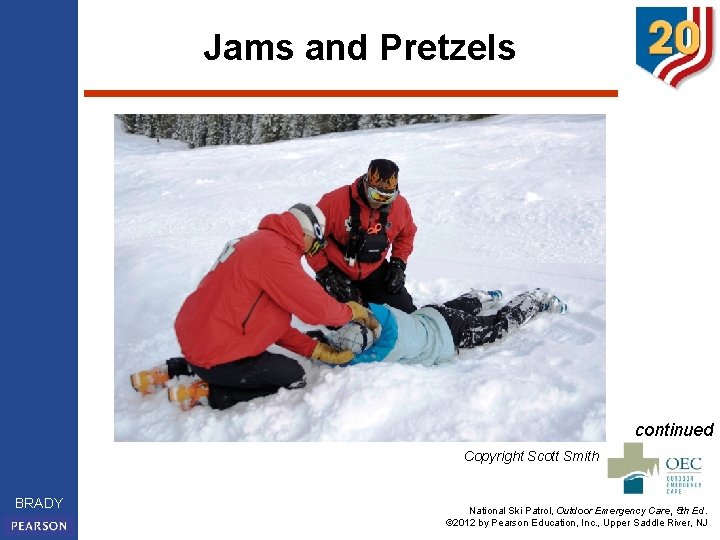
Jams and Pretzels continued Copyright Scott Smith BRADY National Ski Patrol, Outdoor Emergency Care, 5 th Ed. © 2012 by Pearson Education, Inc. , Upper Saddle River, NJ
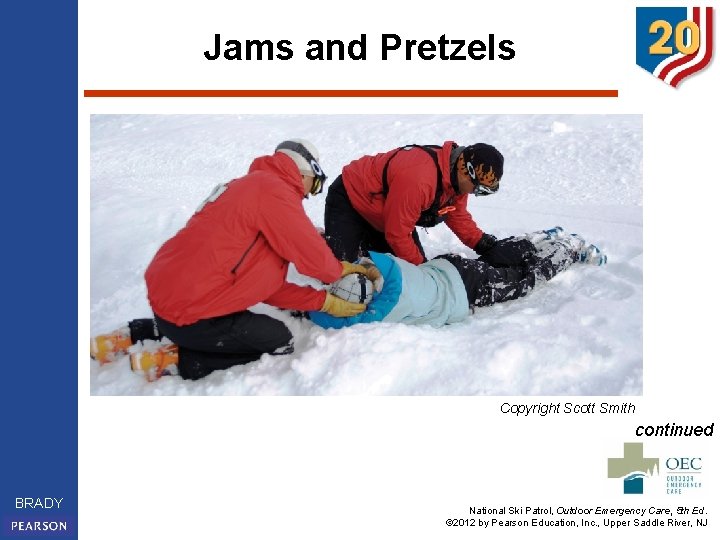
Jams and Pretzels Copyright Scott Smith continued BRADY National Ski Patrol, Outdoor Emergency Care, 5 th Ed. © 2012 by Pearson Education, Inc. , Upper Saddle River, NJ
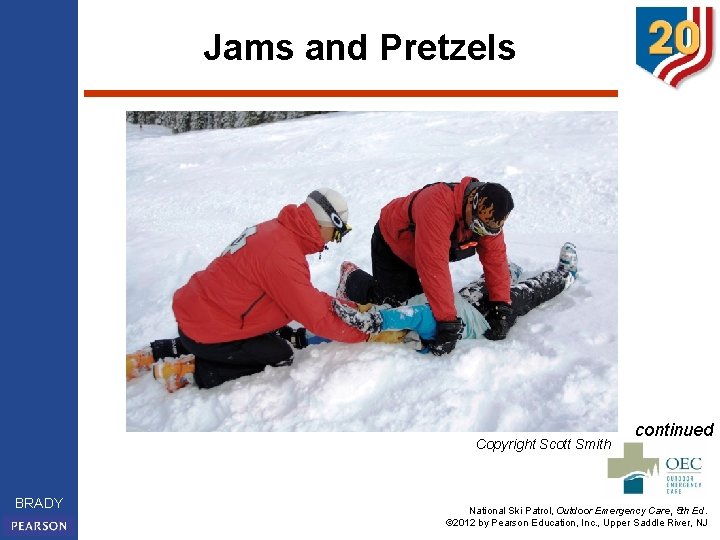
Jams and Pretzels Copyright Scott Smith BRADY continued National Ski Patrol, Outdoor Emergency Care, 5 th Ed. © 2012 by Pearson Education, Inc. , Upper Saddle River, NJ
Jams and Pretzels l Three posterior reference points – head, shoulders, hips ◦ The goal is to keep them aligned and in the same plane during moves ◦ They are secured in all moves (legs too if 4 th rescuer is on scene) BRADY National Ski Patrol, Outdoor Emergency Care, 5 th Ed. © 2012 by Pearson Education, Inc. , Upper Saddle River, NJ
Jams and Pretzels l All moves are axial or vertical – never sideways l Movements are made in short increments l If straightening of head, neck, or limbs is needed, do only one at a time ◦ Begin with head/neck (for airway) ◦ Stop for major pain or resistance l End BRADY in Position 1 on a spine board National Ski Patrol, Outdoor Emergency Care, 5 th Ed. © 2012 by Pearson Education, Inc. , Upper Saddle River, NJ
Case Disposition l You perform a secondary assessment, which reveals a midshaft right arm injury with displacement and no distal pulse, and a possible mid-shaft right femur fracture with no external bleeding. continued BRADY National Ski Patrol, Outdoor Emergency Care, 5 th Ed. © 2012 by Pearson Education, Inc. , Upper Saddle River, NJ
Case Disposition l Because of the lack of a distal pulse and the long transport time to the hospital, you explain to the teen that you need to straighten his arm, that it will hurt, and that you need to get blood flowing to his fingers. Upon straightening the arm, the radial pulse becomes strong. BRADY National Ski Patrol, Outdoor Emergency Care, 5 th Ed. © 2012 by Pearson Education, Inc. , Upper Saddle River, NJ
Case Disposition l You expose the arm, find no bleeding, cover it up, and splint it with a long SAM™ arm splint in a “sugar tong” configuration, and secure the splint with a roller bandage. BRADY National Ski Patrol, Outdoor Emergency Care, 5 th Ed. © 2012 by Pearson Education, Inc. , Upper Saddle River, NJ
Chapter Summary l The musculoskeletal system allows movement and protects internal structures. l The human skeleton has 206 bones. l The upper extremity includes the shoulder, arm, elbow, forearm (lower arm), wrist, hand, and fingers. continued BRADY National Ski Patrol, Outdoor Emergency Care, 5 th Ed. © 2012 by Pearson Education, Inc. , Upper Saddle River, NJ
Chapter Summary l The lower extremity includes the hip, thigh, knee, leg, ankle, foot, and toes. l Skeletal muscles facilitate movement under direct voluntary control of the brain. l A fracture is a disruption in the continuity of a bone. continued BRADY National Ski Patrol, Outdoor Emergency Care, 5 th Ed. © 2012 by Pearson Education, Inc. , Upper Saddle River, NJ
Chapter Summary l. A dislocation is the disruption of a joint in which the bone ends no longer remain in normal contact with each other. l A splint is a soft or rigid device applied to an injured extremity. l The four basic types of splints are soft, rigid or semi-rigid, traction, andcontinued improvised. BRADY National Ski Patrol, Outdoor Emergency Care, 5 th Ed. © 2012 by Pearson Education, Inc. , Upper Saddle River, NJ
Chapter Summary l The most frequent injury in skiing is a knee sprain. l The most frequent injury while snowboarding is a distal radius fracture. l A common upper extremity injury among skiers is skier’s thumb. continued BRADY National Ski Patrol, Outdoor Emergency Care, 5 th Ed. © 2012 by Pearson Education, Inc. , Upper Saddle River, NJ
Chapter Summary l The clavicle is the most commonly broken bone in the body. l For extremity injuries, remove all rings, bracelets, or other jewelry from the hand or foot immediately, before swelling occurs. l Treat all threats to life first, and then manage musculoskeletal injuries. BRADY National Ski Patrol, Outdoor Emergency Care, 5 th Ed. © 2012 by Pearson Education, Inc. , Upper Saddle River, NJ
- Slides: 35