
Caring for Children During Disasters Decontamination December 2018
Caring for Children During Disasters: Decontamination December 2018 1 Illinois EMSC is a collaborative program between the Illinois Department of Public Health and Ann & Robert H. Lurie Children’s Hospital of Chicago.
Illinois Emergency Medical Services (EMS) for Children Illinois EMS for Children is a collaborative grant funded program established in 1994 by the Illinois Department of Public Health to improve pediatric emergency care within our state. � Illinois EMS for Children works with professional health care organizations, public agencies, and key stakeholders to enhance and integrate pediatrics into the emergency care system through: � › › › Education Practice standards Injury prevention Data initiatives Disaster preparedness This educational activity is being presented without the provision of commercial support and without bias or conflict of interest from the planners and presenters. 2
Acknowledgements This educational module was developed by the Illinois EMS for Children Pediatric Preparedness Workgroup. A listing of the members of the committee at the time of the module’s development is provided at the end of this presentation. Suggested Citation: Illinois Emergency Medical Services for Children, Caring for Children During Disasters: Decontamination, December 2018. 3
Disclaimer This module is not meant to be an all-inclusive decontamination course. It is designed to build on existing knowledge regarding general decontamination procedures and outline specific pediatric components that should be incorporated into an organization’s decontamination plans in order to address the needs of children. Nothing in this module should be considered a replacement for prudent and cautious judgement by the health care professional. It is recommended to use the information provided as a guide since every situation is unique. 4
Objectives � Identify the unique characteristics that cause children to be more vulnerable when exposed to chemical, biological, and radiological agents � Review how certain standard decontamination processes can increase these vulnerabilities in children � Review key strategies and concepts to ensure the safety and other key needs of children during decon 5

6 Unique Characteristics of Children
Children are vulnerable during…… � An exposure � Decon in response to an exposure incident � Treatment following an exposure 7
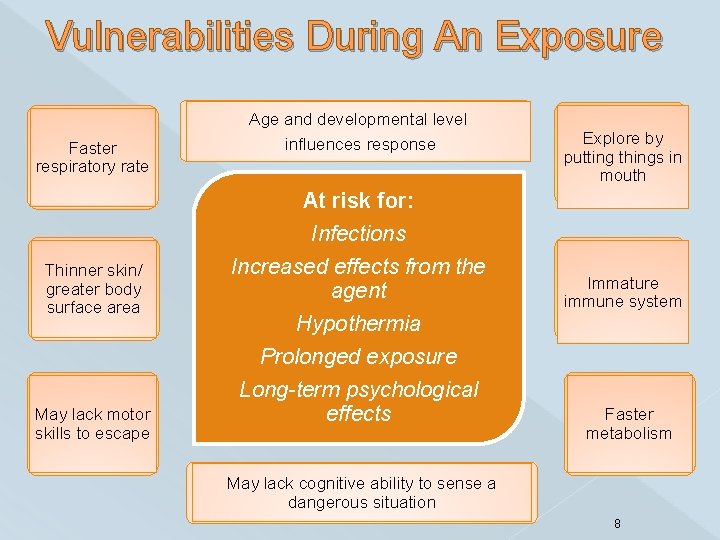
Vulnerabilities During An Exposure Faster respiratory rate Thinner skin/ greater body surface area May lack motor skills to escape Age and developmental level influences response At risk for: Infections Increased effects from the agent Hypothermia Prolonged exposure Long-term psychological effects Explore by putting things in mouth Immature immune system Faster metabolism May lack cognitive ability to sense a dangerous situation 8
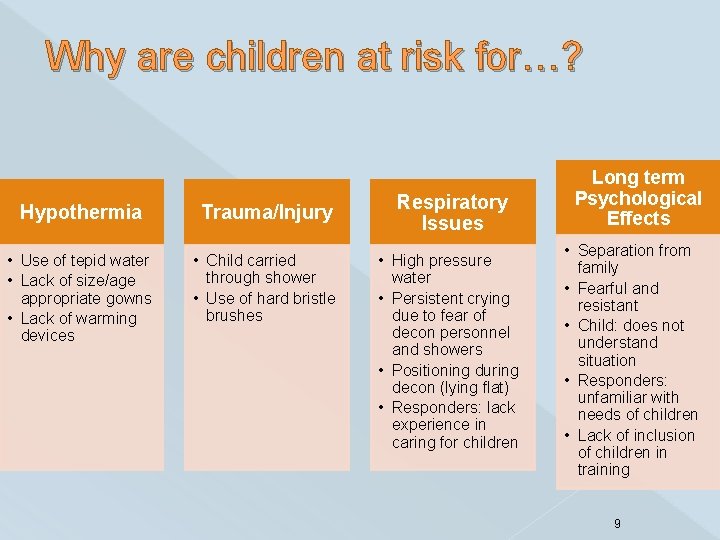
Why are children at risk for…? Hypothermia Trauma/Injury • Use of tepid water • Lack of size/age appropriate gowns • Lack of warming devices • Child carried through shower • Use of hard bristle brushes Respiratory Issues • High pressure water • Persistent crying due to fear of decon personnel and showers • Positioning during decon (lying flat) • Responders: lack experience in caring for children Long term Psychological Effects • Separation from family • Fearful and resistant • Child: does not understand situation • Responders: unfamiliar with needs of children • Lack of inclusion of children in training 9
Vulnerabilities During Treatment After Exposure � Medical countermeasures › Children respond to medications differently than adults › Limited development and testing of products/medications to treat children › Insufficient quantities of liquid suspension › Many medications/vaccinations may be contradicted in pregnancy due to potentially harming the fetus � Responders inexperienced in caring for children 10
11 Strategies to Keep Children Safe During Decon Procedures
General Pediatric Decon Considerations � Safety and security of the child › Child may be unaccompanied › Child is part of a family unit � Extra team members needed › Parent/caregiver will need assistance deconning self and child › 2 team members per child › 3 team members per child with special health care needs/child with functional and access needs › Increased through-put time 12
General Pediatric Decon Considerations � May be uncooperative due to: › The need to undress › An unfamiliar environment causing an increase in fear and anxiety › The removal of comfort items such as blankets and pacifiers � Communicate based on the age and developmental level of the child � Allow extra time for communication 13
General Pediatric Decon Considerations � Use mild soap, or just water � Do not use bleach or chemicals � Utilize soft bristle brushes and soft sponges � Provide privacy when appropriate and able 14
Additional Considerations Age specific: � 0 -2 years old: › Never assume parent can decon self and child/children › Highest risk for hypothermia › Need to remove diaper/pull up � 2 -8 years old: › Likely take the longest to decon › Older children in this group may decon themselves with supervision/encouragement › Need to remove diaper/pull up (as applicable) � 8 -18 years old: › Respect modesty/need for privacy › Gender separation and gender identified assistance is preferred › Can decon themselves with supervision 15
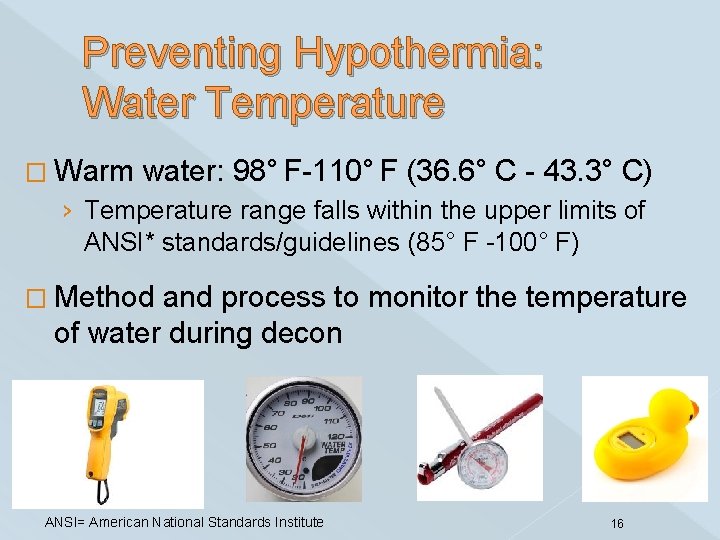
Preventing Hypothermia: Water Temperature � Warm water: 98° F-110° F (36. 6° C - 43. 3° C) › Temperature range falls within the upper limits of ANSI* standards/guidelines (85° F -100° F) � Method and process to monitor the temperature of water during decon ANSI= American National Standards Institute 16
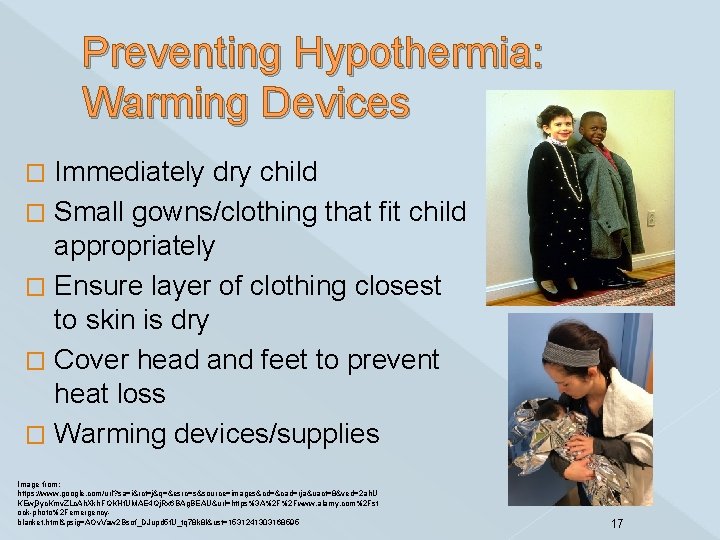
Preventing Hypothermia: Warming Devices Immediately dry child � Small gowns/clothing that fit child appropriately � Ensure layer of clothing closest to skin is dry � Cover head and feet to prevent heat loss � Warming devices/supplies � Image from: https: //www. google. com/url? sa=i&rct=j&q=&esrc=s&source=images&cd=&cad=rja&uact=8&ved=2 ah. U KEwj 3 yc. Kmv. ZLc. Ah. Xkh. FQKHf. UMAE 4 Qj. Rx 6 BAg. BEAU&url=https%3 A%2 F%2 Fwww. alamy. com%2 Fst ock-photo%2 Femergencyblanket. html&psig=AOv. Vaw 2 Bsof_DJupd 5 f. U_tq 78 k 8 I&ust=1531241303168595 17
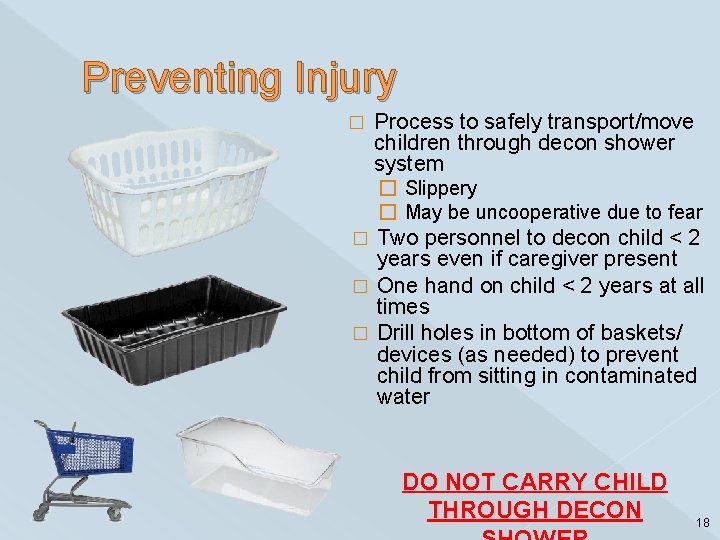
Preventing Injury � Process to safely transport/move children through decon shower system � Slippery � May be uncooperative due to fear Two personnel to decon child < 2 years even if caregiver present � One hand on child < 2 years at all times � Drill holes in bottom of baskets/ devices (as needed) to prevent child from sitting in contaminated water � DO NOT CARRY CHILD THROUGH DECON 18
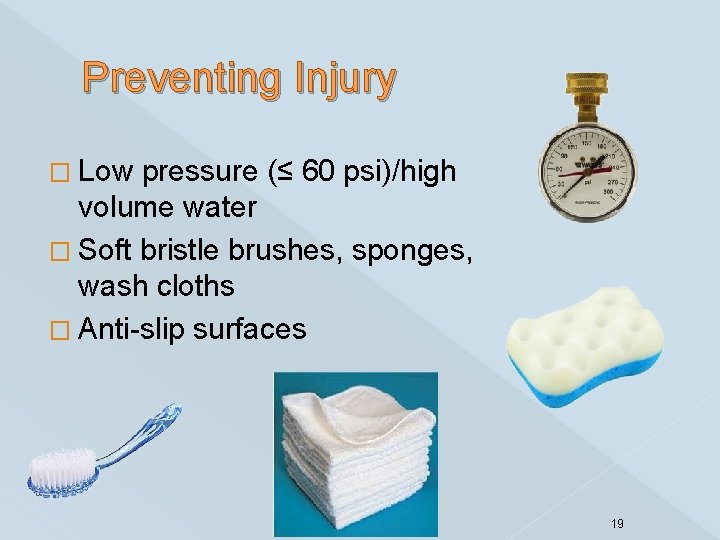
Preventing Injury � Low pressure (≤ 60 psi)/high volume water � Soft bristle brushes, sponges, wash cloths � Anti-slip surfaces 19
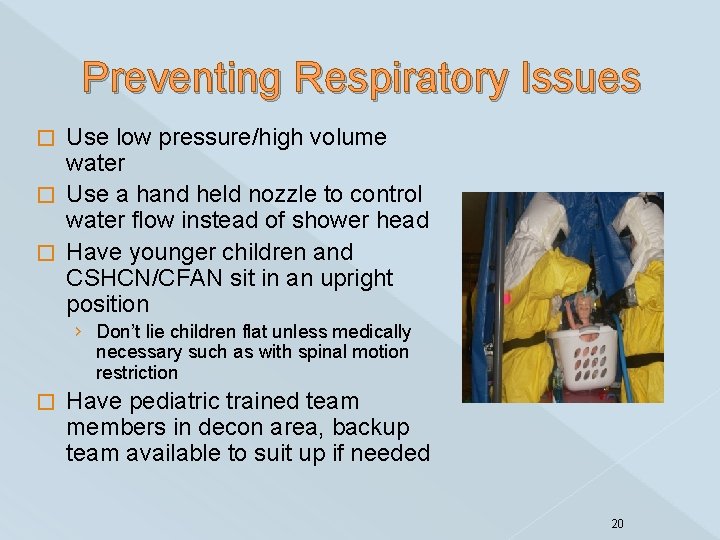
Preventing Respiratory Issues Use low pressure/high volume water � Use a hand held nozzle to control water flow instead of shower head � Have younger children and CSHCN/CFAN sit in an upright position � › Don’t lie children flat unless medically necessary such as with spinal motion restriction � Have pediatric trained team members in decon area, backup team available to suit up if needed 20
Preventing Long Term Psychological Effects Keep family unit together unless critical medical issues take priority � Process family at the level of highest medical priority of single member � Identify and track child through decon process (both accompanied and unaccompanied) � Provide child friendly environment if possible � › Toys › Faucet head shaped as toys 21
Preventing Long Term Psychological Effects � � � Gender separation preferred for children >8 years old Same gender personnel preferred if assistance is needed Utilize team members such as child life specialists/social workers to address mental health needs after incidents/decon Evaluate for psychological trauma due to incident and decon process Provide family with warning signs of psychological trauma that would require further evaluation 22
Addressing EMS Pediatric Decon Challenges in the Field � Difficulty controlling pressure of water � Cold water � Lack of adequate drying and post decon coverings � Lack of pediatric decon protocols � Lack of inclusion of children in decon drills 23
Addressing EMS Pediatric Decon Challenges in the Field Methods to address field decon challenges & the availability of resources to implement these methods may vary. Hazmat teams should consider the use of: � Pop-up tents � Trailers › Ability to control water pressure and temperature › Stockpile blankets and variety of coverings sized for children › Devices to avoid carrying children thru decon 24
Addressing EMS Pediatric Decon Challenges in the Field Methods to address field decon challenges & the availability of resources to implement these methods may vary. Warm EMS vehicles during transport � Ensure pediatric decon protocols are included in every EMS system and for those communities with Hazmat teams � All hazmat trainings should include children of all ages and children with functional and access needs � 25
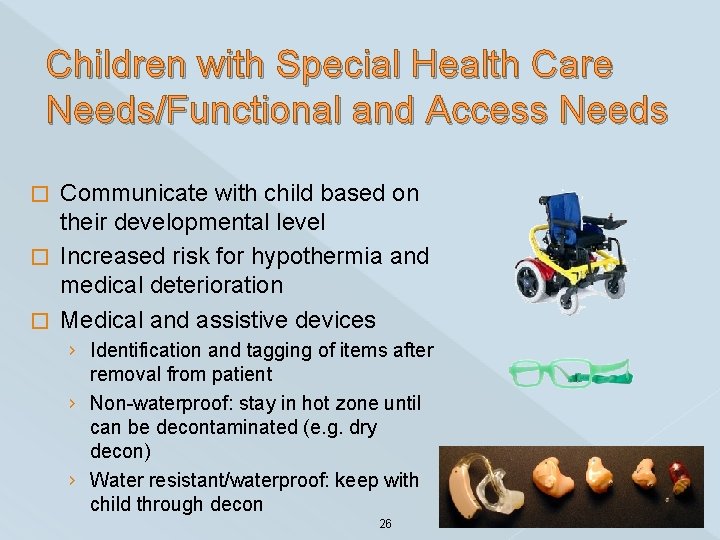
Children with Special Health Care Needs/Functional and Access Needs Communicate with child based on their developmental level � Increased risk for hypothermia and medical deterioration � Medical and assistive devices � › Identification and tagging of items after removal from patient › Non-waterproof: stay in hot zone until can be decontaminated (e. g. dry decon) › Water resistant/waterproof: keep with child through decon 26
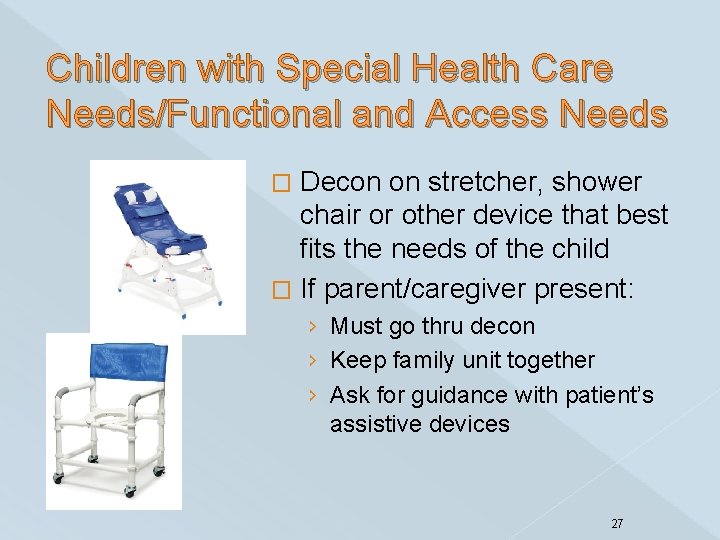
Children with Special Health Care Needs/Functional and Access Needs Decon on stretcher, shower chair or other device that best fits the needs of the child � If parent/caregiver present: � › Must go thru decon › Keep family unit together › Ask for guidance with patient’s assistive devices 27
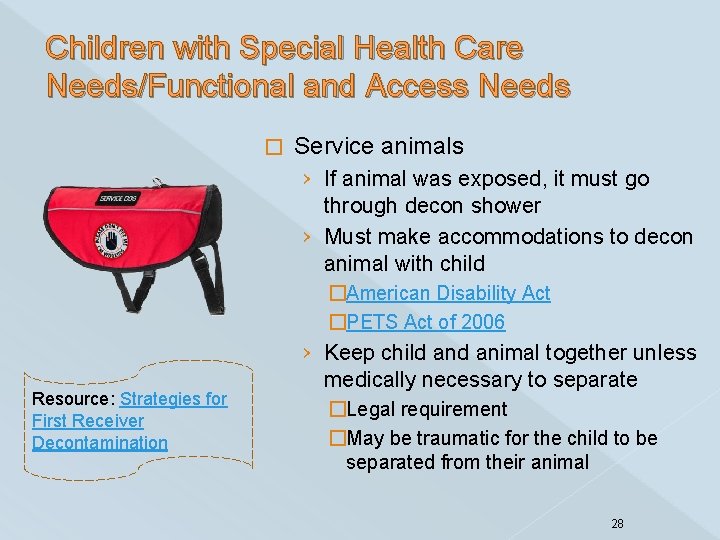
Children with Special Health Care Needs/Functional and Access Needs � Resource: Strategies for First Receiver Decontamination Service animals › If animal was exposed, it must go through decon shower › Must make accommodations to decon animal with child �American Disability Act �PETS Act of 2006 › Keep child animal together unless medically necessary to separate �Legal requirement �May be traumatic for the child to be separated from their animal 28
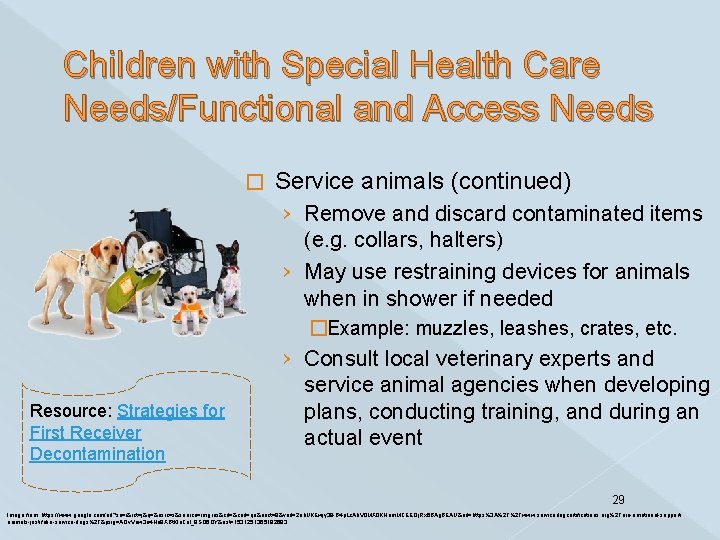
Children with Special Health Care Needs/Functional and Access Needs � Resource: Strategies for First Receiver Decontamination Service animals (continued) › Remove and discard contaminated items (e. g. collars, halters) › May use restraining devices for animals when in shower if needed �Example: muzzles, leashes, crates, etc. › Consult local veterinary experts and service animal agencies when developing plans, conducting training, and during an actual event 29 Image from: https: //www. google. com/url? sa=i&rct=j&q=&esrc=s&source=imgres&cd=&cad=rja&uact=8&ved=2 ah. UKEwjy 39 -B 4 p. Lc. Ah. V 0 MX 0 KHam. MCEEQj. Rx 6 BAg. BEAU&url=https%3 A%2 F%2 Fwww. servicedogcertifications. org%2 Fare-emotional-supportanimals-just-fake-service-dogs%2 F&psig=AOv. Vaw 3 e 4 Hn 8 XBt. Kle. Cnl_9 SO 6 OY&ust=1531251365192693
Training/Exercises/Drills � Conduct regular, ongoing exercises/drills/trainings that include children of all ages as well as children with special health care needs/children with functional and access needs 30
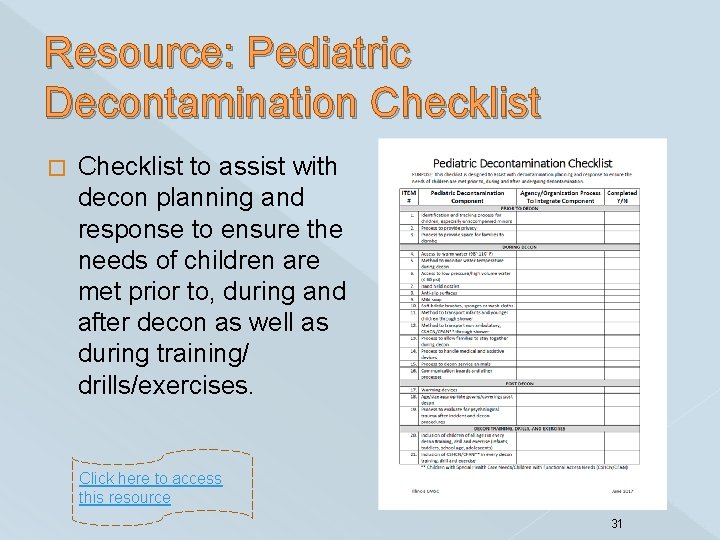
Resource: Pediatric Decontamination Checklist � Checklist to assist with decon planning and response to ensure the needs of children are met prior to, during and after decon as well as during training/ drills/exercises. Click here to access this resource 31

32 Conclusion
Key Points to Remember � Children have anatomical, physiological and developmental differences that make them more vulnerable during: › An exposure › Decon after exposure › Treatment following an exposure Considerations to prevent hypothermia, injury, respiratory issues, and long term psychological effects should be integrated into every EMS, Hazmat Team, and hospital decon policies � Children of all ages and CSHCN/CFAN should be included in all decon trainings, drills, and exercises � www. luriechildrens. org/emsc 33
Pediatric Preparedness Workgroup First Edition: November 2018 Michele Mc. Kee, MD Chair University of Chicago Medicine—Comer Children’s Hospital John Althoff EMT-P Tina Johnston, BSN, RN Decatur Memorial Hospital American Red Cross Annaliza Camia, MSN, RN, CNL, CPEN Amy Krupa, MSN, RN, CPEN, CPN, TCRN, TNS, SANE-A, SANE -P Illinois EMS for Children Advocate Children’s Hospital Brian Churchill EMT-P, BSHA, CHEC Moses Lee, MD, FACEP HSHS St. John’s Hospital Illinois Medical Emergency Response Team Mary Connelly, BSN, RN Evelyn Lyons, MPH, RN Illinois Medical Emergency Response Team Illinois Department of Public Health Judy Courter Charles Nozicka, DO, FAAP, FAAEM Franklin Hospital Advocate Children’s Hospital Troy Erbentraut Cassandra O’Brien, MSN, RN, CPEN, CEN, TCRN, TNS OSF St. Francis Medical Center University of Chicago Medicine—Comer Children’s Hospital Leslie Flament, MS, APN, CPNP-PC Mary Otting, BSN, RN, TNS Ann & Robert H. Lurie Children’s Hospital of Chicago Susan Fuchs, MD, FAAP, FACEP Amanda Phelps, MSN, RN, TNS Ann & Robert H. Lurie Children’s Hospital of Chicago Advocate Children’s Hospital Rita George, RN, IPEM Laura Prestidge, MPH, RN North. Shore University Health. System—Skokie Hospital EMSC Preparedness Coordinator Jeanne Grady, BSN, RN Michael Robbins, Pharm. D UIC—Division of Specialized Care for Children Chicago Department of Public Health Tina Hatzopoulos, Pharm. D Michael Wahl, MD Huron Consulting Group Illinois Poison Center; Illinois Health and Hospital Association Sharon Hebert, RN Elisabeth Weber, MA, RN, CEN, NHDP-BC Northwestern Medicine—Kishwaukee Hospital Chicago Department of Public Health Keneatha Johnson, MPH Barbara Weintraub, MSN, RN, MPH, APN, FAEN Illinois Health and Hospital Association Gottlieb Memorial Hospital 34
Resources/References � � � American Academy of Pediatrics (AAP). (2016). Decontamination of Children. Retrieved from: https: //www. aap. org/en-us/advocacy-and-policy/aap-healthinitiatives/Children-and-Disasters/Pages/Decontamination. aspx Emergency Medical Services for Children (EMSC) Innovation & Improvement Center (IIC). (2015). Checklist: Essential Pediatric Domains and Considerations for Every Hospital’s Disaster Preparedness Policies. Retrieved from: https: //emscimprovement. center/resources/publications/checklist-essential-forevery-hospitals-disaster-preparedness-policies/ Federal Emergency Management Agency (FEMA). Pediatric Disaster Response and Emergency Preparedness-MGT 429. Texas A&M Engineering Extension Service (TEEX): College Station, TX. Heon, D. , & Foltin, G. L. (2009). Principles of Pediatric Decontamination. Clinical Pediatric Emergency Medicine, 10 (3), 186 -194. Retrieved from: http: //www. ny 2 aap. org/pdf/Disaster/186. pdf Illinois Emergency Medical Services for Children (EMSC). (2017). Pediatric Decontamination Checklist. Retrieved from: https: //www. luriechildrens. org/globalassets/documents/emsc/disaster/other/ped iatricdecontaminationchecklistjune 2017. pdf 35
Resources/References � � � Powers, R. & Daily, E. (2010). International Disaster Nursing. Cambridge University Press. Romig, L. (n. d. ). Pediatric decontamination: More than just a bath. Shapira, S. C. , Hammond, J. S. , & Cole, L. A. (2009). Essentials of Terror Medicine. Springer Publishing. U. S. Department of Health & Human Services: Chemical Hazards Emergency Medical Management (CHEMM). (2005). Decontamination of Children. Preparedness and Response for Hospital Emergency Departments. Retrieved from: https: //chemm. nlm. nih. gov/deconchildtranscript. htm U. S. Department of Homeland Security & U. S. Department of Health & Human Services. (2014). Patient Decontamination in a Mass Chemical Exposure Incident: National Planning Guidance for Communities. Retrieved from: https: //www. dhs. gov/sites/default/files/publications/Patient%20 Decon%20 National%20 Planning%20 Guidance_Final_December%202014. pdf 36
- Slides: 36