
CARIBBEAN VOCATIONAL QUALIFICATIONS CVQ OUR TRANSFORMATION CHANGE INNOVATE
CARIBBEAN VOCATIONAL QUALIFICATIONS CVQ
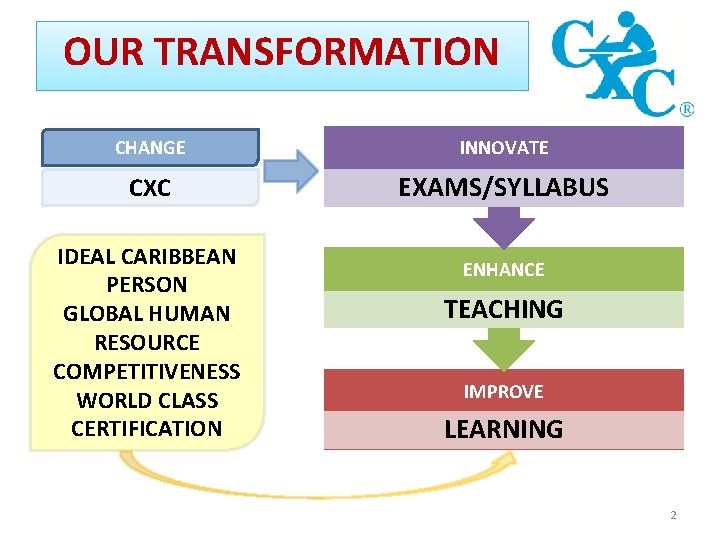
OUR TRANSFORMATION CHANGE INNOVATE CXC EXAMS/SYLLABUS IDEAL CARIBBEAN PERSON GLOBAL HUMAN RESOURCE COMPETITIVENESS WORLD CLASS CERTIFICATION ENHANCE TEACHING IMPROVE LEARNING 2
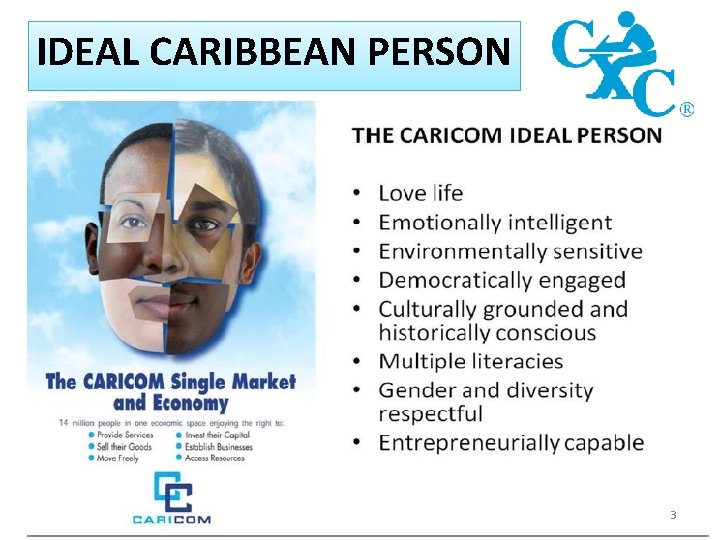
IDEAL CARIBBEAN PERSON 3
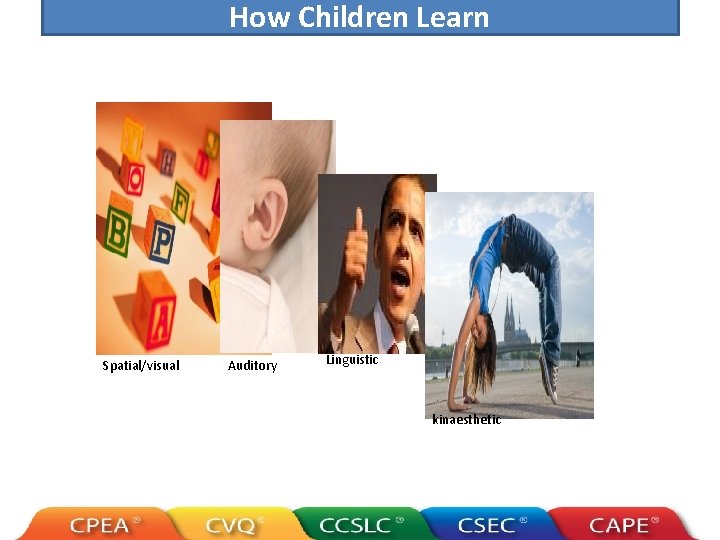
How Children Learn Spatial/visual Auditory Linguistic kinaesthetic
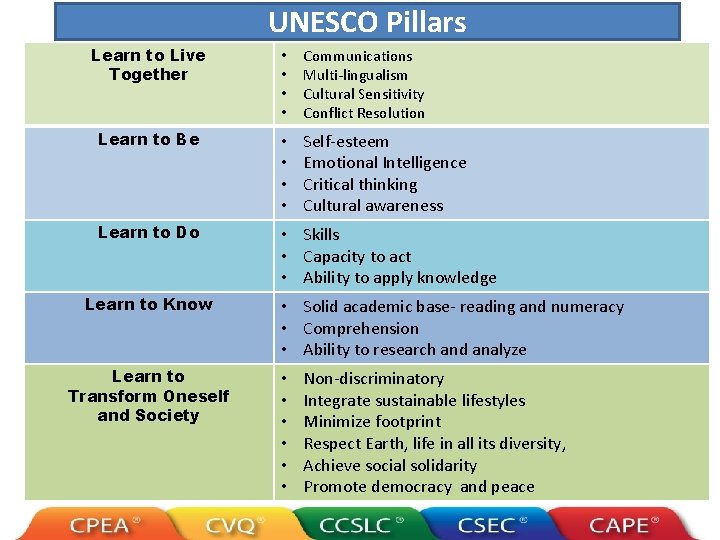
UNESCO Pillars Learn to Live Together • • Communications Multi-lingualism Cultural Sensitivity Conflict Resolution Learn to Be • • Self-esteem Emotional Intelligence Critical thinking Cultural awareness Learn to Do • Skills • Capacity to act • Ability to apply knowledge Learn to Know Learn to Transform Oneself and Society • Solid academic base- reading and numeracy • Comprehension • Ability to research and analyze • • • Non-discriminatory Integrate sustainable lifestyles Minimize footprint Respect Earth, life in all its diversity, Achieve social solidarity Promote democracy and peace
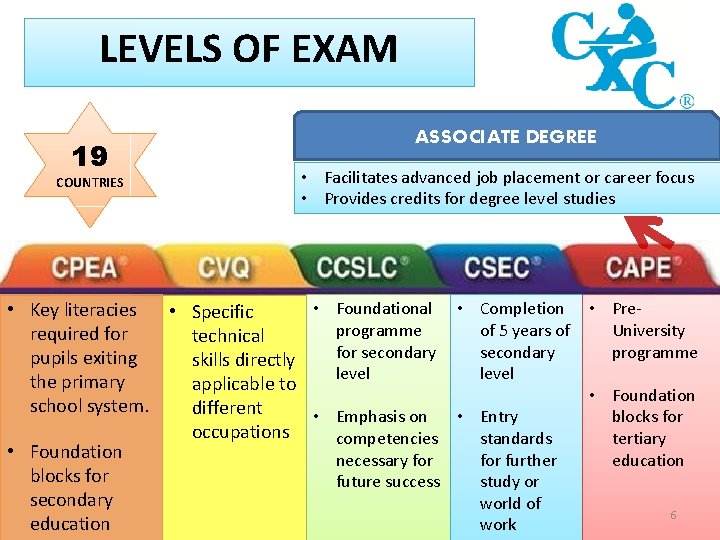
LEVELS OF EXAM 19 COUNTRIES ASSOCIATE DEGREE • Facilitates advanced job placement or career focus • Provides credits for degree level studies • Foundational • Completion • Pre • Key literacies • Specific programme of 5 years of University required for technical for secondary programme pupils exiting skills directly level the primary applicable to • Foundation school system. different • Emphasis on • Entry blocks for occupations competencies standards tertiary • Foundation necessary for further education blocks for future success study or secondary world of 6 education work
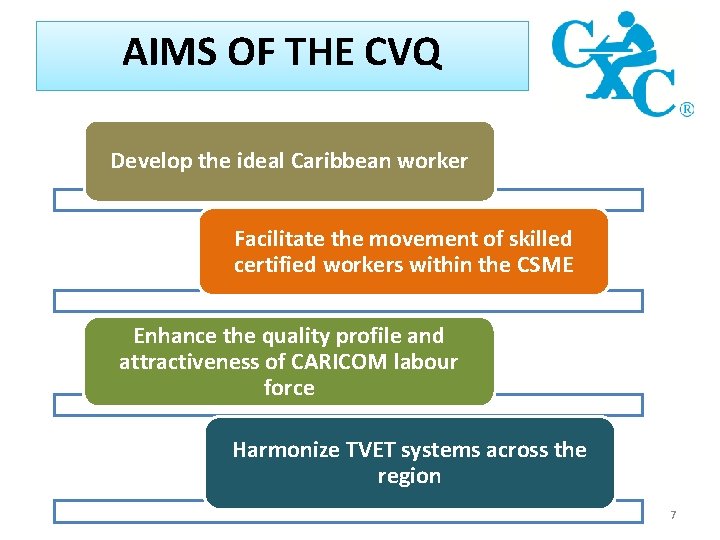
AIMS OF THE CVQ Develop the ideal Caribbean worker Facilitate the movement of skilled certified workers within the CSME Enhance the quality profile and attractiveness of CARICOM labour force Harmonize TVET systems across the region 7
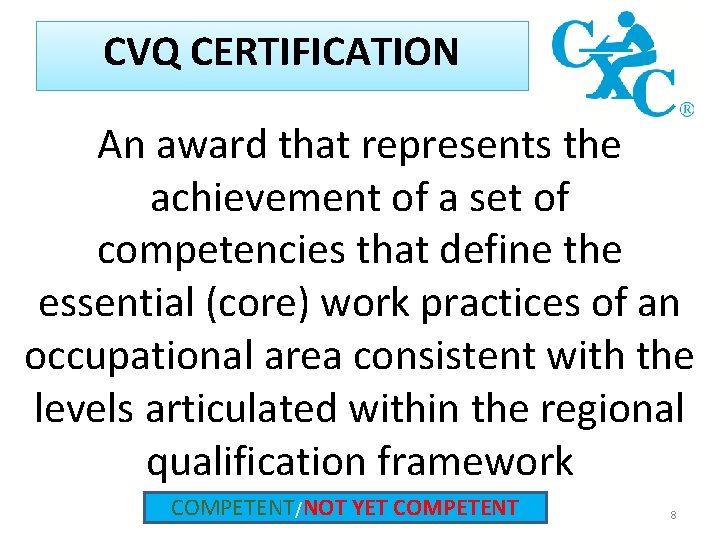
What is the CVQ? CVQ CERTIFICATION An award that represents the achievement of a set of competencies that define the essential (core) work practices of an occupational area consistent with the levels articulated within the regional qualification framework COMPETENT/NOT YET COMPETENT 8
CVQ Levels Level 1 Directly Supervised/Entry – Level Worker Level 2 Supervised Skilled Worker Level 3 Independent or Autonomous Skilled Worker Level 4 Specialized or Supervisory Worker Level 5 Managerial and/or Professional Worker 9
CVQ Levels • CVQs are awarded to those candidates who would have met the required standards in all of the prescribed units of study. • Statements are issued in cases where candidates did not complete all the requirements for the award of CVQ. • Schools that are suitably equipped currently offer Levels 1 & 2. 10
The Competency-Based Education Training and Assessment (CBETA) Approach 11
The CBETA Approach • Tasks are identified by the occupational and industry experts - Standards. • Each student has the opportunity to develop and to be evaluated on the competencies achieved. • Students’ progress by demonstrating the attainment of competencies. 12
The CBETA Approach • Assessment of competency is based on knowledge, demonstration of the competency and attitude. • Students are aware of the Occupational Standards used as the basis for assessing achievement and determining competency. 13
The CBETA Approach • Assessment evidence maintained for moderation and/or verification activities. • Candidates may be assessed repeatedly until they prove they are competent. 14
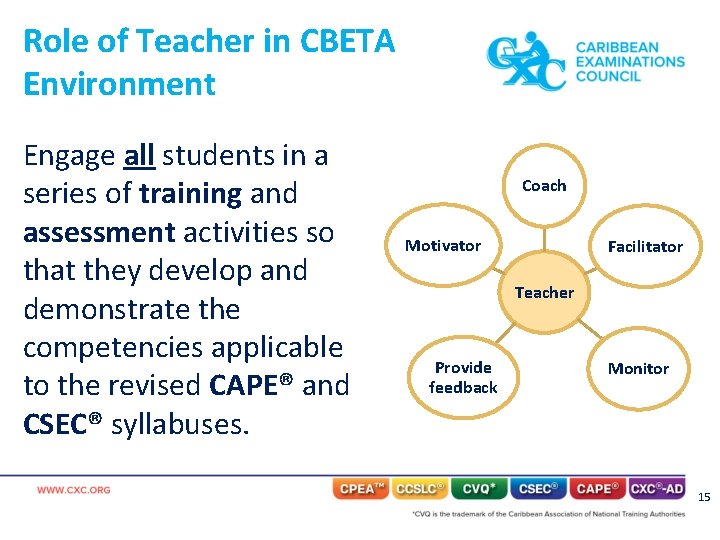
Role of Teacher in CBETA Environment Engage all students in a series of training and assessment activities so that they develop and demonstrate the competencies applicable to the revised CAPE® and CSEC® syllabuses. Coach Motivator Facilitator Teacher Provide feedback Monitor 15
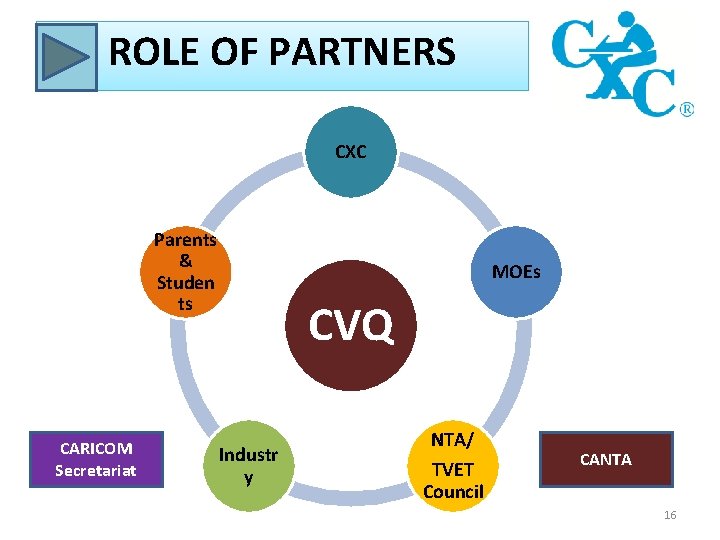
ROLE OF PARTNERS CXC Parents & Studen ts CARICOM Secretariat MOEs CVQ Industr y NTA/ TVET Council CANTA 16
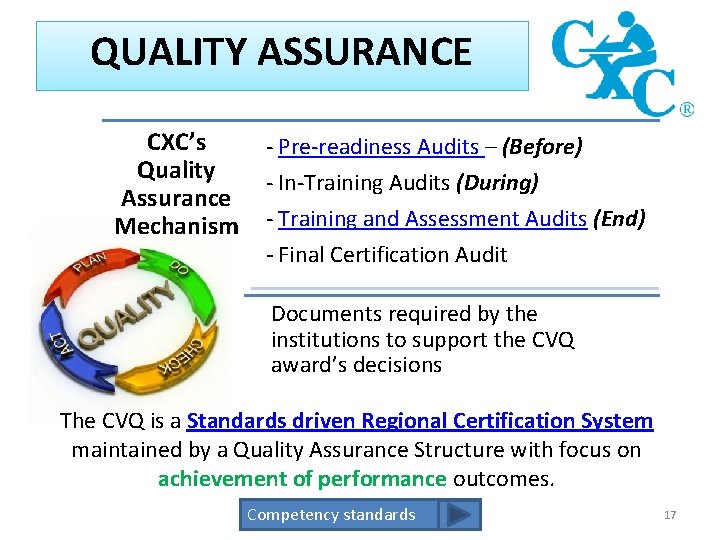
QUALITY ASSURANCE CXC’s Quality Assurance Mechanism - Pre-readiness Audits – (Before) - In-Training Audits (During) - Training and Assessment Audits (End) - Final Certification Audit Documents required by the institutions to support the CVQ award’s decisions The CVQ is a Standards driven Regional Certification System maintained by a Quality Assurance Structure with focus on achievement of performance outcomes. Competency standards 17
PROCEDURAL GUIDELINES ü Knowledge and use of the Regional Qualifications Framework ü Orientation to Competency Based Education and Training and Assessment (CBETA) ü Orientation for Competency Standards ü Evaluation of Existing Resources ü Centre/School Approval ü Development of a Quality Assurance System ü Training of Key Personnel ü Establishment of a Record Keeping System ü Assessment 18
ASSESSMENT CENTRES Minimum requirements for Competence-Based Training, Assessment and Certification. • Statutory Compliance • Resource (Staff, Physical & Learning ) • Assessors • Internal verification procedures • External verification procedures • Management of Information (record management, security and storage) 19
ASSESSMENT Monitoring arrangements stipulated for the delivery of CVQs: üAssessments are conducted by trained assessors Assessments are conducted within approved centres. (Schools or Education Institutions) üVerification of assessments regularly conducted üModeration of assessment results is conducted to maintain consistency 20
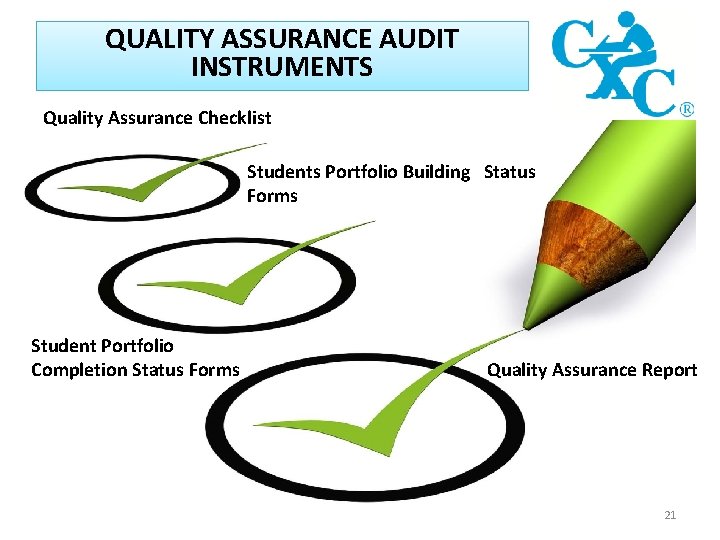
QUALITY ASSURANCE AUDIT INSTRUMENTS Quality Assurance Checklist Students Portfolio Building Status Forms Student Portfolio Completion Status Forms Quality Assurance Report 21
RECORD KEEPING q. Recording of data should be simple and efficient q. Records of assessment should specify what evidence is collected, when it is collected and the method of assessment used q. Assessment records should reflect all areas of performance i. e. knowledge, skills and attitude q. Records should specify clearly the competencies assessed and the degree of competence achieved. This is critical in determining if assessment for the unit/cluster of units is complete. 22
PROCEDURAL GUIDELINES Pathway to Establishing CVQs
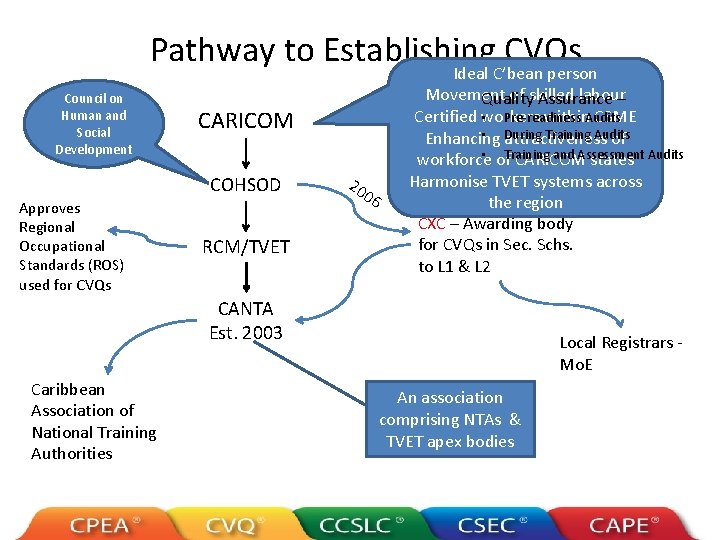
Pathway to Establishing CVQs Ideal C’bean person Council on Human and Social Development CARICOM COHSOD Approves Regional Occupational Standards (ROS) used for CVQs RCM/TVET 20 06 Movement of skilled labour Quality Assurance – Certified workers within CSME • Pre-readiness Audits • During Training Audits Enhancing attractiveness of • Training and Assessment Audits workforce of CARICOM states Harmonise TVET systems across the region CXC – Awarding body for CVQs in Sec. Schs. to L 1 & L 2 CANTA Est. 2003 Caribbean Association of National Training Authorities Local Registrars - Mo. E An association comprising NTAs & TVET apex bodies
PROCEDURAL GUIDELINES Certification Process
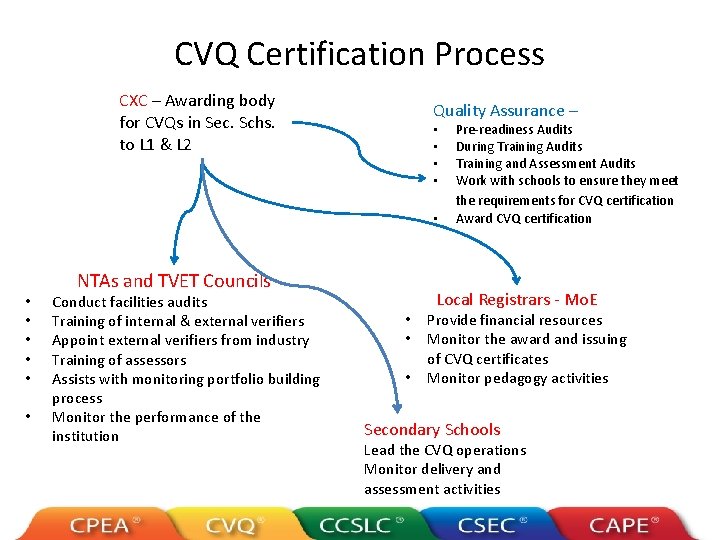
CVQ Certification Process CXC – Awarding body for CVQs in Sec. Schs. to L 1 & L 2 Quality Assurance – • • • NTAs and TVET Councils Conduct facilities audits Training of internal & external verifiers Appoint external verifiers from industry Training of assessors Assists with monitoring portfolio building process Monitor the performance of the institution • • • Pre-readiness Audits During Training Audits Training and Assessment Audits Work with schools to ensure they meet the requirements for CVQ certification Award CVQ certification Local Registrars - Mo. E Provide financial resources Monitor the award and issuing of CVQ certificates Monitor pedagogy activities Secondary Schools Lead the CVQ operations Monitor delivery and assessment activities
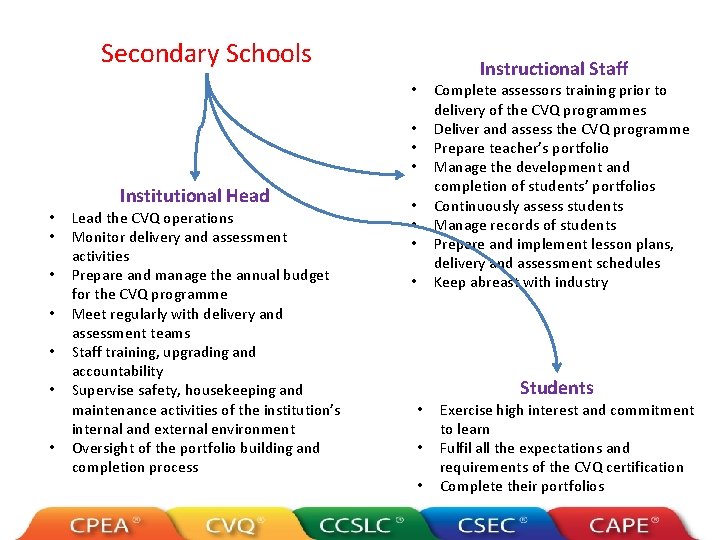
Secondary Schools Instructional Staff Complete assessors training prior to delivery of the CVQ programmes Deliver and assess the CVQ programme Prepare teacher’s portfolio Manage the development and completion of students’ portfolios Continuously assess students Manage records of students Prepare and implement lesson plans, delivery and assessment schedules Keep abreast with industry • • • Institutional Head Lead the CVQ operations Monitor delivery and assessment activities Prepare and manage the annual budget for the CVQ programme Meet regularly with delivery and assessment teams Staff training, upgrading and accountability Supervise safety, housekeeping and maintenance activities of the institution’s internal and external environment Oversight of the portfolio building and completion process • • Students Exercise high interest and commitment to learn Fulfil all the expectations and requirements of the CVQ certification Complete their portfolios
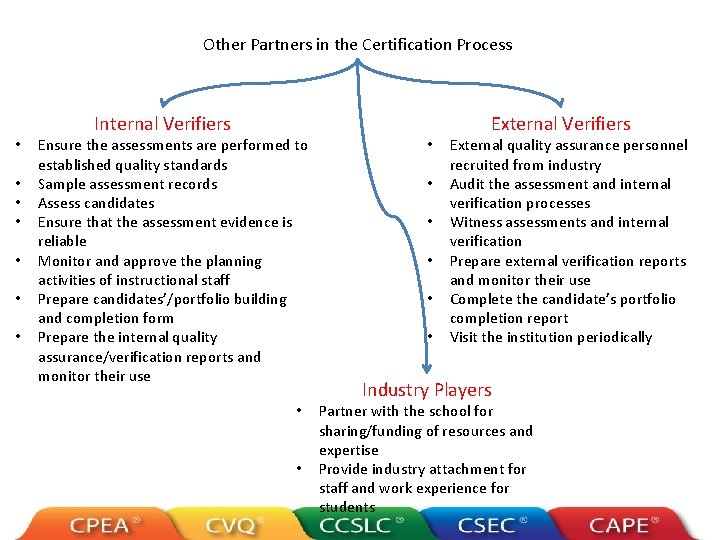
Other Partners in the Certification Process • • Internal Verifiers Ensure the assessments are performed to established quality standards Sample assessment records Assess candidates Ensure that the assessment evidence is reliable Monitor and approve the planning activities of instructional staff Prepare candidates’/portfolio building and completion form Prepare the internal quality assurance/verification reports and monitor their use • • External Verifiers External quality assurance personnel recruited from industry Audit the assessment and internal verification processes Witness assessments and internal verification Prepare external verification reports and monitor their use Complete the candidate’s portfolio completion report Visit the institution periodically Industry Players Partner with the school for sharing/funding of resources and expertise Provide industry attachment for staff and work experience for students
SCHOOL WORK PARTNERSHIPS • Challenges: – Labour laws which restrict age of employment • access to industry experience is relaxed for Level 1 – Identifying partners – Lack of creativity
SCHOOL/WORK PARTNERSHIPS
PROGRESS SINCE 2007 • 9, 135 candidates registered for CVQs in 51 occupational standards • 2, 387 CVQ certificates issued • 5, 844 unit awards were made • Pre-readiness audits at several schs. in the region • Work to rationalize Regional Occupational Standards (ROS) 8 -10 units per standard • Update CVQ database
PROGRESS SINCE 2007 • Training – teachers, IVs, EVs, internal QA processes, developing curricula from ROS • Update QA processes • CXC as a member of CANTA’s QA C’ttee • CXC as a member of TVET Council B’dos QA C’ttee
INTEGRATION for CSEC and CAPE SCHOOL-BASED ASSESSMENT The CXC® APPROACH
Integration for Certification • Connects areas of study and unifies concepts. • Engages students in relevant, meaningful activities that can be connected to real life. • Encourages the use of teaching strategies to include themes, projects, problem-based learning, field studies and investigations. • Arrives at assessment judgement against an establish standard. 34
Integration for Certification With integration decisions are taken on: 1. what form the integration should take; 2. how the integration should take place; 3. where the integration should take place; and, 4. over how much time it should be done. 35
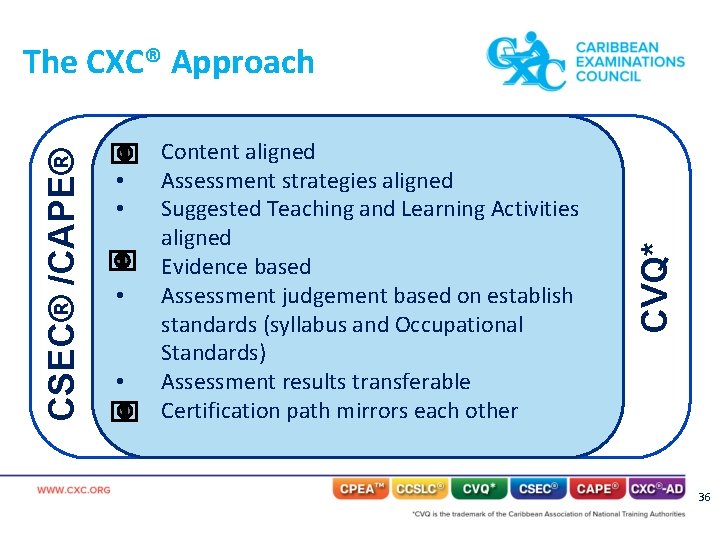
• • Content aligned Assessment strategies aligned Suggested Teaching and Learning Activities aligned Evidence based Assessment judgement based on establish standards (syllabus and Occupational Standards) Assessment results transferable Certification path mirrors each other CVQ* CSEC® /CAPE® The CXC® Approach 36
The CXC® Approach • Competency Based Education Training and Assessment (CBETA) approach to teach and assess syllabuses. • Content in syllabuses aligned to industry standards. • Moderation and audits used for quality assurance. • Dual recognition of competencies CAPE® and CVQ* or CSEC® and CVQ*. • Dual recognition is not automatic. 37
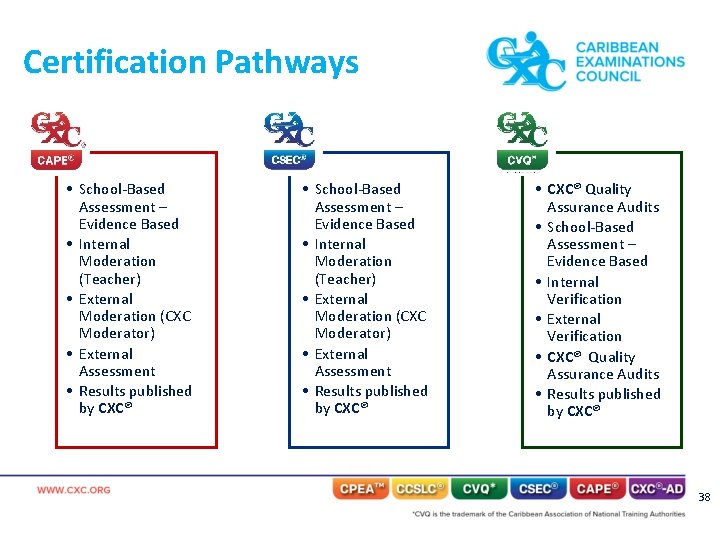
Certification Pathways • School-Based Assessment – Evidence Based • Internal Moderation (Teacher) • External Moderation (CXC Moderator) • External Assessment • Results published by CXC® • CXC® Quality Assurance Audits • School-Based Assessment – Evidence Based • Internal Verification • External Verification • CXC® Quality Assurance Audits • Results published by CXC® 38
General Information • In 2016, the number of registered candidates was 3789 in 40 occupational areas. • In 2015, candidates registered to pursue CVQs in 34 occupational areas compared with 31 in 2014. 39
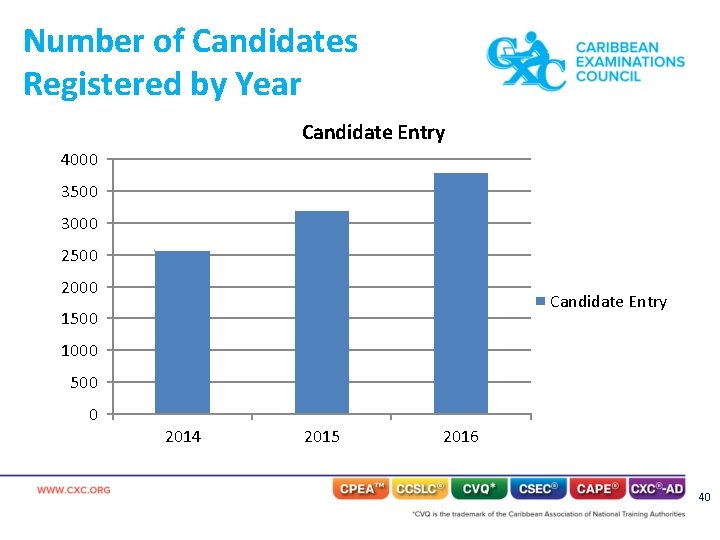
Number of Candidates Registered by Year Candidate Entry 4000 3500 3000 2500 2000 Candidate Entry 1500 1000 500 0 2014 2015 2016 40
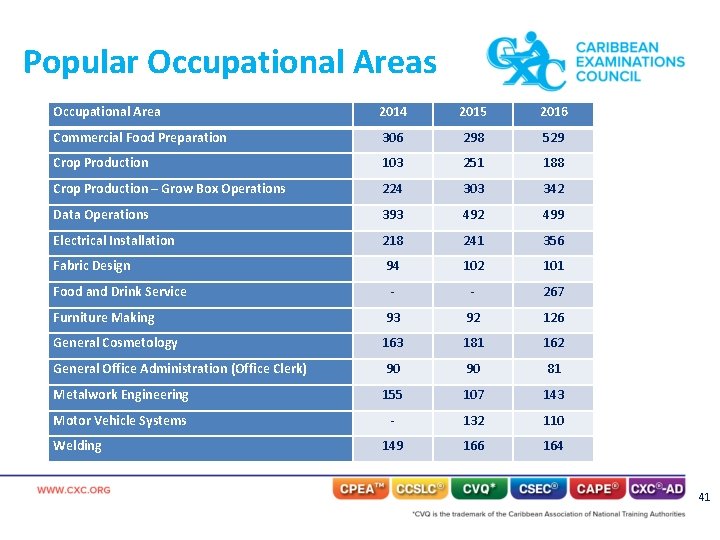
Popular Occupational Areas Occupational Area 2014 2015 2016 Commercial Food Preparation 306 298 529 Crop Production 103 251 188 Crop Production – Grow Box Operations 224 303 342 Data Operations 393 492 499 Electrical Installation 218 241 356 Fabric Design 94 102 101 - - 267 Furniture Making 93 92 126 General Cosmetology 163 181 162 General Office Administration (Office Clerk) 90 90 81 Metalwork Engineering 155 107 143 Motor Vehicle Systems - 132 110 149 166 164 Food and Drink Service Welding 41
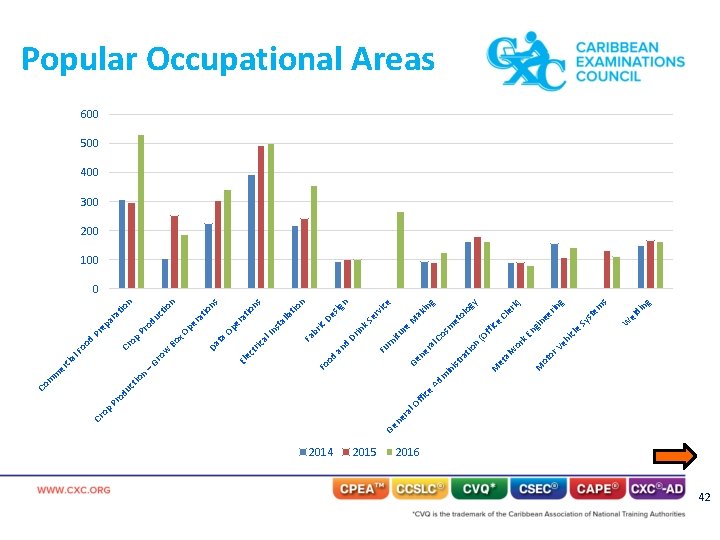
2014 2015 di ng el W g em s st rin ee in icl e Sy eh or V ot y rk ) le og ol C ce ffi or k E ng al w et M M m et in g ice rv ak M re os (O n tio ra st in i l C ra ne Ge itu rn Fu n n sig De ric in k S e Dr d an od Fo Fa b io la t al st ns io n ns io ra t pe l In ca tri El ec O ta Da pe tio uc n io ar at od P r ox O B op re p P od Cr ro w – G n dm A ffi ce tio uc od P r l O ra ne Ge op Cr l F o er cia m m Co Popular Occupational Areas 600 500 400 300 200 100 0 2016 42
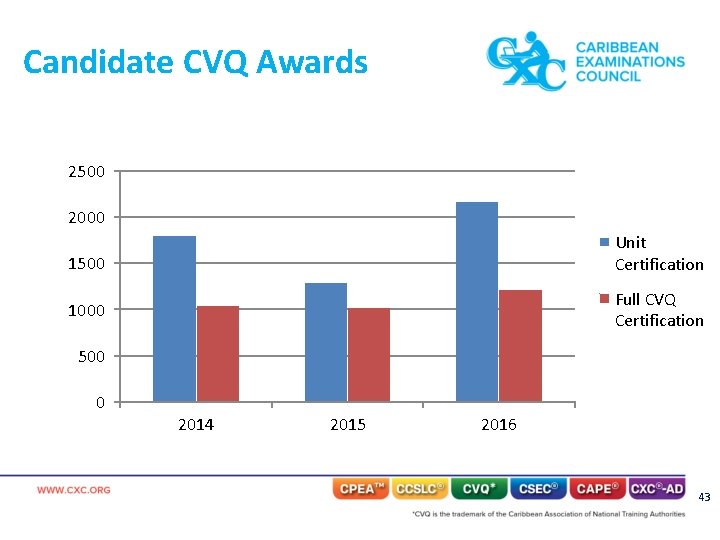
Candidate CVQ Awards 2500 2000 Unit Certification 1500 Full CVQ Certification 1000 500 0 2014 2015 2016 43
Questions and Answers 44
COPYRIGHT Caribbean Examinations Council© 2015. Copyright protected and may not be reproduced without written consent. The CXC “logo”, Caribbean Examinations Council©, Caribbean Advanced Proficiency Examination®, Caribbean Secondary Education Certificate®, Certificate of Secondary Level Competence®, Caribbean Vocational Qualification®, CXC®, CSEC®, CAPE®, CCSLC® and CVQ* are registered trade marks of the Caribbean Examinations Council. They may not only be used in accordance with established usage guidelines as outlined in the Council’s Intellectual Property Policy. The Council reserves the right to object to unfair uses, infringements, unauthorised use or other violations of its intellectual property rights. All rights reserved. No part of the material protected by this copyright may be reproduced or utilised in any form or by any means, electronic or mechanical, including photocopying, recording, or by any information storage and retrieval system, without written permission of the copyright owner. Visit our website http: //www. cxc. org 45
- Slides: 45