
Cargo Management Loading Transportation and Unloading Importance of
- Slides: 29
Cargo Management Loading, Transportation, and Unloading
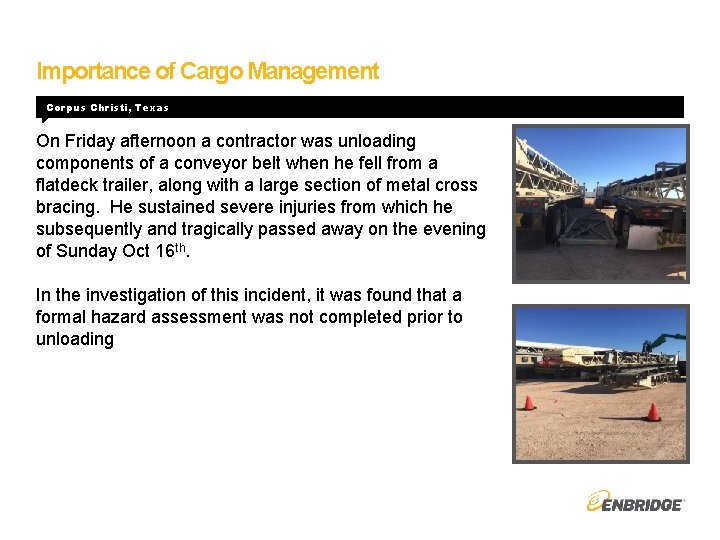
Importance of Cargo Management Corpus Christi, Texas On Friday afternoon a contractor was unloading components of a conveyor belt when he fell from a flatdeck trailer, along with a large section of metal cross bracing. He sustained severe injuries from which he subsequently and tragically passed away on the evening of Sunday Oct 16 th. In the investigation of this incident, it was found that a formal hazard assessment was not completed prior to unloading
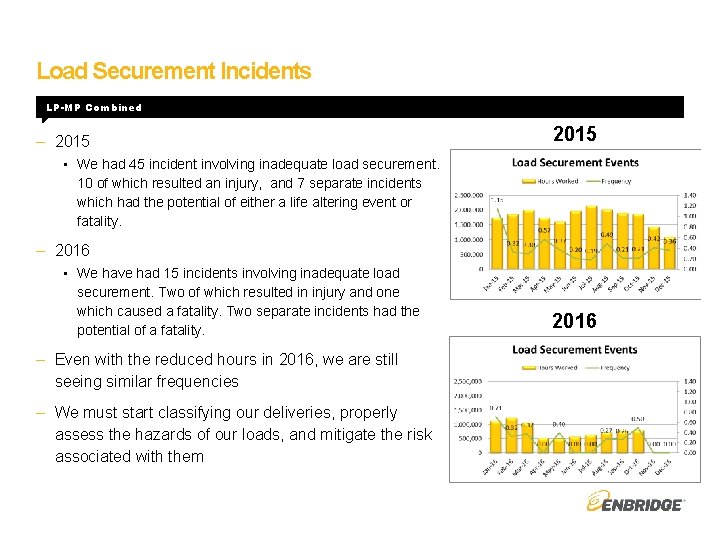
Load Securement Incidents LP-MP Combined – 2015 • We had 45 incident involving inadequate load securement. 10 of which resulted an injury, and 7 separate incidents which had the potential of either a life altering event or fatality. – 2016 • We have had 15 incidents involving inadequate load securement. Two of which resulted in injury and one which caused a fatality. Two separate incidents had the potential of a fatality. – Even with the reduced hours in 2016, we are still seeing similar frequencies – We must start classifying our deliveries, properly assess the hazards of our loads, and mitigate the risk associated with them 2016
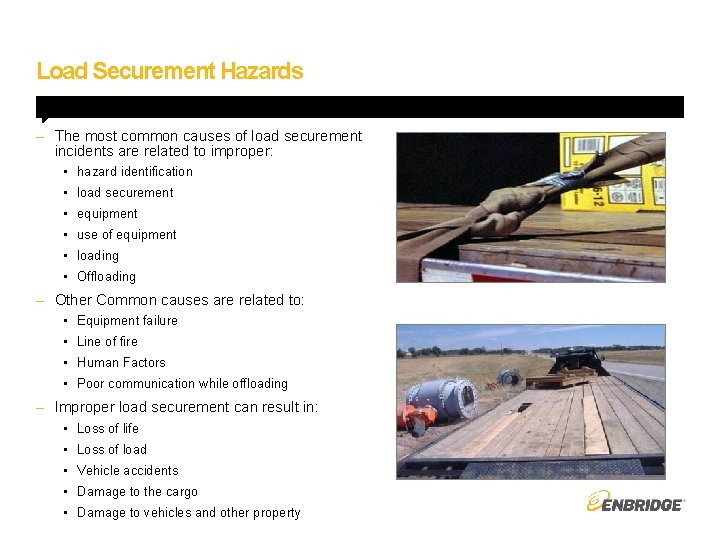
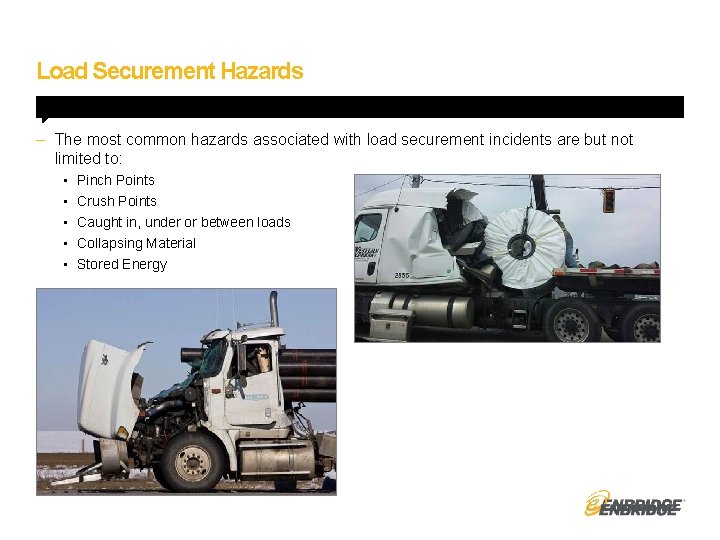
Load Securement Hazards – The most common causes of load securement incidents are related to improper: • hazard identification • load securement • equipment • use of equipment • loading • Offloading – Other Common causes are related to: • Equipment failure • Line of fire • Human Factors • Poor communication while offloading – Improper load securement can result in: • Loss of life • Loss of load • Vehicle accidents • Damage to the cargo • Damage to vehicles and other property
Load Securement Hazards – The most common hazards associated with load securement incidents are but not limited to: • • • Pinch Points Crush Points Caught in, under or between loads Collapsing Material Stored Energy
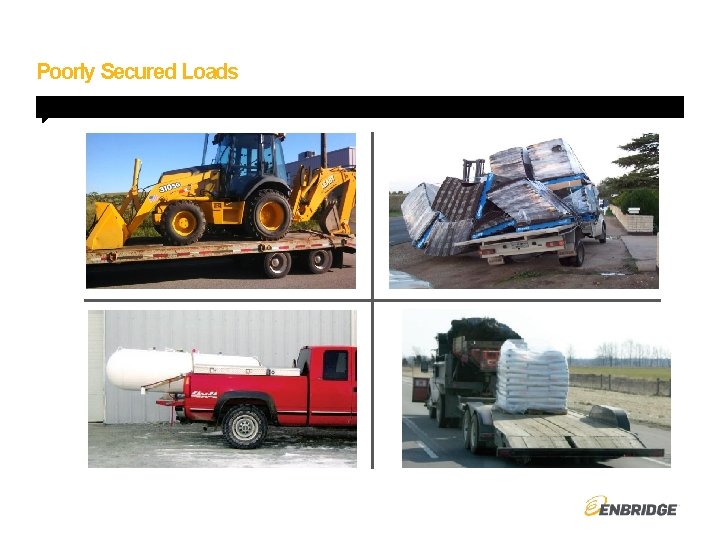
Poorly Secured Loads
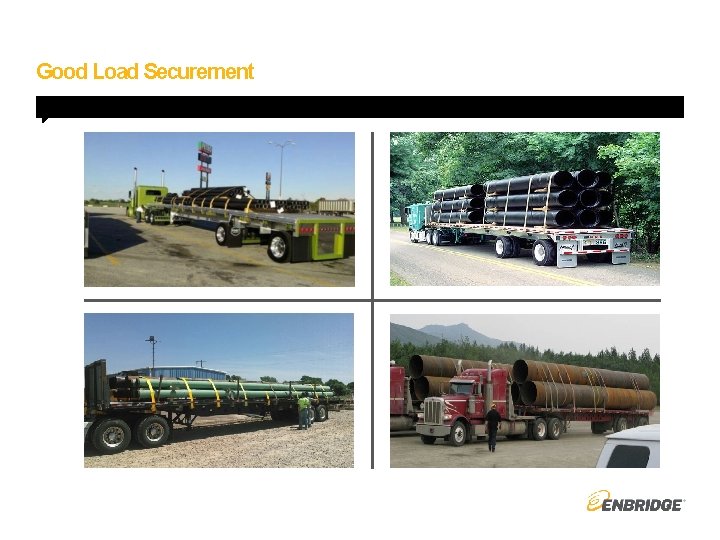
Good Load Securement
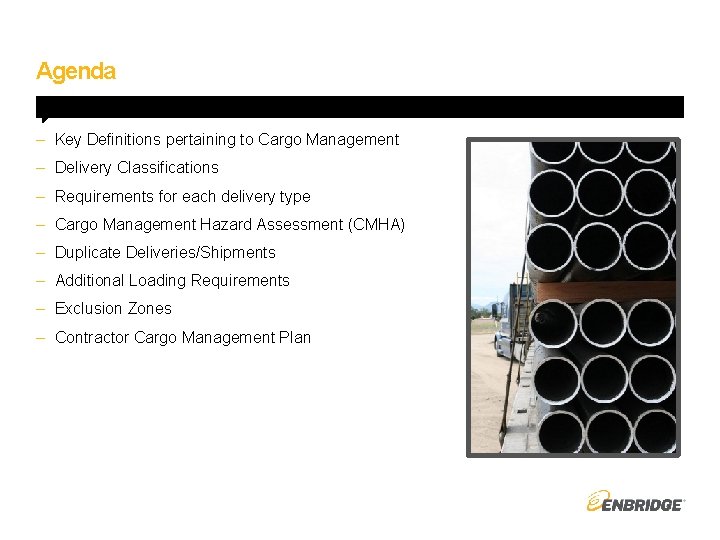
Agenda – Key Definitions pertaining to Cargo Management – Delivery Classifications – Requirements for each delivery type – Cargo Management Hazard Assessment (CMHA) – Duplicate Deliveries/Shipments – Additional Loading Requirements – Exclusion Zones – Contractor Cargo Management Plan
Key Definitions – Access Point - A primary point of entry for deliveries onto Enbridge Location. On mainline activities this will be specified in the Contractor Cargo Management Plan – Contractor Cargo Management Plan (CCMP) - A plan submitted by a prime or general contractor, and approved by Enbridge Safety, which details contractor/sub-Contractor and vendor management regarding all aspects of loading, unloading, and transporting cargo for work on Enbridge Locations. – Enbridge Location- Workplaces, facilities, terminals, stations, contractor sites and administrative and project offices in support of Enbridge – Loading/Unloading Operation - Includes all types of general freight/cargo loads that require lifting/hoisting equipment (i. e. forklift or crane) to load. Loading/Unloading Operations do not include commodities in bulk that lack structure or fixed shape (e. g. liquids, gases, sand, gravel, aggregates) that are transported in a tank, hopper, box or similar device.
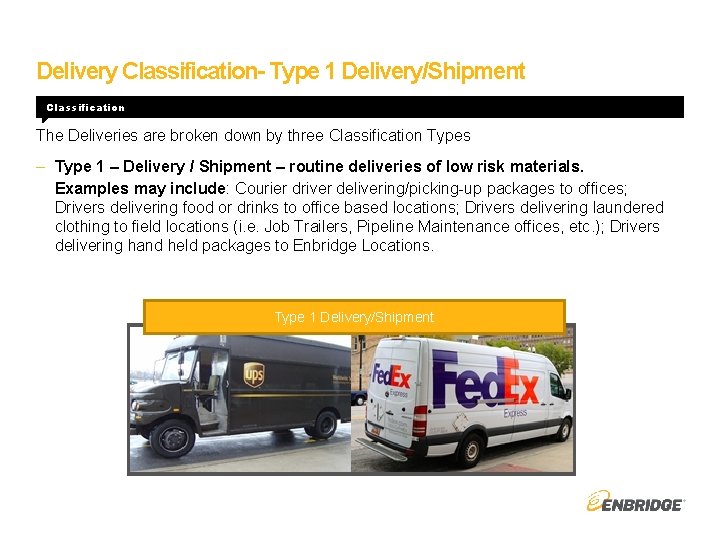
Delivery Classification- Type 1 Delivery/Shipment Classification The Deliveries are broken down by three Classification Types – Type 1 – Delivery / Shipment – routine deliveries of low risk materials. Examples may include: Courier driver delivering/picking-up packages to offices; Drivers delivering food or drinks to office based locations; Drivers delivering laundered clothing to field locations (i. e. Job Trailers, Pipeline Maintenance offices, etc. ); Drivers delivering hand held packages to Enbridge Locations. Type 1 Delivery/Shipment
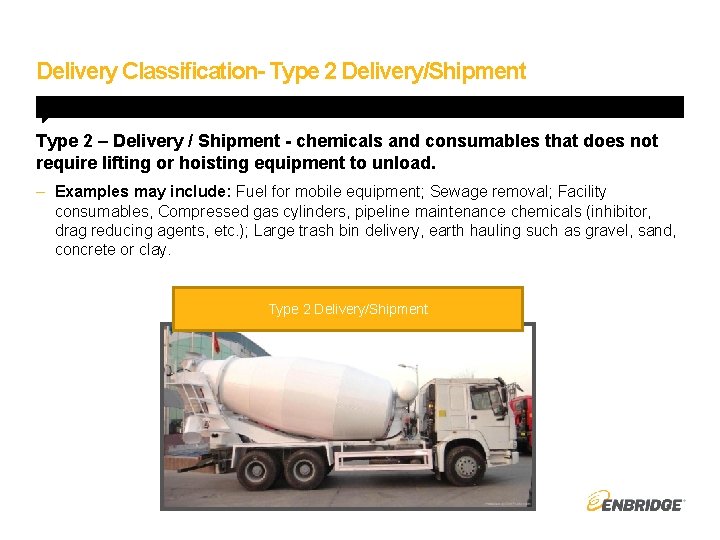
Delivery Classification- Type 2 Delivery/Shipment Type 2 – Delivery / Shipment - chemicals and consumables that does not require lifting or hoisting equipment to unload. – Examples may include: Fuel for mobile equipment; Sewage removal; Facility consumables, Compressed gas cylinders, pipeline maintenance chemicals (inhibitor, drag reducing agents, etc. ); Large trash bin delivery, earth hauling such as gravel, sand, concrete or clay. Type 2 Delivery/Shipment
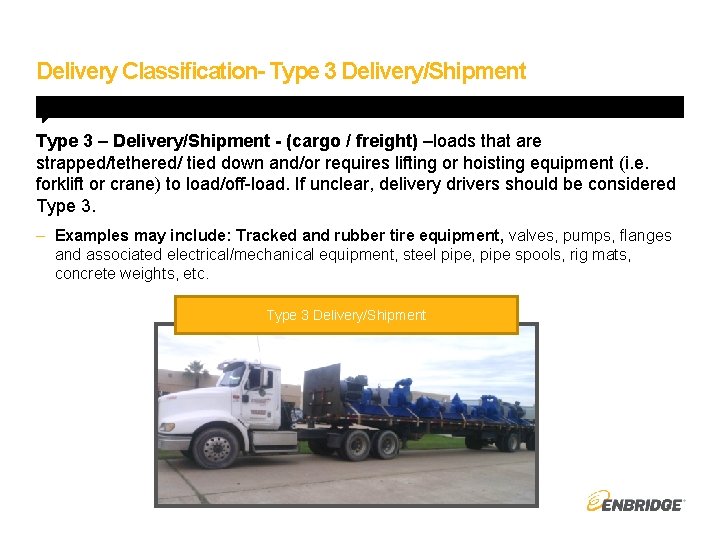
Delivery Classification- Type 3 Delivery/Shipment Type 3 – Delivery/Shipment - (cargo / freight) –loads that are strapped/tethered/ tied down and/or requires lifting or hoisting equipment (i. e. forklift or crane) to load/off-load. If unclear, delivery drivers should be considered Type 3. – Examples may include: Tracked and rubber tire equipment, valves, pumps, flanges and associated electrical/mechanical equipment, steel pipe, pipe spools, rig mats, concrete weights, etc. Type 3 Delivery/Shipment
Designating A Representative – It is the responsibility of the loading/unloading party to designate a representative to receive the delivery – If the contractor is loading/unloading then the contractor will designate a representative – If Enbridge is loading/unloading then Enbridge will designate a representative
Representative’s Responsibility – The Representative will need to: • • Meet the delivery driver at the designated Access Point Determine the delivery type (Type 1, Type 2, or Type 3) For all Deliveries that are required to come into an Enbridge Location Follow check-in requirements outlined by the Facility or Contractor Cargo Management Plan Confirm delivery Require driver to sign-in Verify personal protective equipment (supply if necessary) – Provide the driver with site specific safety information, as appropriate. This may include: • A site map outlining prescribed driving routes and pre- designated parking / off-loading locations; • A listing of key site safety rules (i. e. back-in parking, traffic routes, etc. ); and/or • Other information that may be relevant to the delivery
Check-in For All Deliveries – Delivery drivers are required to check-in at a designated Access Point – Upon arrival at the designated Access Point, the Representative will meet the delivery driver – If the delivery is required to enter the Enbridge Location, the designated representative will then meet the driver and: • • Confirm the delivery (what delivery to what location) Require the driver to sign-in Verify personal protective equipment Provide the driver with site specific safety information, as appropriate. This may include: • A site map outlining prescribed driving routes and pre- designated parking / off-loading locations; • A listing of key site safety rules (i. e. back-in parking, traffic routes, etc. ); and/or • Other information that may be relevant to the delivery
Requirements by Classification Type – TYPE 1 –DELIVERIES • Follow Check-in requirements if required to enter Enbridge Location – TYPE 2–DELIVERIES • Follow Check-in requirements • Enbridge Representative: • Issue a Safe Work Permit (as required in the LP/MP Safety Manual) – TYPE 3 – DELIVERIES • Follow Check-in requirements • Enbridge Representative: • Issue a Safe Work Permit (as required in the LP/MP Safety Manual) • Enbridge Representative or Contractor Representative must: • Complete a Cargo Management Hazard Assessment (CMHA) specific to the loading/ off-loading operation Delivery for contracted work will require a Cargo Management Hazard Assessment to be filled out by the Contractor Representative.
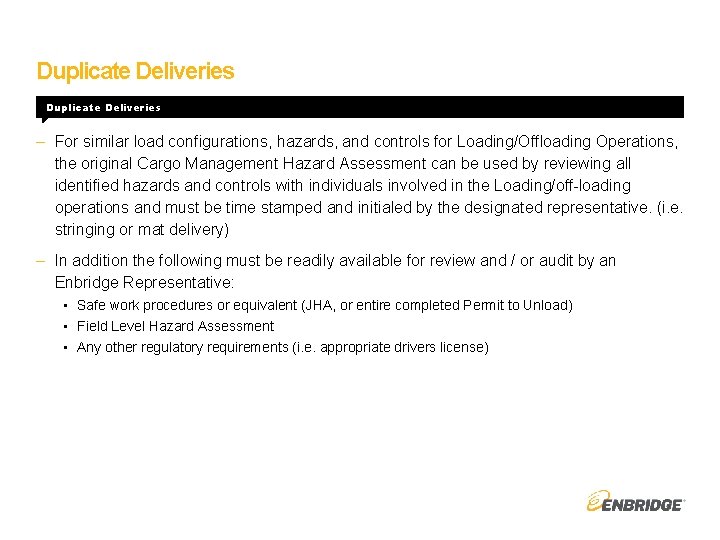
Duplicate Deliveries – For similar load configurations, hazards, and controls for Loading/Offloading Operations, the original Cargo Management Hazard Assessment can be used by reviewing all identified hazards and controls with individuals involved in the Loading/off-loading operations and must be time stamped and initialed by the designated representative. (i. e. stringing or mat delivery) – In addition the following must be readily available for review and / or audit by an Enbridge Representative: • Safe work procedures or equivalent (JHA, or entire completed Permit to Unload) • Field Level Hazard Assessment • Any other regulatory requirements (i. e. appropriate drivers license)
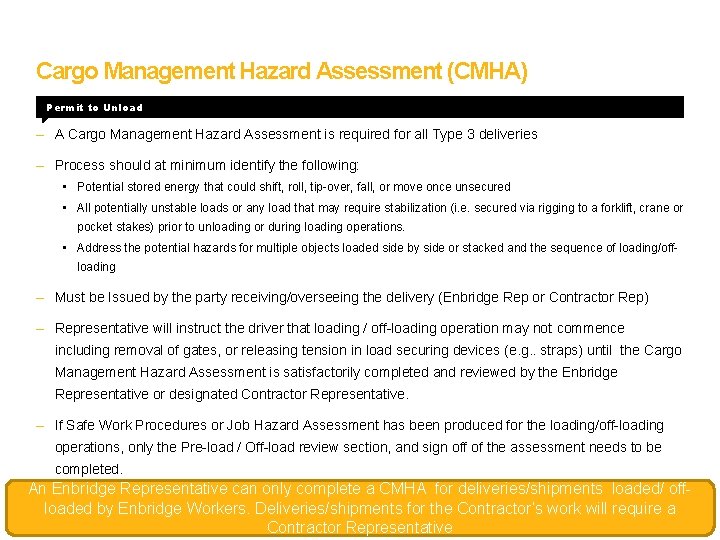
Cargo Management Hazard Assessment (CMHA) Permit to Unload – A Cargo Management Hazard Assessment is required for all Type 3 deliveries – Process should at minimum identify the following: • Potential stored energy that could shift, roll, tip-over, fall, or move once unsecured • All potentially unstable loads or any load that may require stabilization (i. e. secured via rigging to a forklift, crane or pocket stakes) prior to unloading or during loading operations. • Address the potential hazards for multiple objects loaded side by side or stacked and the sequence of loading/offloading – Must be Issued by the party receiving/overseeing the delivery (Enbridge Rep or Contractor Rep) – Representative will instruct the driver that loading / off-loading operation may not commence including removal of gates, or releasing tension in load securing devices (e. g. . straps) until the Cargo Management Hazard Assessment is satisfactorily completed and reviewed by the Enbridge Representative or designated Contractor Representative. – If Safe Work Procedures or Job Hazard Assessment has been produced for the loading/off-loading operations, only the Pre-load / Off-load review section, and sign off of the assessment needs to be completed. An Enbridge Representative can only complete a CMHA for deliveries/shipments loaded/ offloaded by Enbridge Workers. Deliveries/shipments for the Contractor’s work will require a Contractor Representative
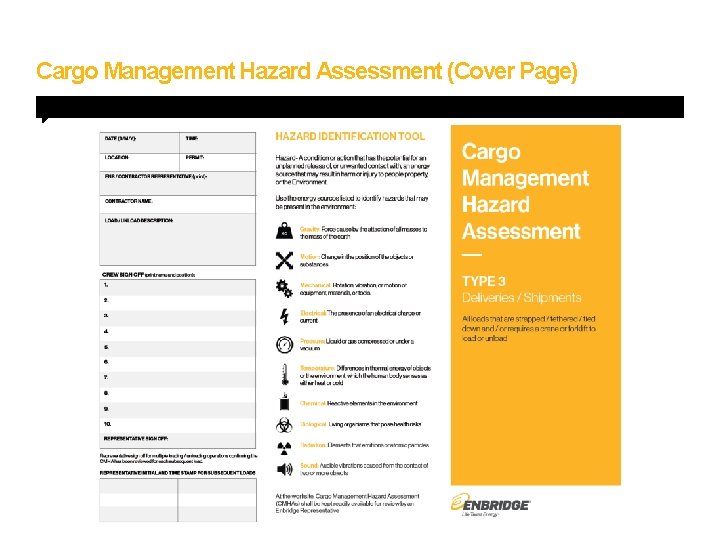
Cargo Management Hazard Assessment (Cover Page)
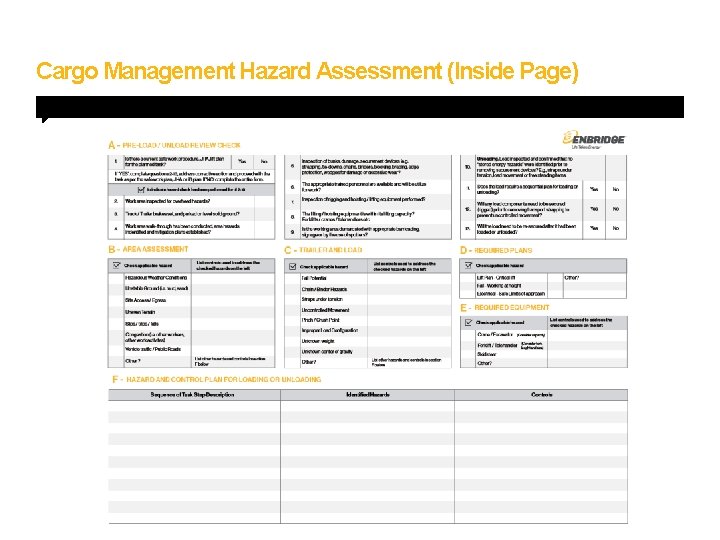
Cargo Management Hazard Assessment (Inside Page)
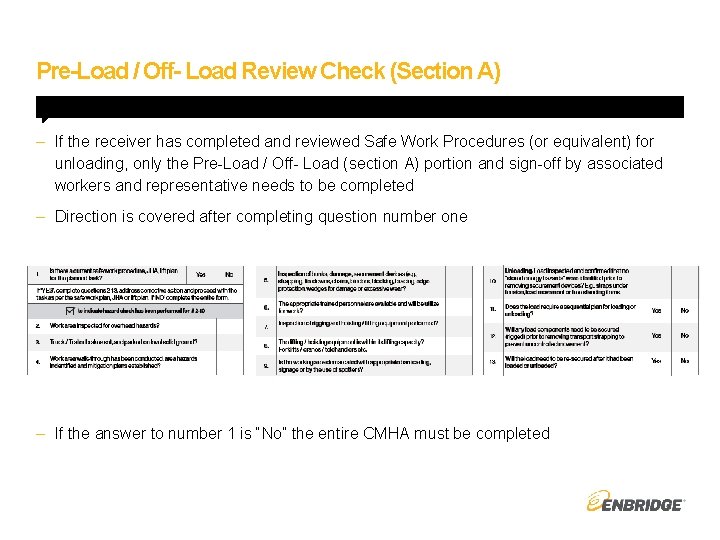
Pre-Load / Off- Load Review Check (Section A) – If the receiver has completed and reviewed Safe Work Procedures (or equivalent) for unloading, only the Pre-Load / Off- Load (section A) portion and sign-off by associated workers and representative needs to be completed – Direction is covered after completing question number one – If the answer to number 1 is “No” the entire CMHA must be completed
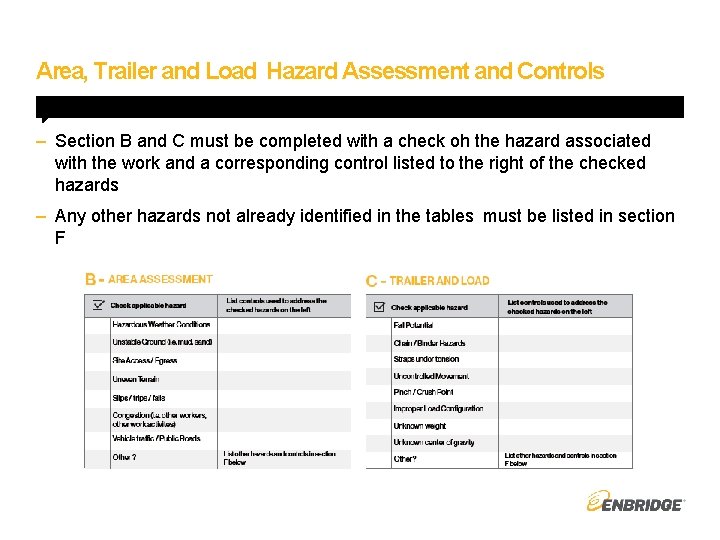
Area, Trailer and Load Hazard Assessment and Controls – Section B and C must be completed with a check oh the hazard associated with the work and a corresponding control listed to the right of the checked hazards – Any other hazards not already identified in the tables must be listed in section F
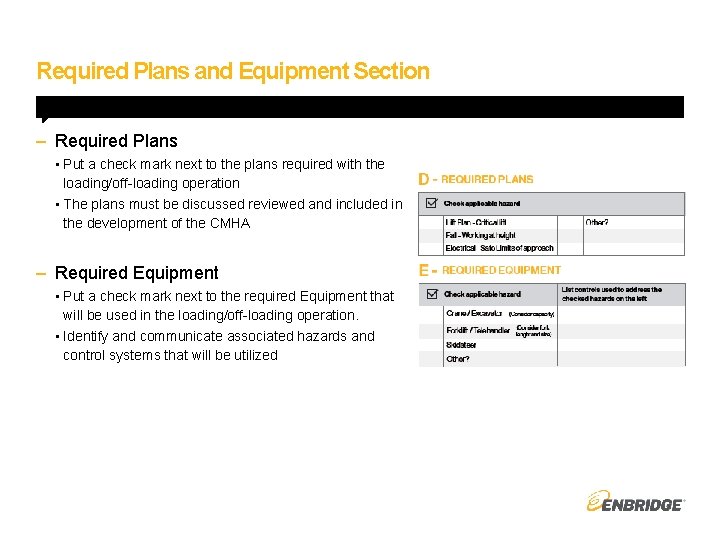
Required Plans and Equipment Section – Required Plans • Put a check mark next to the plans required with the loading/off-loading operation • The plans must be discussed reviewed and included in the development of the CMHA – Required Equipment • Put a check mark next to the required Equipment that will be used in the loading/off-loading operation. • Identify and communicate associated hazards and control systems that will be utilized
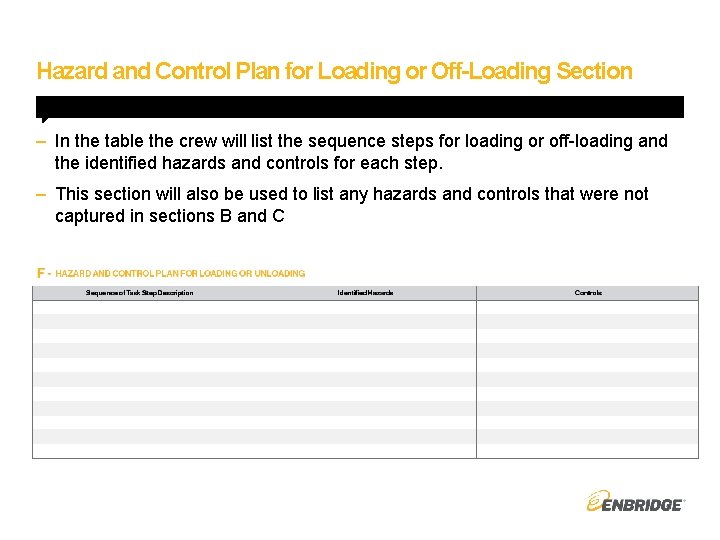
Hazard and Control Plan for Loading or Off-Loading Section – In the table the crew will list the sequence steps for loading or off-loading and the identified hazards and controls for each step. – This section will also be used to list any hazards and controls that were not captured in sections B and C
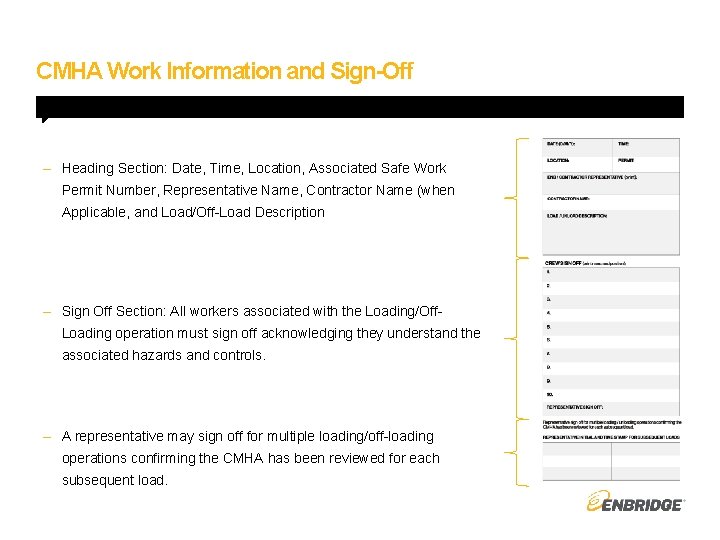
CMHA Work Information and Sign-Off – Heading Section: Date, Time, Location, Associated Safe Work Permit Number, Representative Name, Contractor Name (when Applicable, and Load/Off-Load Description – Sign Off Section: All workers associated with the Loading/Off. Loading operation must sign off acknowledging they understand the associated hazards and controls. – A representative may sign off for multiple loading/off-loading operations confirming the CMHA has been reviewed for each subsequent load.
Exclusion Zones – Loading and Unloading Operations • Pedestrian exclusion zones are to be set and demarcated through the use of hard/soft barricading or, if accepted by Enbridge Safety and Management, the use of spotters during operations. • Anyone not directly involved in the operation is not to enter these exclusion zones unless the equipment operator has signaled that it is safe to enter and the equipment operation has ceased all movement • The truck driver is to remain outside the exclusion zone in a designated location (safety zone) during the operation unless otherwise instructed by the operator. • Operators will immediately stop work if the location of the driver cannot be confirmed or any pedestrian or vehicle enters the exclusion zone without permission.
Contractor Requirements Contractor Cargo Management Plan (CCMP) – A plan must be submitted by the prime or general contractor, and approved by Enbridge Safety, which details Contractor/Sub-Contractor and vendor management regarding all aspects of loading, unloading, and transporting cargo for work on Enbridge Locations. – In this plan you will find • • • Designated Access Points Roles and Responsibilities Unloading Procedure Training Requirements Document retention procedures – Additional Type 2 Delivery Requirements • Required to check-in at a pre-determined location identified by the contractor prior to delivery or support services – Additional Type 3 Exceptions • For multiple pipe stringing trucks delivering on the same day and same location/spread, only one Cargo Management Guideline will need to be completed and reviewed with workers
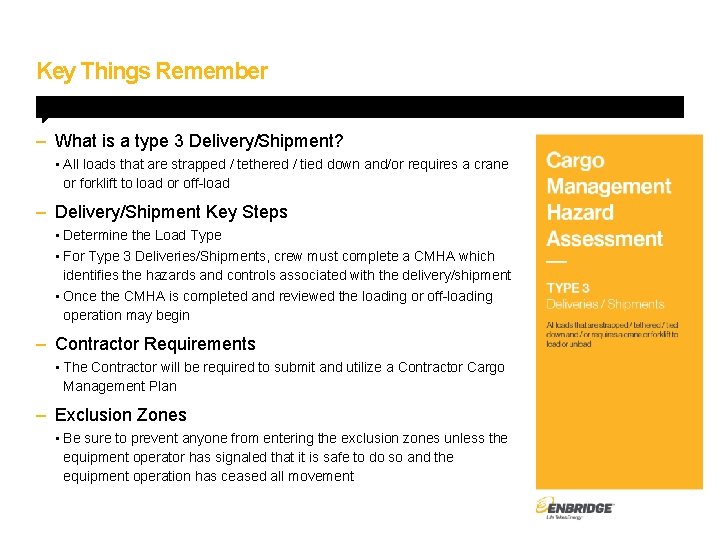
Key Things Remember – What is a type 3 Delivery/Shipment? • All loads that are strapped / tethered / tied down and/or requires a crane or forklift to load or off-load – Delivery/Shipment Key Steps • Determine the Load Type • For Type 3 Deliveries/Shipments, crew must complete a CMHA which identifies the hazards and controls associated with the delivery/shipment • Once the CMHA is completed and reviewed the loading or off-loading operation may begin – Contractor Requirements • The Contractor will be required to submit and utilize a Contractor Cargo Management Plan – Exclusion Zones • Be sure to prevent anyone from entering the exclusion zones unless the equipment operator has signaled that it is safe to do so and the equipment operation has ceased all movement
Call to Action Please ensure: – The requirements outlined in the Cargo Management Guideline are being followed – When meeting drivers upon delivery, make them aware that unloading operation may not commence, including removal of gates, or releasing tension in load securing devices, until instructed to do so – If you are loading or unloading a Type 3 Delivery / Shipment, fill out and communicate the hazards and controls documented on the completed Cargo Management Hazard Assessment – Perform regular systematic Focused Competency Assessments on Load Securement to ensure workers understand the hazards. – All Cargo Management Hazard Assessment forms are turned in as required