
CAREERS Year 10 11 Post16 pathways general information
- Slides: 2
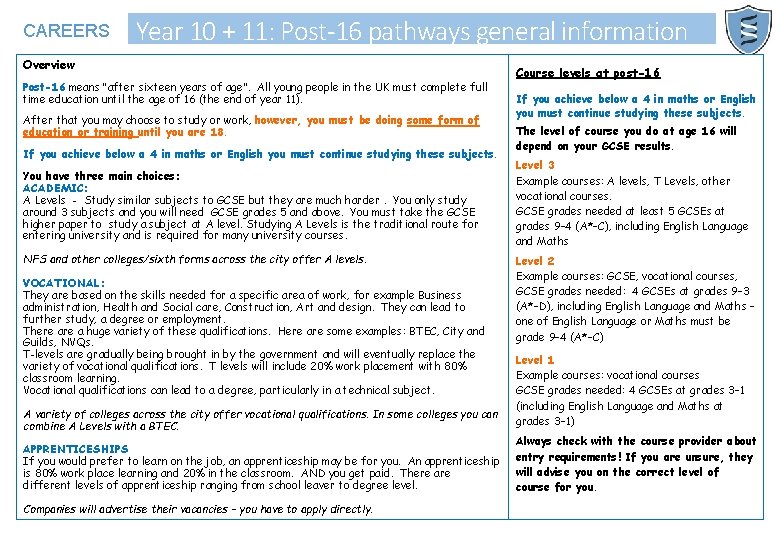
CAREERS Year 10 + 11: Post-16 pathways general information Overview Post-16 means “after sixteen years of age”. All young people in the UK must complete full time education until the age of 16 (the end of year 11). After that you may choose to study or work, however, you must be doing some form of education or training until you are 18. If you achieve below a 4 in maths or English you must continue studying these subjects. You have three main choices: ACADEMIC: A Levels - Study similar subjects to GCSE but they are much harder. You only study around 3 subjects and you will need GCSE grades 5 and above. You must take the GCSE higher paper to study a subject at A level. Studying A Levels is the traditional route for entering university and is required for many university courses. NFS and other colleges/sixth forms across the city offer A levels. VOCATIONAL: They are based on the skills needed for a specific area of work, for example Business administration, Health and Social care, Construction, Art and design. They can lead to further study, a degree or employment. There a huge variety of these qualifications. Here are some examples: BTEC, City and Guilds, NVQs. T-levels are gradually being brought in by the government and will eventually replace the variety of vocational qualifications. T levels will include 20% work placement with 80% classroom learning. Vocational qualifications can lead to a degree, particularly in a technical subject. Course levels at post-16 If you achieve below a 4 in maths or English you must continue studying these subjects. The level of course you do at age 16 will depend on your GCSE results. Level 3 Example courses: A levels, T Levels, other vocational courses. GCSE grades needed at least 5 GCSEs at grades 9– 4 (A*–C), including English Language and Maths Level 2 Example courses: GCSE, vocational courses, GCSE grades needed: 4 GCSEs at grades 9– 3 (A*–D), including English Language and Maths – one of English Language or Maths must be grade 9– 4 (A*–C) A variety of colleges across the city offer vocational qualifications. In some colleges you can combine A Levels with a BTEC. Level 1 Example courses: vocational courses GCSE grades needed: 4 GCSEs at grades 3– 1 (including English Language and Maths at grades 3– 1) APPRENTICESHIPS If you would prefer to learn on the job, an apprenticeship may be for you. An apprenticeship is 80% work place learning and 20% in the classroom. AND you get paid. There are different levels of apprenticeship ranging from school leaver to degree level. Always check with the course provider about entry requirements! If you are unsure, they will advise you on the correct level of course for you. Companies will advertise their vacancies – you have to apply directly.
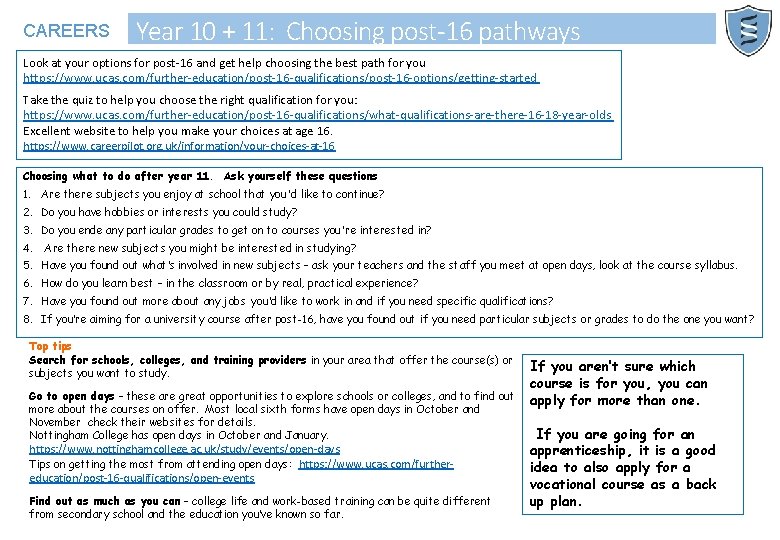
CAREERS Year 10 + 11: Choosing post-16 pathways Look at your options for post-16 and get help choosing the best path for you https: //www. ucas. com/further-education/post-16 -qualifications/post-16 -options/getting-started Take the quiz to help you choose the right qualification for you: https: //www. ucas. com/further-education/post-16 -qualifications/what-qualifications-are-there-16 -18 -year-olds Excellent website to help you make your choices at age 16. https: //www. careerpilot. org. uk/information/your-choices-at-16 Choosing what to do after year 11. Ask yourself these questions 1. Are there subjects you enjoy at school that you'd like to continue? 2. Do you have hobbies or interests you could study? 3. Do you ende any particular grades to get on to courses you're interested in? 4. Are there new subjects you might be interested in studying? 5. Have you found out what’s involved in new subjects – ask your teachers and the staff you meet at open days, look at the course syllabus. 6. How do you learn best – in the classroom or by real, practical experience? 7. Have you found out more about any jobs you’d like to work in and if you need specific qualifications? 8. If you’re aiming for a university course after post-16, have you found out if you need particular subjects or grades to do the one you want? Top tips Search for schools, colleges, and training providers in your area that offer the course(s) or subjects you want to study. Go to open days – these are great opportunities to explore schools or colleges, and to find out more about the courses on offer. Most local sixth forms have open days in October and November check their websites for details. Nottingham College has open days in October and January. https: //www. nottinghamcollege. ac. uk/study/events/open-days Tips on getting the most from attending open days: https: //www. ucas. com/furthereducation/post-16 -qualifications/open-events Find out as much as you can – college life and work-based training can be quite different from secondary school and the education you’ve known so far. If you aren’t sure which course is for you, you can apply for more than one. If you are going for an apprenticeship, it is a good idea to also apply for a vocational course as a back up plan.