
Careers with Public Services Careers with Public Services

Careers with Public Services
Careers with Public Services • • • • • Ambulance Care Assistant Armed Forces Pilot Army Serviceman/woman Emergency Care Assistant Firefighter Merchant Navy Deck Officer Merchant Navy Electro-Technical Officer Merchant Navy Engineer Officer Merchant Navy Rating Paramedic Police Community Support Officer Police Officer Prison Officer RAF Airman/Woman Royal Marines Commando Royal Marines Officer Royal Navy Rating Security Officer
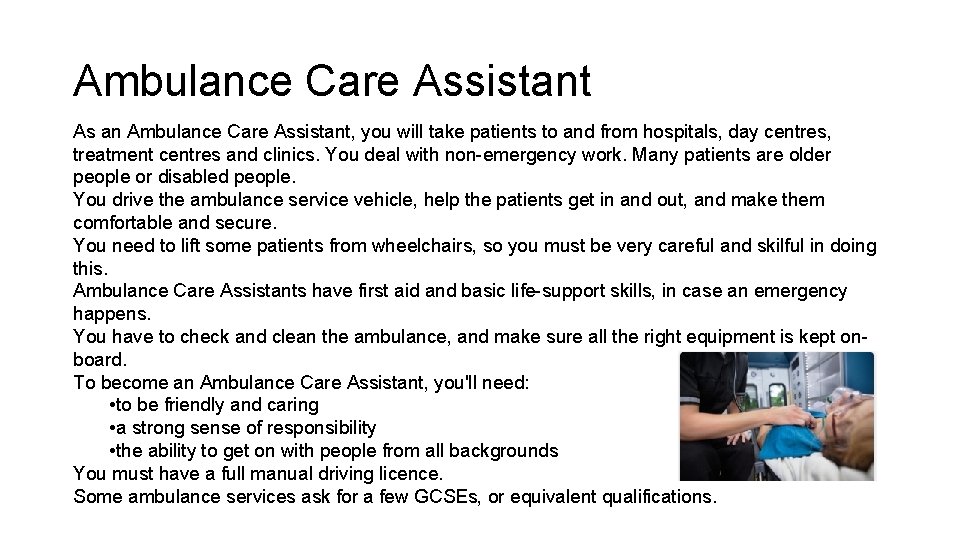
Ambulance Care Assistant As an Ambulance Care Assistant, you will take patients to and from hospitals, day centres, treatment centres and clinics. You deal with non-emergency work. Many patients are older people or disabled people. You drive the ambulance service vehicle, help the patients get in and out, and make them comfortable and secure. You need to lift some patients from wheelchairs, so you must be very careful and skilful in doing this. Ambulance Care Assistants have first aid and basic life-support skills, in case an emergency happens. You have to check and clean the ambulance, and make sure all the right equipment is kept onboard. To become an Ambulance Care Assistant, you'll need: • to be friendly and caring • a strong sense of responsibility • the ability to get on with people from all backgrounds You must have a full manual driving licence. Some ambulance services ask for a few GCSEs, or equivalent qualifications.
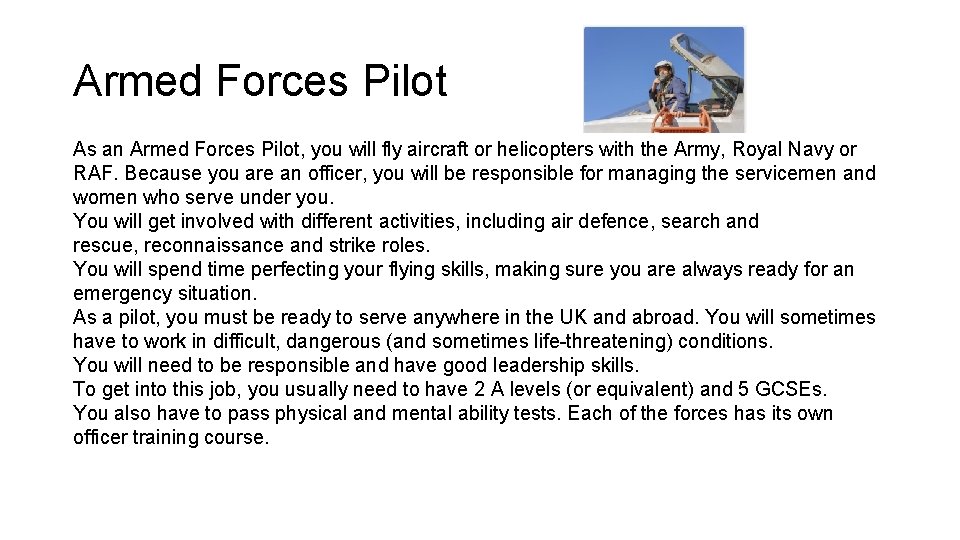
Armed Forces Pilot As an Armed Forces Pilot, you will fly aircraft or helicopters with the Army, Royal Navy or RAF. Because you are an officer, you will be responsible for managing the servicemen and women who serve under you. You will get involved with different activities, including air defence, search and rescue, reconnaissance and strike roles. You will spend time perfecting your flying skills, making sure you are always ready for an emergency situation. As a pilot, you must be ready to serve anywhere in the UK and abroad. You will sometimes have to work in difficult, dangerous (and sometimes life-threatening) conditions. You will need to be responsible and have good leadership skills. To get into this job, you usually need to have 2 A levels (or equivalent) and 5 GCSEs. You also have to pass physical and mental ability tests. Each of the forces has its own officer training course.
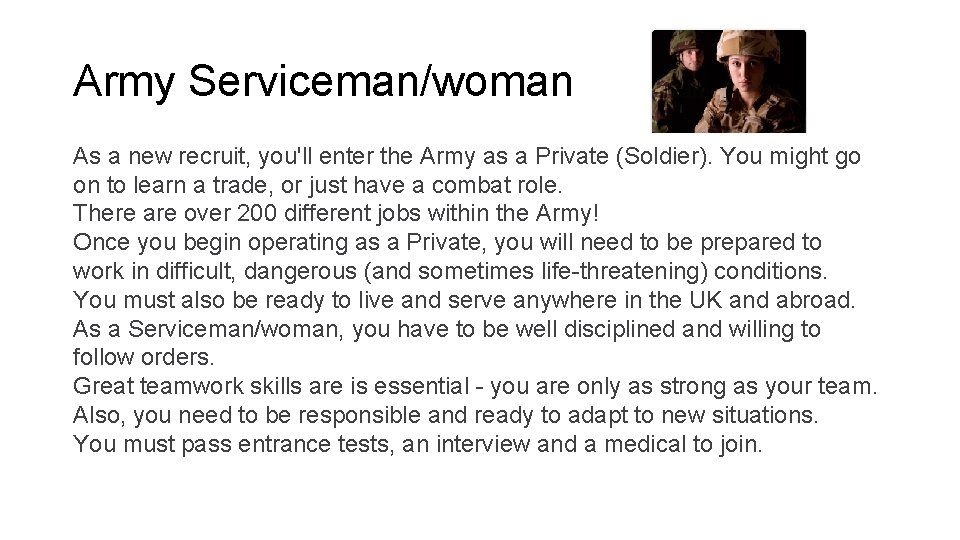
Army Serviceman/woman As a new recruit, you'll enter the Army as a Private (Soldier). You might go on to learn a trade, or just have a combat role. There are over 200 different jobs within the Army! Once you begin operating as a Private, you will need to be prepared to work in difficult, dangerous (and sometimes life-threatening) conditions. You must also be ready to live and serve anywhere in the UK and abroad. As a Serviceman/woman, you have to be well disciplined and willing to follow orders. Great teamwork skills are is essential - you are only as strong as your team. Also, you need to be responsible and ready to adapt to new situations. You must pass entrance tests, an interview and a medical to join.
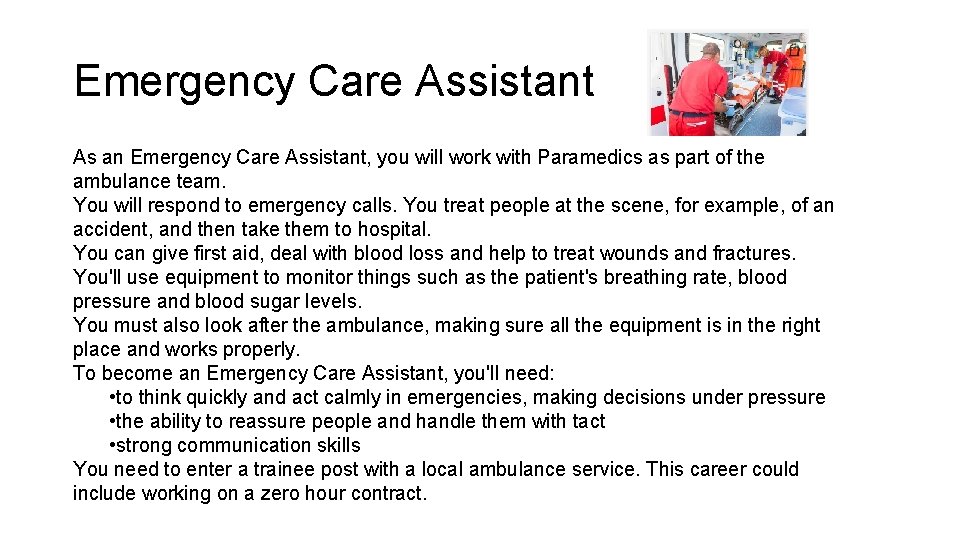
Emergency Care Assistant As an Emergency Care Assistant, you will work with Paramedics as part of the ambulance team. You will respond to emergency calls. You treat people at the scene, for example, of an accident, and then take them to hospital. You can give first aid, deal with blood loss and help to treat wounds and fractures. You'll use equipment to monitor things such as the patient's breathing rate, blood pressure and blood sugar levels. You must also look after the ambulance, making sure all the equipment is in the right place and works properly. To become an Emergency Care Assistant, you'll need: • to think quickly and act calmly in emergencies, making decisions under pressure • the ability to reassure people and handle them with tact • strong communication skills You need to enter a trainee post with a local ambulance service. This career could include working on a zero hour contract.
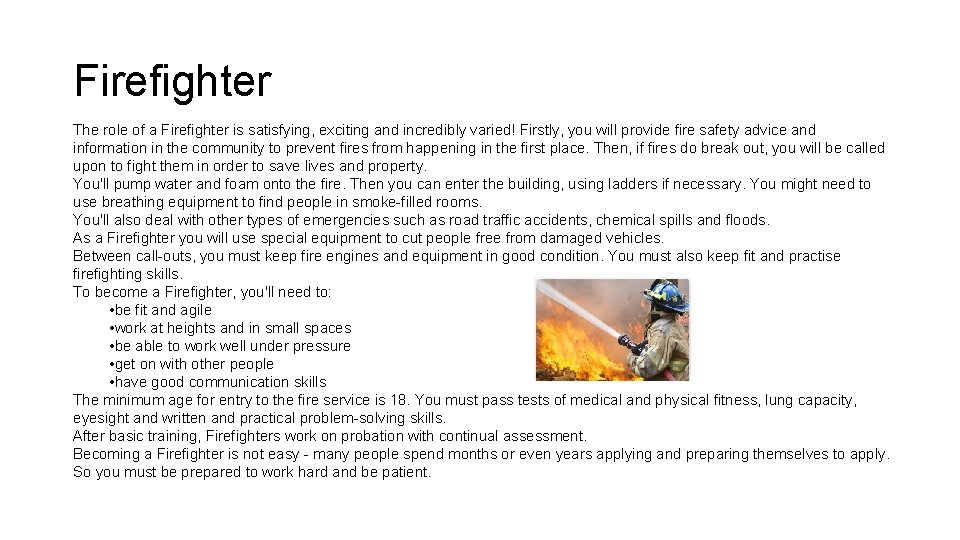
Firefighter The role of a Firefighter is satisfying, exciting and incredibly varied! Firstly, you will provide fire safety advice and information in the community to prevent fires from happening in the first place. Then, if fires do break out, you will be called upon to fight them in order to save lives and property. You'll pump water and foam onto the fire. Then you can enter the building, using ladders if necessary. You might need to use breathing equipment to find people in smoke-filled rooms. You'll also deal with other types of emergencies such as road traffic accidents, chemical spills and floods. As a Firefighter you will use special equipment to cut people free from damaged vehicles. Between call-outs, you must keep fire engines and equipment in good condition. You must also keep fit and practise firefighting skills. To become a Firefighter, you'll need to: • be fit and agile • work at heights and in small spaces • be able to work well under pressure • get on with other people • have good communication skills The minimum age for entry to the fire service is 18. You must pass tests of medical and physical fitness, lung capacity, eyesight and written and practical problem-solving skills. After basic training, Firefighters work on probation with continual assessment. Becoming a Firefighter is not easy - many people spend months or even years applying and preparing themselves to apply. So you must be prepared to work hard and be patient.
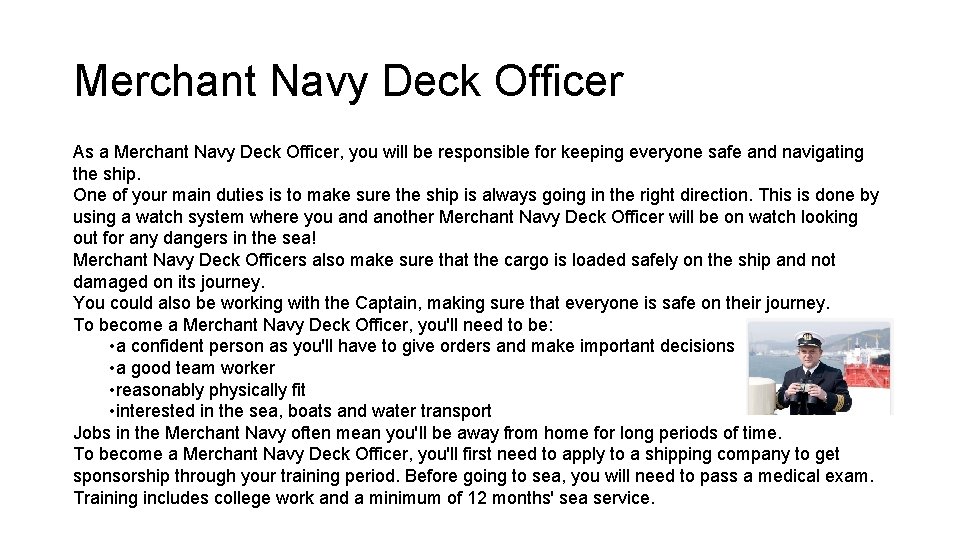
Merchant Navy Deck Officer As a Merchant Navy Deck Officer, you will be responsible for keeping everyone safe and navigating the ship. One of your main duties is to make sure the ship is always going in the right direction. This is done by using a watch system where you and another Merchant Navy Deck Officer will be on watch looking out for any dangers in the sea! Merchant Navy Deck Officers also make sure that the cargo is loaded safely on the ship and not damaged on its journey. You could also be working with the Captain, making sure that everyone is safe on their journey. To become a Merchant Navy Deck Officer, you'll need to be: • a confident person as you'll have to give orders and make important decisions • a good team worker • reasonably physically fit • interested in the sea, boats and water transport Jobs in the Merchant Navy often mean you'll be away from home for long periods of time. To become a Merchant Navy Deck Officer, you'll first need to apply to a shipping company to get sponsorship through your training period. Before going to sea, you will need to pass a medical exam. Training includes college work and a minimum of 12 months' sea service.
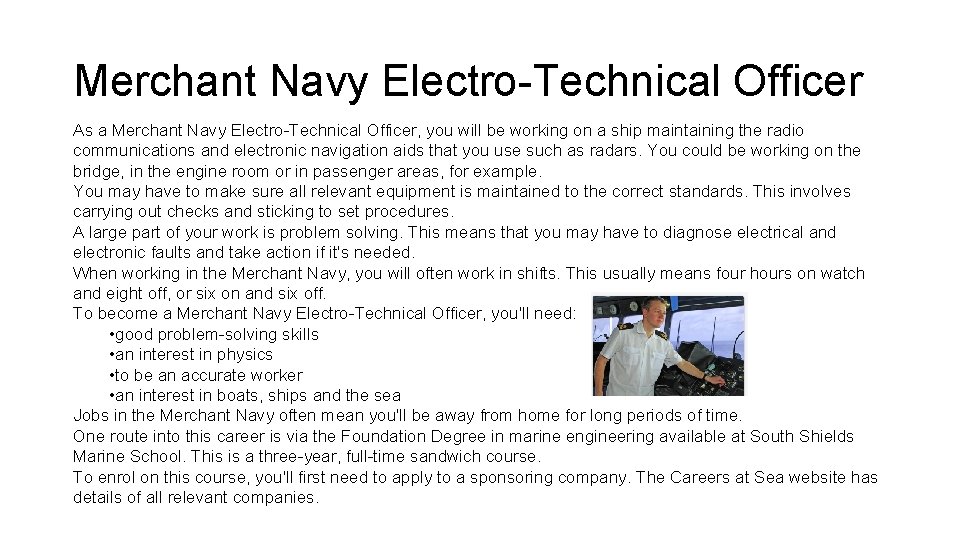
Merchant Navy Electro-Technical Officer As a Merchant Navy Electro-Technical Officer, you will be working on a ship maintaining the radio communications and electronic navigation aids that you use such as radars. You could be working on the bridge, in the engine room or in passenger areas, for example. You may have to make sure all relevant equipment is maintained to the correct standards. This involves carrying out checks and sticking to set procedures. A large part of your work is problem solving. This means that you may have to diagnose electrical and electronic faults and take action if it's needed. When working in the Merchant Navy, you will often work in shifts. This usually means four hours on watch and eight off, or six on and six off. To become a Merchant Navy Electro-Technical Officer, you'll need: • good problem-solving skills • an interest in physics • to be an accurate worker • an interest in boats, ships and the sea Jobs in the Merchant Navy often mean you'll be away from home for long periods of time. One route into this career is via the Foundation Degree in marine engineering available at South Shields Marine School. This is a three-year, full-time sandwich course. To enrol on this course, you'll first need to apply to a sponsoring company. The Careers at Sea website has details of all relevant companies.
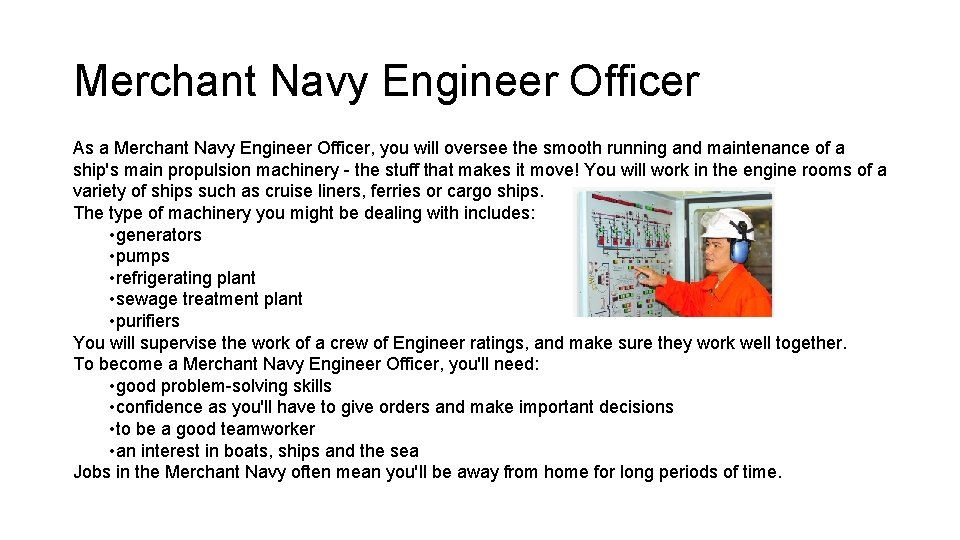
Merchant Navy Engineer Officer As a Merchant Navy Engineer Officer, you will oversee the smooth running and maintenance of a ship's main propulsion machinery - the stuff that makes it move! You will work in the engine rooms of a variety of ships such as cruise liners, ferries or cargo ships. The type of machinery you might be dealing with includes: • generators • pumps • refrigerating plant • sewage treatment plant • purifiers You will supervise the work of a crew of Engineer ratings, and make sure they work well together. To become a Merchant Navy Engineer Officer, you'll need: • good problem-solving skills • confidence as you'll have to give orders and make important decisions • to be a good teamworker • an interest in boats, ships and the sea Jobs in the Merchant Navy often mean you'll be away from home for long periods of time.
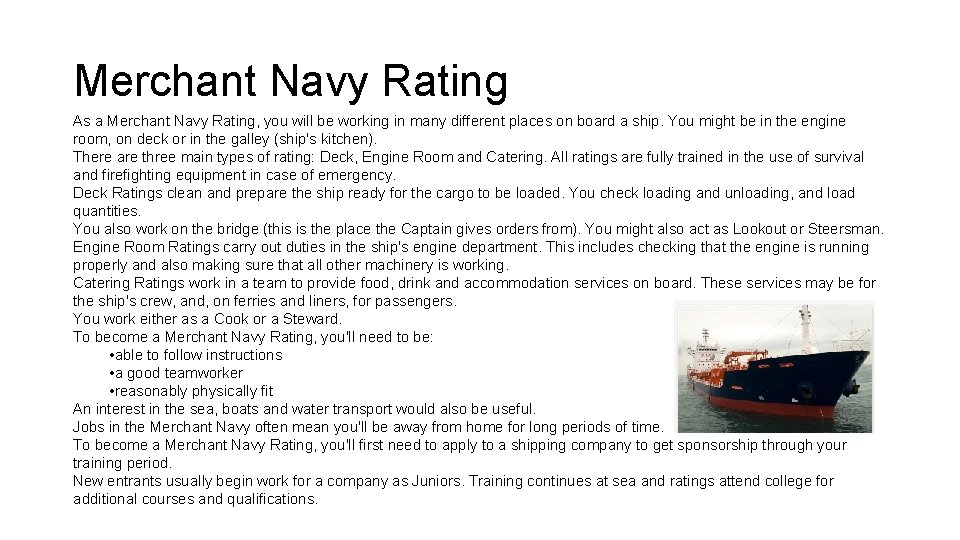
Merchant Navy Rating As a Merchant Navy Rating, you will be working in many different places on board a ship. You might be in the engine room, on deck or in the galley (ship's kitchen). There are three main types of rating: Deck, Engine Room and Catering. All ratings are fully trained in the use of survival and firefighting equipment in case of emergency. Deck Ratings clean and prepare the ship ready for the cargo to be loaded. You check loading and unloading, and load quantities. You also work on the bridge (this is the place the Captain gives orders from). You might also act as Lookout or Steersman. Engine Room Ratings carry out duties in the ship's engine department. This includes checking that the engine is running properly and also making sure that all other machinery is working. Catering Ratings work in a team to provide food, drink and accommodation services on board. These services may be for the ship's crew, and, on ferries and liners, for passengers. You work either as a Cook or a Steward. To become a Merchant Navy Rating, you'll need to be: • able to follow instructions • a good teamworker • reasonably physically fit An interest in the sea, boats and water transport would also be useful. Jobs in the Merchant Navy often mean you'll be away from home for long periods of time. To become a Merchant Navy Rating, you'll first need to apply to a shipping company to get sponsorship through your training period. New entrants usually begin work for a company as Juniors. Training continues at sea and ratings attend college for additional courses and qualifications.
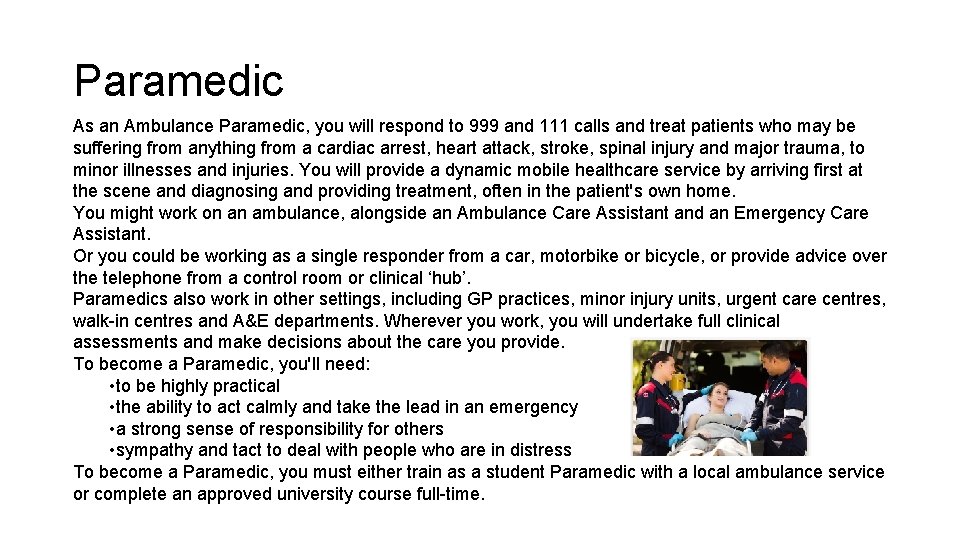
Paramedic As an Ambulance Paramedic, you will respond to 999 and 111 calls and treat patients who may be suffering from anything from a cardiac arrest, heart attack, stroke, spinal injury and major trauma, to minor illnesses and injuries. You will provide a dynamic mobile healthcare service by arriving first at the scene and diagnosing and providing treatment, often in the patient's own home. You might work on an ambulance, alongside an Ambulance Care Assistant and an Emergency Care Assistant. Or you could be working as a single responder from a car, motorbike or bicycle, or provide advice over the telephone from a control room or clinical ‘hub’. Paramedics also work in other settings, including GP practices, minor injury units, urgent care centres, walk-in centres and A&E departments. Wherever you work, you will undertake full clinical assessments and make decisions about the care you provide. To become a Paramedic, you'll need: • to be highly practical • the ability to act calmly and take the lead in an emergency • a strong sense of responsibility for others • sympathy and tact to deal with people who are in distress To become a Paramedic, you must either train as a student Paramedic with a local ambulance service or complete an approved university course full-time.
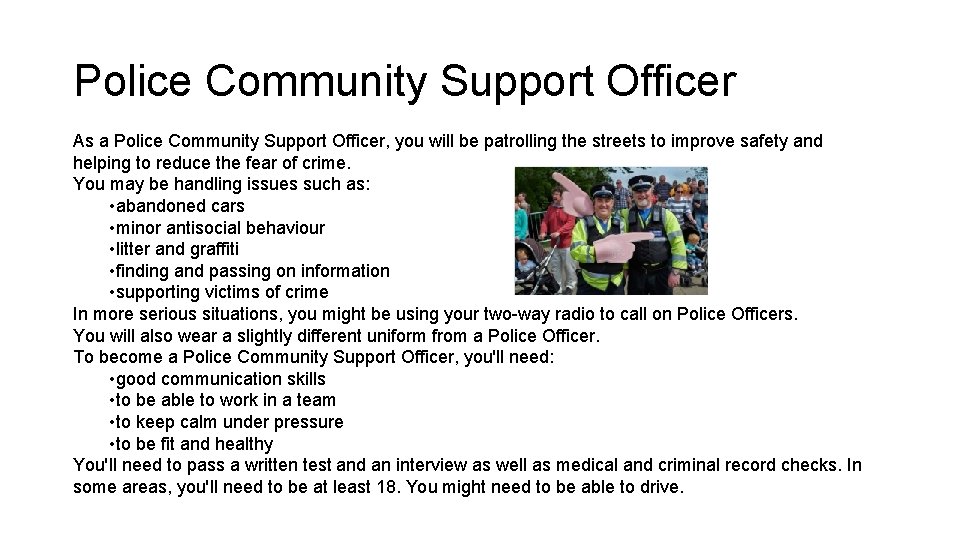
Police Community Support Officer As a Police Community Support Officer, you will be patrolling the streets to improve safety and helping to reduce the fear of crime. You may be handling issues such as: • abandoned cars • minor antisocial behaviour • litter and graffiti • finding and passing on information • supporting victims of crime In more serious situations, you might be using your two-way radio to call on Police Officers. You will also wear a slightly different uniform from a Police Officer. To become a Police Community Support Officer, you'll need: • good communication skills • to be able to work in a team • to keep calm under pressure • to be fit and healthy You'll need to pass a written test and an interview as well as medical and criminal record checks. In some areas, you'll need to be at least 18. You might need to be able to drive.
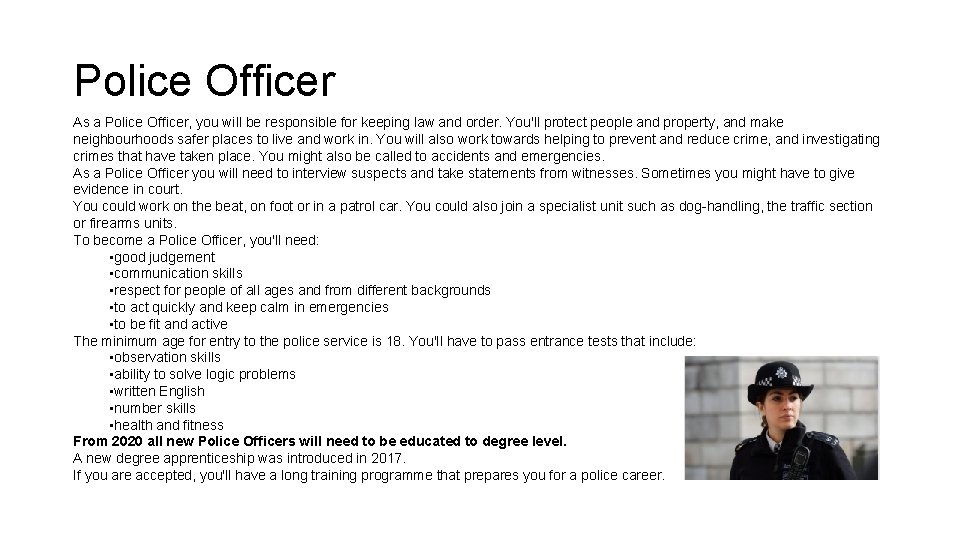
Police Officer As a Police Officer, you will be responsible for keeping law and order. You'll protect people and property, and make neighbourhoods safer places to live and work in. You will also work towards helping to prevent and reduce crime, and investigating crimes that have taken place. You might also be called to accidents and emergencies. As a Police Officer you will need to interview suspects and take statements from witnesses. Sometimes you might have to give evidence in court. You could work on the beat, on foot or in a patrol car. You could also join a specialist unit such as dog-handling, the traffic section or firearms units. To become a Police Officer, you'll need: • good judgement • communication skills • respect for people of all ages and from different backgrounds • to act quickly and keep calm in emergencies • to be fit and active The minimum age for entry to the police service is 18. You'll have to pass entrance tests that include: • observation skills • ability to solve logic problems • written English • number skills • health and fitness From 2020 all new Police Officers will need to be educated to degree level. A new degree apprenticeship was introduced in 2017. If you are accepted, you'll have a long training programme that prepares you for a police career.
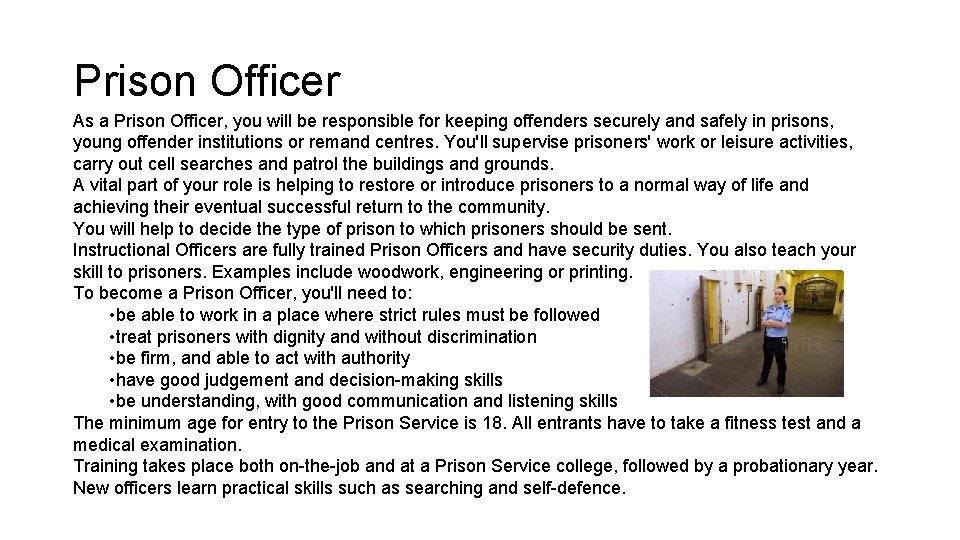
Prison Officer As a Prison Officer, you will be responsible for keeping offenders securely and safely in prisons, young offender institutions or remand centres. You'll supervise prisoners' work or leisure activities, carry out cell searches and patrol the buildings and grounds. A vital part of your role is helping to restore or introduce prisoners to a normal way of life and achieving their eventual successful return to the community. You will help to decide the type of prison to which prisoners should be sent. Instructional Officers are fully trained Prison Officers and have security duties. You also teach your skill to prisoners. Examples include woodwork, engineering or printing. To become a Prison Officer, you'll need to: • be able to work in a place where strict rules must be followed • treat prisoners with dignity and without discrimination • be firm, and able to act with authority • have good judgement and decision-making skills • be understanding, with good communication and listening skills The minimum age for entry to the Prison Service is 18. All entrants have to take a fitness test and a medical examination. Training takes place both on-the-job and at a Prison Service college, followed by a probationary year. New officers learn practical skills such as searching and self-defence.
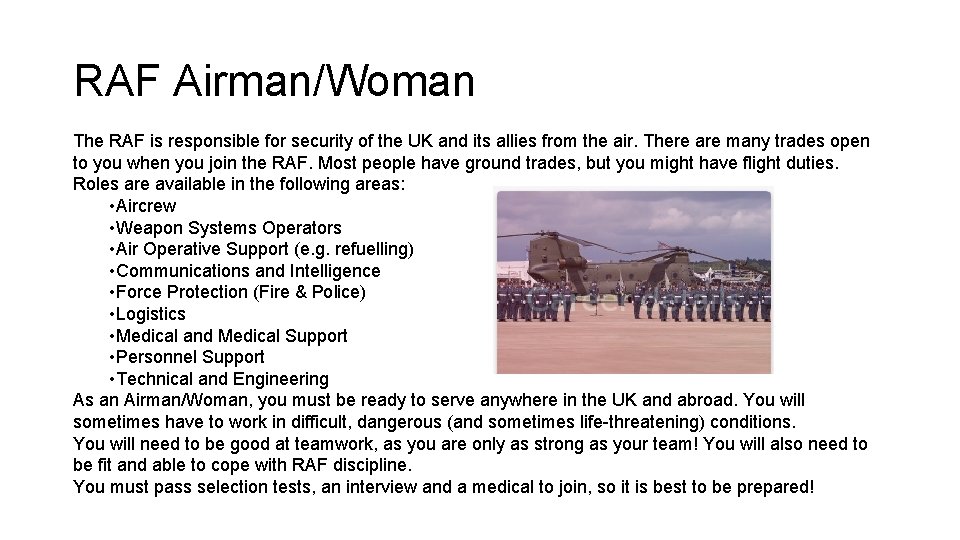
RAF Airman/Woman The RAF is responsible for security of the UK and its allies from the air. There are many trades open to you when you join the RAF. Most people have ground trades, but you might have flight duties. Roles are available in the following areas: • Aircrew • Weapon Systems Operators • Air Operative Support (e. g. refuelling) • Communications and Intelligence • Force Protection (Fire & Police) • Logistics • Medical and Medical Support • Personnel Support • Technical and Engineering As an Airman/Woman, you must be ready to serve anywhere in the UK and abroad. You will sometimes have to work in difficult, dangerous (and sometimes life-threatening) conditions. You will need to be good at teamwork, as you are only as strong as your team! You will also need to be fit and able to cope with RAF discipline. You must pass selection tests, an interview and a medical to join, so it is best to be prepared!
Royal Marines Commando When you join the Royal Marine Commandos you join the Royal Navy’s elite amphibious (landing from the sea) force! Royal Marines Commandos are a fighting force, and are part of the Royal Navy. You will work at sea, in the air and on land; anywhere from the Arctic to tropical jungles! As a Marine, you will be trained to land secure your position on every type of coastline. Most likely, you will start as a General Duty Marine, before going on to train in one of the many specialist positions available. Once you've got your green beret, then you will have 27 specialist roles to choose from! The Royal Marines are after, 'People with who push through when things get tough. Who never lose sight of the mission – no matter what they’re faced with. People who thrive on adrenaline and know the value of teamwork' (www. royalnavy. mod. uk/careers/role-finder/roles/royalmarinescommando) Could this be you?
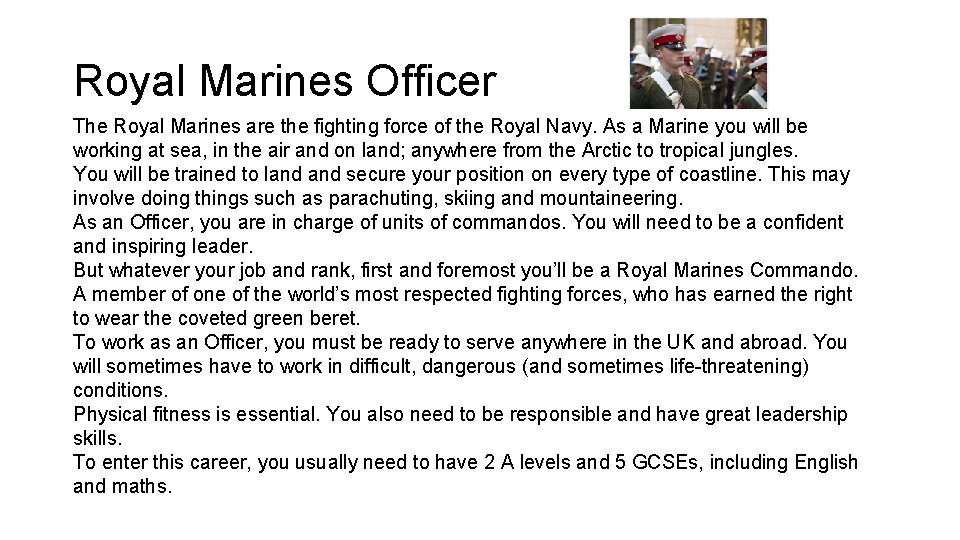
Royal Marines Officer The Royal Marines are the fighting force of the Royal Navy. As a Marine you will be working at sea, in the air and on land; anywhere from the Arctic to tropical jungles. You will be trained to land secure your position on every type of coastline. This may involve doing things such as parachuting, skiing and mountaineering. As an Officer, you are in charge of units of commandos. You will need to be a confident and inspiring leader. But whatever your job and rank, first and foremost you’ll be a Royal Marines Commando. A member of one of the world’s most respected fighting forces, who has earned the right to wear the coveted green beret. To work as an Officer, you must be ready to serve anywhere in the UK and abroad. You will sometimes have to work in difficult, dangerous (and sometimes life-threatening) conditions. Physical fitness is essential. You also need to be responsible and have great leadership skills. To enter this career, you usually need to have 2 A levels and 5 GCSEs, including English and maths.
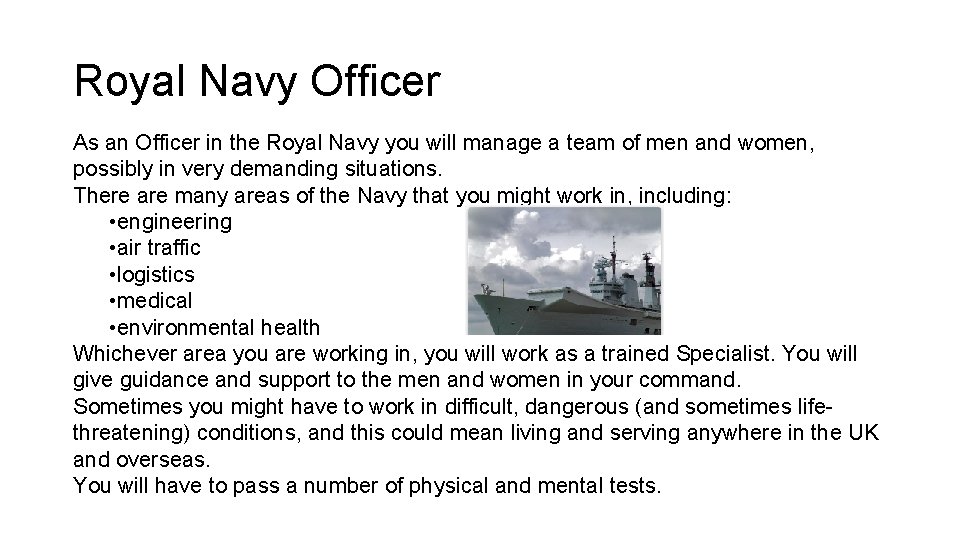
Royal Navy Officer As an Officer in the Royal Navy you will manage a team of men and women, possibly in very demanding situations. There are many areas of the Navy that you might work in, including: • engineering • air traffic • logistics • medical • environmental health Whichever area you are working in, you will work as a trained Specialist. You will give guidance and support to the men and women in your command. Sometimes you might have to work in difficult, dangerous (and sometimes lifethreatening) conditions, and this could mean living and serving anywhere in the UK and overseas. You will have to pass a number of physical and mental tests.
Royal Navy Ratings are the servicemen and women of the Navy. You'll work in different trades on ships and submarines, and onshore. Jobs include Engineer, Chef, Accountant, Medical Assistant and Communications Expert. Sometimes living conditions on ships and submarines can be cramped, and so you will need to be able to get on with people and your job in this situation. You may also have to work in difficult, dangerous (and sometimes lifethreatening) conditions. As a Royal Navy Rating, you need to be prepared to live and serve anywhere in the UK and overseas. You will need to be good at teamwork. You will also need to be fit and ready to accept Navy discipline. You must pass a selection test, an interview and a medical to join.
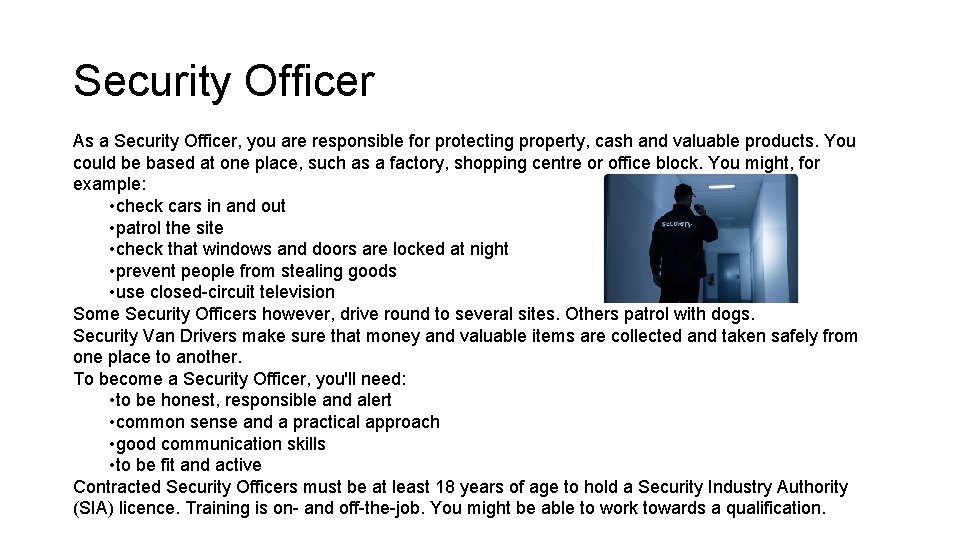
Security Officer As a Security Officer, you are responsible for protecting property, cash and valuable products. You could be based at one place, such as a factory, shopping centre or office block. You might, for example: • check cars in and out • patrol the site • check that windows and doors are locked at night • prevent people from stealing goods • use closed-circuit television Some Security Officers however, drive round to several sites. Others patrol with dogs. Security Van Drivers make sure that money and valuable items are collected and taken safely from one place to another. To become a Security Officer, you'll need: • to be honest, responsible and alert • common sense and a practical approach • good communication skills • to be fit and active Contracted Security Officers must be at least 18 years of age to hold a Security Industry Authority (SIA) licence. Training is on- and off-the-job. You might be able to work towards a qualification.
- Slides: 21