
Career Theory Review Parsons Holland Trait and Factor

- Slides: 36
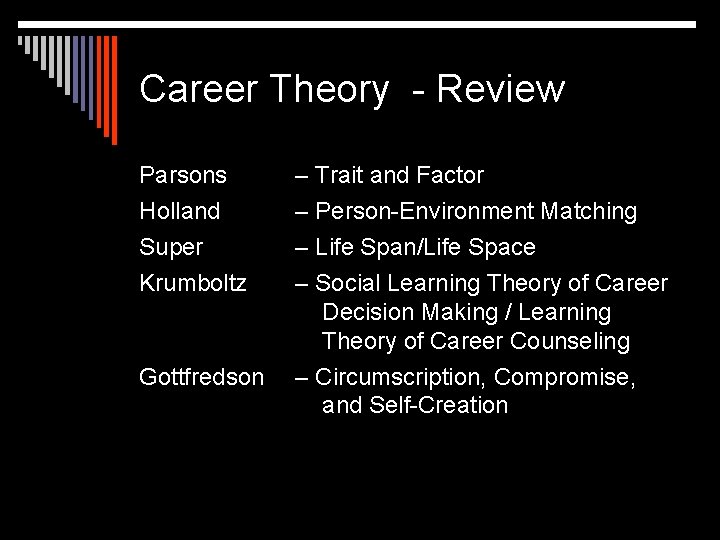
Career Theory - Review Parsons Holland – Trait and Factor – Person-Environment Matching Super Krumboltz – Life Span/Life Space – Social Learning Theory of Career Decision Making / Learning Theory of Career Counseling – Circumscription, Compromise, and Self-Creation Gottfredson
Trait and Factor (Frank Parsons) o “Matching men to jobs o Identify individual’s traits o Know workplace factors o Match individual to the ONE right job
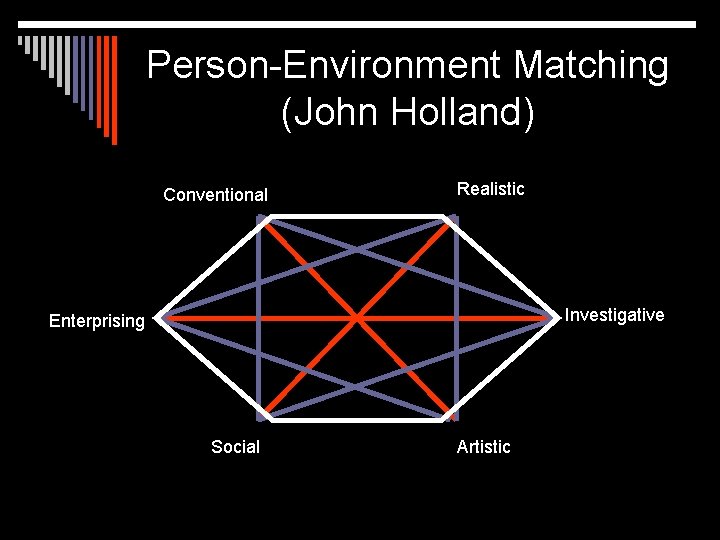
Person-Environment Matching (John Holland) o Individuals express their personalities through their vocational interests o Individuals seek out work environments in which they can fully utilize their skills and abilities and express their attitudes and values o Individuals and work environments can be classified respectively by their personalities and personality requirements into 1 or some combination of 6 categories
Person-Environment Matching (John Holland) Conventional Realistic Investigative Enterprising Social Artistic
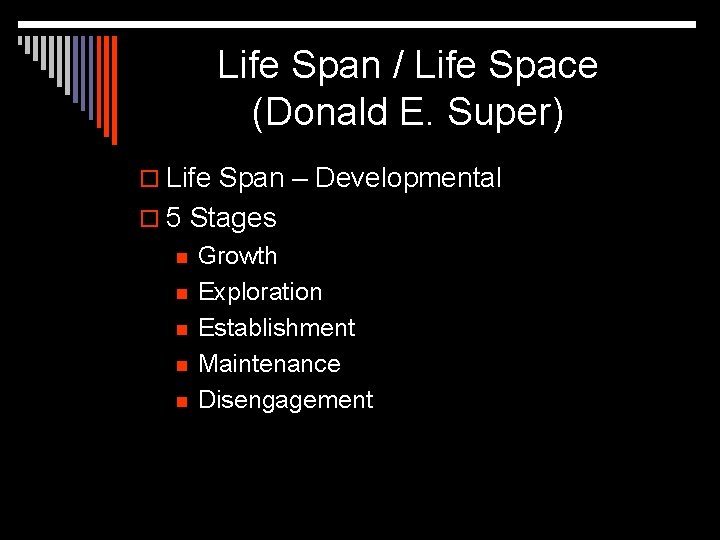
Life Span / Life Space (Donald E. Super) o Life Span – Developmental o 5 Stages n n n Growth Exploration Establishment Maintenance Disengagement
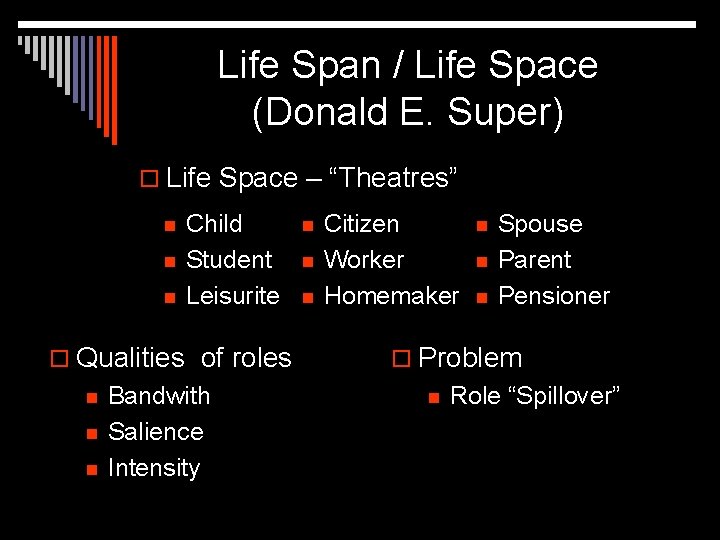
Life Span / Life Space (Donald E. Super) o Life Space – “Theatres” n n n Child Student Leisurite o Qualities of roles n n n Bandwith Salience Intensity n n n Citizen Worker Homemaker n n n Spouse Parent Pensioner o Problem n Role “Spillover”
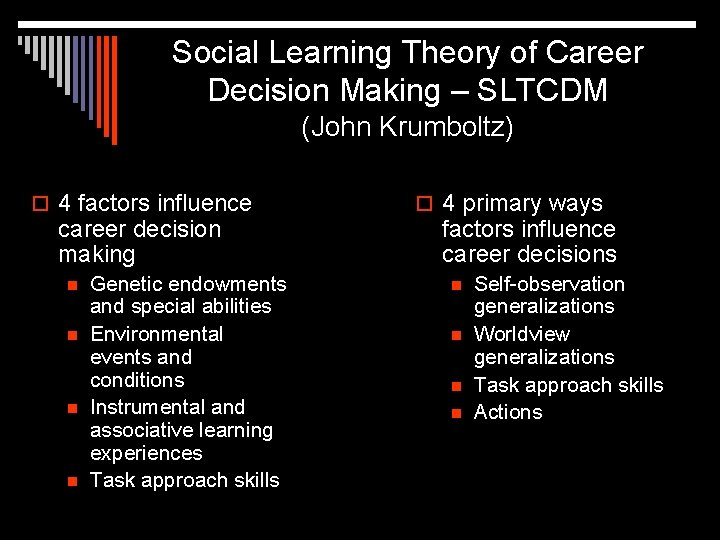
Social Learning Theory of Career Decision Making – SLTCDM (John Krumboltz) o 4 factors influence career decision making n n Genetic endowments and special abilities Environmental events and conditions Instrumental and associative learning experiences Task approach skills o 4 primary ways factors influence career decisions n n Self-observation generalizations Worldview generalizations Task approach skills Actions
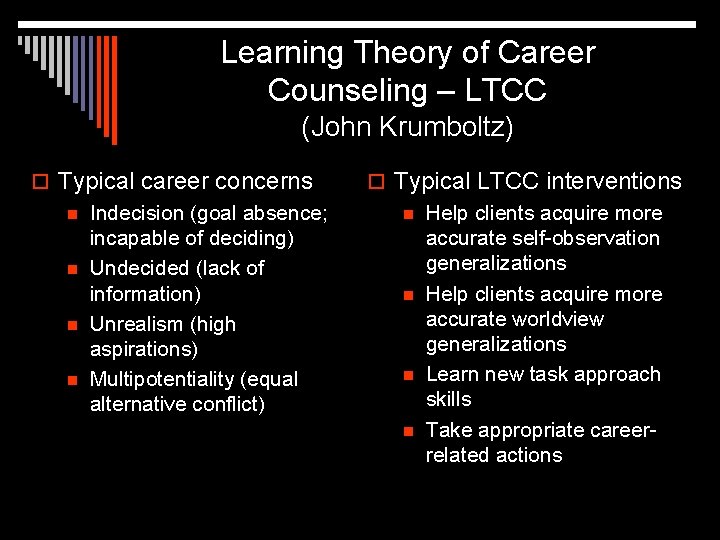
Learning Theory of Career Counseling – LTCC (John Krumboltz) o Typical career concerns n Indecision (goal absence; incapable of deciding) n Undecided (lack of information) n Unrealism (high aspirations) n Multipotentiality (equal alternative conflict) o Typical LTCC interventions n Help clients acquire more accurate self-observation generalizations n Help clients acquire more accurate worldview generalizations n Learn new task approach skills n Take appropriate careerrelated actions
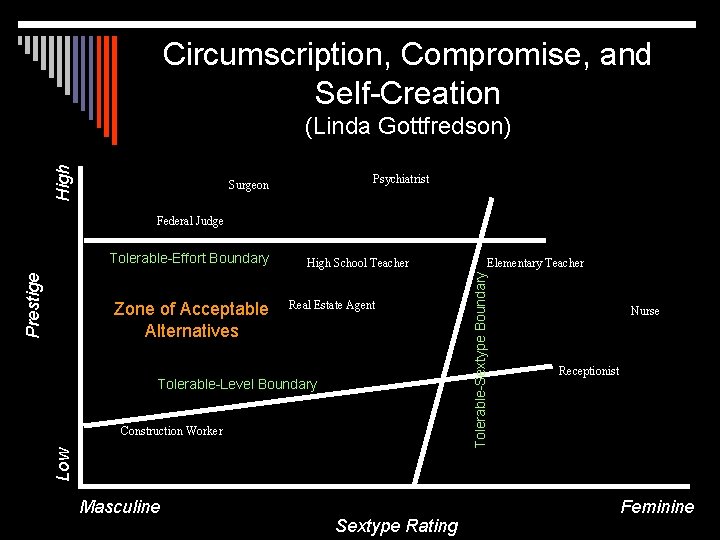
Circumscription, Compromise, and Self-Creation (Linda Gottfredson) o Circumscription – Process of eliminating unacceptable occupational alternatives based primarily upon gender and prestige o Guided by 5 principles n n n Children capable of understanding and organizing complex information Occupational preferences reflect attempts to implement and enhance self-concept Children integrate complex distinctions among people (prestige) while integrating the more concrete phenomena (sex roles) Children progressively eliminate occupational options as self-concept complexity and clarity increases Process is gradual and not readily obvious
Circumscription, Compromise, and Self-Creation (Linda Gottfredson) o Principles operate throughout 4 cognitive stages which describe process n n Orientation to size and power Orientation to sex roles Orientation to social valuation Orientation to internal, unique self
Circumscription, Compromise, and Self-Creation (Linda Gottfredson) o Compromise – Modifying occupational choices in light of limiting factors, whether internally or externally imposed n n Tolerable-effort boundary Tolerable-level boundary Tolerable-sextype boundary Zone of acceptable alternatives o Self-Creation – Included in circumscription process; altering selfconcept in light of developmental or environmental factors
Circumscription, Compromise, and Self-Creation (Linda Gottfredson) o Compromise – Modifying occupational choices in light of limiting factors, whether internally or externally imposed n n Tolerable-effort boundary Tolerable-level boundary Tolerable-sextype boundary Zone of acceptable alternatives
Circumscription, Compromise, and Self-Creation High (Linda Gottfredson) Psychiatrist Surgeon Federal Judge Zone of Acceptable Alternatives High School Teacher Real Estate Agent Tolerable-Level Boundary Low Construction Worker Masculine Sextype Rating Elementary Teacher Tolerable-Sextype Boundary Prestige Tolerable-Effort Boundary Nurse Receptionist Feminine
Circumscription, Compromise, and Self-Creation (Linda Gottfredson) o Self-Creation – Included in circumscription process; altering selfconcept in light of developmental or environmental factors
Career Theory - What’s New Lent, Brown, & Hackett – Social Cognitive Career Theory (SCCT) Peterson, Sampson, Reardon, & Lenz – Cognitive Information Processing (CIP) Hansen – Integrative Life Planning (ILP)
Social Cognitive Career Theory (SCCT) Robert W. Lent Steven D. Brown Gail Hackett
SCCT - Influences n n n Cognitive variables and processes Personal agency Constructivism
SCCT - Goals n n n To trace connections between persons and their careerrelated contexts To trace connections between cognitive and interpersonal factors To trace connections between self-directed and externally imposed influences Intended to build conceptual linkages with other theories of career development Offer a potentially unifying framework p How Holland types develop p How learning experiences influence interests in Krumboltz’s theory p What factors affect differential role salience in Super’s theory p How people acquire abilities in Dawis’ and Loftquist’s Theory of Work Adjustment
SCCT – Central concepts and assumptions o Person-environment interaction is dynamic and situation specific o People are products AND producers of their environments o Key Theoretical Constructs n n n Self-efficacy Outcomes expectations Goals
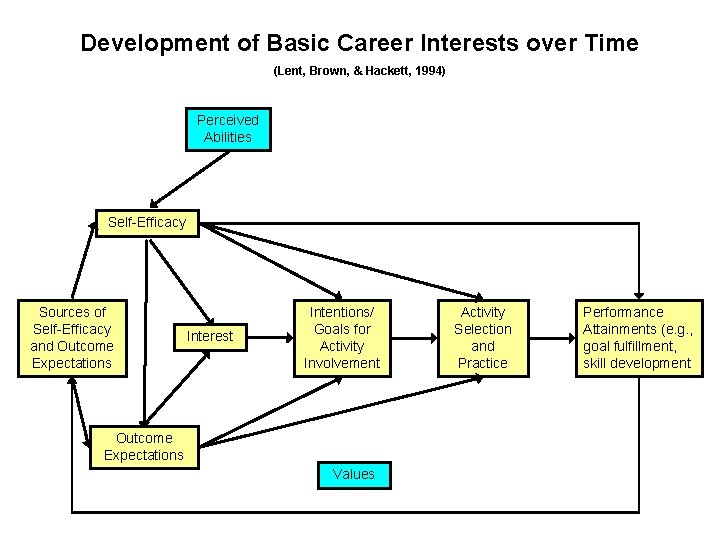
Development of Basic Career Interests over Time (Lent, Brown, & Hackett, 1994) Perceived Abilities Self-Efficacy Sources of Self-Efficacy and Outcome Expectations Interest Intentions/ Goals for Activity Involvement Outcome Expectations Values Activity Selection and Practice Performance Attainments (e. g. , goal fulfillment, skill development
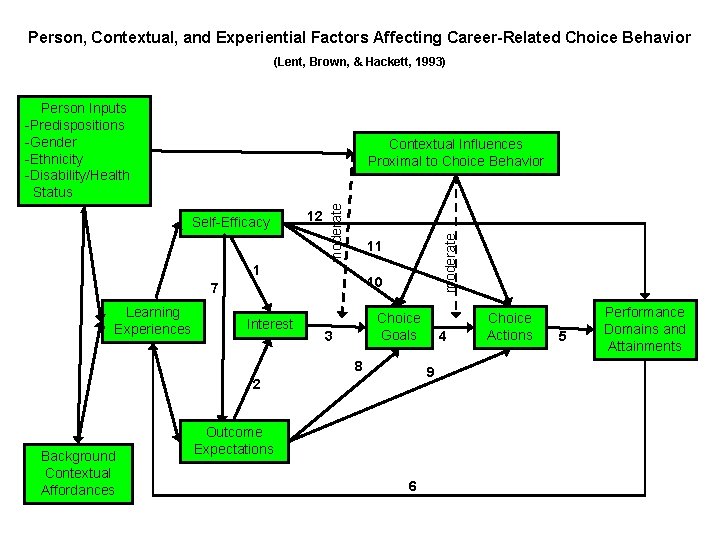
Person, Contextual, and Experiential Factors Affecting Career-Related Choice Behavior (Lent, Brown, & Hackett, 1993) Person Inputs -Predispositions -Gender -Ethnicity -Disability/Health Status 1 12 11 10 7 Learning Experiences Interest moderate Self-Efficacy moderate Contextual Influences Proximal to Choice Behavior Choice Goals 3 8 9 2 Background Contextual Affordances 4 Outcome Expectations 6 Choice Actions 5 Performance Domains and Attainments
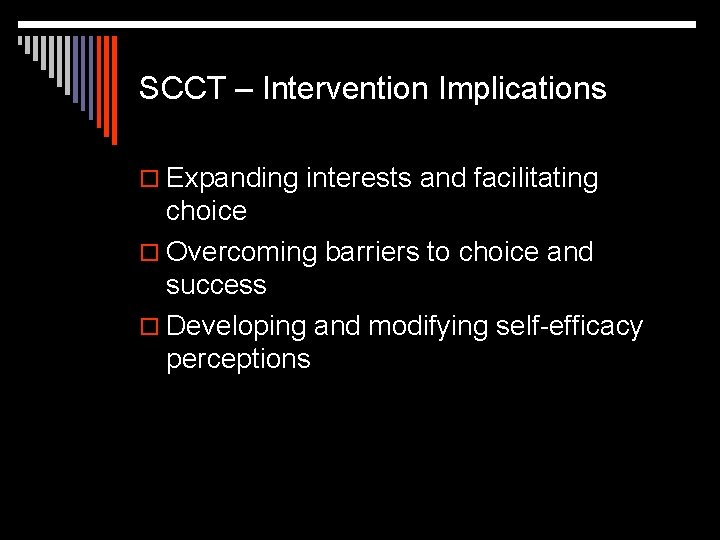
SCCT – Intervention Implications o Expanding interests and facilitating choice o Overcoming barriers to choice and success o Developing and modifying self-efficacy perceptions
Cognitive Information Processing – CIP o Developers n n Gary W. Peterson James P. Sampson Robert C. Reardon Janet G. Lenz
Cognitive Information Processing – CIP o“Give a man a fish and he will eat for a day. Teach a man to fish and he will eat for a lifetime. ”
CIP in context o. Theoretically integrative n Trait & Factor (Parsons) n P/E Matching (Holland) n Earlier decision theories (Janis & Mann; Katz; Gelatt, Tiedeman) n SLTCDM (Krumboltz)
CIP definitions o. Career problem solving o. Career decision making o. Career development o. Lifestyle
CIP – 4 Assumptions 1. Career decision making involves interaction between cognitive and affective processes 2. Decision making capacity depends upon availability of cognitive operations and knowledge 3. Career development is ongoing and cognitive structures continually evolve 4. Enhancing information processing skills is the goal of career counseling
CIP – 3 Dimensions o Pyramid of information processing o CASVE cycle of decision making skills o Executive processing domain
CIP – Pyramid of Information Processing Executive Processing Domain Metacognitions Generic Information-Processing Skills (CASVE) Self-Knowledge Occupational Knowledge Decision Making Skills Domain Knowledge Domains
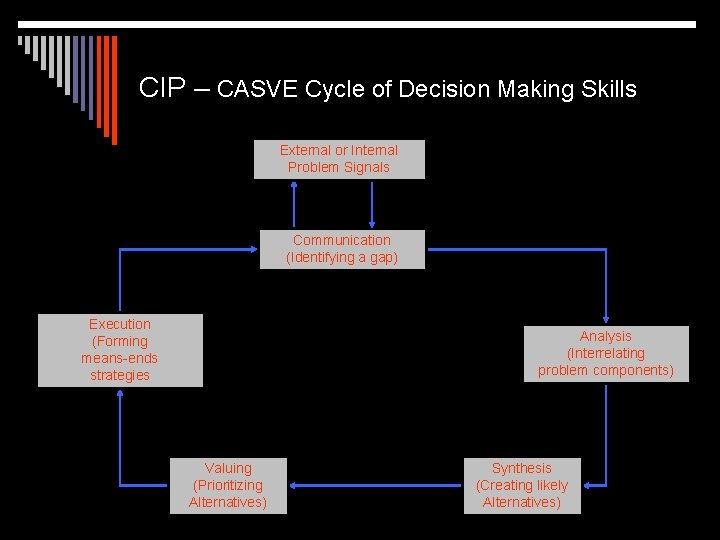
CIP – CASVE Cycle of Decision Making Skills External or Internal Problem Signals Communication (Identifying a gap) Execution (Forming means-ends strategies Analysis (Interrelating problem components) Valuing (Prioritizing Alternatives) Synthesis (Creating likely Alternatives)
CIP – Executive Processing Domain o Metacognitive skills n Self-talk n Self-awareness n Monitoring and control
CIP – Intervention Implications o Foci are three domains n n n Acquisition of knowledge Acquisition of decision-making skills Development of executive processing domain o Specifics n n n n Teaching decision making skills before problems become apparent Helping students identify and utilize information sources Assessment for self-knowledge Applying CASVE to help clients solve specific problems Disputing irrational beliefs (developing positive self-talk) Help clients develop internal locus of control Help clients understand what “success” looks like
Integrative Life Planning – ILP (L. Sunny Hansen) o Focuses on adult career development o “New worldview” o Addresses diversity issues o Holistic integration o Personal agency o Connections
ILP – 4 Assumptions 1. Nature of knowledge changing demanding new ways of knowing 2. Connections in life are important 3. Broader kinds of self-knowledge and societal knowledge are critical 4. Career counseling needs to focus on career professionals as change agents
ILP – 6 Career Development Tasks 1. Finding work that needs doing in 2. 3. 4. 5. 6. changing global contexts Weaving our lives into a meaningful whole Connecting family and work Valuing pluralism and diversity Managing personal transitions and organizational change Exploring spirituality and life purpose
ILP – Intervention Implications o Focus on developmental tasks n n Understand them See interrelatedness Prioritize tasks according to personal needs Teach approach to life planning p Connectedness p Wholeness p Community