
Career Review Case Management May 26 2021 Office

- Slides: 42
Career Review Case Management May 26, 2021 Office of Academic Personnel
Agenda § Overview – career review cases § Eligibility – departmental consultation, candidate preparation § Deadlines – departmental, campus § Case materials – biobibs, CVs, self-statements § Extramural letters – name selection, solicitations, letter redaction, coded list § Case preparation – departmental processing, voting, preparation of recommendation (department letter) § Reviewing agencies – role in the review process
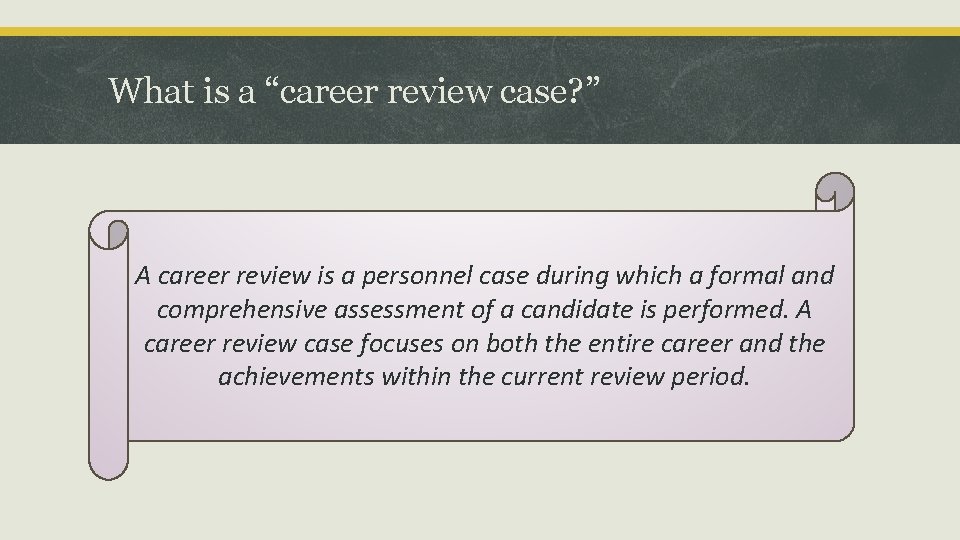
What is a “career review case? ” A career review is a personnel case during which a formal and comprehensive assessment of a candidate is performed. A career review case focuses on both the entire career and the achievements within the current review period.
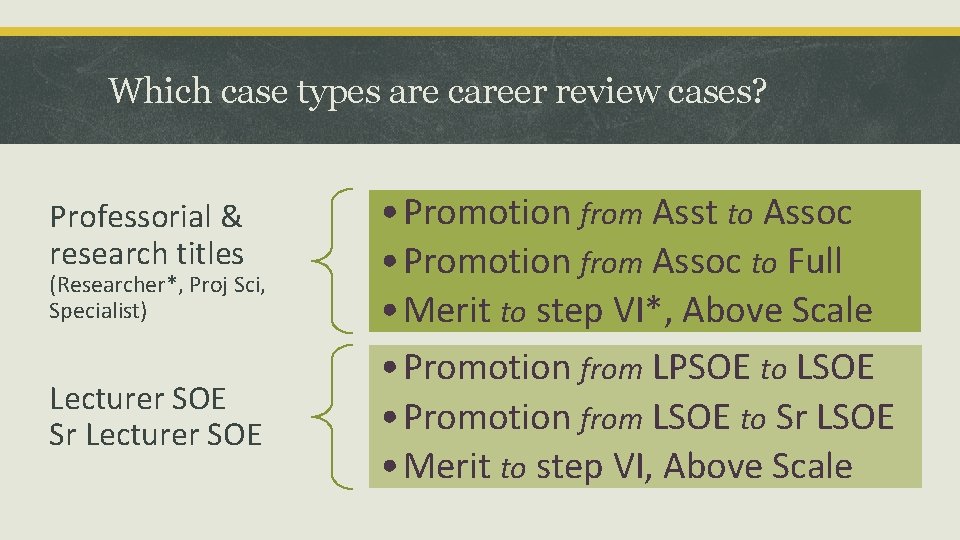
Which case types are career review cases? Professorial & research titles (Researcher*, Proj Sci, Specialist) Lecturer SOE Sr Lecturer SOE • Promotion from Asst to Assoc • Promotion from Assoc to Full • Merit to step VI*, Above Scale • Promotion from LPSOE to LSOE • Promotion from LSOE to Sr LSOE • Merit to step VI, Above Scale
New for 2021 -22 cycle and beyond (Step VI) § Merit to Step VI is still a career review § However! External letters are no longer required § Initial appointment to/beyond Step VI still requires Step VI-IX specific language in solicitation letters
Above Scale Reminders § Advancement increments: § One increment = 10% of on-scale Step IX rate § $17, 600 on general scale; $19, 300 on B/E/E scale § Accelerations: § No longer permitted in time (min 4 years between advancements) § 1. 5 increments: extraordinary achievement in 2+ areas of review § 2 increments: extraordinary achievements in ALL areas of review
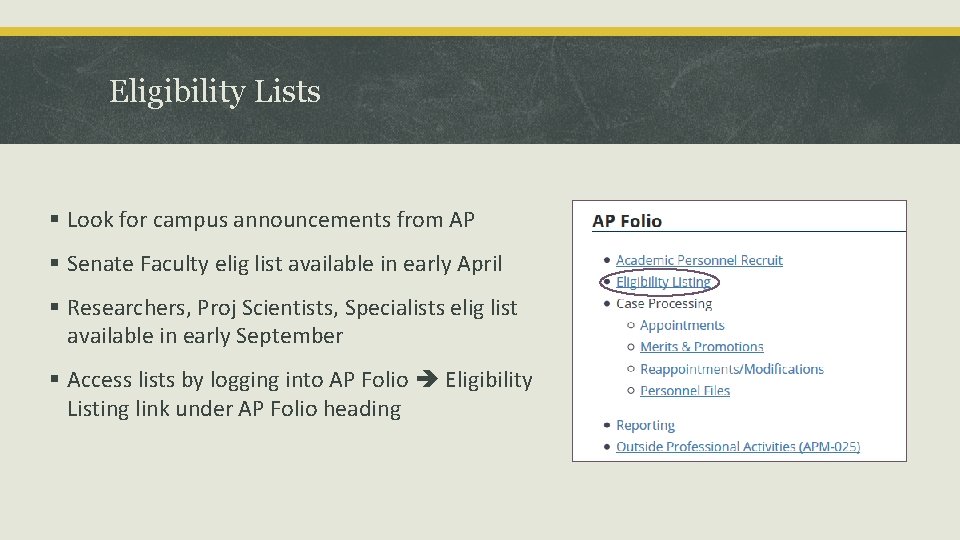
Eligibility Lists § Look for campus announcements from AP § Senate Faculty elig list available in early April § Researchers, Proj Scientists, Specialists elig list available in early September § Access lists by logging into AP Folio Eligibility Listing link under AP Folio heading
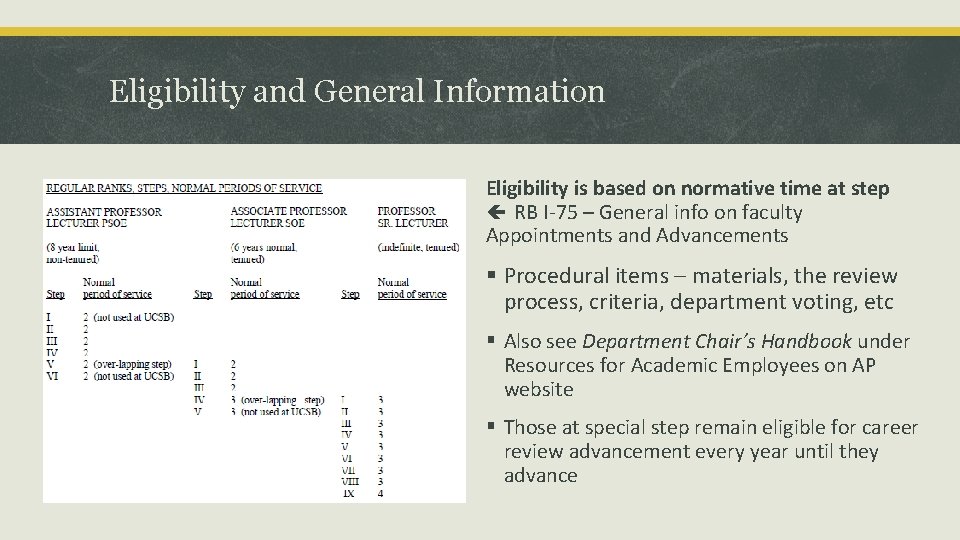
Eligibility and General Information Eligibility is based on normative time at step RB I-75 – General info on faculty Appointments and Advancements § Procedural items – materials, the review process, criteria, department voting, etc § Also see Department Chair’s Handbook under Resources for Academic Employees on AP website § Those at special step remain eligible for career review advancement every year until they advance
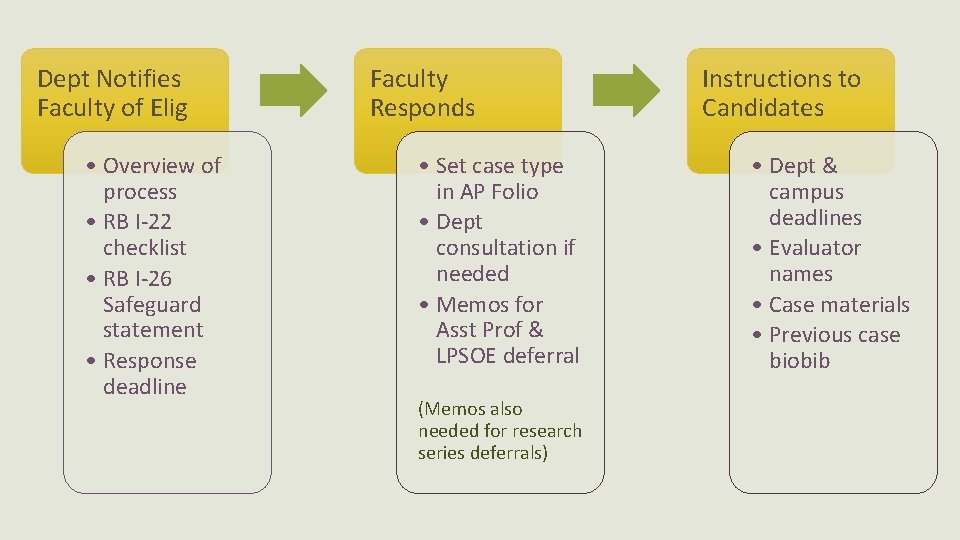
Dept Notifies Faculty of Elig • Overview of process • RB I-22 checklist • RB I-26 Safeguard statement • Response deadline Faculty Responds • Set case type in AP Folio • Dept consultation if needed • Memos for Asst Prof & LPSOE deferral (Memos also needed for research series deferrals) Instructions to Candidates • Dept & campus deadlines • Evaluator names • Case materials • Previous case biobib
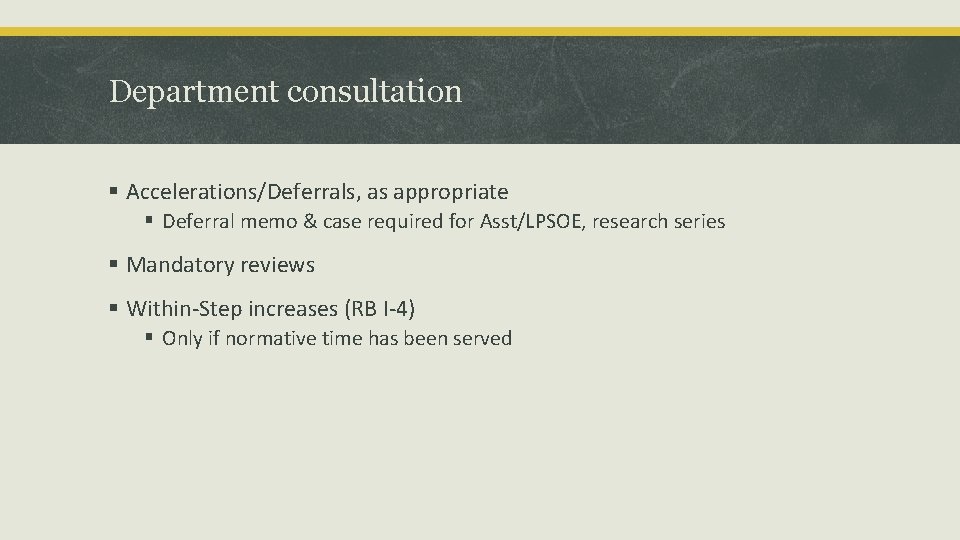
Department consultation § Accelerations/Deferrals, as appropriate § Deferral memo & case required for Asst/LPSOE, research series § Mandatory reviews § Within-Step increases (RB I-4) § Only if normative time has been served
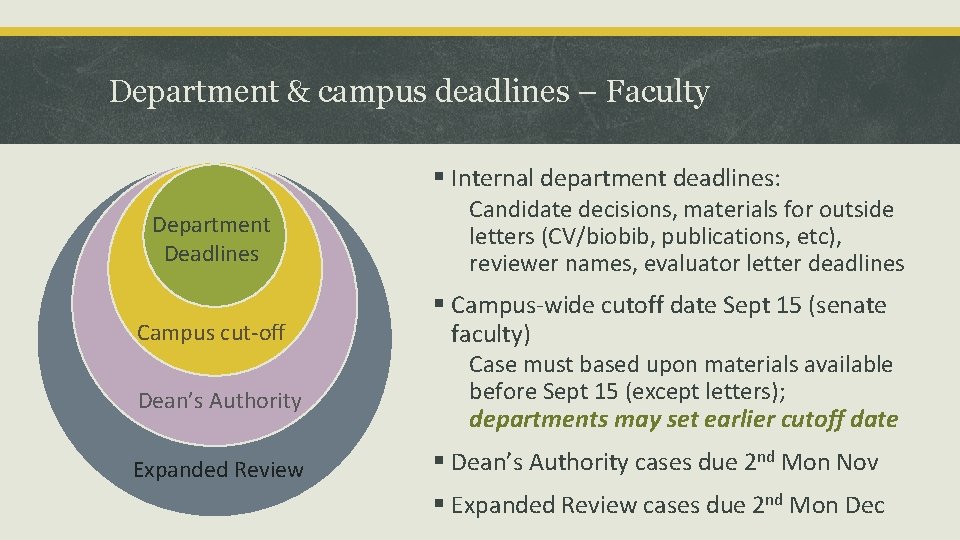
Department & campus deadlines – Faculty § Internal department deadlines: Department Deadlines Campus cut-off Dean’s Authority Expanded Review Candidate decisions, materials for outside letters (CV/biobib, publications, etc), reviewer names, evaluator letter deadlines § Campus-wide cutoff date Sept 15 (senate faculty) Case must based upon materials available before Sept 15 (except letters); departments may set earlier cutoff date § Dean’s Authority cases due 2 nd Mon Nov § Expanded Review cases due 2 nd Mon Dec
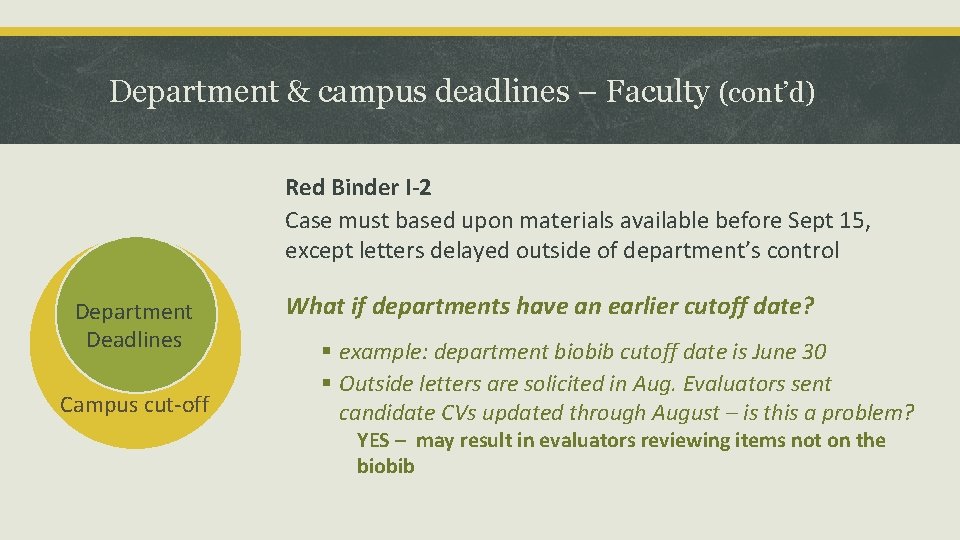
Department & campus deadlines – Faculty (cont’d) Red Binder I-2 Case must based upon materials available before Sept 15, except letters delayed outside of department’s control Department Deadlines Campus cut-off What if departments have an earlier cutoff date? § example: department biobib cutoff date is June 30 § Outside letters are solicited in Aug. Evaluators sent candidate CVs updated through August – is this a problem? YES – may result in evaluators reviewing items not on the biobib
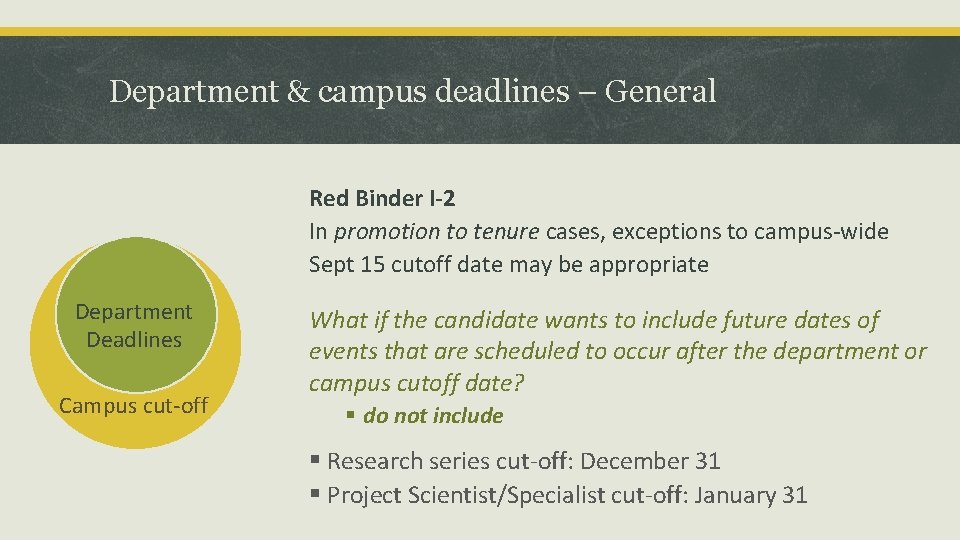
Department & campus deadlines – General Red Binder I-2 In promotion to tenure cases, exceptions to campus-wide Sept 15 cutoff date may be appropriate Department Deadlines Campus cut-off What if the candidate wants to include future dates of events that are scheduled to occur after the department or campus cutoff date? § do not include § Research series cut-off: December 31 § Project Scientist/Specialist cut-off: January 31
Case Materials - Biobib § What is a Bio-bibliography or “biobib? ” Why does the review process require a biobib instead of a Curriculum Vitae (CV)? § Contains information also found in a traditional curriculum vitae, but arranged in a specific format to ensure consistency and clarity § Generally divided into: § § § Mini CV (first page) Research Teaching Professional Activities Service § LSOE series can use a single section, Professional and/or Scholarly achievement and Activity rather than two separate sections of Research and Professional Activity.
Case Materials – Biobib (general) § RB I-27: Instructions for Completion of the Bio-bibliography (biobib) § Word document template available on Forms page on AP website § Do not delete sections that are applicable but have no items § Faculty member maintains/updates it; dept analyst checks for accuracy and compares against biobib from prior case § Electronic links should function correctly: § should link to the final version (of publications) § should not require sign-in to access (UCSBNet. Id okay)
Case Materials – Biobib (Research) § The only section that is cumulative § Research/creative activity should be complete and accurate § Correct titles, complete citations, accurate order of author § Correctly categorized (peer-reviewed article, book, conf proceedings, etc…) § If applicable, include links to publications above the line that are submitted as part of the “representative sampling” of the career.
Case Materials – Biobib (Research) – cont’d § Works in press (B items) are “counted” in the current review; these are assigned a number on the next review, but appear below the line on the next biobib and include an * § Submitted (C items): links must remain consistent throughout so that reviewing agencies are looking at the same version. § In-process (D items) are not tracked, so often these are not included with the case materials § If included, item must remain consistent throughout
Case Materials – Biobib (Teaching) § Teaching Load § Statement of department teaching load § Clarify how candidate met that teaching load § Teaching section omitted for research title reviews (more on this later)
Case Materials – Self-assessments § Self-statements may cover research, teaching, professional service, contributions to diversity, COVID impacts, and should be included in the case upload § Especially in research title career reviews, self-assessments can be an appropriate place to list individualized teaching and mentoring (vs Service *) § Advancement criteria in Researcher reviews: research/creative activities, professional activities, university and public service § No teaching on biobib § Project Scientist: Research/creative activity; professional activities § Service encouraged but not required § Specialist: same as Project Scientist, but areas of review may be used flexibly § Service is a criteria for advancement at the Associate/full Specialist ranks
Extramural Letters – Evaluator Names § Requirements (RB I-46) § § § Even mix of department and candidate-suggested names At least 6 letters, at least 2 UC-familiar No close associates (collaborators, colleagues, advisors, personal friends) No repeat letter writers from previous cases Refer to RB III-12, III-14 & III-16 for research title requirements § Deviations from the above should be explained in the coded list (NOT in the department letter!) § Evaluators should be tenured faculty from distinguished institutions, preferably Full Professors § Above Scale: include international faculty/researchers § Question: are more letters always better? i. e. if six letters are good in a tenure case, are twelve even better?
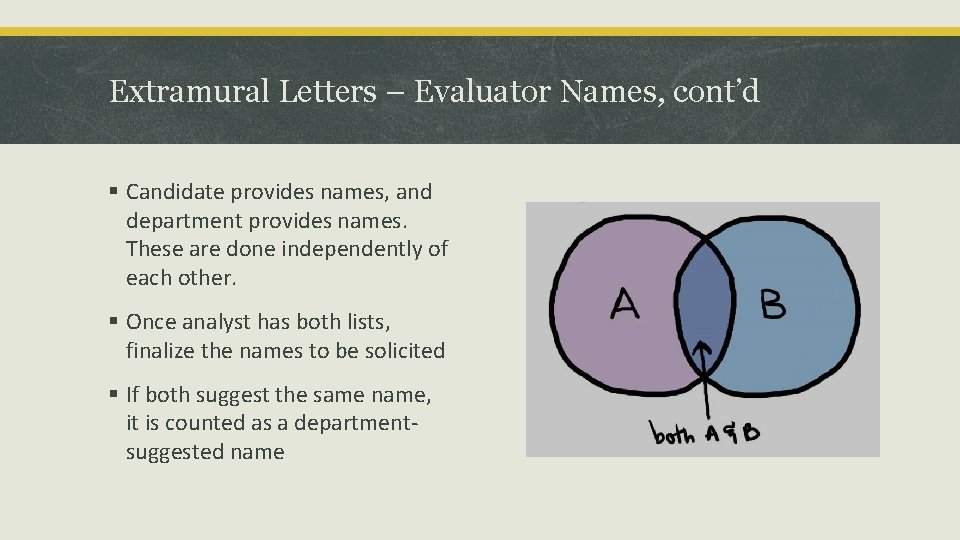
Extramural Letters – Evaluator Names, cont’d § Candidate provides names, and department provides names. These are done independently of each other. § Once analyst has both lists, finalize the names to be solicited § If both suggest the same name, it is counted as a departmentsuggested name
Extramural Letters – Solicitations § Do not change prescribed wording from RB I-49 and RB I-50 without AP approval § Use correct wording for the proposed action § RB I-49: sample letter & confidentiality statement § For research titles, refer to external evaluation sections RB III-12, III-14 & III-16 § Do not direct/steer letter writers on what to include in their evaluation § Include a deadline for return of letters § Consider department timelines, e. g. fall faculty meeting schedules § Dept chair contact to encourage response must be careful – free of bias/influence
Extramural Letters – Materials to External Reviewers § Candidates should be treated equitably § Items sent to reviewers depend upon department culture and practice § All reviewers should receive the same materials § Curriculum Vitae (CV) versus Bio-bibliography (biobib) § Consider department cutoff dates versus “up-to-date” CV § Take care that external evaluators are not reviewing items that are not going to be on the candidate’s (campus) biobib OR that are not actually in the state of publication as represented § Solicitation letter and any materials sent to reviewers that are not already in the case are uploaded to AP Folio § No ESCIs or written student evaluations
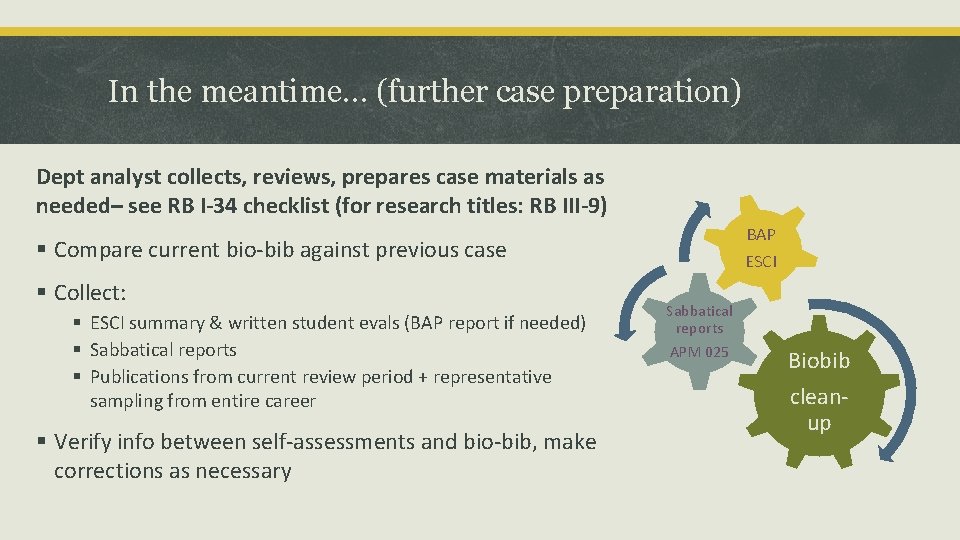
In the meantime… (further case preparation) Dept analyst collects, reviews, prepares case materials as needed– see RB I-34 checklist (for research titles: RB III-9) BAP § Compare current bio-bib against previous case § Collect: § ESCI summary & written student evals (BAP report if needed) § Sabbatical reports § Publications from current review period + representative sampling from entire career § Verify info between self-assessments and bio-bib, make corrections as necessary ESCI Sabbatical reports APM 025 Biobib cleanup
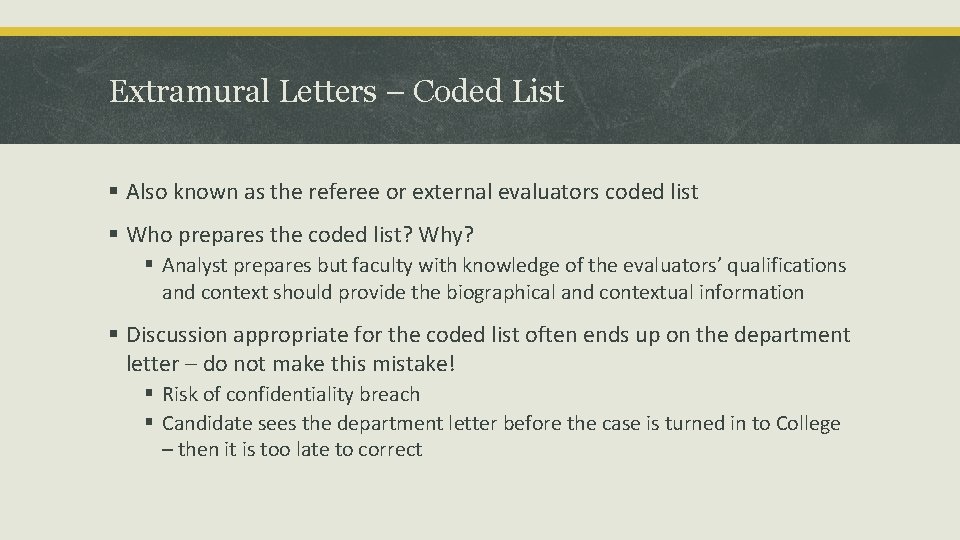
Extramural Letters – Coded List § Also known as the referee or external evaluators coded list § Who prepares the coded list? Why? § Analyst prepares but faculty with knowledge of the evaluators’ qualifications and context should provide the biographical and contextual information § Discussion appropriate for the coded list often ends up on the department letter – do not make this mistake! § Risk of confidentiality breach § Candidate sees the department letter before the case is turned in to College – then it is too late to correct
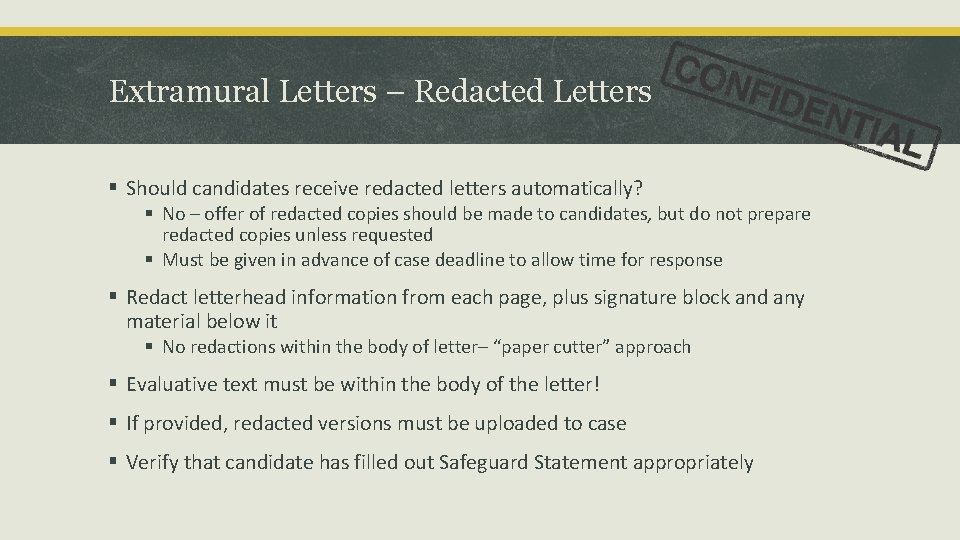
Extramural Letters – Redacted Letters § Should candidates receive redacted letters automatically? § No – offer of redacted copies should be made to candidates, but do not prepare redacted copies unless requested § Must be given in advance of case deadline to allow time for response § Redact letterhead information from each page, plus signature block and any material below it § No redactions within the body of letter– “paper cutter” approach § Evaluative text must be within the body of the letter! § If provided, redacted versions must be uploaded to case § Verify that candidate has filled out Safeguard Statement appropriately
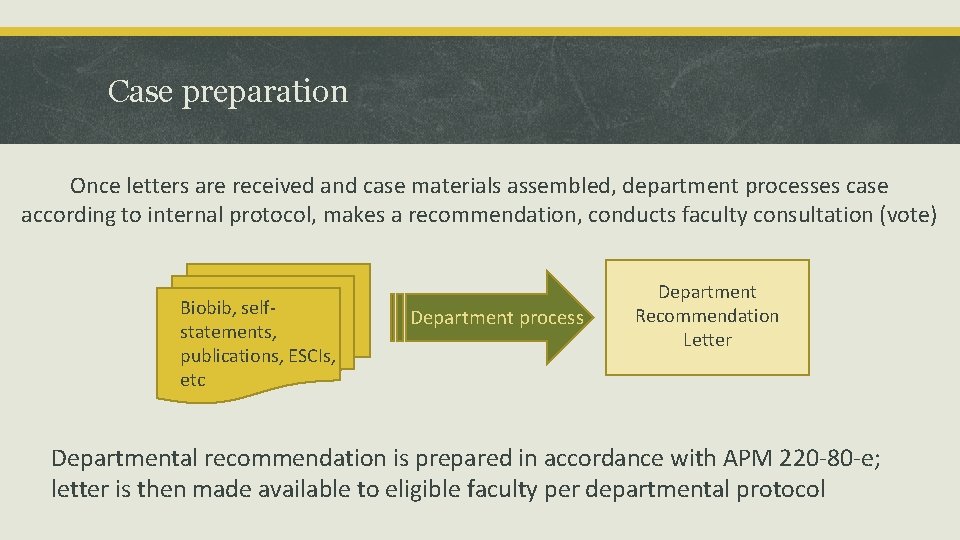
Case preparation Once letters are received and case materials assembled, department processes case according to internal protocol, makes a recommendation, conducts faculty consultation (vote) Biobib, selfstatements, publications, ESCIs, etc Department process Department Recommendation Letter Departmental recommendation is prepared in accordance with APM 220 -80 -e; letter is then made available to eligible faculty per departmental protocol
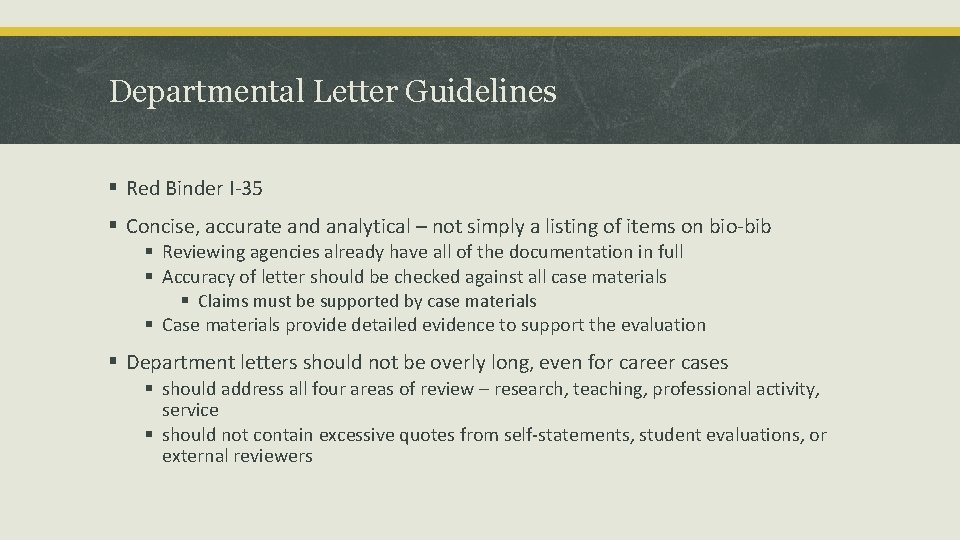
Departmental Letter Guidelines § Red Binder I-35 § Concise, accurate and analytical – not simply a listing of items on bio-bib § Reviewing agencies already have all of the documentation in full § Accuracy of letter should be checked against all case materials § Claims must be supported by case materials § Case materials provide detailed evidence to support the evaluation § Department letters should not be overly long, even for career cases § should address all four areas of review – research, teaching, professional activity, service § should not contain excessive quotes from self-statements, student evaluations, or external reviewers
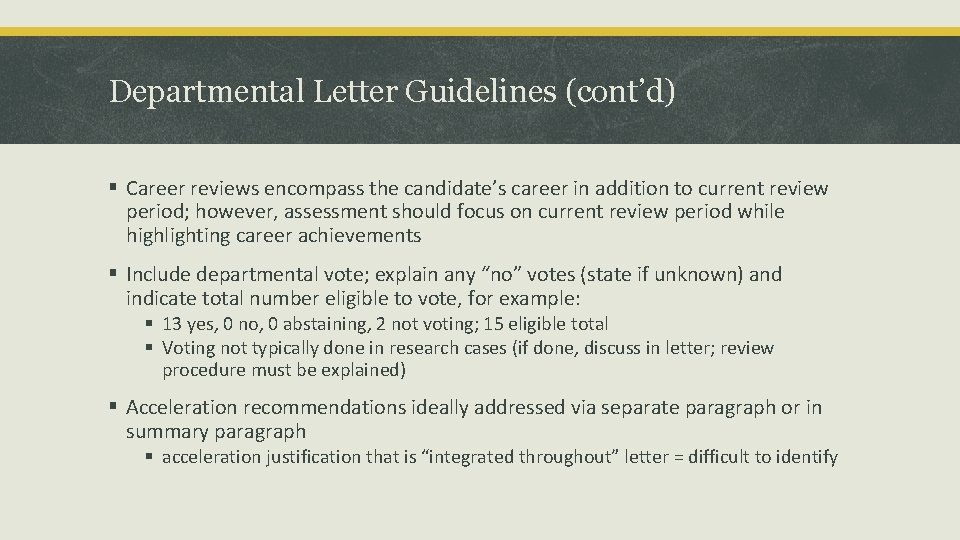
Departmental Letter Guidelines (cont’d) § Career reviews encompass the candidate’s career in addition to current review period; however, assessment should focus on current review period while highlighting career achievements § Include departmental vote; explain any “no” votes (state if unknown) and indicate total number eligible to vote, for example: § 13 yes, 0 no, 0 abstaining, 2 not voting; 15 eligible total § Voting not typically done in research cases (if done, discuss in letter; review procedure must be explained) § Acceleration recommendations ideally addressed via separate paragraph or in summary paragraph § acceleration justification that is “integrated throughout” letter = difficult to identify
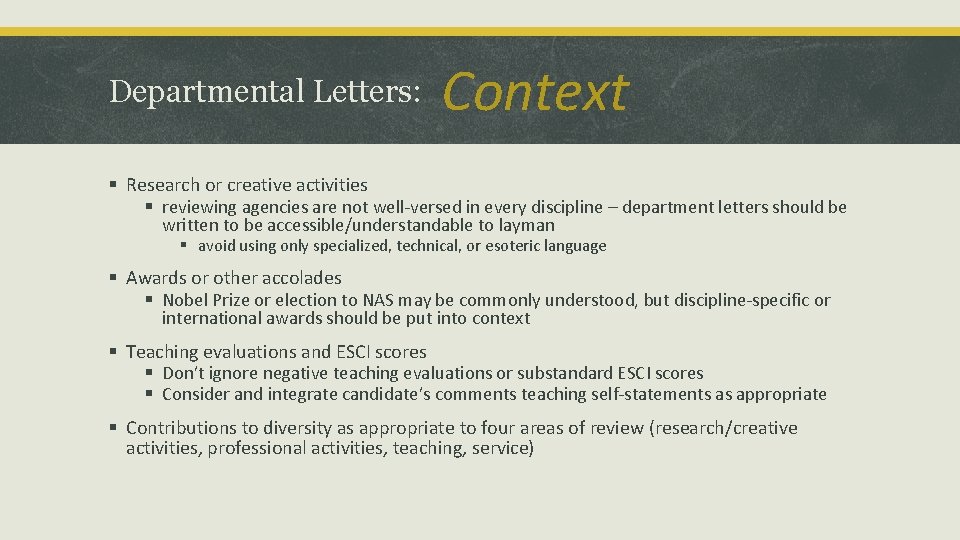
Departmental Letters: Context § Research or creative activities § reviewing agencies are not well-versed in every discipline – department letters should be written to be accessible/understandable to layman § avoid using only specialized, technical, or esoteric language § Awards or other accolades § Nobel Prize or election to NAS may be commonly understood, but discipline-specific or international awards should be put into context § Teaching evaluations and ESCI scores § Don’t ignore negative teaching evaluations or substandard ESCI scores § Consider and integrate candidate’s comments teaching self-statements as appropriate § Contributions to diversity as appropriate to four areas of review (research/creative activities, professional activities, teaching, service)
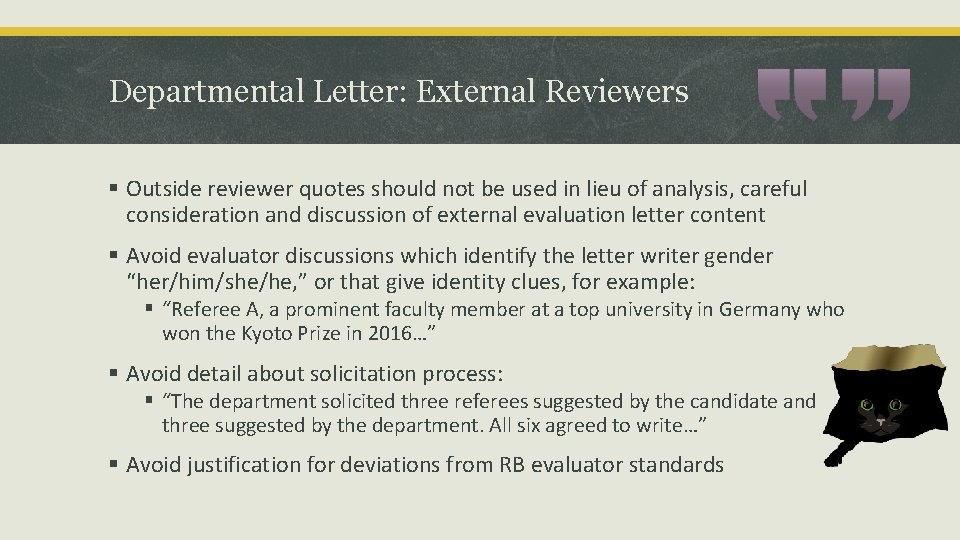
Departmental Letter: External Reviewers § Outside reviewer quotes should not be used in lieu of analysis, careful consideration and discussion of external evaluation letter content § Avoid evaluator discussions which identify the letter writer gender “her/him/she/he, ” or that give identity clues, for example: § “Referee A, a prominent faculty member at a top university in Germany who won the Kyoto Prize in 2016…” § Avoid detail about solicitation process: § “The department solicited three referees suggested by the candidate and three suggested by the department. All six agreed to write…” § Avoid justification for deviations from RB evaluator standards
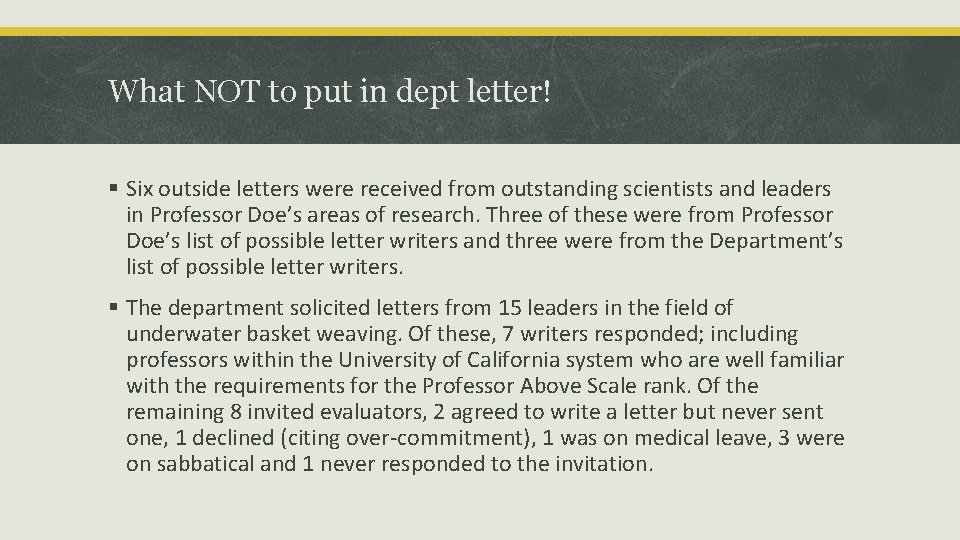
What NOT to put in dept letter! § Six outside letters were received from outstanding scientists and leaders in Professor Doe’s areas of research. Three of these were from Professor Doe’s list of possible letter writers and three were from the Department’s list of possible letter writers. § The department solicited letters from 15 leaders in the field of underwater basket weaving. Of these, 7 writers responded; including professors within the University of California system who are well familiar with the requirements for the Professor Above Scale rank. Of the remaining 8 invited evaluators, 2 agreed to write a letter but never sent one, 1 declined (citing over-commitment), 1 was on medical leave, 3 were on sabbatical and 1 never responded to the invitation.
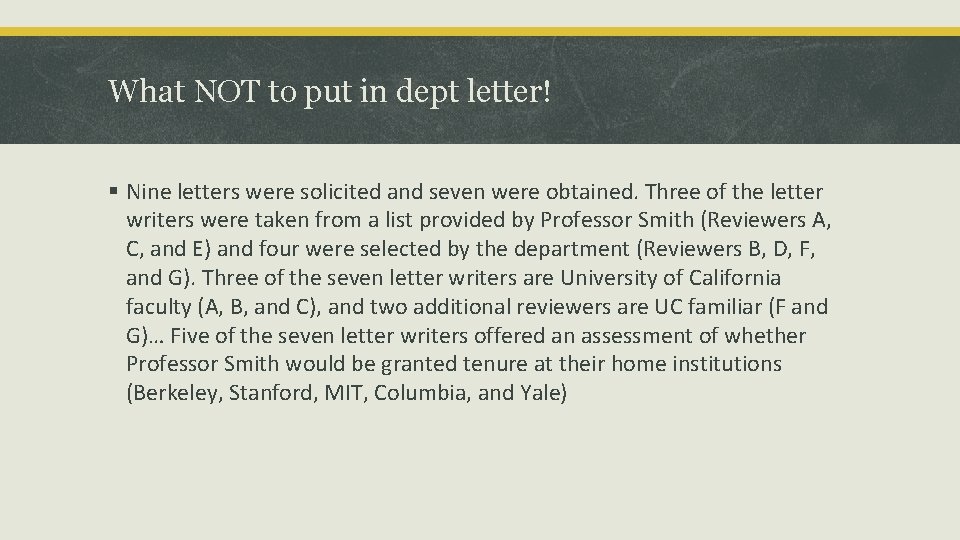
What NOT to put in dept letter! § Nine letters were solicited and seven were obtained. Three of the letter writers were taken from a list provided by Professor Smith (Reviewers A, C, and E) and four were selected by the department (Reviewers B, D, F, and G). Three of the seven letter writers are University of California faculty (A, B, and C), and two additional reviewers are UC familiar (F and G)… Five of the seven letter writers offered an assessment of whether Professor Smith would be granted tenure at their home institutions (Berkeley, Stanford, MIT, Columbia, and Yale)
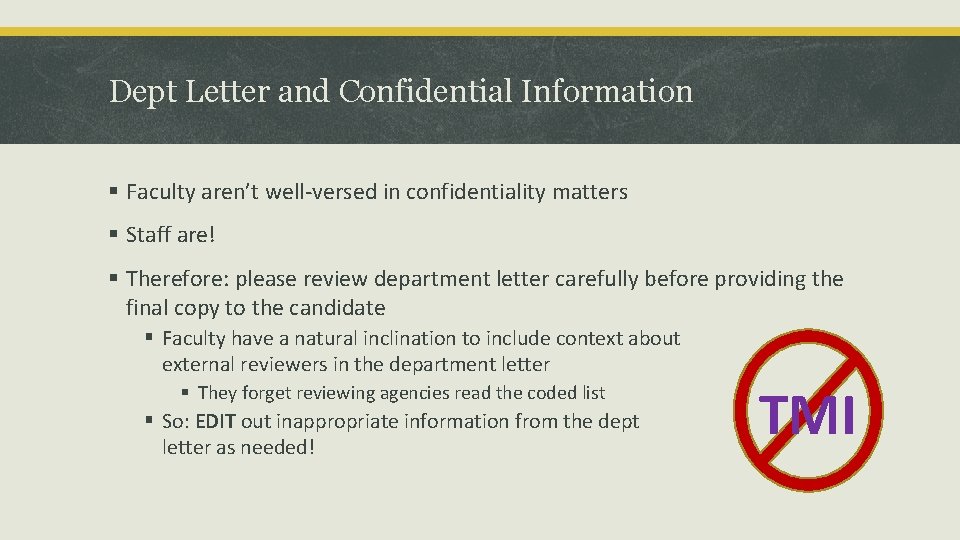
Dept Letter and Confidential Information § Faculty aren’t well-versed in confidentiality matters § Staff are! § Therefore: please review department letter carefully before providing the final copy to the candidate § Faculty have a natural inclination to include context about external reviewers in the department letter § They forget reviewing agencies read the coded list § So: EDIT out inappropriate information from the dept letter as needed! TMI
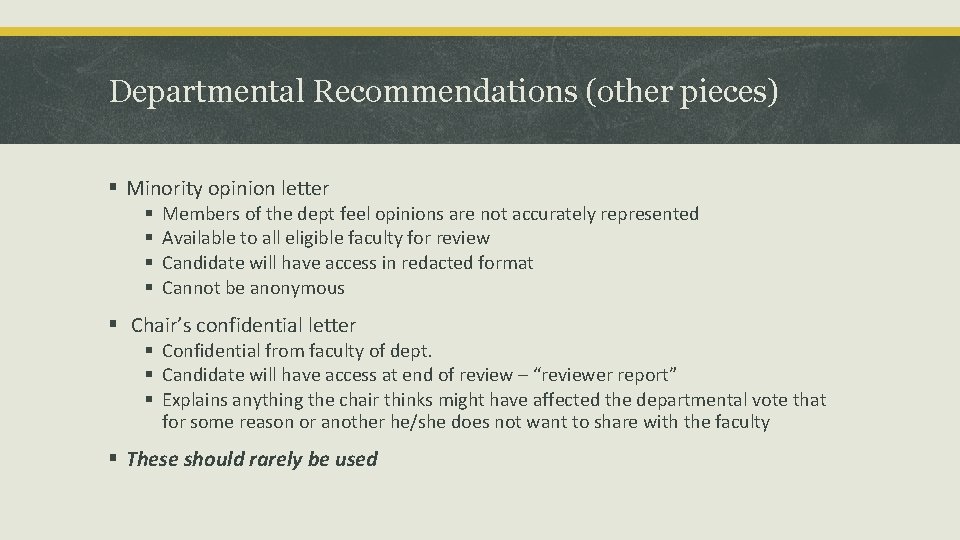
Departmental Recommendations (other pieces) § Minority opinion letter § § Members of the dept feel opinions are not accurately represented Available to all eligible faculty for review Candidate will have access in redacted format Cannot be anonymous § Chair’s confidential letter § Confidential from faculty of dept. § Candidate will have access at end of review – “reviewer report” § Explains anything the chair thinks might have affected the departmental vote that for some reason or another he/she does not want to share with the faculty § These should rarely be used
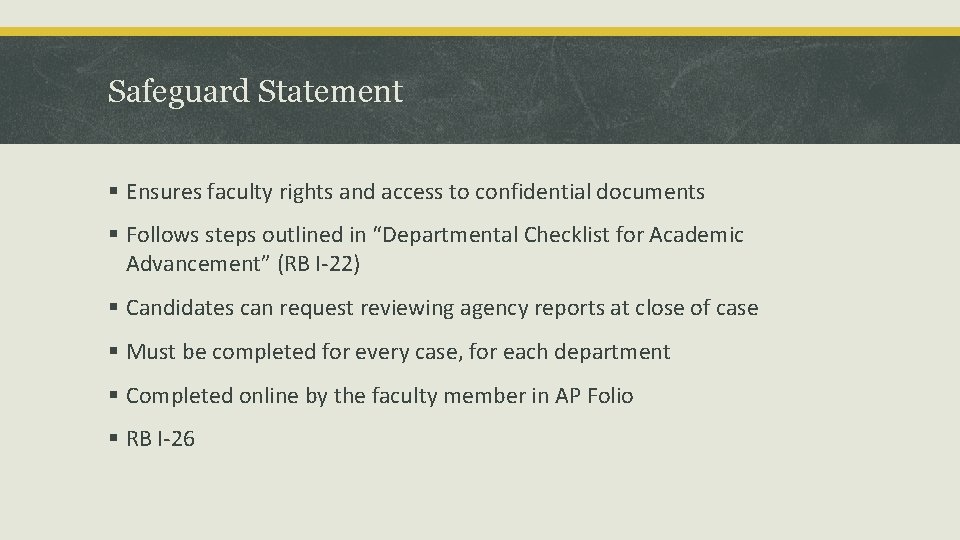
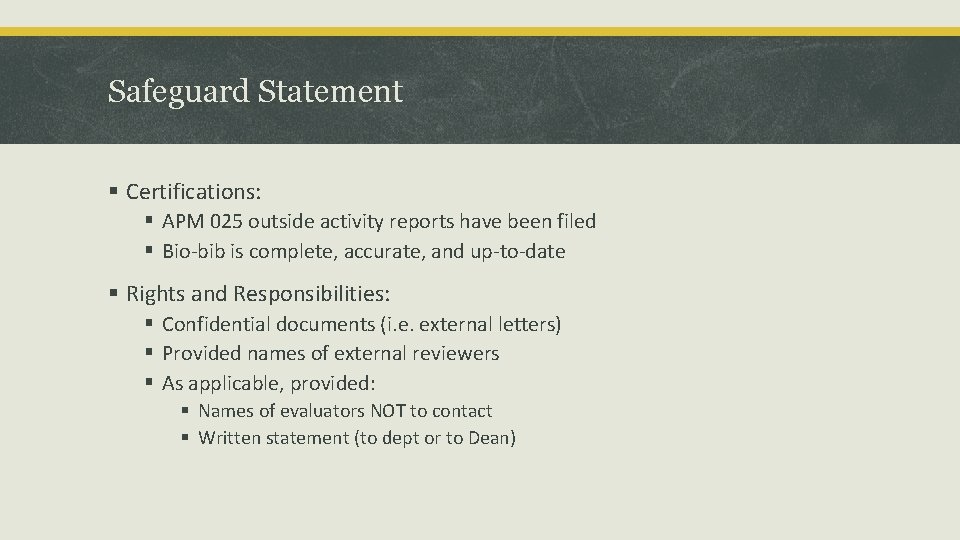
Safeguard Statement § Ensures faculty rights and access to confidential documents § Follows steps outlined in “Departmental Checklist for Academic Advancement” (RB I-22) § Candidates can request reviewing agency reports at close of case § Must be completed for every case, for each department § Completed online by the faculty member in AP Folio § RB I-26
Safeguard Statement § Certifications: § APM 025 outside activity reports have been filed § Bio-bib is complete, accurate, and up-to-date § Rights and Responsibilities: § Confidential documents (i. e. external letters) § Provided names of external reviewers § As applicable, provided: § Names of evaluators NOT to contact § Written statement (to dept or to Dean)
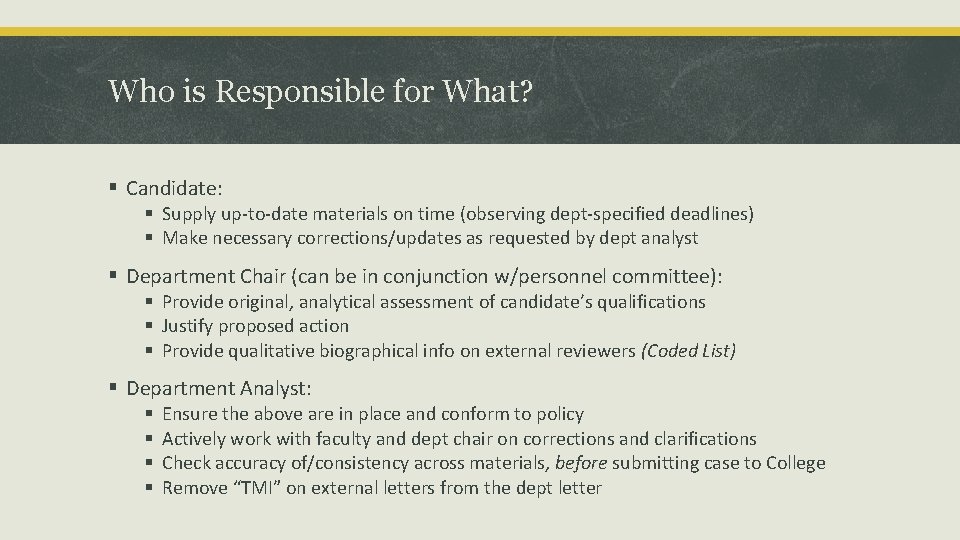
Who is Responsible for What? § Candidate: § Supply up-to-date materials on time (observing dept-specified deadlines) § Make necessary corrections/updates as requested by dept analyst § Department Chair (can be in conjunction w/personnel committee): § Provide original, analytical assessment of candidate’s qualifications § Justify proposed action § Provide qualitative biographical info on external reviewers (Coded List) § Department Analyst: § § Ensure the above are in place and conform to policy Actively work with faculty and dept chair on corrections and clarifications Check accuracy of/consistency across materials, before submitting case to College Remove “TMI” on external letters from the dept letter
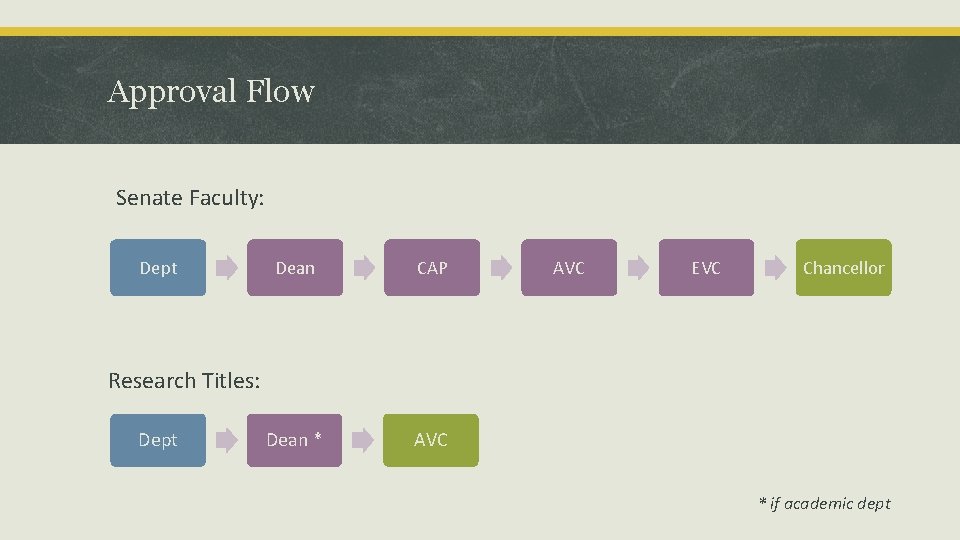
Approval Flow Senate Faculty: Dept Dean CAP Dean * AVC EVC Chancellor Research Titles: Dept * if academic dept
Campus reviewing agencies § College analysts review the case first § Respond to their requests for revisions/corrections promptly § Additional information requests § Any reviewing agency at any stage may request add’l info § Not a negative reflection on the candidate § Candidate may need to be informed of new info (APM, Section 220 -80 -h)
Academic Personnel Contacts Helly Kwee Senate Faculty MLPS; Engineering; ORUs; Bren x 5428 helly. kwee@ucsb. edu Lia Cabello Senate Faculty HFA; SOSC; Academic Programs; CCS; Education x 5979 lia. cabello@ucsb. edu Joanna Kettmann Research Series; Project Scientists; Specialists x 5048 joanna. kettmann@ucsb. edu June Betancourt General AP policy x 5728 june. betancourt@ucsb. edu
Questions?