
Career Progression Pathways Advanced Manufacturing involves the production
- Slides: 2
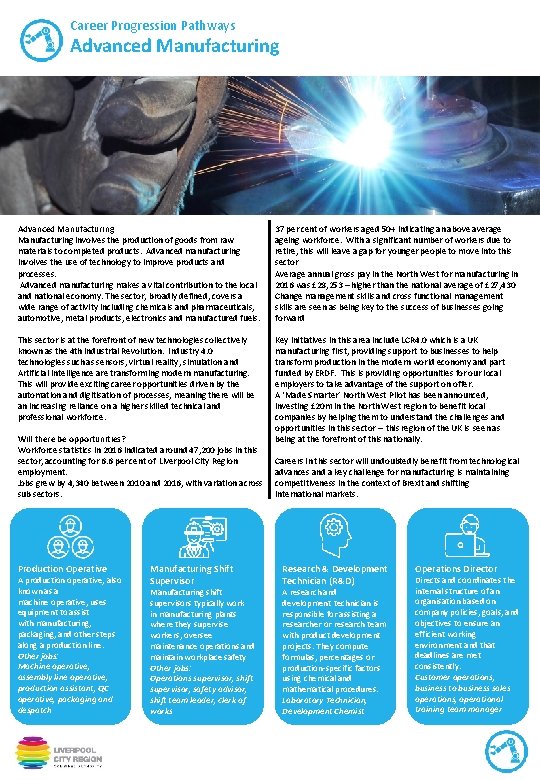
Career Progression Pathways Advanced Manufacturing involves the production of goods from raw materials to completed products. Advanced manufacturing involves the use of technology to improve products and processes. Advanced manufacturing makes a vital contribution to the local and national economy. The sector, broadly defined, covers a wide range of activity including chemicals and pharmaceuticals, automotive, metal products, electronics and manufactured fuels. 37 per cent of workers aged 50+ indicating an above average ageing workforce. With a significant number of workers due to retire, this will leave a gap for younger people to move into this sector Average annual gross pay in the North West for manufacturing in 2016 was £ 28, 253 – higher than the national average of £ 27, 430 Change management skills and cross functional management skills are seen as being key to the success of businesses going forward This sector is at the forefront of new technologies collectively known as the 4 th Industrial Revolution. Industry 4. 0 technologies such as sensors, virtual reality, simulation and Artificial Intelligence are transforming modern manufacturing. This will provide exciting career opportunities driven by the automation and digitisation of processes, meaning there will be an increasing reliance on a higher skilled technical and professional workforce. Key initiatives in this area include LCR 4. 0 which is a UK manufacturing first, providing support to businesses to help transform production in the modern world economy and part funded by ERDF. This is providing opportunities for our local employers to take advantage of the support on offer. A ‘Made Smarter’ North West Pilot has been announced, investing £ 20 m in the North West region to benefit local companies by helping them to understand the challenges and opportunities in this sector – this region of the UK is seen as being at the forefront of this nationally. Will there be opportunities? Workforce statistics in 2016 indicated around 47, 200 jobs in this sector, accounting for 6. 6 per cent of Liverpool City Region employment. Jobs grew by 4, 340 between 2010 and 2016, with variation across sub sectors. Production Operative A production operative, also known as a machine operative, uses equipment to assist with manufacturing, packaging, and other steps along a production line. Other jobs: Machine operative, assembly line operative, production assistant, QC operative, packaging and despatch Manufacturing Shift Supervisor Manufacturing shift supervisors typically work in manufacturing plants where they supervise workers, oversee maintenance operations and maintain workplace safety Other jobs: Operations supervisor, shift supervisor, safety advisor, shift team leader, clerk of works Careers in this sector will undoubtedly benefit from technological advances and a key challenge for manufacturing is maintaining competitiveness in the context of Brexit and shifting international markets. Research & Development Technician (R&D) A research and development technician is responsible for assisting a researcher or research team with product development projects. They compute formulas, percentages or production-specific factors using chemical and mathematical procedures. Laboratory Technician, Development Chemist Operations Director Directs and coordinates the internal structure of an organisation based on company policies, goals, and objectives to ensure an efficient working environment and that deadlines are met consistently. Customer operations, business to business sales operations, operational training team manager
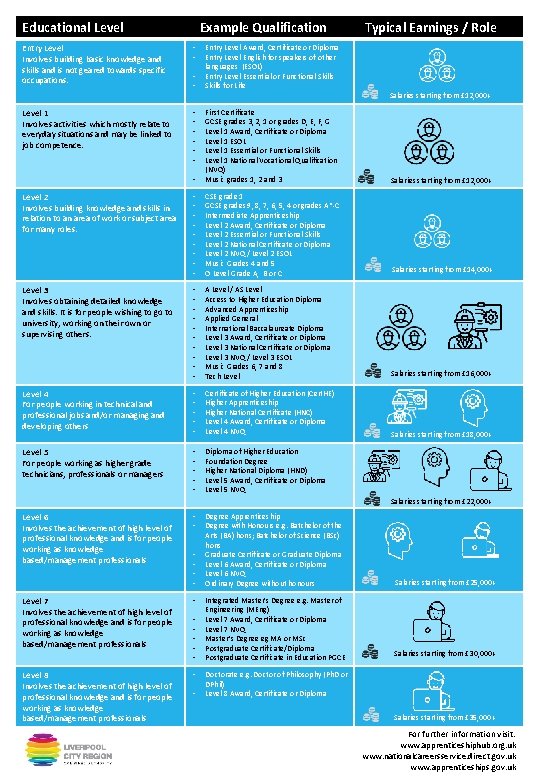
Educational Level Entry Level Involves building basic knowledge and skills and is not geared towards specific occupations. Level 1 Involves activities which mostly relate to everyday situations and may be linked to job competence. Example Qualification • • • Entry Level Award, Certificate or Diploma Entry Level English for speakers of other languages (ESOL) Entry Level Essential or Functional Skills for Life Typical Earnings / Role Salaries starting from £ 12, 000+ • First Certificate GCSE grades 3, 2, 1 or grades D, E, F, G Level 1 Award, Certificate or Diploma Level 1 ESOL Level 1 Essential or Functional Skills Level 1 National Vocational Qualification (NVQ) Music grades 1, 2 and 3 Salaries starting from £ 12, 000+ • • • CSE grade 1 GCSE grades 9, 8, 7, 6, 5, 4 or grades A*-C Intermediate Apprenticeship Level 2 Award, Certificate or Diploma Level 2 Essential or Functional Skills Level 2 National Certificate or Diploma Level 2 NVQ / Level 2 ESOL Music Grades 4 and 5 O Level Grade A, B or C Salaries starting from £ 14, 000+ • • • A Level / AS Level Access to Higher Education Diploma Advanced Apprenticeship Applied General International Baccalaureate Diploma Level 3 Award, Certificate or Diploma Level 3 National Certificate or Diploma Level 3 NVQ / Level 3 ESOL Music Grades 6, 7 and 8 Tech Level Salaries starting from £ 16, 000+ Level 4 For people working in technical and professional jobs and/or managing and developing others • • • Certificate of Higher Education (Cert. HE) Higher Apprenticeship Higher National Certificate (HNC) Level 4 Award, Certificate or Diploma Level 4 NVQ Salaries starting from £ 18, 000+ Level 5 For people working as higher grade technicians, professionals or managers • • • Diploma of Higher Education Foundation Degree Higher National Diploma (HND) Level 5 Award, Certificate or Diploma Level 5 NVQ Level 2 Involves building knowledge and skills in relation to an area of work or subject area for many roles. Level 3 Involves obtaining detailed knowledge and skills. It is for people wishing to go to university, working on their own or supervising others. Salaries starting from £ 22, 000+ Level 6 Involves the achievement of high level of professional knowledge and is for people working as knowledge based/management professionals • • • Level 7 Involves the achievement of high level of professional knowledge and is for people working as knowledge based/management professionals • Level 8 Involves the achievement of high level of professional knowledge and is for people working as knowledge based/management professionals • • Degree Apprenticeship Degree with Honours e. g. Batchelor of the Arts (BA) hons; Batchelor of Science (BSc) hons Graduate Certificate or Graduate Diploma Level 6 Award, Certificate or Diploma Level 6 NVQ Ordinary Degree without honours Integrated Master’s Degree e. g. Master of Engineering (MEng) Level 7 Award, Certificate or Diploma Level 7 NVQ Master’s Degree eg MA or MSc Postgraduate Certificate/Diploma Postgraduate Certificate in Education PGCE Salaries starting from £ 25, 000+ Salaries starting from £ 30, 000+ Doctorate e. g. Doctor of Philosophy (Ph. D or DPhil) Level 8 Award, Certificate or Diploma Salaries starting from £ 35, 000+ For further information visit: www. apprenticeshiphub. org. uk www. nationalcareersservice. direct. gov. uk www. apprenticeships. gov. uk