
Career Pathways for Individuals with Disabilities CPID CPID
+ Career Pathways for Individuals with Disabilities (CPID) CPID Overview: Purpose, Activities, and Outcomes “The contents of this product was developed under a grant from the Department of Education, under CFDA #84. 235 N. However, those contents do not necessarily represent the policy of the Department of Education, and you should not assume endorsement by the Federal Government. ”
+ Today’s Objectives n Today we want to share our experiences and some factors that we believe other agencies would want to consider when infusing a Career Pathways focus/approach into their operations. n We will share some additional resources and contact information for further investigation. n Finally, we will share some information about our plans for more in-depth topical webinars. CPID Model Demonstration Projects 2

+ Purpose - CPID Model Demonstration Projects n “The purpose of the Career Pathways for Individuals with Disabilities Model Demonstrations is to demonstrate promising practices in the use of career pathways in order to improve employment outcomes for individuals with disabilities. n Specifically, the projects are designed to promote State VR agency partnerships in the development of and the use of career pathways to help individuals with disabilities eligible for VR services, including youth with disabilities, to acquire marketable skills and recognized postsecondary credentials and secure competitive integrated employment in high–demand, high–quality occupations. “ CPID Model Demonstration Projects 3

+ CPID - Background n Grant funding was awarded to 4 state vocational rehabilitation agencies. n Each agency was essentially tasked with answering the same question: ‘Can you demonstrate how to use a career pathways model within VR? ’ n All projects used the same WIOA building blocks WIOA definition n Skills and education n Workforce partners n Career counseling, etc. Those building blocks are apparent in the structuring and prioritization used by the projects, but there are 4 distinct projects in the end. n CPID Model Demonstration Projects 4
+ Today’s Presenters n Lee Bryan, Career Pathways for Georgia n Helga Gilbert, Kentucky’s Project CASE n Janet Drudik, Nebraska’s VR Career Pathway Advancement Project (CPAP) n Kate Kaegi, Virginia’s Career Pathways for Individuals with Disabilities CPID Model Demonstration Projects 5

6 + CPID PROJECTS – Important Related Constructs CPID Model Demonstration Projects

+ Targeted Occupational Clusters Manufacturing: Kentucky, Nebraska, Virginia, Georgia Healthcare, Information Technology: Kentucky, Nebraska, Virginia Transportation, Distribution, Logistics (TDL): Nebraska, Virginia Architecture/Construction: Nebraska Auto Mechanics and Welding: Virginia CPID Model Demonstration Projects 7
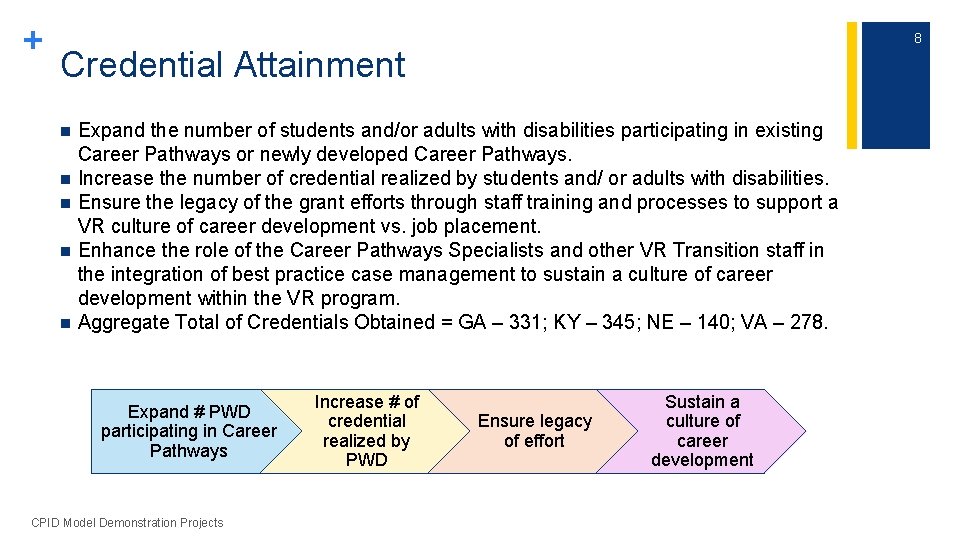
+ 8 Credential Attainment n n n Expand the number of students and/or adults with disabilities participating in existing Career Pathways or newly developed Career Pathways. Increase the number of credential realized by students and/ or adults with disabilities. Ensure the legacy of the grant efforts through staff training and processes to support a VR culture of career development vs. job placement. Enhance the role of the Career Pathways Specialists and other VR Transition staff in the integration of best practice case management to sustain a culture of career development within the VR program. Aggregate Total of Credentials Obtained = GA – 331; KY – 345; NE – 140; VA – 278. Expand # PWD participating in Career Pathways CPID Model Demonstration Projects Increase # of credential realized by PWD Ensure legacy of effort Sustain a culture of career development
+ Workforce Partners n Provide outreach and develop relationships with Workforce Partners from grant inception n Co-Enroll Clients – Share business leads through business account managers n Planned tours of businesses for WIOA partners n Industry specific academies and industry tours n Develop relationships with the community colleges. n Working closely with Department of Education and Career, Technical and Agricultural Education. CPID Model Demonstration Projects 9

+ Business n Industry specific academies and industry tours Lean Accessibility Program Assessments n Ergonomic Assessments n Advancing incumbent workers n Providing training to businesses regarding Section 503, ADA, Disability Awareness and Disability Etiquette n Business and Job Seeker Ergonomic Assessments CPID Model Demonstration Projects 10
+ Apprenticeships, Customized Employment n Welding and Logistics cohort training n Hershey Boot Camp n Paid Internships n Wilson Workforce Rehabilitation Center Credential Training and Preapprenticeships n VR Certificate Programs CPID Model Demonstration Projects 11
+ Internal Agency Operations n Statewide VR Counselor Outreach n Career Pathways Training and importance of industry recognized credentials n Implementation of bi-weekly Transition Talk to share Career Pathways information and provide training to VR staff n Introduction of a new agency Transition website with a central focus on Career Pathway n Motivational n Career Interviewing Pathway Website CPID Model Demonstration Projects 12
+ Distinctive Features n Project Commonalities/Differences Nebraska used the upskill, backfill model. n Virginia focused on staffing subject matter experts to support Career Pathway efforts. n Kentucky focused on the Career Pathway Coordinator role. n Georgia focused on the high school population. n CPID Model Demonstration Projects 13

14 + Outcomes, Systems Change, and Sustainability: Each state’s story CPID Model Demonstration Projects
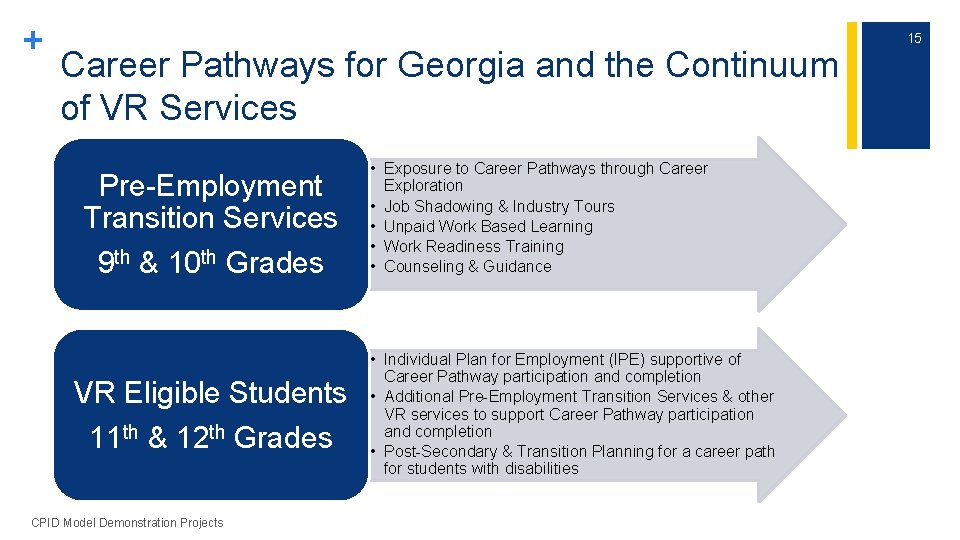
+ Career Pathways for Georgia and the Continuum of VR Services Pre-Employment Transition Services 9 th & 10 th Grades VR Eligible Students 11 th & 12 th Grades CPID Model Demonstration Projects • Exposure to Career Pathways through Career Exploration • Job Shadowing & Industry Tours • Unpaid Work Based Learning • Work Readiness Training • Counseling & Guidance • Individual Plan for Employment (IPE) supportive of Career Pathway participation and completion • Additional Pre-Employment Transition Services & other VR services to support Career Pathway participation and completion • Post-Secondary & Transition Planning for a career path for students with disabilities 15
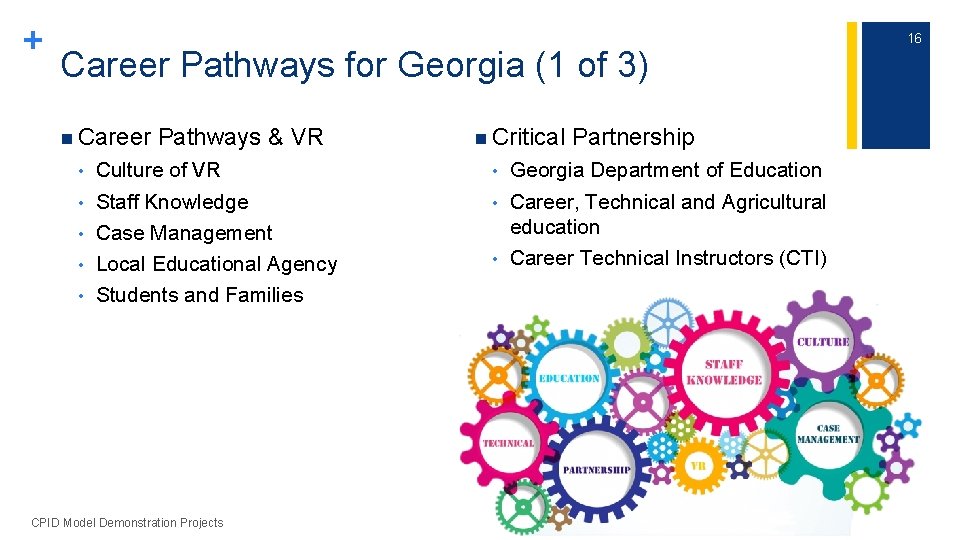
+ Career Pathways for Georgia (1 of 3) n Career • • • Pathways & VR Culture of VR Staff Knowledge Case Management Local Educational Agency Students and Families CPID Model Demonstration Projects n Critical • • • Partnership Georgia Department of Education Career, Technical and Agricultural education Career Technical Instructors (CTI) 16
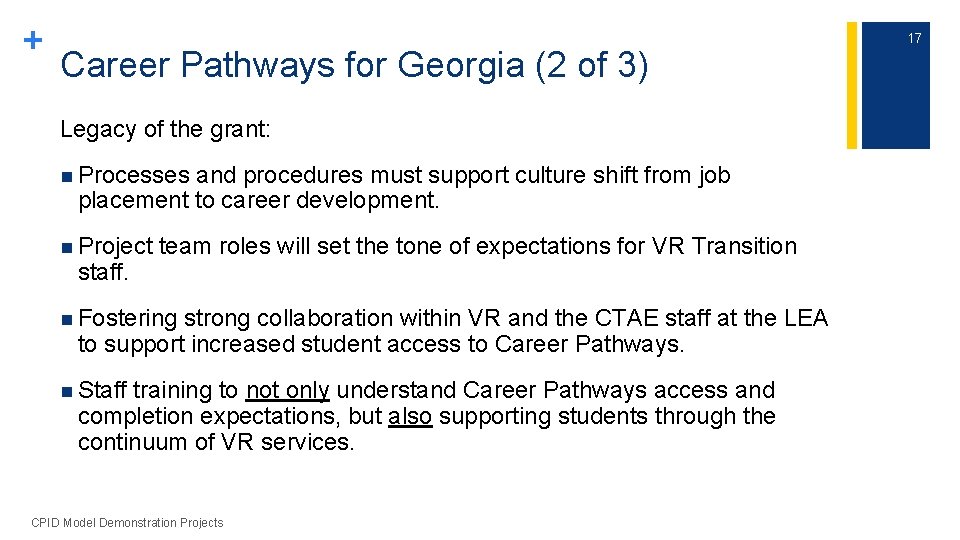
+ Career Pathways for Georgia (2 of 3) Legacy of the grant: n Processes and procedures must support culture shift from job placement to career development. n Project staff. team roles will set the tone of expectations for VR Transition n Fostering strong collaboration within VR and the CTAE staff at the LEA to support increased student access to Career Pathways. n Staff training to not only understand Career Pathways access and completion expectations, but also supporting students through the continuum of VR services. CPID Model Demonstration Projects 17
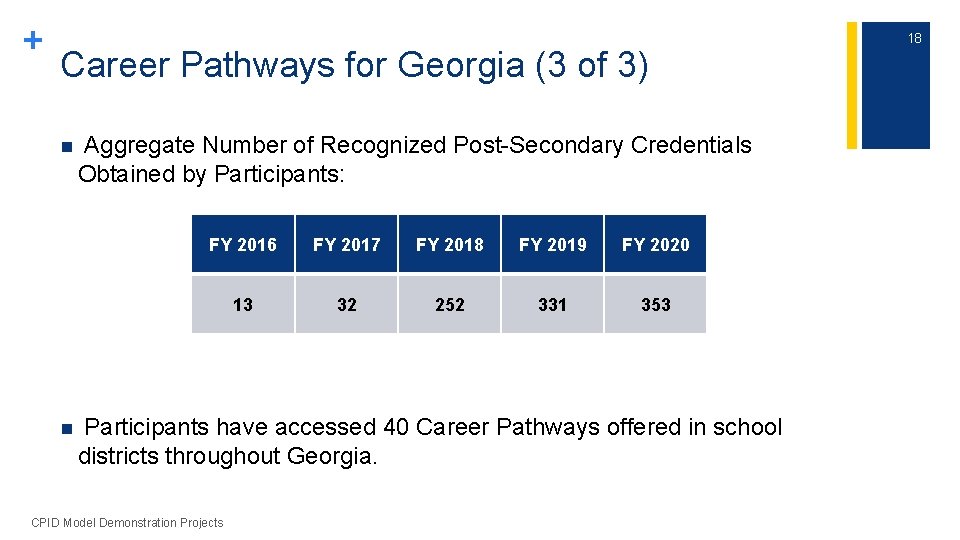
+ Career Pathways for Georgia (3 of 3) n n Aggregate Number of Recognized Post-Secondary Credentials Obtained by Participants: FY 2016 FY 2017 FY 2018 FY 2019 FY 2020 13 32 252 331 353 Participants have accessed 40 Career Pathways offered in school districts throughout Georgia. CPID Model Demonstration Projects 18

19 + Kentucky CPID Model Demonstration Projects

+ Kentucky CPID (1 of 3) Key Features n The role of the Career Pathways Coordinator n Career Pathways STEM events to provide quality Pre. Employment Transition Services n Employer Engagement through tours, reverse job fairs, work experiences, etc. n Value and necessity of workforce partnerships CPID Model Demonstration Projects 20

+ 21 Kentucky CPID (2 of 3) Participants 2017 2018 2019 # CPID participants added each year 720 326 323 # CPID participants in postsecondary training 168 237 294 Aggregate # of credentials earned 38 131 162 # CPID participants ready for employment 81 191 274 # CPID participants closed in employment 168 237 294 CPID Model Demonstration Projects

+ Jonathan’s Career Pathway 22 • OVR consumer from Pikeville, KY • Associates of Science Big Sandy Community Technical College • A+ Computer Repair, Cisco Networking Basic, and Cisco Networking Enhanced • Bachelor’s degree in Computer Information Systems from Morehead State • HTML, Java, C++, Visual Studio, Microsoft Office, Apache, CSS, Java. Script, and Alice Support Services addressed: • Personal Needs • Employability Skills • Job Entry Skills CPID Model Demonstration Projects

+ Kentucky CPID (3 of 3) Sustainability and Systems Change 1. Incorporate continuous staff development which encourages a Career Pathways approach to VR services and case management, with a focus on: n n (IPE) Plan development that promotes in-demand credential attainment and advancement in a career Referring consumers into workforce partner programs that enhance job readiness 2. Continue successful CPC services using VR Employer Services Branch staff to facilitate tours, work experiences 3. Use VR agency data to: n n Tell a story of our skilled, credentialed job seekers Provide timely targeted advising about job opportunities CPID Model Demonstration Projects 23
24 + Nebraska CPID Model Demonstration Projects
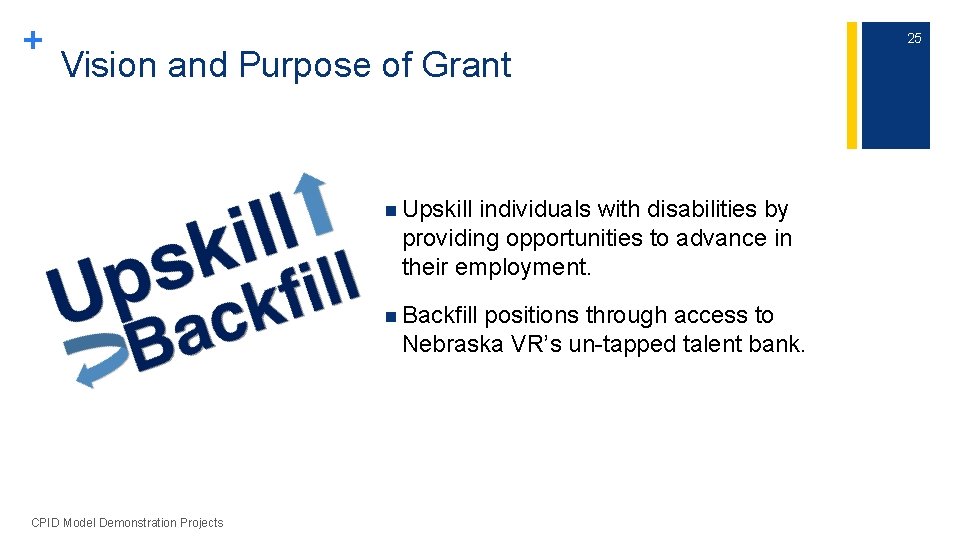
+ Vision and Purpose of Grant n Upskill individuals with disabilities by providing opportunities to advance in their employment. n Backfill positions through access to Nebraska VR’s un-tapped talent bank. CPID Model Demonstration Projects 25
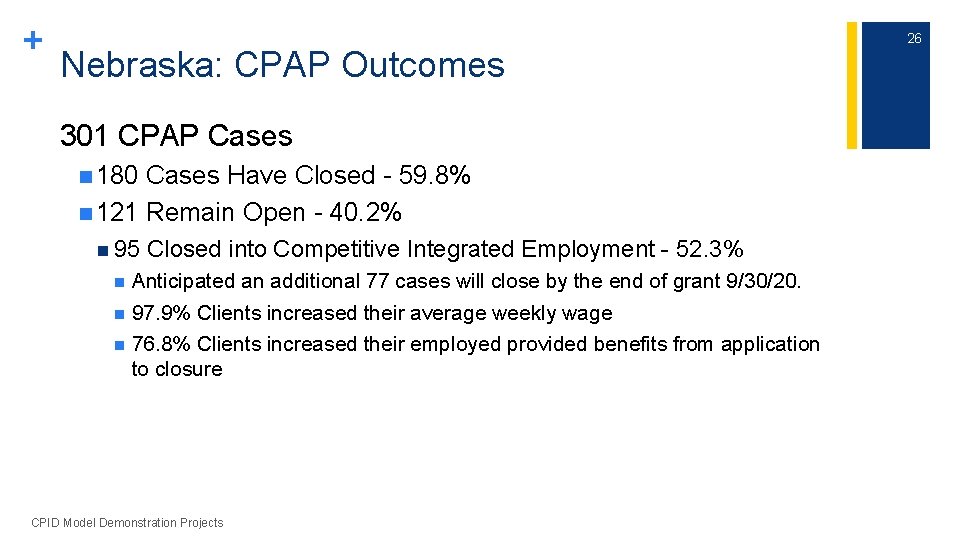
+ Nebraska: CPAP Outcomes 301 CPAP Cases n 180 Cases Have Closed - 59. 8% n 121 Remain Open - 40. 2% n 95 Closed into Competitive Integrated Employment - 52. 3% Anticipated an additional 77 cases will close by the end of grant 9/30/20. n 97. 9% Clients increased their average weekly wage n 76. 8% Clients increased their employed provided benefits from application to closure n CPID Model Demonstration Projects 26
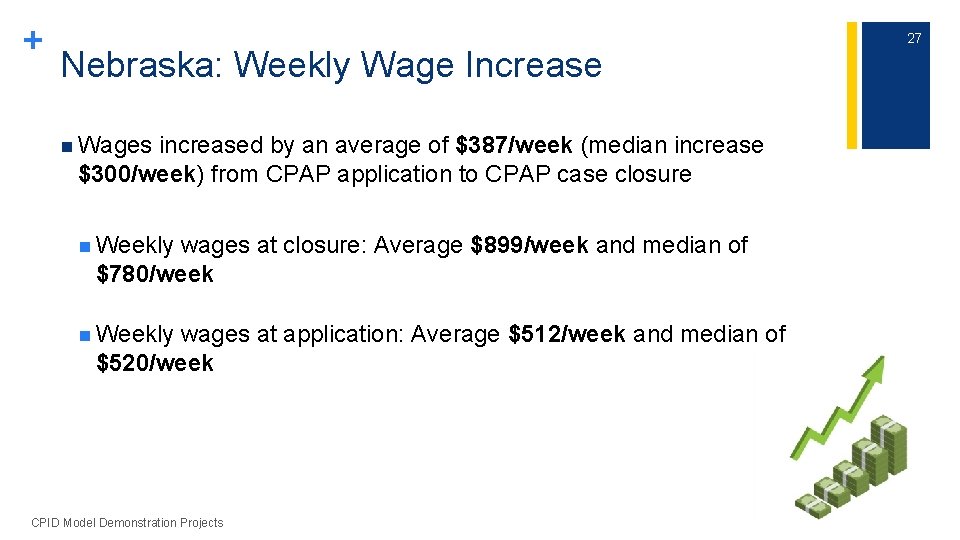
+ Nebraska: Weekly Wage Increase n Wages increased by an average of $387/week (median increase $300/week) from CPAP application to CPAP case closure n Weekly wages at closure: Average $899/week and median of $780/week n Weekly wages at application: Average $512/week and median of $520/week CPID Model Demonstration Projects 27
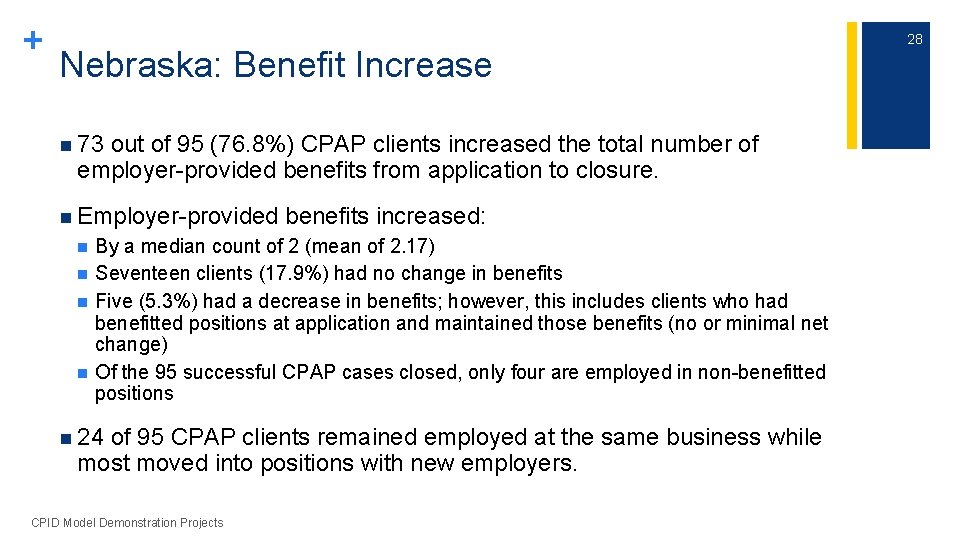
+ Nebraska: Benefit Increase n 73 out of 95 (76. 8%) CPAP clients increased the total number of employer-provided benefits from application to closure. n Employer-provided n n benefits increased: By a median count of 2 (mean of 2. 17) Seventeen clients (17. 9%) had no change in benefits Five (5. 3%) had a decrease in benefits; however, this includes clients who had benefitted positions at application and maintained those benefits (no or minimal net change) Of the 95 successful CPAP cases closed, only four are employed in non-benefitted positions n 24 of 95 CPAP clients remained employed at the same business while most moved into positions with new employers. CPID Model Demonstration Projects 28
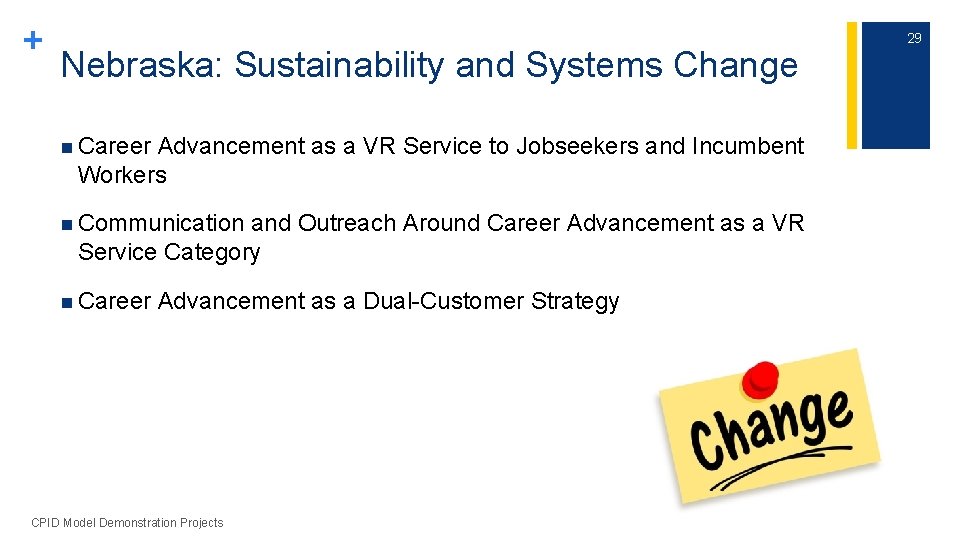
+ Nebraska: Sustainability and Systems Change n Career Advancement as a VR Service to Jobseekers and Incumbent Workers n Communication and Outreach Around Career Advancement as a VR Service Category n Career Advancement as a Dual-Customer Strategy CPID Model Demonstration Projects 29

30 + Virginia CPID Model Demonstration Projects

+ Virginia CPID Demographics n 73% are aged 14 -23 n 85% are MSD n Affected by OOS n Individuals n Both in Delayed Status DARS and DBVI CPID Model Demonstration Projects 31
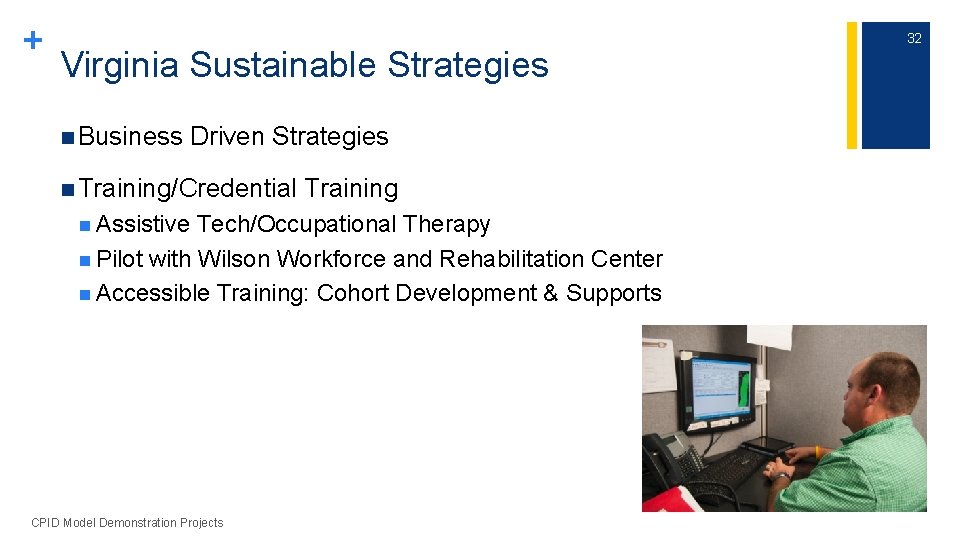
+ Virginia Sustainable Strategies n Business Driven Strategies n Training/Credential n Assistive Training Tech/Occupational Therapy n Pilot with Wilson Workforce and Rehabilitation Center n Accessible Training: Cohort Development & Supports CPID Model Demonstration Projects 32

+ Virginia WIOA Collaborations n Workforce n Adult Co-Enrolled Education n Partnerships with VCCS and other Training Providers n Relationships built with VA Manufacturing Association and Northern VA Technology Council CPID Model Demonstration Projects 33
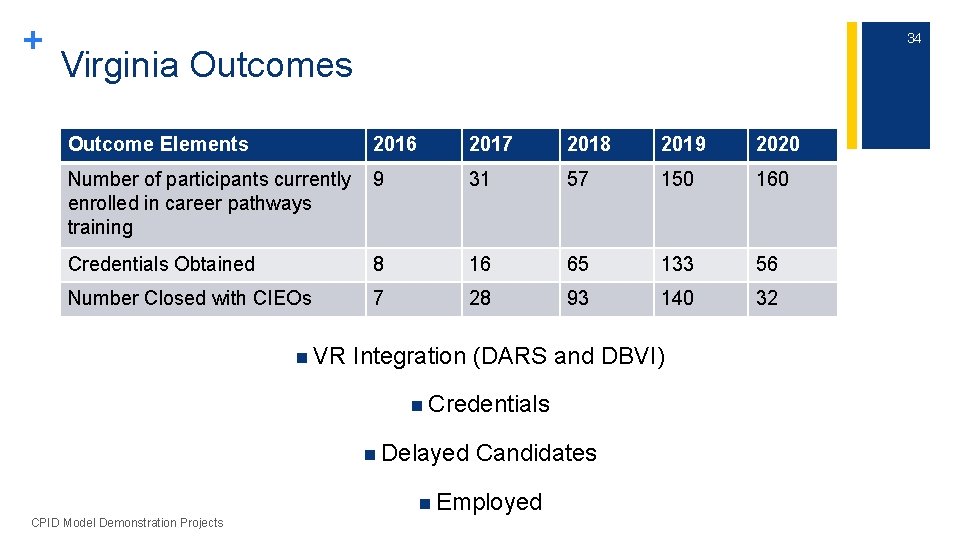
+ 34 Virginia Outcomes Outcome Elements 2016 2017 2018 2019 2020 Number of participants currently enrolled in career pathways training 9 31 57 150 160 Credentials Obtained 8 16 65 133 56 Number Closed with CIEOs 7 28 93 140 32 n VR Integration (DARS and DBVI) n Credentials n Delayed Candidates n Employed CPID Model Demonstration Projects
+ Stay Tuned n 2 page Information Sheet linked to webinar n Tool Kits n In-Depth Webinars CPID Model Demonstration Projects 35
+ For More Information n Georgia – Lee Bryan - Lee. Bryan@gvs. ga. gov n Kentucky – Helga Gilbert - Helga. Gilbert@ky. gov n Nebraska – Janet Drudik - Janet. Drudik@nebraska. gov n Virginia – Kate Kaegi - Kate. Kaegi@dars. virginia. gov CPID Model Demonstration Projects 36
+ Thank you!
- Slides: 37