
Career Management in Business Module 12 Victoria Hadfield
Career Management in Business Module 12 Victoria Hadfield February 2013
Today’s Agenda �Introduction to the module �What is Career Development? �Group Task – Identify the key skills needed for a successful career in business �Break �Plenary – Discuss key skills and prioritise �Introduction to Reflective Practice
Module Aim To help you develop a range of professional and personal skills in order to promote future personal and career development: �Personal and career development – self appraisal, development planning, portfolio building, building an effective c. v. �Evaluating progress – Aims, objectives, targets, monitoring and evaluating �Interpersonal and transferable skills – Problem-solving, verbal communication, time management �Self – Managed Learning – targets, learning styles, effective learning, assessment of learning
Group Task: Identify the key skills needed to build a successful career in business. Be prepared to justify your reasoning! Use Flip Chart/White board as you want
Ways of solving problems �Reflective Practice ◦ Reflection is somewhat ambiguous in the professional context ◦ TRANSFORMATIVE REFLECTION is better October 2020 5
Transformative Reflection �Snow White had a mirror to reflect in �It showed her what she might become �Snow White’s mirror uses the transformation from the unsatisfactory ‘what-is’ situation to the more effective ‘what could be’ October 2020 6
Models of reflection Critical Incident approach (David Tripp) � Reflective writing / learning journals (Jennifer Moon) � Free form, creative and imaginative writing (Gillie Bolton, Sue Wallace) � Gibbs – Reflective Cycle � October 2020 7
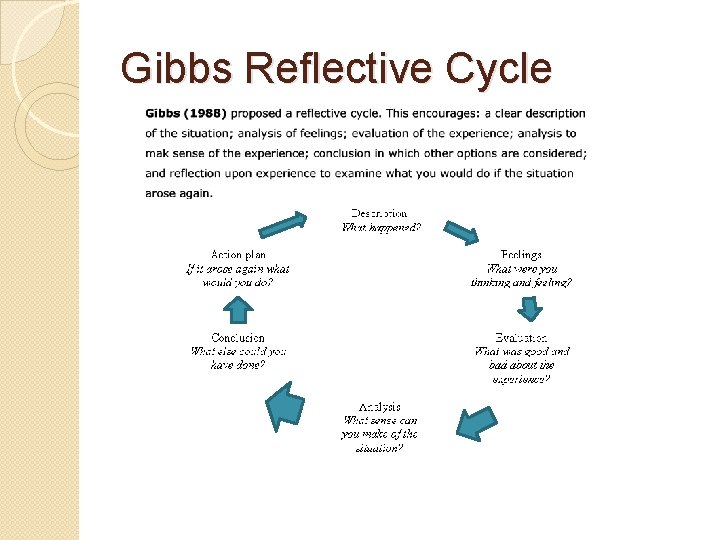
Gibbs Reflective Cycle
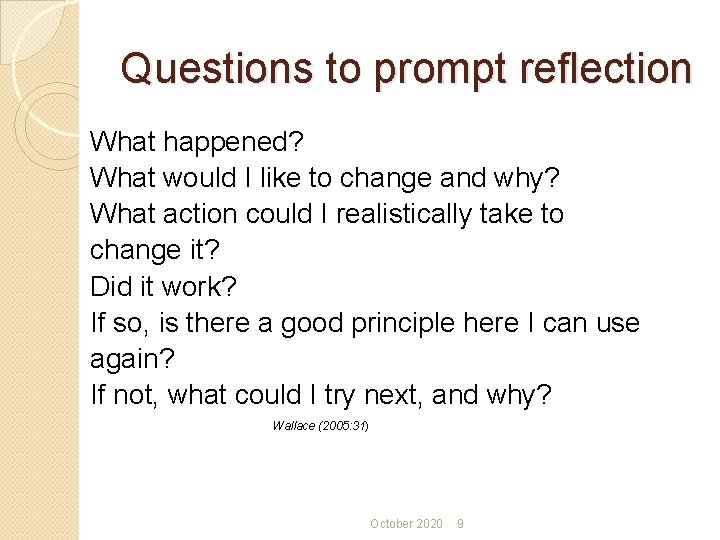
Questions to prompt reflection What happened? What would I like to change and why? What action could I realistically take to change it? Did it work? If so, is there a good principle here I can use again? If not, what could I try next, and why? Wallace (2005: 31) October 2020 9
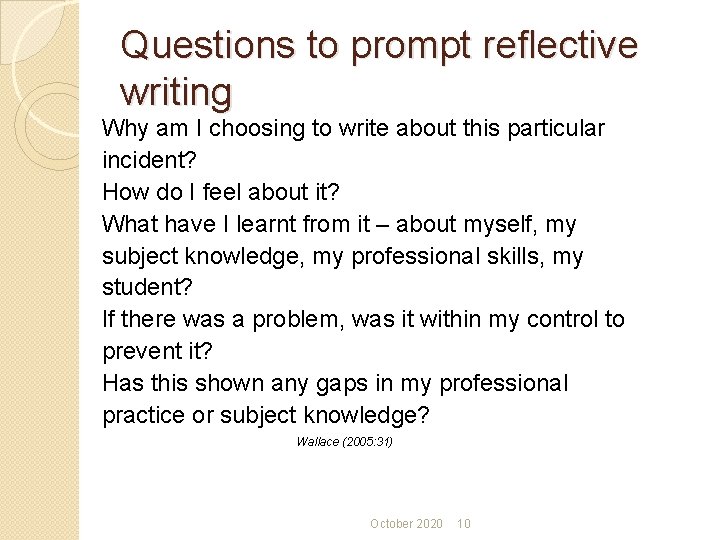
Questions to prompt reflective writing Why am I choosing to write about this particular incident? How do I feel about it? What have I learnt from it – about myself, my subject knowledge, my professional skills, my student? If there was a problem, was it within my control to prevent it? Has this shown any gaps in my professional practice or subject knowledge? Wallace (2005: 31) October 2020 10

Kolb’s Learning Cycle
- Slides: 11