
CARE Team Training Unified Homelessness Response Center September
CARE Team Training Unified Homelessness Response Center September, 2019 1
Agenda I. Welcome and Introductions II. Homelessness 101 Briefing III. About the CARE Plan IV. Team Mission V. Field Operations VI. About the UHRC VII. Team Safety 2
Welcome and introductions Meeting your new team. 3
Goals for Today’s Training ❏ ❏ Build familiarity with your team Learn about the goals of the CARE program Review and train for operations in the field Review best practices for team safety 4
Homelessness 101 5
6
7
8

9
10
11
12
13
14

Why do we outreach? ● We outreach to connect with those in the community that may have been forgotten by society and are experiencing homelessness. ● Our goal is to house people experiencing homelessness. ● We provide linkages to services like mental health care, physical health care, employment, veterans services, and substance use services. ● LAHSA’s Homeless Engagement Team (HET) provides direct outreach to individual experiencing homelessness throughout LA County. ● We inform people in the community of services that they may not know is available to them. 15
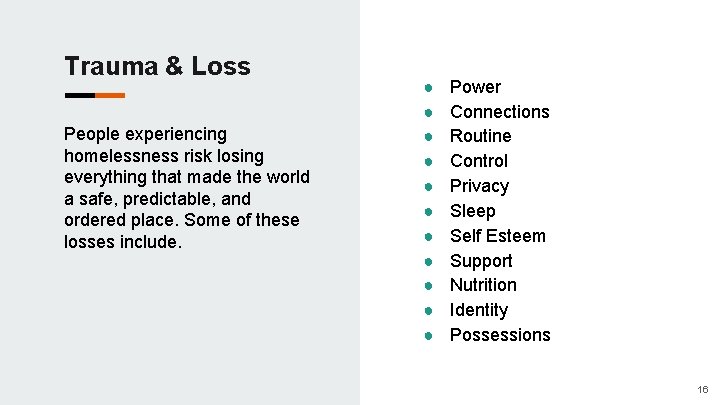
Trauma & Loss People experiencing homelessness risk losing everything that made the world a safe, predictable, and ordered place. Some of these losses include. ● ● ● Power Connections Routine Control Privacy Sleep Self Esteem Support Nutrition Identity Possessions 16
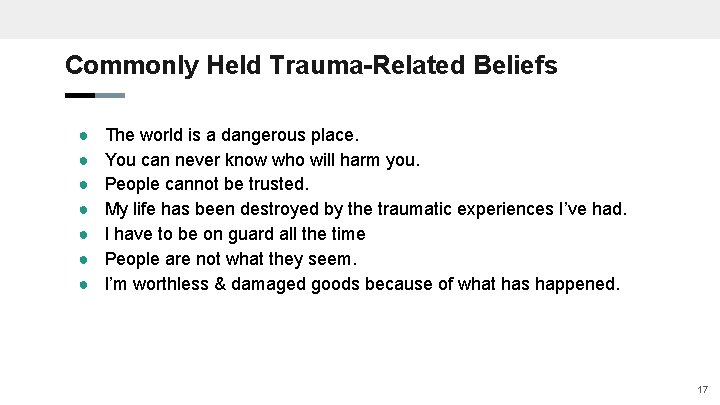
Commonly Held Trauma-Related Beliefs ● ● ● ● The world is a dangerous place. You can never know who will harm you. People cannot be trusted. My life has been destroyed by the traumatic experiences I’ve had. I have to be on guard all the time People are not what they seem. I’m worthless & damaged goods because of what has happened. 17
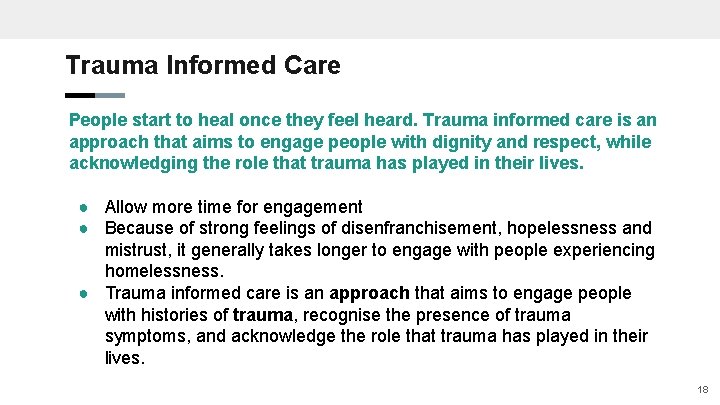
Trauma Informed Care People start to heal once they feel heard. Trauma informed care is an approach that aims to engage people with dignity and respect, while acknowledging the role that trauma has played in their lives. ● Allow more time for engagement ● Because of strong feelings of disenfranchisement, hopelessness and mistrust, it generally takes longer to engage with people experiencing homelessness. ● Trauma informed care is an approach that aims to engage people with histories of trauma, recognise the presence of trauma symptoms, and acknowledge the role that trauma has played in their lives. 18
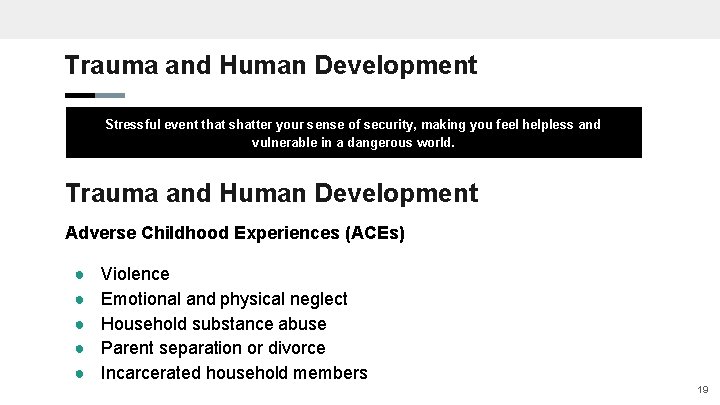
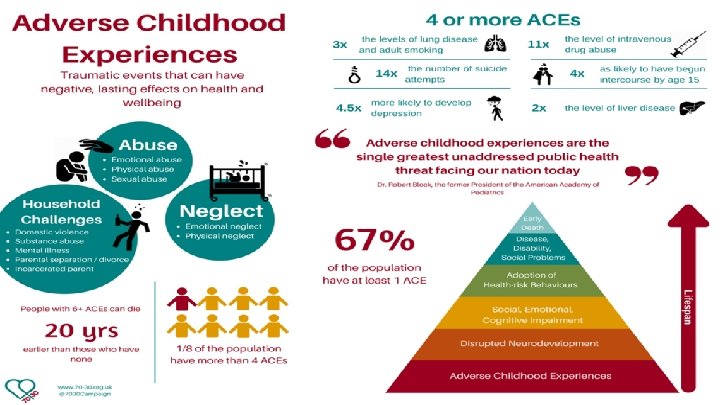
Trauma and Human Development Stressful event that shatter your sense of security, making you feel helpless and vulnerable in a dangerous world. Trauma and Human Development Adverse Childhood Experiences (ACEs) ● ● ● Violence Emotional and physical neglect Household substance abuse Parent separation or divorce Incarcerated household members 19
20

Language matters 21
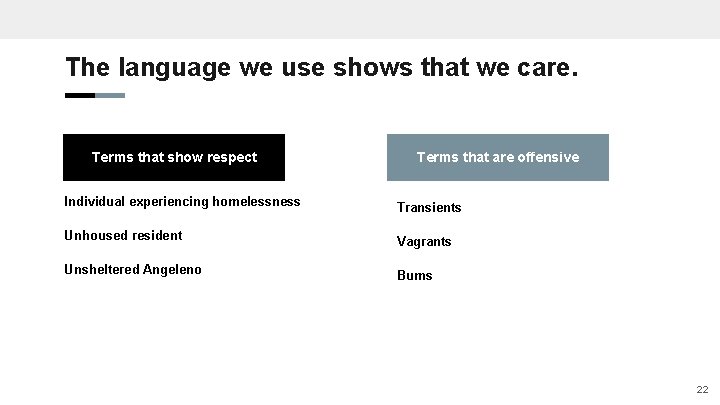
The language we use shows that we care. Terms that show respect Terms that are offensive Individual experiencing homelessness Transients Unhoused resident Vagrants Unsheltered Angeleno Bums 22

5 minute break 23
About the CARE plan 24
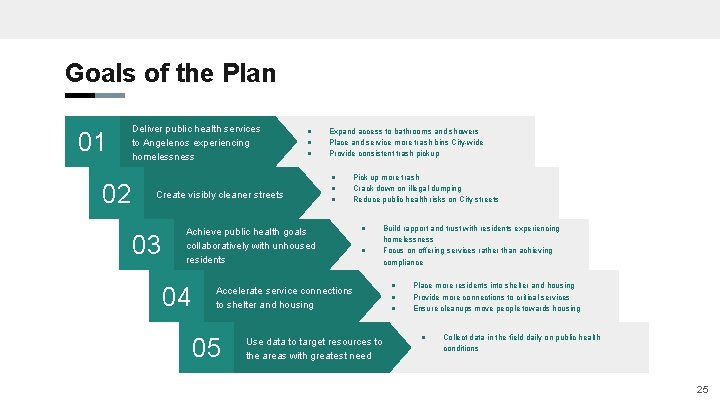
Goals of the Plan 01 02 Deliver public health services to Angelenos experiencing homelessness ● ● ● Create visibly cleaner streets 03 Expand access to bathrooms and showers Place and service more trash bins City-wide Provide consistent trash pickup ● ● ● Pick up more trash Crack down on illegal dumping Reduce public health risks on City streets Achieve public health goals collaboratively with unhoused residents 04 ● ● Accelerate service connections to shelter and housing 05 Use data to target resources to the areas with greatest need Build rapport and trust with residents experiencing homelessness Focus on offering services rather than achieving compliance ● ● ● Place more residents into shelter and housing Provide more connections to critical services Ensure cleanups move people towards housing ● Collect data in the field daily on public health conditions 25
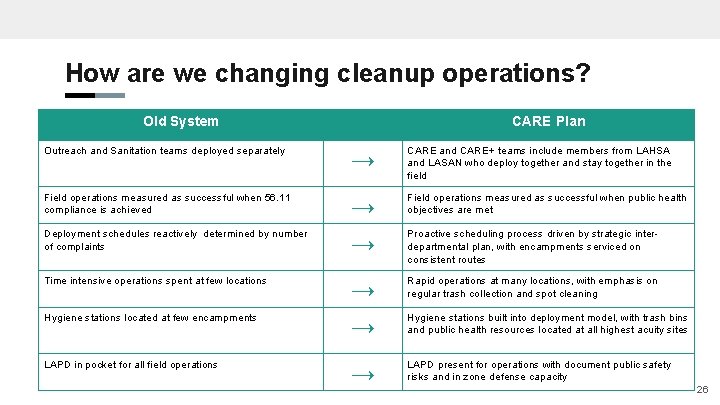
How are we changing cleanup operations? Old System CARE Plan Outreach and Sanitation teams deployed separately → CARE and CARE+ teams include members from LAHSA and LASAN who deploy together and stay together in the field Field operations measured as successful when 56. 11 compliance is achieved → Field operations measured as successful when public health objectives are met Deployment schedules reactively determined by number of complaints → Proactive scheduling process driven by strategic interdepartmental plan, with encampments serviced on consistent routes Time intensive operations spent at few locations → Rapid operations at many locations, with emphasis on regular trash collection and spot cleaning Hygiene stations located at few encampments → Hygiene stations built into deployment model, with trash bins and public health resources located at all highest acuity sites → LAPD present for operations with document public safety risks and in zone defense capacity LAPD in pocket for all field operations 26
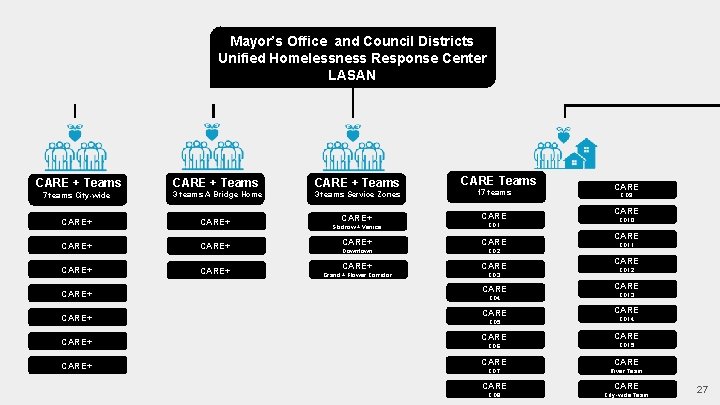
Mayor’s Office and Council Districts Unified Homelessness Response Center LASAN CARE + Teams 7 teams City-wide CARE + Teams 3 teams A Bridge Home 3 teams Service Zones 17 teams CARE+ CARE+ CARE+ CARE Teams CARE + Teams Skidrow + Venice CD 1 CARE+ CARE Downtown CD 2 CARE+ CARE Grand + Flower Corridor CD 3 CARE CD 4 CARE CD 9 CARE CD 10 CARE CD 11 CARE CD 12 CARE CD 13 CARE CD 5 CD 14 CARE CD 6 CD 15 CARE CD 7 River Team CARE CD 8 City-wide Team 27
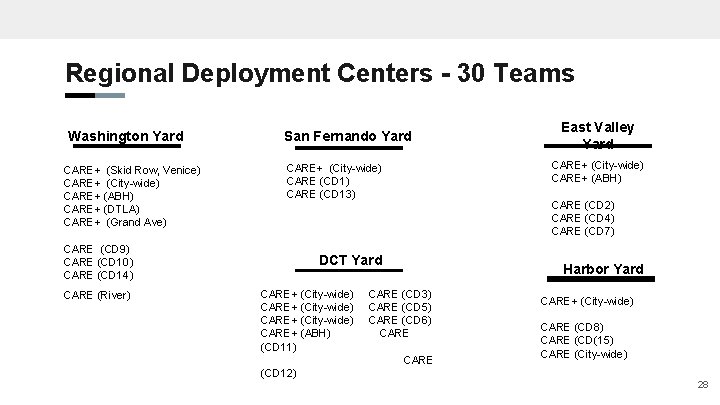
Regional Deployment Centers - 30 Teams Washington Yard CARE+ (Skid Row, Venice) CARE+ (City-wide) CARE+ (ABH) CARE+ (DTLA) CARE+ (Grand Ave) San Fernando Yard CARE (River) CARE+ (City-wide) CARE+ (ABH) CARE+ (City-wide) CARE (CD 13) CARE (CD 9) CARE (CD 10) CARE (CD 14) CARE (CD 2) CARE (CD 4) CARE (CD 7) DCT Yard CARE+ (City-wide) CARE+ (ABH) (CD 11) Harbor Yard CARE (CD 3) CARE (CD 5) CARE (CD 6) CARE (CD 12) East Valley Yard CARE+ (City-wide) CARE (CD 8) CARE (CD(15) CARE (City-wide) 28
Team Mission 29
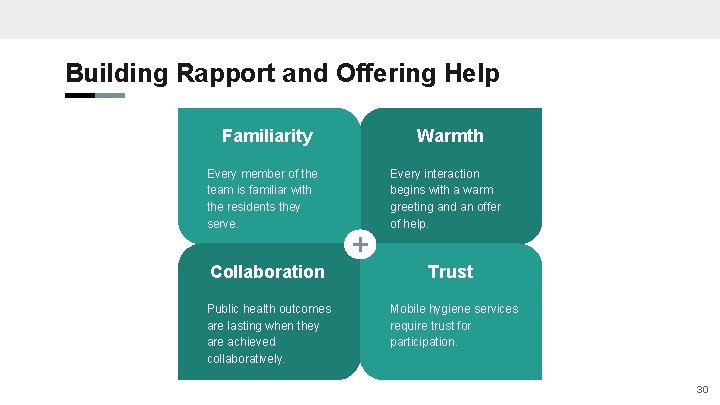
Building Rapport and Offering Help Familiarity Every member of the team is familiar with the residents they serve. Warmth Every interaction begins with a warm greeting and an offer of help. Collaboration Trust Public health outcomes are lasting when they are achieved collaboratively. Mobile hygiene services require trust for participation. 30
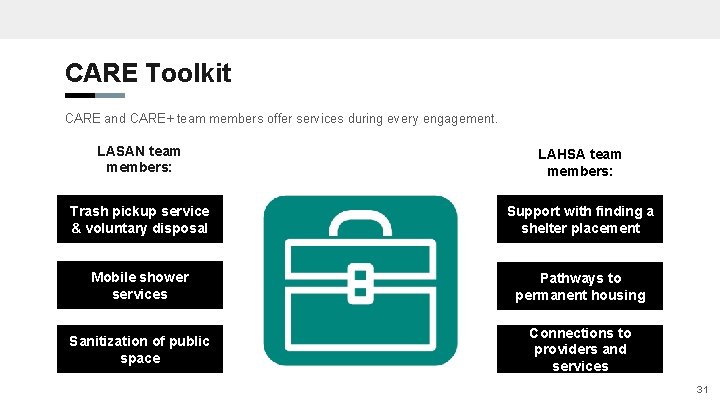
CARE Toolkit CARE and CARE+ team members offer services during every engagement. LASAN team members: LAHSA team members: Trash pickup service & voluntary disposal Support with finding a shelter placement Mobile shower services Pathways to permanent housing Sanitization of public space Connections to providers and services 31
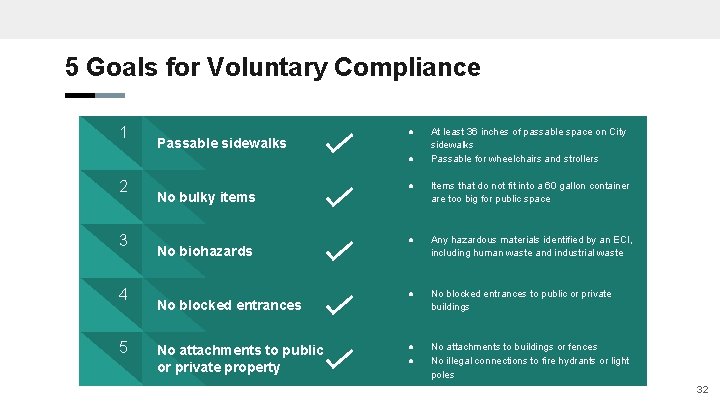
5 Goals for Voluntary Compliance 1 Passable sidewalks ● ● 2 3 4 5 No bulky items No biohazards No blocked entrances No attachments to public or private property At least 36 inches of passable space on City sidewalks Passable for wheelchairs and strollers ● Items that do not fit into a 60 gallon container are too big for public space ● Any hazardous materials identified by an ECI, including human waste and industrial waste ● No blocked entrances to public or private buildings ● ● No attachments to buildings or fences No illegal connections to fire hydrants or light poles 32
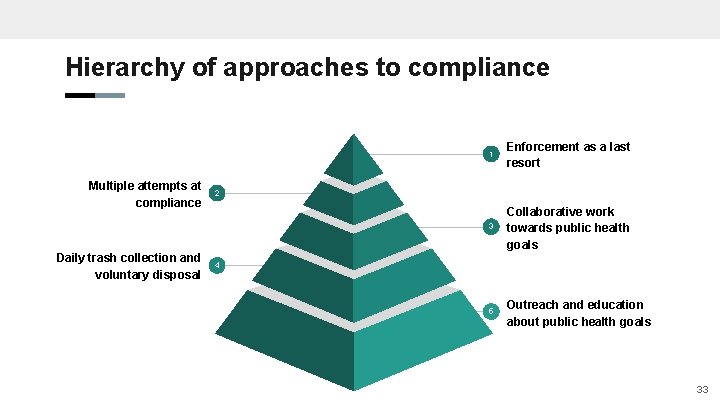
Hierarchy of approaches to compliance Multiple attempts at compliance Daily trash collection and voluntary disposal 1 Enforcement as a last resort 3 Collaborative work towards public health goals 5 Outreach and education about public health goals 2 4 33
Measuring Performance Compliance with the municipal code is not the leading objective of CARE deployment. Team performance will be measured against three key metrics: 1. Improved public health conditions 2. Service connections 3. Visible improvements to City streets Performance data includes: ● Changes measured through environmental conditions assessments ● HMIS service connection and housing data 34
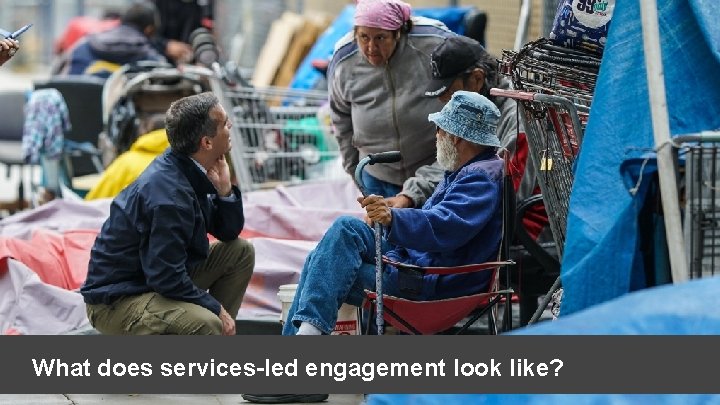
What does services-led engagement look like? 35

Team Exercise 36
Writing your team’s mission statement Guiding questions: ● What region are you serving and what are the needs of the community? ● How will you build trust and rapport with the Angelenos experiencing homelessness? ● What words do you want the neighborhood you serve to use to describe your team’s work? ● What will the legacy of your team be? 37
CARE Field Operations 38
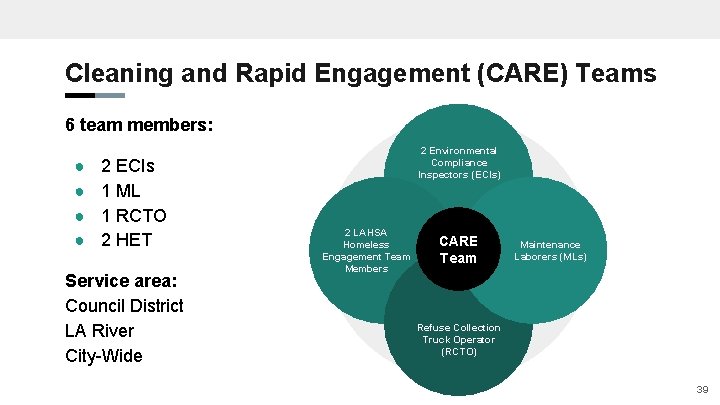
Cleaning and Rapid Engagement (CARE) Teams 6 team members: ● ● 2 ECIs 1 ML 1 RCTO 2 HET Service area: Council District LA River City-Wide 2 Environmental Compliance Inspectors (ECIs) 2 LAHSA Homeless Engagement Team Members CARE Team Maintenance Laborers (MLs) Refuse Collection Truck Operator (RCTO) 39
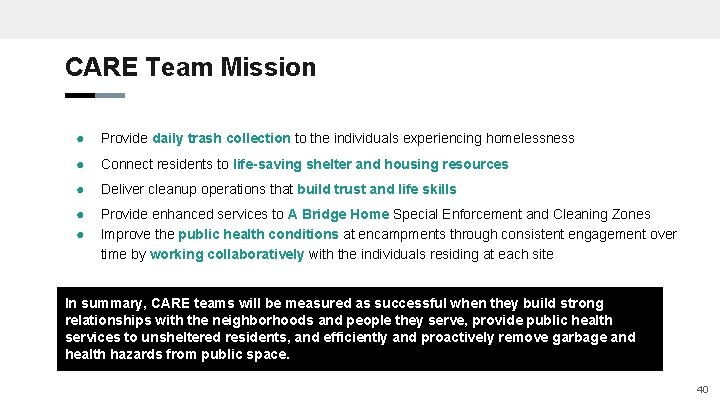
CARE Team Mission ● Provide daily trash collection to the individuals experiencing homelessness ● Connect residents to life-saving shelter and housing resources ● Deliver cleanup operations that build trust and life skills ● ● Provide enhanced services to A Bridge Home Special Enforcement and Cleaning Zones Improve the public health conditions at encampments through consistent engagement over time by working collaboratively with the individuals residing at each site In summary, CARE teams will be measured as successful when they build strong relationships with the neighborhoods and people they serve, provide public health services to unsheltered residents, and efficiently and proactively remove garbage and health hazards from public space. 40
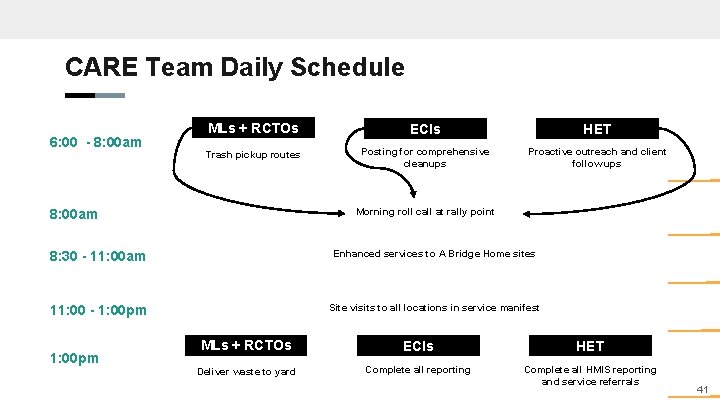
CARE Team Daily Schedule 6: 00 - 8: 00 am MLs + RCTOs ECIs HET Trash pickup routes Posting for comprehensive cleanups Proactive outreach and client follow ups Morning roll call at rally point 8: 00 am 8: 30 - 11: 00 am Enhanced services to A Bridge Home sites 11: 00 - 1: 00 pm Site visits to all locations in service manifest 1: 00 pm MLs + RCTOs ECIs HET Deliver waste to yard Complete all reporting Complete all HMIS reporting and service referrals 41
Trash Pickup Routes ● From 6: 00 - 8: 00 am, RCTO and ML on each CARE team will drive a standard trash collection route. ● At each encampment along the route, the team will collect bagged trash left out by residents at the designated pickup location in clearly demarcated green LASAN trash bags. ● The team will leave behind replacement trash bags for residents to fill before the next service day. ● If teams encounter a site with loose litter that is not on their service manifest for the week, they will provide spot cleaning services. ● The goal for this operation is to rapidly move between many encampments to provide the service broadly. 42
Roll Call and Rally Point CARE Teams will assemble at their designated rally at 8: 00 am to begin joint operations. Teams will review: ❏ Daily schedule available in the service manifest in the CARE team’s LASAN mobile app ❏ ECI update on locations for the day and public health goals ❏ LAHSA update on outreach progress and daily goals ❏ LAHSA flags on behavioral health, safety, or sensitivities for the day’s deployment ❏ LAPD updates on public safety flags ❏ Review call signs for the day Following roll call, teams will caravan in the field together to their first service location. 43
Team Introductions Following HET’s report back to the CARE team, HET will introduce all CARE team members to the residents at the site. CARE team members will: ● Introduce themselves ● Build rapport with individuals at the site ● Offer public health services 44
Voluntary Disposal CARE team will remove any trash or items that individuals at the site want to dispose of. CARE team will help prepare residents to participate in regular trash pickup: ● ● ECIs and LASAN crew will lead a conversation with residents of the encampment on how to prepare for a regular trash pickup program LASAN will present demarcated green LASAN trash bags to residents ECIs will review rules for what can and cannot be placed inside the bags, and the schedule on which trash bags will be picked up CARE team will work with residents of the encampment to determine the pickup location where trash bags will be placed curbside for pickup 45
Public Health and Safety Operations In addition to voluntary disposal, CARE teams will work collaboratively with the individuals residing at each location to improve the public health and safety conditions at the location. LAHSA and LASAN team members will work together to educate individuals on what site conditions goals they will work together to achieve, and which belongings will need to change in order to achieve compliance Team will assist individuals in making changes if they are ready to do so, or will notify individuals at the site when compliance will need to begin 46
End of day briefing CARE Teams will assemble in the field following their final operation to review the following: ❏ Requests for additional services that need to be referred to the UHRC ❏ Lessons learned for the next engagement at each site ❏ Rally location for the next service day After the briefing, the team will ensure that all members have safely departed the area. 47

10 minute break 48
CARE+ Field Operations 49
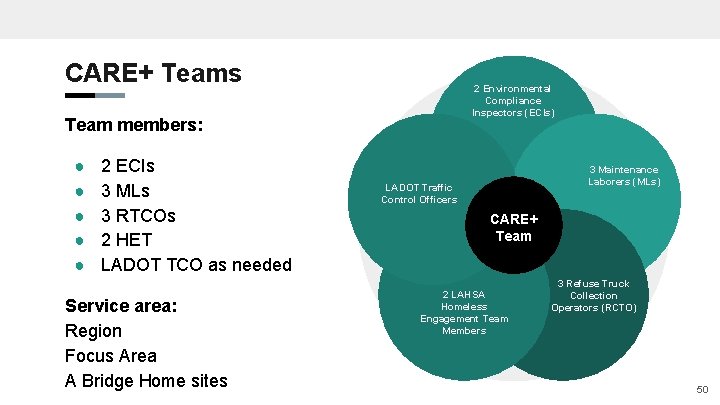
CARE+ Teams 2 Environmental Compliance Inspectors (ECIs) Team members: ● ● ● 2 ECIs 3 MLs 3 RTCOs 2 HET LADOT TCO as needed Service area: Region Focus Area A Bridge Home sites 3 Maintenance Laborers (MLs) LADOT Traffic Control Officers CARE+ Team 2 LAHSA Homeless Engagement Team Members 3 Refuse Truck Collection Operators (RCTO) 50
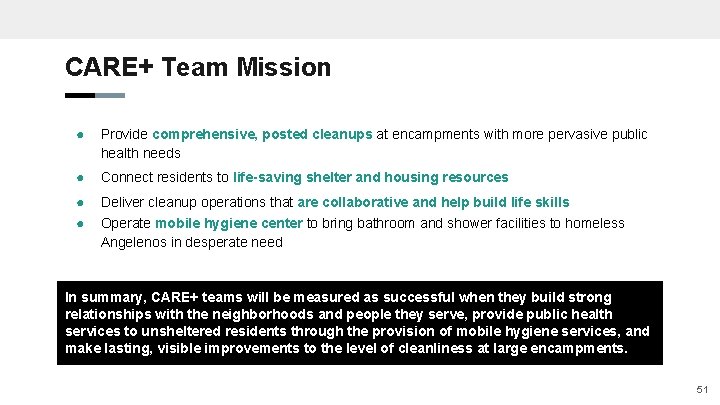
CARE+ Team Mission ● Provide comprehensive, posted cleanups at encampments with more pervasive public health needs ● Connect residents to life-saving shelter and housing resources ● ● Deliver cleanup operations that are collaborative and help build life skills Operate mobile hygiene center to bring bathroom and shower facilities to homeless Angelenos in desperate need In summary, CARE+ teams will be measured as successful when they build strong relationships with the neighborhoods and people they serve, provide public health services to unsheltered residents through the provision of mobile hygiene services, and make lasting, visible improvements to the level of cleanliness at large encampments. 51
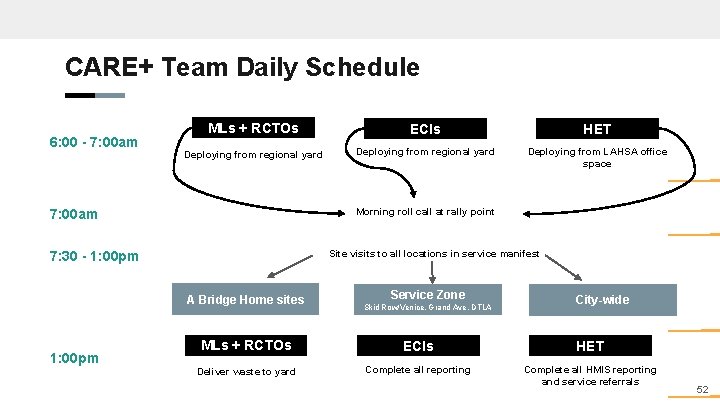
CARE+ Team Daily Schedule 6: 00 - 7: 00 am MLs + RCTOs ECIs HET Deploying from regional yard Deploying from LAHSA office space Morning roll call at rally point 7: 00 am Site visits to all locations in service manifest 7: 30 - 1: 00 pm A Bridge Home sites 1: 00 pm Service Zone Skid Row/Venice, Grand Ave, DTLA City-wide MLs + RCTOs ECIs HET Deliver waste to yard Complete all reporting Complete all HMIS reporting and service referrals 52
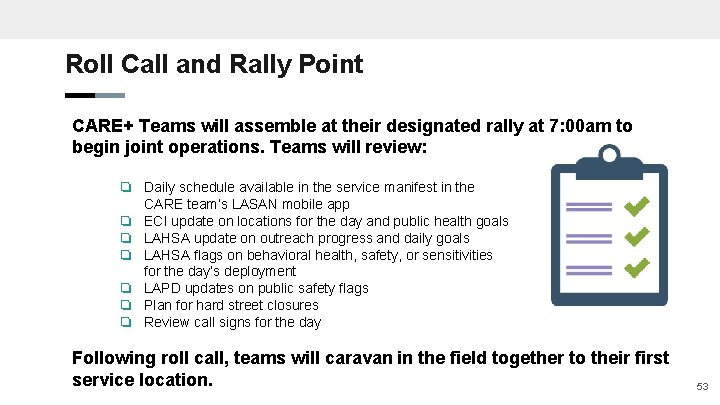
Roll Call and Rally Point CARE+ Teams will assemble at their designated rally at 7: 00 am to begin joint operations. Teams will review: ❏ Daily schedule available in the service manifest in the CARE team’s LASAN mobile app ❏ ECI update on locations for the day and public health goals ❏ LAHSA update on outreach progress and daily goals ❏ LAHSA flags on behavioral health, safety, or sensitivities for the day’s deployment ❏ LAPD updates on public safety flags ❏ Plan for hard street closures ❏ Review call signs for the day Following roll call, teams will caravan in the field together to their first service location. 53
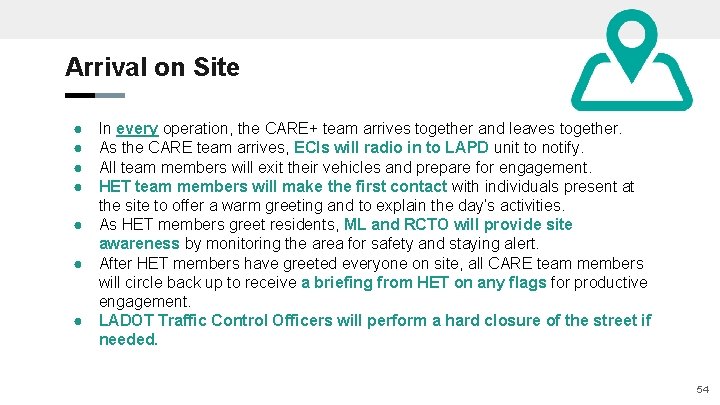
Arrival on Site ● ● In every operation, the CARE+ team arrives together and leaves together. As the CARE team arrives, ECIs will radio in to LAPD unit to notify. All team members will exit their vehicles and prepare for engagement. HET team members will make the first contact with individuals present at the site to offer a warm greeting and to explain the day’s activities. ● As HET members greet residents, ML and RCTO will provide site awareness by monitoring the area for safety and staying alert. ● After HET members have greeted everyone on site, all CARE team members will circle back up to receive a briefing from HET on any flags for productive engagement. ● LADOT Traffic Control Officers will perform a hard closure of the street if needed. 54
Safe area for belongings The lead ECI for the operation, in consultation with HET, will designate a safe area where individuals can place their belongings during the cleanup that will not be disposed of. Individuals may not bring bulky items or objects that pose a public health risk into the safe area. The lead ECI on site will have the final determination on what may enter the safe area. 55
Preparation for cleaning Individuals will be given up to 30 minutes to relocate their belongings into the safe area, or away from the site if they choose. During this time, team members may assist by encouraging individuals to move their belongings, and help provide clarity on the public health goals. If the CARE+ team is working with an individual with a disability, the HET will be responsible to providing reasonable accommodations to the individual. The HET will also call the UHRC to consult with the UHRC’s representative from the Department on Disability to help connect the individual with additional resources. 56
Mobile Hygiene Centers September: 1 st mobile hygiene center arrives September - October: CARE+ team pilots the program, and determines best practices November: CARE+ teams operative 5 hygiene centers January: CARE+ teams operate 7 hygiene centers Long-term: Every CARE+ team operates one hygiene center 57

Guidelines for Contingencies 58
Refusal to comply If the CARE or CARE+ team encounters an individual who refuses to comply or work towards voluntary compliance, the team will notify the individual of the next date that they will return, and will lay out the expectations for what will need to be changed at the next visit. The CARE or CARE+ team will document the attempt at voluntary compliance in the LASAN mobile app, and will return to take enforcement actions as needed at the next visit. 59
Refusal to relinquish a biohazard If a CARE or CARE+ team encounters an individual who refuses to relinquish a biohazardous material that will negatively impact the health of the individual or community, the CARE or CARE+ team will attempt to use de-escalation training to achieve voluntary compliance. If attempts at deescalation are unsuccessful, the team will radio for LAPD backup and law enforcement will follow Department operations to achieve compliance. 60
More extensive intervention needed When multiple attempts at collaboratively improving public health conditions or egress are not successful, CARE teams may request a visit from a CARE+ team to improve site conditions by flagging the need for additional services by calling the UHRC. Illegal connections in the field If teams encounter illegal taps into a fire hydrant or light pole, the ECI will immediately report the hazard by calling the UHRC. 61
Unattended property ECIs will determine whether the belongings pose an imminent threat to public health or safety. If the items constitute a biohazard, they will be removed from public space. If the items do not constitute a biohazard and do not obstruct egress, the LAHSA team members will work to locate the owners of the belongings. If the individual cannot be located, the CARE or CARE+ team will leave posted notice on the belongings notifying the owner of the planned date of return, and the benchmarks that will need to be met to achieve compliance. 62
Bulky item structure When a bulky item structure is found during operations, LAHSA will work to engage with the owner of the structure. LASAN will post the item with a 24 hour notice of removal. On the next available business day, the CARE or CARE+ team will return to the structure and will work with the owner - if present - to remove the structure. The CARE or CARE+ team will work to provide a shelter placement or service referral. 63
Data and Reporting 64
CARE and CARE+ Data Reporting What does data-driven deployment mean? Because we have limited resources to address wide-scale needs, we are all responsible for helping to target resources to the areas of greatest need. This means that data recorded in the field by every team is critical to the City’s success. Your data inputs will be integral to the way we measure the performance of your team. 65
LASAN Team Members Data Reporting Environmental Conditions Assessments Teams may be instructed to conduct environmental conditions assessments using the LASAN mobile tablet. Collection reports Following each engagement, ECIs will report on what they have collected from the field and how the team reached decisions on what to store, leave, or dispose of. 66
LAHSA Team Members Data Reporting Homeless Management Information System (HMIS) HET members are responsible for completing data entry in the field to report on services provided. Data on service referrals, housing placements, and shelter placements will help measure the team’s impact 67
The Unified Homelessness Response Center 68
UHRC Support for Field Teams The Unified Homelessness Response Center (UHRC) is on call to triage questions and requests directly from CARE and CARE+ teams. The UHRC can be called when additional resources are needed on site, including: ● Outreach assistance and shelter placements ● Behavioral health services ● Sanitation equipment or crews ● Animal services support ● DOT support to redirect traffic or make hard street closures ● Disability services The UHRC can also triage incoming requests for guidance or direction related to: ● Reaching a decision on how to implement L. A. M. C. 56. 11 ● Reaching a decision on whether to enact rainy day protocols ● Providing reasonable accommodations to an individual with a disability Contact the UHRC: Phone: 213 -484 -4855 | E-mail: UHRC@lacity. org 69

A Bridge Home 70
A Bridge Home Operations Every Council District will have at least one A Bridge Home program over the next year. Every A Bridge Home site has a Special Enforcement and Cleaning Zone that receives: ● 4 days a week of CARE team services ● 1 day a week of CARE+ team services Prior to your A Bridge Home program opening, the UHRC team will join you in the field for an operations planning meeting to ensure you are ready to provide services to the site. 71
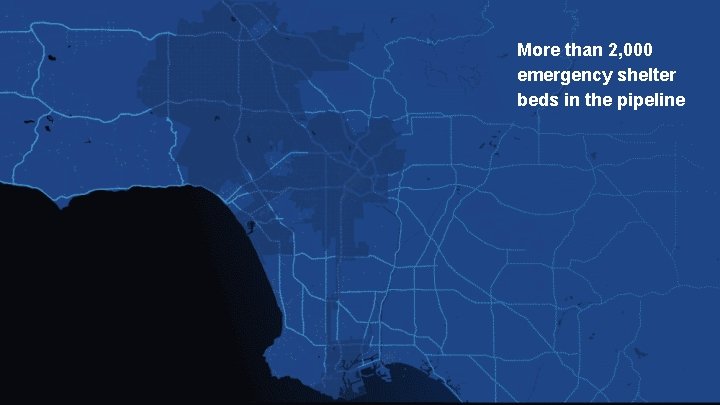
More than 2, 000 emergency shelter beds in the pipeline
Team Safety 73
LAPD’s Role ● Each team conducting operations in encampments will continue to have dedicated LAPD protection. ● Under the CARE plan, the LAPD unit assigned to partner with each CARE team will be protecting the zone around the CARE operation. ● LAPD will not arrive on scene with the CARE team, but will be radioconnected to the CARE team at all times. ● LAPD will provide safety information during daily team roll call and will maintain constant radio communication. If at any time the CARE team needs law enforcement on scene, LAPD will be radioed in for rapid arrival on site. 74
LAPD deployment during CARE operations LAPD HOPE Officers will have primary responsibility to respond to requests from CARE Teams ● There are 4 HOPE teams, one team per LAPD Bureau (Central, South, West and Valley) ● We have 42 HOPE Officers and 4 HOPE Sergeants between the 4 teams ● HOPE officers have been through LAPD de-escalation training and have been working with LAHSA and LASAN as rapid response teams Central Division has their own dedicated team known as RESET ● RESET officers are assigned specifically to the Skid Row Area 75
Zone Coverage LAPD HOPE Officers will be assigned in a “Zone” to provide coverage for your CARE Team ● The HOPE team will monitor the radios Sanitation has been assigned ● One HOPE unit will be assigned to monitor multiple CARE and CARE+ teams ● The HOPE unit will stay within the proximity of the CARE & CARE+ teams ● If you request an additional unit, the HOPE unit will respond ● If your request is more of an emergency (you request a back-up or help) the HOPE unit will respond, other patrol units in the area will also respond (another divisional unit may get there first) 76
Zone Coverage continued If HOPE unit or any LAPD unit responds to your request ● Allow the HOPE/ LAPD unit to take lead/ control of the scene ● Meet up with the LAPD unit and advise them why they were called in ● Be mindful of any tactical situation which may develop, try to back off to a safe location and let the officers deal with the situation at hand ● Once the officers determine there is a “Code-4” they will leave the location and go back into zone coverage 77
Morning Briefing Talk about any safety concerns ● Many of these sites have been visited before ● If there were prior concerns, talk about them PD will be able to give some insight of any prior safety issues at the site If you have a reason why you believe the site is not safe to approach without PD, let the HOPE team know 78
Situational Awareness When you arrive at scene, we request the Solids Lead to keep an eye out on what is going on with the entire CARE team. Solids lead should have an LAPD radio and will be expected to communicate with PD if needed LAHSA and ECI’s will be engaged, you are their eyes and ears. Remain VIGILANT! 79

Hand Signals Hold up Gather Up 80
Call Signs You will be given a call sign to use when on the radio This should be the same call sign each day you are working Example CARE 101 Your radio designation will be based on the LAPD Bureau you are working ● ● CARE 100 series will be Central Bureau (CARE 101, CARE 102 ect. ) CARE 200 series will be Valley Bureau (CARE 201, CARE 202 ect. ) CARE 300 series will be South Bureau (CARE 301, CARE 302 ect. ) CARE 400 series will be West Bureau (CARE 401, CARE 402 ect. ) 81
Radio Communications Environmental Compliance Inspectors/ Solids are radio trained and will carry a radio with direct connection to your dedicated HOPE detail at all times. ● Each team will have 2 radios ● When you get to a location, please radio in where you are ○ CARE 101 we are code-6 (at scene) at 1 st and Hill ● When you leave a location, please radio in you are clear ○ CARE 101 we are clear from 1 st and Hill 82
Radio Communications continued When broadcasting on the radio, try to give as much information, description of what you need ● Example “CARE 101 can we get a back-up to respond to 1 st and Main Street. ” (PAUSE) “We have a male, armed with a knife, he is sitting down in a tent not approaching us, . He is in a blue tent on the north/ west corner of 1 st and Main Street” 83
Radio Communications continued 120. 40 RADIO CODES AND PROCEDURES. The following codes and phrases shall be used, when applicable, in local radio transmissions: ● ● ● Officer Needs Help. This emergency call shall be broadcast when an officer requires immediate aid for a life-threatening incident or an incident that requires immediate aid because of serious bodily injury, death, or a serious threat to public safety is imminent. The officer requesting shall include the location, followed if possible, by the unit identification and all other pertinent information. A specific unit shall be dispatched “Code Three” and all additional responding units may also respond “Code Three. ” Firefighter Needs Help. This emergency call shall be broadcast when immediate police assistance is required because firefighters are being attacked, attack is imminent, or other emergency exists. A specific unit shall be dispatched "Code Three" and all additional responding units may also respond “Code Three. ” Firefighter Needs Assistance. This emergency call shall be broadcast when police assistance is required due to hostile crowd action or other incident. A specific unit shall be dispatched "Code Three" and all additional responding units may also respond “Code Three. ” Back‑up Unit Request. This emergency call shall be broadcast when an officer requires additional units immediately, but the situation does not rise to the level where serious bodily injury, death or serious threat to public safety is imminent. Additional Unit Request. An “Additional Unit” broadcast is when an officer requires an additional unit for a non-emergency situation. The officer requesting shall include the location, followed by the unit identification and all other pertinent information. An “additional unit” request is not an emergency call and responding officers shall obey all traffic laws when responding. 84
Radio Communications continued When you have completed operations in the field, call in to the UHRC to close out for the day. We want to make sure not to leave any CARE units out there without us knowing about it Prior to calling the UHRC or after you call, go on the radio and say: CARE 101 we are clear from (your last location) and end of watch 85
De-Escalation You all will be going through/ or have gone through De-Escalation training Remember your de-escalation techniques ● Give choices, speak in a calm tone, be respectful Disengagement is always a viable option ● Back-off ● Go to a safe location, wait for PD to arrive 86

Simulations 87
Simulation 1 Your team arrives on site and meets an individual who has accumulated belongings that are fully blocking the sidewalk. Your team discusses a few public health and egress goals with him, but he states that he is uninterested in working with the team. What is your next step? 88
Simulation 2 Your team arrives on site, but no one is present. There is loose litter and several bulky items. What action will your team take? 89
Simulation 3 You encounter a tent that has small amount of biohazardous material inside, but the owner of the tent is not present. What is your next step? 90
Simulation 4 What is a scenario that you have already encountered in the field? 91

Addendum 92
Roles and Responsibilities Homeless Engagement Team: ● Be the first point of contact with unsheltered population at each location, explain why teams are on-site that day ● Offer connections to services, shelter, and housing ● Provide guidance and expertise on productive engagement at each site to ensure that CARE team engagement moves people forward on their pathway to housing ● Advise on historical successes and challenges with engagement at each site ● Support LASAN in achieving public health goals ● Advise if teams should return another day 93
Roles and Responsibilities Maintenance Laborer: ● Support LAHSA in making positive contacts with individuals at each location in service area ● Build rapport with individuals at each site ● Perform maintenance labor with guidance from ECIs ● Maintain site awareness for team safety Refuse Collection Truck Operators: ● Support LAHSA in making positive contacts with individuals at each location in service area ● Load and unload refuse collection vehicles ● Maintain site awareness for team safety 94
Roles and Responsibilities Environmental Compliance Inspector: ● Support LAHSA in making positive contacts with individuals at each location in service area ● Retain records of operations at each site ● Make final decisions on items to remain in public space, be placed into storage, or disposed of ● Clear all items for hazards ● Maintain radio connection with LAPD 95
Roles and Responsibilities LADOT Traffic Control Officers: ● Perform hard closures of the street when needed to designate working area for crews during CARE+ operations ● Assess the traffic patterns at the site to ensure team safety Third party mobile hygiene provider: ● Operate the mobile hygiene centers ● Help build connections with clients to LAHSA outreach teams 96
- Slides: 96