
Care of the Pediatric Patient with Cystic Fibrosis
Care of the Pediatric Patient with Cystic Fibrosis
OBJECTIVES Introduction of patient/PMH Cultural Considerations Reason for Hospitalization Primary/Secondary Medical Diagnosis Developmental Considerations & related theory Exceptions to the norms Nursing dx and Care plans Teaching and discharge planning Research
Introduction T. R. D is a 9 y. o. Caucasian male patient Admission date: 28 Oct 14 Diagnosed with CF exacerbation/MRSA Secondary dx: Positive Rhino Virus Isolation: Contact & Droplet Full Code Allergies: Claritin, Chloraprep, Seasonal Allergies, Cestazidine, Ceftazidime, Tape, Tubes/Equipment: RAC (20 gauge), CVAD R chest 22 gauge, GT feeding tube
Past Pertinent Health History of CF: dx at 3 y. o. , Multiple hospitalizations: Cholecystectomy at 2 years Bronchoscopy at 4 y. o. G-tube feeding: pt. will only eat certain food. Family/Psychosocial: under full custody of grandparents (always at bedside)

Cultural Considerations Divorce household Under full custody of grandparents since childhood GT tube feeding CVAD R chest
Reason for hospitalization Sent home from school d/t excessive coughing since Florida vacation. PFT poor results during clinic admission. c/o LL back flank pain Admission Vitals: 36. 8*C (PO), HR: 112, RR, 24, BP 120/94 Primary dx: CF tune up/exacerbation/MRSA Secondary dx: Positive Rhino Virus Extravasation of Contrast dye
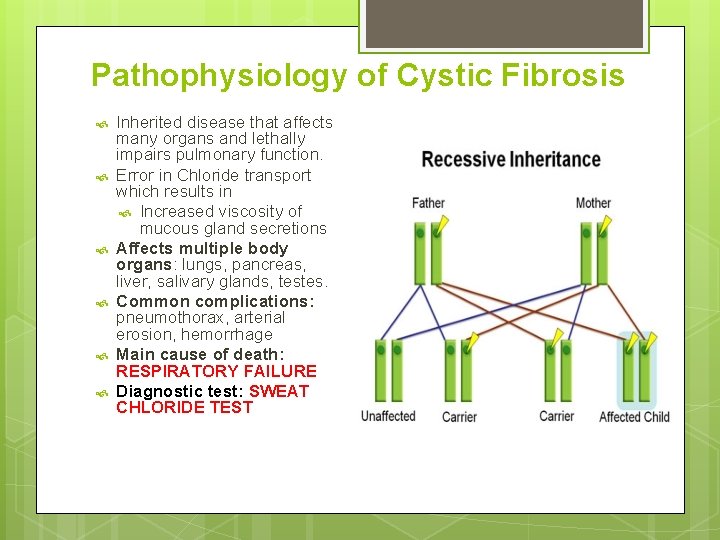
Pathophysiology of Cystic Fibrosis Inherited disease that affects many organs and lethally impairs pulmonary function. Error in Chloride transport which results in Increased viscosity of mucous gland secretions Affects multiple body organs: lungs, pancreas, liver, salivary glands, testes. Common complications: pneumothorax, arterial erosion, hemorrhage Main cause of death: RESPIRATORY FAILURE Diagnostic test: SWEAT CHLORIDE TEST

Organs affected in CF
Treatment Plan Goals: Treatment of Infections, Airway Clearance, Increased Oxygenation, Prevention of malnutrition: Antibiotics Therapy CPT, Bronchodilators, Nebulizer Supplemental O 2 PRN Continued G-Tube feeding, Pancrelipase Routine Vitals infection Tylenol: PRN Hot compress: RUE extravasation
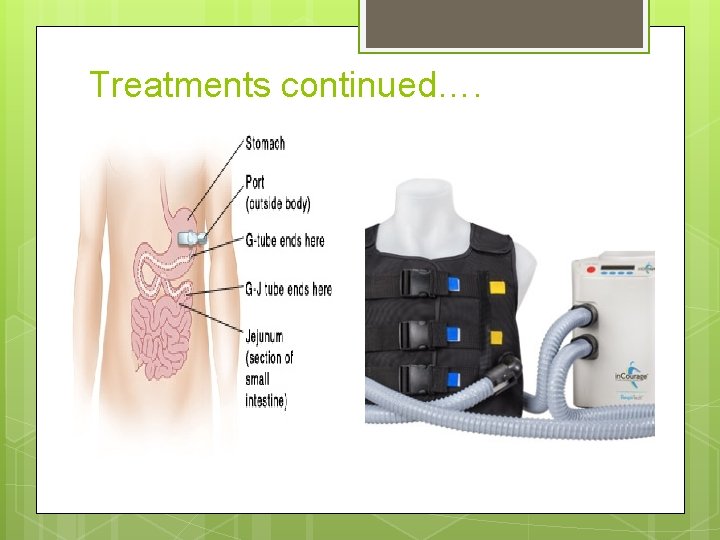
Treatments continued….

Clinical Manifestations of CF Often Malnourish; Failure to thrive: appear thinner and smaller Vitamin deficiencies: especially fat-soluble vitamins (A, D, E, K) Possible development of DM as pancreas declines Pulmonary manifestations CXR: persistent infiltrates and increased anterior posterior (AP) diameter.
Relationship of Secondary dx Dx of MRSA on admission day Dx of Rhino Virus: 7 th day of hospitalization
Developmental Stage and Developmental Theory to Care Personal/social/cognition: Erikson’s Psychosocial Theory: 4 th stage Industry vs. Inferiority (6 -12 years old) Enjoys working with others; tends to follow rules; forming social relationships takes on greater importance. Norms meet? Why or why not? Application of theory to care and communication Speech/language: Give similarities/differences Understand concepts of space Fine motor/adaptive: Likes to play & compete More sociable Looks after own needs Likes school, answer questions Gross motor: Always on the go; jumps Likely to overdo; hard to quiet down
Exceptions to the Norms Appears lethargic “slept remainder of the day” Grand parents (day prior admission) Vitals: BP (141/83 mm. Hg); HR: 112 bpm Pain: 6/10 Face Scale Poor eating habits/wt. gain Infections: MRSA/Rhinovirus Extravasation of CT dye: RUE
Nursing Diagnosis #1: Acute/Chronic Pain Supporting Data: --r/o hx of pancreatitis; -- extravasation of CT dye --LL flank pain: 6/10 hx of pancreatitis --RUE swelling/pain: 6/10 (CT dye extravasation) gallstone -- HR: 112 bpm; BP: 141/83 mm Hg Meds: Phytonadione, Ursodiol(prophylactic), Warm compress, Tylenol PRN, Child life specialist (bedside/CAT scan)
Acute Pain: Holistic Nursing care and Interventions Assess pain characteristics q 4 h/PRN (use pain scale: 6/10) Observe non-verbal cues Respond immediately to c/o of pain Prophylactic treatment: Ursodiol (gallstones) Distraction Technique Expected Outcome: Pt will have decreased swelling of RUE and pain level will be in satisfactory level (2/10 face scale) Evaluation: Not met: Pt. level went down but still 4/10 on FACE scale. BP still remains elevated during pt. care.
Nursing Diagnosis #2: Ineffective Airway Clearance/Impaired Gas Exchange Supporting data: Hx of CF, coughing Medications: Albuterol, CPT (qid), Flovent, Advair, Dornase, Pantanase
Ineffective Airway clearance/Impaired Gas Exchange Holistic Nursing Care & Interventions Monitor RR, breathing effort & areas of cyanosis q 4 hrs Assess O 2 Sat and administer supplemental O 2 PRN Auscultate lung sounds q 4 hr Continued pulmonary treatment QID Flovent & Advair bid(2 puffs) Expected Outcome: Pt. ’s Sp. O 2 will be maintained at >/= 92% RA throughout hospitalization. Evaluation: Met Pt. Sp. O 2 was 100% RA before end of shift.
Nursing Diagnosis #3: Imbalance Nutrition less than body requirements/GI Supporting Data: Decreased appetite, pt. refused to eat, NPO, fever, constipation, increased metabolic need due to CF, constipation Meds: 5 cans of ensure (115 ml/hr)night time feeding via GT tube, pancrelipase, vitamins, Miralax, Pt. gaining wt.
Imbalanced Nutrition: less than body requirements Holistic Nursing care and Interventions Assess daily wt. Monitor attitudes towards eating/food Pancrelipase enzymes Tube feed at 115 m. L/hr(night time feed) Multivitamins BID Miralax for constipation High fat, calorie, protein diet Expected Outcome: Pt. will maintain or gain more than admission body wt. before discharge. Evaluation: Met Pt. gains 0. 2 kg during 9 th day of hospitalization
Nursing diagnosis #4: Infection Supporting data: Positive Rhino Virus, MRSA, mucus in the lungs, Isolation(contact/droplet), RAC, Central IV (portacath), GT tube feeding Medications: CPT, Tobramycin, Meropenem, Levofloxacin, Linezolid
Infection Holistic Nursing Care and Interventions Assess for signs of infection q 4 h Encourage & promote hand washing and other aseptic interventions (PPE), Contact/Droplet Isolation Antibiotic treatment Expected Outcome: Pt. temperature will stay within normal parameters (36. 4*C-37. 4*C)based on age during hospitalization. Evaluation: Met Pt. temp remain within accepted parameters: 36. 3*C 1330; 36. 9*C 1500 before and during end of shift.
Nursing Diagnosis #5: Anxiety Supporting data: --Pt. verbalizes fear of telling pain “I don’t want to tell the doctors I’m on pain because the more I get hurt” --Patient uncooperative with tx/interventions(refused to eat) --CT dye extravasation Meds: Sertraline, Adderall Alternative Therapy: pt. playing games with Child life volunteer, interacting/playing with RN, Child life volunteer (at bedside & CT scan procedure)
Anxiety Holistic Nursing Care and Interventions Acknowledge pt. ’s anxiety Coping strategies Reduce sensory stimuli Maintain manner a calm Expected Outcome: Pt. will be more open to discuss feelings and fears (pain level) about medical condition during hospitalization Evaluation: Partially Met Pt. more truthful about pain level measures, however still uncertain pt’s openness to discuss feelings
Discharge Teaching & Planning Continue to monitor and assess pt. pain level Continue to monitor patients breathing pattern or any signs of decreased Sp. O 2 (cyanosis etc) Prevent exhaustion (too much playing, moving around) Maintain adequate nutrition/feeding pattern Continue to monitor patient vital signs and document abnormal parameters and administer PRN meds (Tylenol) Continue to assess and monitor pain level: noting any discrepancy between facial and verbal response. Encourage more open communication with pt. through play method

Research Name of Journal: Journal of Pediatric Nursing Title of Research: Distraction Techniques for Children Undergoing Procedures: A Critical Review of Pediatric Research

Conclusion

References Gulanick , M. , & Myers , J. (2011). Nursing care plans: Diagnosis, interventions, and outcomes. (7 ed. , pp. 1 -991). St Louis, MO: Elsevier Mosby Hockenberry, M. & Wilson, D. (2010). Nursing care of infants and children, (9 th ed. ). St. Louis, MO: Elsevier Mosby Ignatavicius, D. D. , & Workman, M. L. (2013). Medical surgical nursing (7 th ed. ). ST. Louis, MO: Elsevier Mosby. Koller, D. , Goldman, R. D. , (2012). Distraction techniques for children undergoing procedures: A critical review of pediatric research. Journal of Pediatric Nursing, 27, 652 -681.
- Slides: 29