
Care of Patients with Eye and Vision Problems
Care of Patients with Eye and Vision Problems

Blepharitis Inflammation of the eyelid edges Itchy, red, and burning eyes Seborrhea of the eyebrows and eyelids with greasy scales and mattering Control with eyelid care using warm, moist compresses followed by gentle scrubbing with diluted baby shampoo Avoid rubbing the eyes Entropion Turning inward of the eyelid causing the lashes to rub against the eye Caused by eyelid muscle spasms , trauma, aging Eyelid turned inward; red conjunctiva Corneal Abrasion may occur Surgical correction of eyelid position Instruction in procedure to instill eyedrops and eye ointment Chart 49 -1

Ectropion Turning outward and sagging of the eyelid Caused by relaxation of the orbicular muscle Reduced washing action of tears, leading to corneal drying and ulceration Surgery to restore proper lid alignment Hordeolum Ø Stye can be external or internal. Ø Treatment is with warm compresses four times a day and antibacterial ointment, which may blur vision. Ø To remove ointment, close the eye and gently wipe the closed eyelid from the nasal side of the eye outward. Ø Painful & tender
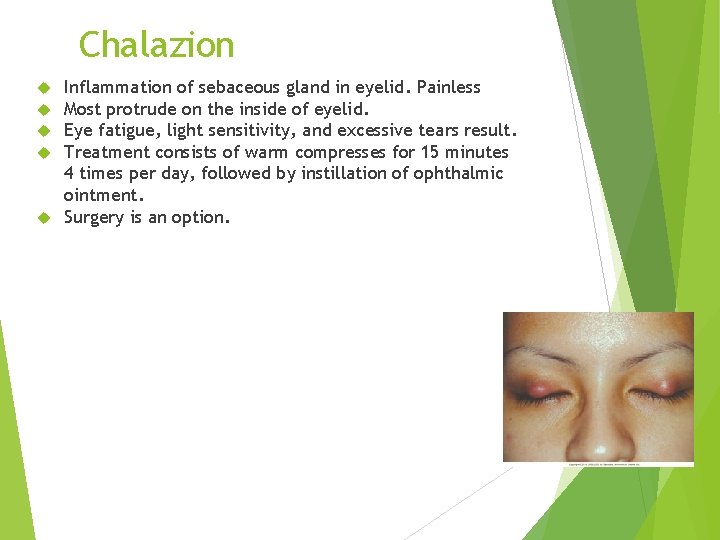
Chalazion Inflammation of sebaceous gland in eyelid. Painless Most protrude on the inside of eyelid. Eye fatigue, light sensitivity, and excessive tears result. Treatment consists of warm compresses for 15 minutes 4 times per day, followed by instillation of ophthalmic ointment. Surgery is an option.
Keratoconjunctivitis Sicca Also called dry eye syndrome, results from changes in tear composition, lacrimal gland malfunction, or altered tear distribution Artificial tears, lubricating ointment Surgery Conjunctival Hemorrhage -Small, well-defined area of hemorrhage that is bright red under the conjunctiva -No pain -No visual impairment -Resolves in 14 days without treatment
Conjunctivitis: Inflammation of conjunctiva Characterized by hyperemia (congestion, unusual amount of blood in an area; redness) of conjunctiva Usually spreads rapidly from one eye to another Usually benign and self-limiting Seldom affects vision If chronic, may signal degenerative changes or damage from repeated acute attacks Acute bacterial (pink eye) lasts about 2 weeks Chronic viral conjunctival infections may last 2 -3 weeks and may produce severe disability TREATMENT & TEACHING
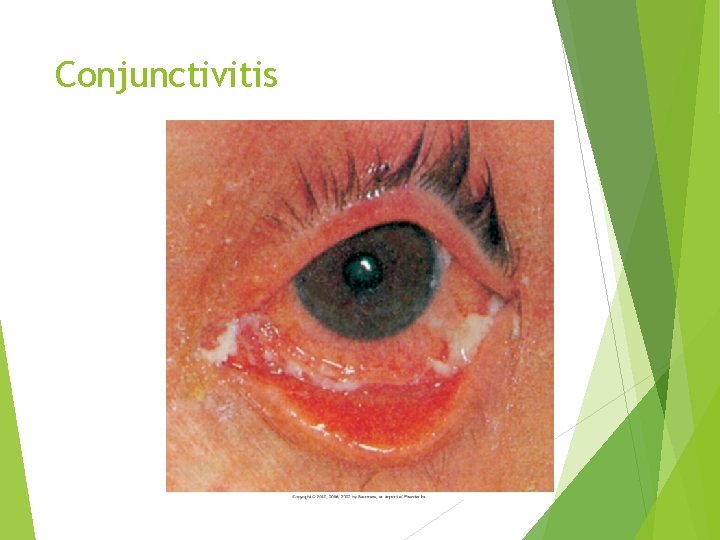
Conjunctivitis
Trachoma Chronic, bilateral scarring form of conjunctivitis caused by Chlamydia trachomatis Chief cause of preventable blindness in the world Infection control
Corneal Disorders Corneal Abrasion Corneal Ulceration S/S: Pain, photophobia, eye secretions, purulent fluid on eyelids/lashes, reduced vision. -Cornea appears cloudy with ulceration Reduce symptoms, restore corneal clarity, enhance patient’s ability to use remaining vision. Antibiotics, antifungals, antivirals, steroids. Stress the importance of applying the drug as often as prescribed, even at night.
Eye Donation Corneal tissue from donors free of infectious disease or cancer at the time of their deaths. Care of potential eye donors at death: Raise head of bed 30 degrees. Apply antibiotic eyedrops. Close the eyelids, and apply small ice pack. Discuss donation with family and physician.

Conditions of the Eye Cataract: Opacity of the lens of the eye Causes Incidence Characteristics painless, gradual vision loss, glare; milky white pupil Complications
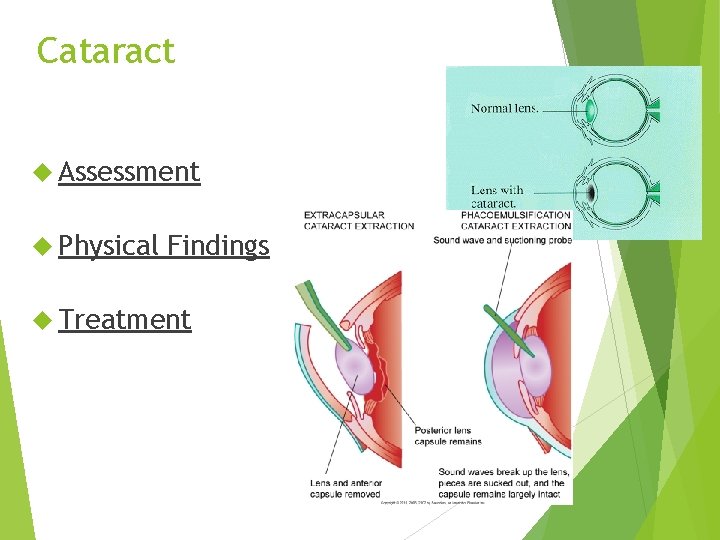
Cataract Assessment Physical Findings Treatment
Cataract: Postoperative Care Antibiotics & steroid ointments are given subconjunctivally. Eye is unpatched. Discharge usually occurs within 1 hr with dark glasses. Wear dark glasses outdoors or in bright lights until pupil responds to light Instill antibiotic-steroid eyedrops. Mild itching is normal. Pain indicates a complication. Reduce IOP. Prevent infection. Assess for bleeding.
Health Teaching Report to surgeon—sharp, sudden pain in the eye, bleeding or increased discharge, lid swelling, decreased vision, or flashes of light or floating shapes. Avoid activities that might increase IOP. Review procedure for use of eyedrops.

Conditions of the Eye Glaucoma: Group of disorders characterized by high intraocular pressure (IOP) and optic nerve damage Two forms: Open-angle Angle-closure Assessment Open-angle Angle-closure Physical findings
Glaucoma Treatment Medication Alerts Nursing considerations: Give medications, as ordered (topicals, pain) Prepare client for surgery, if indicated Encourage ambulation immediately after surgery Encourage client to express concerns related to chronic condition Monitor VS, response to tx, and visual acuity
Glaucoma Patient teaching: Cover disorder, diagnostic studies, and treatment Need for meticulous compliance with prescribed drug therapy All procedures and treatments, especially surgery Lost vision cannot be restored, but treatment can usually prevent further loss Modification of environment for safety S/sx that require immediate attention (i. e. eye pain or sudden change in vision) Importance of screening for early detection and prevention Avoid emotional upsets, constrictive clothing
Conditions of the Eye Diabetic Retinopathy: disorder of the blood vessels of the eye; small aneurysms; occurs in 60 -65% of diabetics. Symptoms: floaters and vision loss Macular Degeneration: due to an aging retina; cause unknown Symptoms: central vision loss and decrease in color discrimination Tx: None available
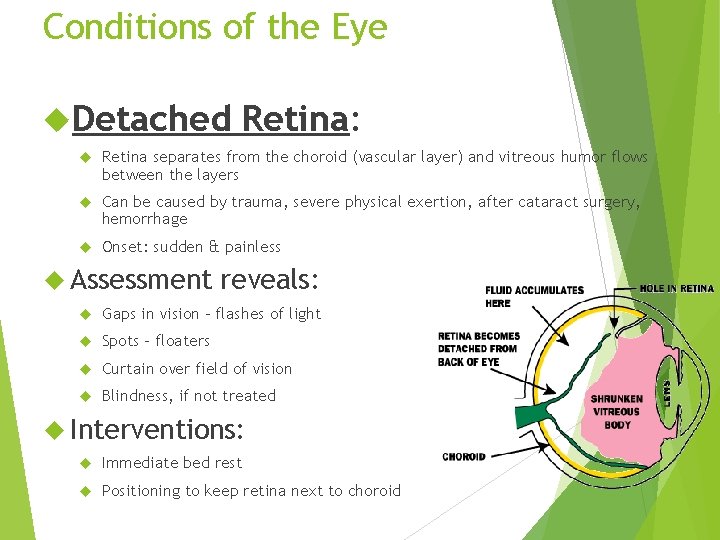
Conditions of the Eye Detached Retina: Retina separates from the choroid (vascular layer) and vitreous humor flows between the layers Can be caused by trauma, severe physical exertion, after cataract surgery, hemorrhage Onset: sudden & painless Assessment reveals: Gaps in vision – flashes of light Spots - floaters Curtain over field of vision Blindness, if not treated Interventions: Immediate bed rest Positioning to keep retina next to choroid
Detached Retina Surgical intervention: scleral buckling; scarring by heat, cold, or laser Post-op care: Bedrest with both eyes bandaged Avoid jarring or bumping head No coughing Give antiemetic to prevent N/V. Positioning to keep retina next to choroid—may be on operative side Client teaching Report pain or pain & N/V: report to MD immediately Avoid reading, writing, close work (sewing) for 1 st week pot-op Monitor for eye infection s/s of detachment: sudden reduced visual acuity, eye pain, pupil that does not respond to light by constricting. Call MD immediately.
Conditions of the Ear Meniere’s Assessment Disease Vertigo, tinnitus, ear feels full, nystagmus Intervention Instruct pt to move slowly to prevent injury from dizziness avoid bright or glaring lights Move head slowly STOP smoking avoid caffeine Low Na diet & fluid restriction Medications Surgical Intervention
Conditions of the Ear: Hearing Loss: Deafness Deaf: hearing is non-functional for activities of daily living Conductive (transmission deafness): Impacted cerumen (wax) Foreign body in external auditory canal Defects (thickening; scarring) of eardrum: perforation of tympanic membrane Otitis media with effusion: mostly in children Otosclerosis of ossicles Overgrowth of soft bony tissue (scars, tumors) from previous ear surgeries Sensorineural (perceptive or nerve deafness) Arteriosclerosis Infectious diseases (mumps, measles, meningitis) Drug toxicities: gentamycin Tumors Head traumas High-intensity noises Meniere’s Disease
Deafness Central deafness: Tumors Stroke (brain attack) Noise-Induced or occupational noise hearing loss: Blast injury Firearms Loud music or machinery Aging
Care of the Client with Diminished Hearing Care of client with hearing aid: Chart 51 -6 Keep it dry Turn off and remove battery when not in use Check and replace battery frequently. Keep extras. If not working, check on-off switch and volume control, Change battery, and Check plastic tubing for cracks and loose connections. When not in use, store in a covered container to prevent dust/water from damaging the mechanism Wipe clean with soap and water (do not immerse)
Conditions of the Ear Care of client with Diminished Hearing: Communication: Attract client attention by raising hand or arm Face client when speaking Speak slowly and distinctly without shouting Use low-pitched voice when possible, because the ability to hear high frequencies is usually lost first. Check with client to be sure instructions are understood To make lip reading easier, make sure the client’s view of your mouth is not obstructed and you are not standing with your back to a bright light
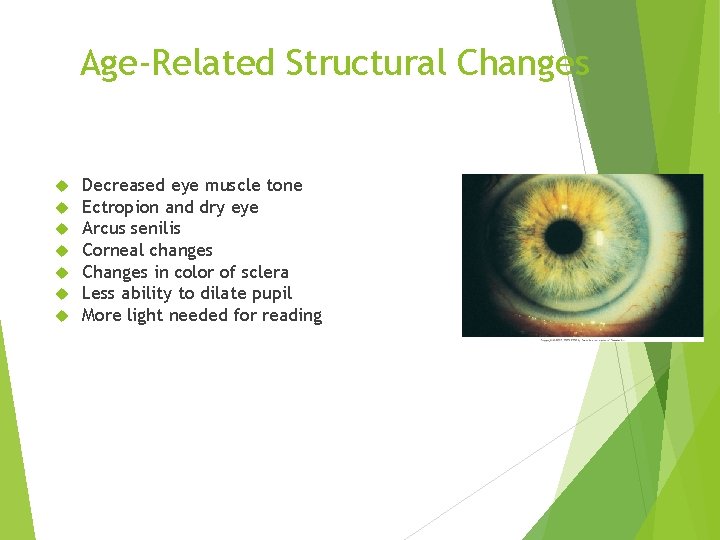
Age-Related Structural Changes Decreased eye muscle tone Ectropion and dry eye Arcus senilis Corneal changes Changes in color of sclera Less ability to dilate pupil More light needed for reading

This work is licensed under a Creative Commons Attribution 4. 0 International License. Except where otherwise noted, this content by Southern Regional Technical College is licensed under the Creative Commons Attribution 4. 0 International License. To view a copy of this license, click https: //creativecommons. org/licenses/by/4. 0/ Healthcare Careers Work!(HCW) is sponsored by a $2. 3 million grant from the U. S. Department of Labor, Employment & Training Administration. TAACCCT Grant #TC- 26488 -14 -60 -A-13. Southern Regional Technical College is an equal opportunity employer and will make adaptive equipment available to persons with disabilities upon request. This workforce product was funded by a grant awarded by the U. S. Department of Labor’s Employment and Training Administration. The product was created by the grantee and does not necessarily reflect the official position of the U. S. Department of Labor. The U. S. Department of Labor makes no guarantees, warranties, or assurances of any kind, express or implied, with respect to such information, including any information on linked sites and including, but not limited to, accuracy of the information or its completeness, timeliness, usefulness, adequacy, continued availability, or ownership.
- Slides: 27