
Care of Patients with Cardiac Problems Blood Flow
Care of Patients with Cardiac Problems
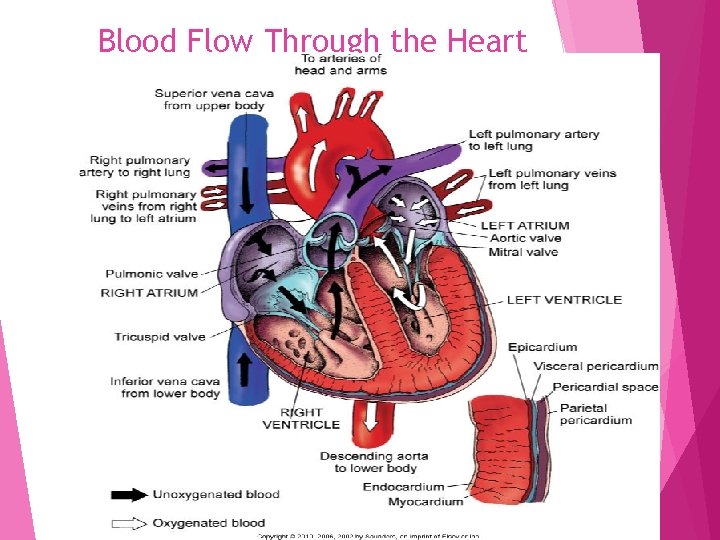
Blood Flow Through the Heart
Heart Failure Also called pump failure, general term for the inability of the heart to work effectively as a pump. Left-sided heart failure Right-sided heart failure High-output failure ETIOLGY Geriatric patients may present 75% of cases caused by Hypertension with atypical signs and 1/3 of patients with MI develop HF symptoms such as fatigue, Structural heart Changes weakness, and somnolence. Pulmonic or aortic stenosis cause pressure or overload on the heart Use of NSAIDS
Left-Sided Heart Failure Pulmonary Edema Typical causes—hypertensive, coronary artery, valvular disease Ischemic heart disease, MI, Cardiomyopathy, Valvular heart disease ( mitral or aortic valve), Hypertension Formerly known as congestive heart failure Occurs from elevated systemic vascular resistance Results in pulmonary congestion due to inability of the left ventricle to pump blood into circulation. Leads to decreased cardiac output & tissue perfusion and blood accumulates in pulmonary vessels/lungs > pulmonary edema
Left-Sided Heart Failure Two types of left-sided heart failure: Systolic heart failure an alteration in ventricular contraction Ejection Diastolic an Fracture heart failure alteration of ventricular filling
Right-Sided Heart Failure Peripheral Edema Typical causes—left ventricular failure, right ventricular MI, pulmonary hypertension, COPD Right ventricle not able to empty completely Increased volume and pressure in the venous system and peripheral edema occurs
High-Output Failure Cardiac output remains normal or above normal Caused by increased metabolic needs such as: Septicemia Anemia Hyperthyroidism
Classification & Staging of HF Compensatory Mechanisms American college of Cardiology (ACC) and American Heart Association: Evidenced based Guidelines for staging & managing heart failure as a chronic disease Compensatory Mechanisms Sympathetic nervous system stimulation 1. Increases HR, RR, & BP 2. Increase Stroke Volume (SV) 3. Arterial Vasoconstriction Other chemical responses: B-type natriuretic peptide (BNP) Myocardial Hypertrophy
Signs and symptoms of: Left sided heart failure Results of Pulmonary Congestion & Decreased Cardiac Output: Chart 37 -1 Dyspnea Non-productive cough with pink frothy sputum Pulmonary crackles- “wet-lung” sounds Weakness/fatigue as fluid moves into lung decreasing gas exchange P t will complain of SOB: esp after climbing stairs Lower than normal O 2 saturation levels An extra heart sound: S 3 gallop Orthopnea Paroxysmal nocturnal dyspnea- fluid in the extremities go into the circulating blood volume when the person is lying downthe fluid shifts to the alveoli. Pt will c/o NOCTURNAL COUGH- needs evaluation Decreased perfusion that leads to oliguria
Signs and symptoms of: Left sided heart failure Decreased cardiac output causes altered digestion, decreased brain perfusion- fatigue, dizziness, lightheadedness, confusion, restlessness, and anxiety. Stimulation of the sympathetic nervous system causes the peripheral blood vessels to constrict- skin pale ashen, cool and clammy. Tachycardia, pulse weak and thready.
Signs and symptoms of: Right sided heart failure JVD Dependent & Peripheral edema Hepatomegaly Ascites Weakness, anorexia, nausea due to venous engorgement in the abdomen Weight gain due to fluid retention. Pt. will c/o tightness of shoes/ rings due to peripheral edema
How is it diagnosed Labs: Electrolytes BUN/Creatinine UA HGB, HCT B-type natriuretic peptide Microalbuminuria ABG Imaging Chest xray: hypertrophy/enlargement of heart Note: Apical pulse will be displaced to the LEFT. Other ECG: Echocardiography to determine HF Pulmonary Artery Catheters
Drug Therapy Pharmacologic therapy varies with the type of HF. The basic objectives are: 1. eliminate or reduce any contributory factors especially those that may be reversible 2. reduce the workload of the heart by reducing afterload and preload. 3. Enhance contractility of the Heart muscle Afterload=the force that impede the flow of blood out of the heart. Pressure from peripheral vasculature, mass or viscosity of blood. Preload=the stretched condition of the heart muscle at the end of diastole just before contraction
Drugs that reduce Afterload=the force that impede the flow of blood out of the heart ACE inhibitors & ARB -used for heart failure to suppress RAS system -help relax blood vessels to decrease BP and workload of the heart - Decrease Blood Pressure (ANTI-HYPERTENSIVE) -block aldosterone to prevent Na and water retention to decrease fluid overload - Give cautiously to patients with low blood pressure -Monitor for hyperkolemia in patients with renal dysfunction. -MORE EFFECTIVE FOR EURO-AMERICANS THAN AFRICAN- AMERICANS -Dosing: start with low dose to monitor drop in BP. -Monitor for orthostatic hypotension, dizziness, decrease of more than 20 mm HG systolic pressure, DRY-NAGGING cough ACE Inhibitors: Capoten (Captopril) : SE: dry, naggng cough Lotensin, Vasotec (enalapril) ARB: Cozaar (Losartan) - good choice for patients with nagging cough from ACE or those with hyperkalemia or poor renal function Human B-type natriuretic peptides Natrecor (Nesiritide)- used to treat acute HF
Interventions That Reduce Preload=the stretched condition of the heart muscle at the end of diastole just before contraction Nutrition therapy Drug therapy Narcotic analgesic Morphine sulfate Diuretics Venous vasodilators Drugs that enhance contractility Digoxin other inotropic drugs Beta-adrenergic blockers
Interventions That Reduce Preload=the stretched condition of the heart muscle at the end of diastole just before contraction Drug therapy Diuretics Used to reduce fluid volume when diet & fluid restrictions not effective First line drug of choice in older adults with HF and fluid overload Produce diuresis and excretion of sodium & water Loop (High ceiling) diuretic: Thiazide Lasix (Furosemide) IVP 20 -40 mg IV. May increase by 20 mg every 2 hours until diuresis reached Bumex (Bumetanide 1 -2 mg once or twice daily but usually given 10 mg over 24 hours continuous IV Self-limiting as diuresis decreases after edema fluid is lost Not as dehydrating as Loops HCTZ (hydrochlorothizide)- daily Zaroxolyn (metolazone) – long-acting. Given every 2 nd, 3 rd, or 4 th day Monitor for hypotension, ototoxicity, and hypokalemia Potassium-Sparing Venous Vasodilators Nitrates: HF with persistent dypsnea, Acute HF Aldactone (Spironolactone): Imdur (Isosorbide). Monitor BP. Give Tylenol if patient c/o headache.
Interventions That Reduce Preload=the stretched condition of the heart muscle at the end of diastole just before contraction Drugs that enhance contractility Digoxin (Lanoxin) Increases contractility Reduces heart rate ALWAYS CHECK APICAL PULSE BEFORE ADMINISTERING– HOLD IF <60 AND CONTACT MD Monitor Blood levels Therapeutic Level: 0. 5 -2 mg Dig Toxicity: occurs due to loss of potassium with diuretics (hypokalemia), poor renal function, dehydration, decreased tolerance for drug S/S: Anorexia, Fatigue, MS changes, dysrhythmia (PVCs), HA Early: bradycardia and loss of P wave on ECG Later: tachycardia, vision changes: Yellow or green halo around objects or snowy vision Nursing: cardiac monitor, serum K and dig levels, heart rate, angina (chest pain from increased workload of heart) ANTIDOTE for Dig Toxicity: Digibind (Digoxin – immune Fab)
Interventions That Reduce Preload=the stretched condition of the heart muscle at the end of diastole just before contraction Drugs that enhance contractility Other inotropic drugs Primacor (Milrinone) vasodialator/inotropic and enhances Calcium in heart cells to increase contractions. Given IV. Used for acute HF. Simdax ( Levosimendan) – sensitizes heart to calcium and increases contraction of the heart. Beta-adrenergic blockers (Beta Blockers) Acute HF Dobutrex (Dobutamine) – IV. Inproves cardiac contractility Chronic HF: Start with low doses. Coreg (Carvedilol) Lopressor /Toprol(Metoprolol) Zebeta (Bisoprolol) NURSING: WEIGH DAILY, MONITOR BP, PULSE (55 -60 AT REST) , ORTHOPNEA, ACTIVITY TOLERANCE.
Nursing Diagnosis & Interventions Impaired Gas Exchange Decreased Cardiac Output Ineffective tissue perfusion Activity Intolerance Excess Fluid Volume Anxiety Chart 37 -3 – Intervention Activities Patient Teaching Table 37 -4
Nursing Diagnosis & Interventions Impaired Gas Exchange Decreased Cardiac Output Ineffective tissue perfusion Activity Intolerance Excess Fluid Volume Anxiety- Depression Chart 37 -3 – Intervention Activities Patient Teaching Table 37 -4
Definition: Potential for Pulmonary Edema -potentially life threatening accumulation of fluid in the interstitium and alveoli of the lungs. - Occurs due to inability of L Ventricle to eject sufficient blood (received from the lungs) into circulation resulting in pressure & fluid back-up in lungs. -collection of fluid may block the exchange of oxygen and carbon dioxide and produce respiratory failure. Cause of: severe HF w/fluid overload, acute MI, Mitral Valve Disease, Dysrhythmias
Test results ABG-shows hypoxia, acidosis CXR- shows diffuse haziness of the lung fields, cardiomegaly and pleural effusion Pulse ox decreased EKG to rule out valve disease or problems with the ventricles
Nursing interventions Administer medications as ordered High Fowler’s position Oxygen- @ 5 -6 L/m by facemask to relieve hypoxemia and dyspnea Pulse Ox & cardiac monitor: keep O 2 sat > 90% Sublingual Nitroglycerin (NTG) if BP > 100. Give every 5 minutes x 3 doses Diuretic- usually Lasix I. V. to excrete water and sodium. Give over 40 mg 1 -2 minutes IV push -May give Bumex IVP or continuous infusion over 24 hours. -Monitor VS every 30 -60 minutes Morphine (if BP wnl) 1 -2 -mg to reduce peripheral resistance and venous return also reduces anxiety. -Monitor VS Restrict fluids and sodium intake Promote rest and relaxation Provide emotional support

This work is licensed under a Creative Commons Attribution 4. 0 International License. Except where otherwise noted, this content by Southern Regional Technical College is licensed under the Creative Commons Attribution 4. 0 International License. To view a copy of this license, click https: //creativecommons. org/licenses/by/4. 0/ Healthcare Careers Work!(HCW) is sponsored by a $2. 3 million grant from the U. S. Department of Labor, Employment & Training Administration. TAACCCT Grant #TC- 26488 -14 -60 -A-13. Southern Regional Technical College is an equal opportunity employer and will make adaptive equipment available to persons with disabilities upon request. This workforce product was funded by a grant awarded by the U. S. Department of Labor’s Employment and Training Administration. The product was created by the grantee and does not necessarily reflect the official position of the U. S. Department of Labor. The U. S. Department of Labor makes no guarantees, warranties, or assurances of any kind, express or implied, with respect to such information, including any information on linked sites and including, but not limited to, accuracy of the information or its completeness, timeliness, usefulness, adequacy, continued availability, or ownership.
- Slides: 24