
Care of a normal baby at birth Until
Care of a normal baby at birth (Until 1 hour after birth)
Objectives To describe evidence-based routine care of a newborn baby at and soon after birth Teaching Aids: ENC NC- 2
Basic needs of a baby at birth FOUR basic needs at birth: • • Thermal protection Normal breathing Mother’s milk Protection from infection Teaching Aids: ENC NC- 3
Care of normal baby at birth The birth of Meghna Teaching Aids: ENC NC- 4
Care at birth Steps 1. Call out time of birth 2. Receive the baby onto a warm clean towel and place on mother’s chest 3. Clamp and cut the umbilical cord 4. Dry the baby with a warm, clean towel or piece of cloth 5. Assess baby’s breathing while drying Teaching Aids: ENC NC- 5
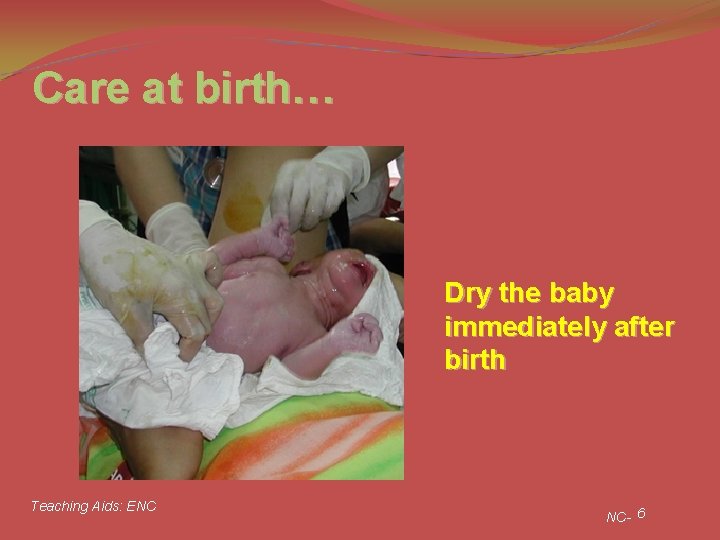
Care at birth… Dry the baby immediately after birth Teaching Aids: ENC NC- 6
Care at birth… 6. Wipe both eyes (separately) with sterile gauze pieces 7. Put the baby between mother’s breasts for skin-to- skin contact 8. Place an identity label on the baby 9. Cover mother and baby with warm cloth; put a cap on the baby’s head 10. Initiate breastfeeding Teaching Aids: ENC NC- 7
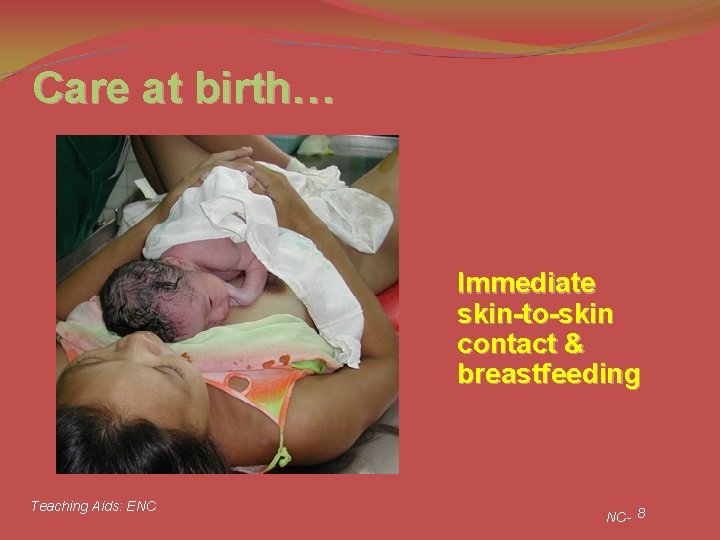
Care at birth… Immediate skin-to-skin contact & breastfeeding Teaching Aids: ENC NC- 8

Ensuring warmth at the time of delivery: ‘Warm chain’ Teaching Aids: ENC NC- 9
‘Warm chain’: At delivery: 1. Ensure the delivery room is warm (25° C), with no draughts. 2. Dry the baby immediately; remove wet cloth 3. Wrap the baby with clean dry cloth 4. Keep the baby skin-to-skin with mother Teaching Aids: ENC NC- 10
Helping the baby breathe Assess baby’s breathing at the time of drying: If the baby is crying vigorously or breathing adequately, then no intervention is needed if the baby is not breathing or gasping, then skilled care in the form of positive pressure ventilation etc. (i. e. RESUSCITATION) would be required Teaching Aids: ENC NC- 11
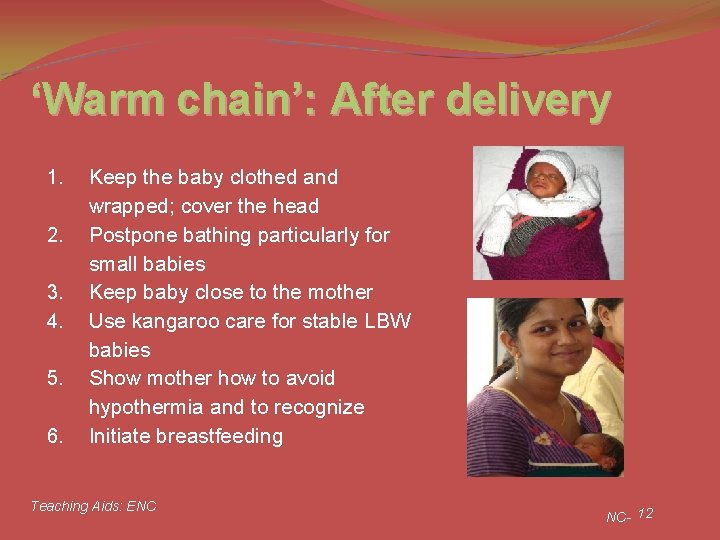
‘Warm chain’: After delivery 1. 2. 3. 4. 5. 6. Keep the baby clothed and wrapped; cover the head Postpone bathing particularly for small babies Keep baby close to the mother Use kangaroo care for stable LBW babies Show mother how to avoid hypothermia and to recognize Initiate breastfeeding Teaching Aids: ENC NC- 12
Initiating breastfeeding Keep the baby in skin-to-skin contact between mother’s breasts immediately after drying Help the mother in her first few attempts to breastfeed Make her and the baby comfortable Explain and show her proper positioning and attachment Teaching Aids: ENC NC- 13
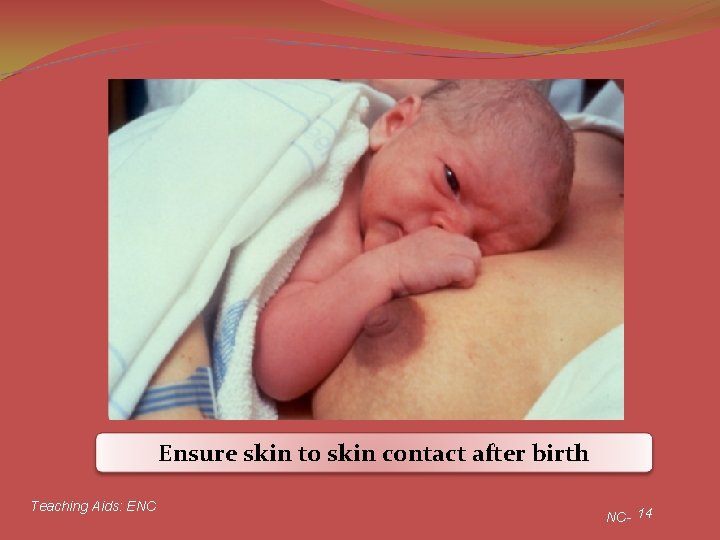
Ensure skin to skin contact after birth Teaching Aids: ENC NC- 14
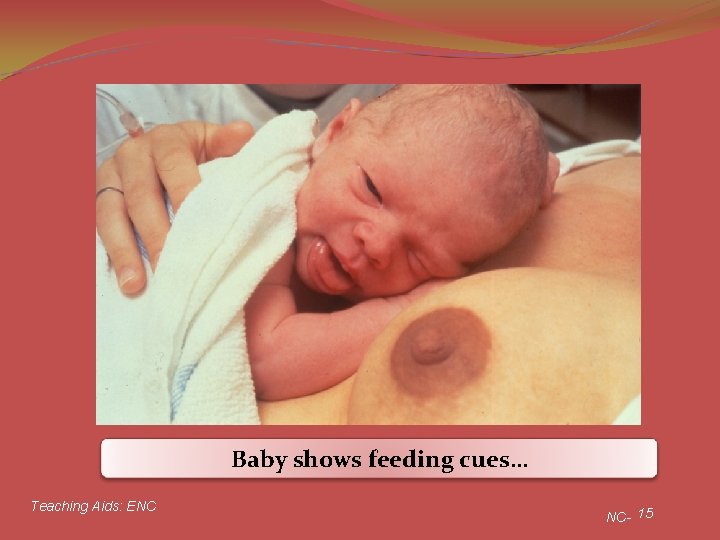
Baby shows feeding cues… Teaching Aids: ENC NC- 15
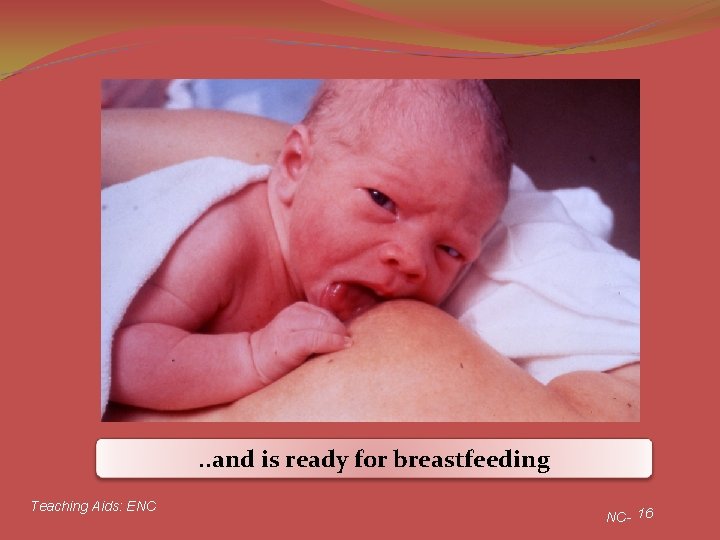
. . and is ready for breastfeeding Teaching Aids: ENC NC- 16
Prevention of infections: ‘Clean chain’ At delivery: WHO five cleans Clean 1. Hands of attendants (washed with soap) 2. Surface for delivery 3. Cutting instrument for cord(i. e. razor, blade) 4. String to tie cord 5. Cloth to wrap baby and mother Teaching Aids: ENC NC- 17
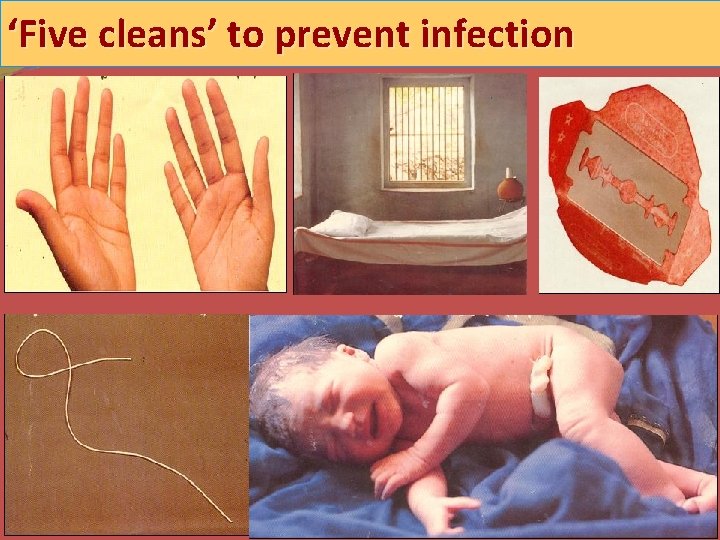
‘Five cleans’ to prevent infection
Prevention of infections: ‘Clean chain’ After delivery 1. Hand washing before handling the baby 2. Exclusive breastfeeding 3. Keep the cord clean and dry; do not apply anything 4. Use a clean cloth as a diaper/napkin 5. Hand wash after changing diaper/napkin Teaching Aids: ENC NC- 19
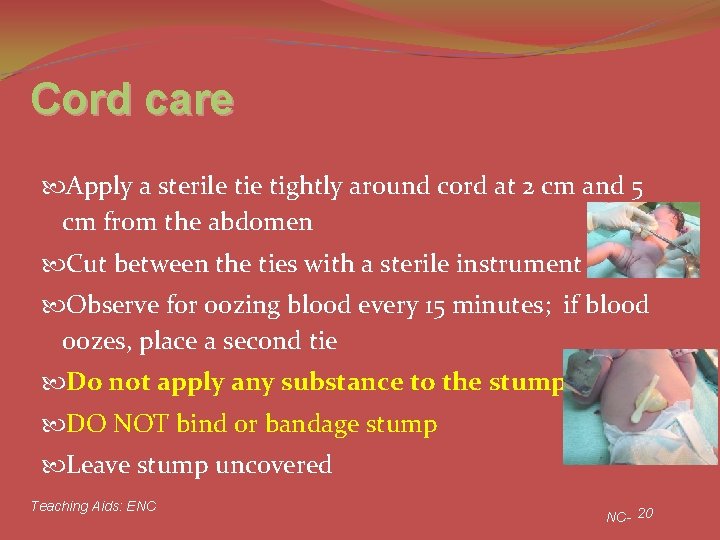
Cord care Apply a sterile tightly around cord at 2 cm and 5 cm from the abdomen Cut between the ties with a sterile instrument Observe for oozing blood every 15 minutes; if blood oozes, place a second tie Do not apply any substance to the stump DO NOT bind or bandage stump Leave stump uncovered Teaching Aids: ENC NC- 20
Eye care Clean eyes immediately after birth with swab soaked in sterile water Use separate swabs for each eye; clean from medial to lateral side Give prophylactic eye drops within 1 hour of birth (as per hospital policy) Do not put anything else in baby’s eyes Teaching Aids: ENC NC- 21

Monitoring the baby Do not leave the mother and baby alone in the first hour after birth Monitor three parameters every 15 minutes: Breathing: Grunting, chest in-drawing, fast breathing (>60/min) Warmth: Check if the baby’s feet are cold (by using your hands) Color: Evaluate the color of trunk and extremities Teaching Aids: ENC NC- 22
Special situations Mother has HIV/AIDS 1. Follow universal precautions as with any other delivery 2. Baby can have immediate skin-to-skin contact as any other mother and baby 3. Breastfeeding can begin when the baby is ready* 4. If mother chooses replacement feeding, prepare formula for the first few feeds 5. All other care (including cord care and eye care) remain the same Teaching Aids: ENC NC- 23
Key messages Four basic needs at birth: warmth, normal breathing, breastfeeding, prevention of infections Ensure warmth by skin to skin contact with mother’s chest/abdomen Help the mother to initiate early breastfeeding Follow ‘WHO five cleans’ to prevent infections Teaching Aids: ENC NC- 24
- Slides: 24