
CARE Global MEL Framework OutcomeImpact Indicators May 2018
CARE Global MEL Framework & Outcome/Impact Indicators May 2018
The Program Strategy and Contribution to Change
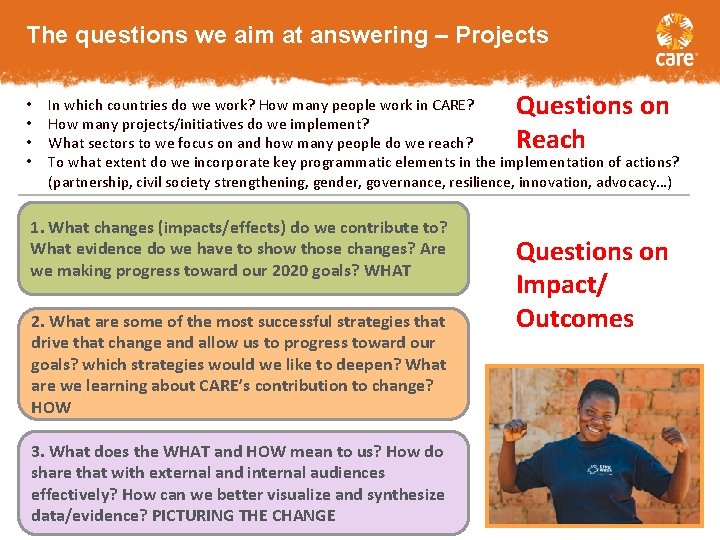
The questions we aim at answering – Projects • • Questions on Reach In which countries do we work? How many people work in CARE? How many projects/initiatives do we implement? What sectors to we focus on and how many people do we reach? To what extent do we incorporate key programmatic elements in the implementation of actions? (partnership, civil society strengthening, gender, governance, resilience, innovation, advocacy…) 1. What changes (impacts/effects) do we contribute to? What evidence do we have to show those changes? Are we making progress toward our 2020 goals? WHAT 2. What are some of the most successful strategies that drive that change and allow us to progress toward our goals? which strategies would we like to deepen? What are we learning about CARE’s contribution to change? HOW 3. What does the WHAT and HOW mean to us? How do share that with external and internal audiences effectively? How can we better visualize and synthesize data/evidence? PICTURING THE CHANGE Questions on Impact/ Outcomes
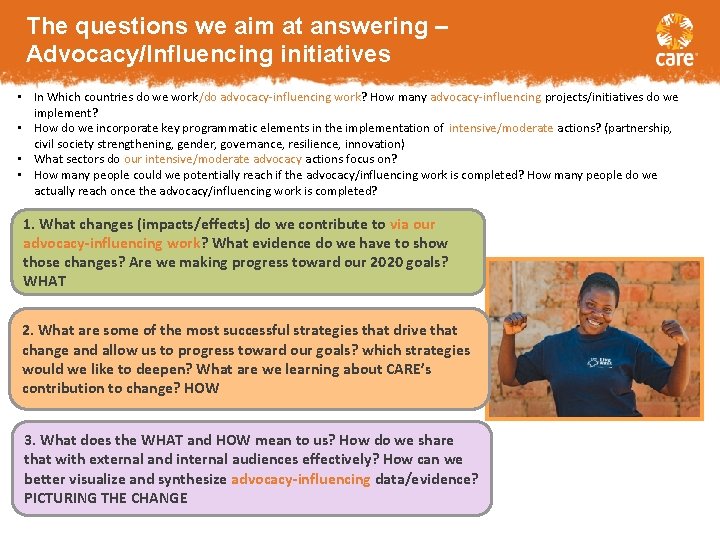
The questions we aim at answering – Advocacy/Influencing initiatives • In Which countries do we work/do advocacy-influencing work? How many advocacy-influencing projects/initiatives do we implement? • How do we incorporate key programmatic elements in the implementation of intensive/moderate actions? (partnership, civil society strengthening, gender, governance, resilience, innovation) • What sectors do our intensive/moderate advocacy actions focus on? • How many people could we potentially reach if the advocacy/influencing work is completed? How many people do we actually reach once the advocacy/influencing work is completed? 1. What changes (impacts/effects) do we contribute to via our advocacy-influencing work? What evidence do we have to show those changes? Are we making progress toward our 2020 goals? WHAT 2. What are some of the most successful strategies that drive that change and allow us to progress toward our goals? which strategies would we like to deepen? What are we learning about CARE’s contribution to change? HOW 3. What does the WHAT and HOW mean to us? How do we share that with external and internal audiences effectively? How can we better visualize and synthesize advocacy-influencing data/evidence? PICTURING THE CHANGE

CARE’s Approach to MEL
The global indicators Why we need the global indicators Our ability to measure progress towards our commitments and to explain how CARE contributes to lasting change has led to the establishment of a global evidence system. The core of this system is a common set of 25 global indicators plus other supplementary indicators, applicable to CARE projects and initiatives worldwide, allowing for the collection and consolidation of coherent and comparable outcome and impact data 5 September 20, 2021
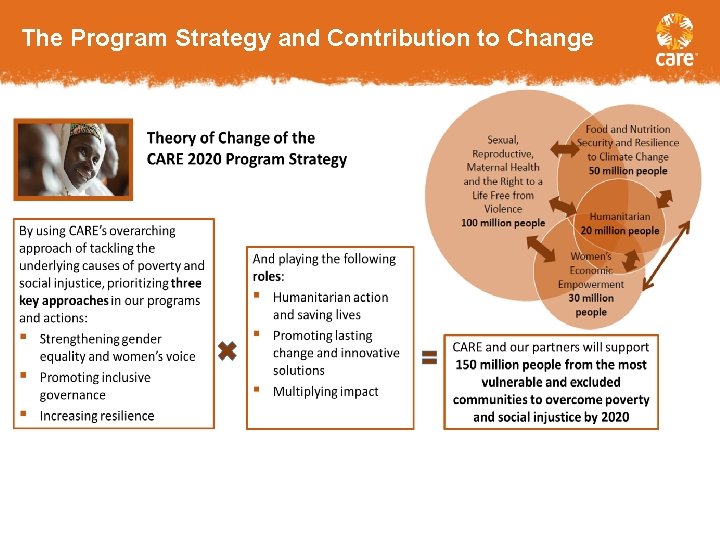
The commitments around the indicators • Incorporate the global indicators in proposals/new contracts (as appropriate and relevant) from 1 July, 2016 onwards: At least one relevant outcome indicator (indicators 1 to 18) and as many as possible from the indicators for the CARE approach and roles (indicators 19 to 25) plus the supplementary indicators. • In existing projects/programs/contracts, assess where the global and supplementary indicators can be integrated in monitoring and evaluation plans. Please revise these plans accordingly and integrate indicators where possible. • Include the proposed global and supplementary indicators in upcoming evaluations (from now onwards, wherever possible). • Report data to the Project/Program Information and Impact Reporting System (PIIRS), every time an evaluative process takes place and a project or initiatives has collected analysed data on the indicators selected Impact/Outcomes form • The data on impact/outcomes is cumulative (over a 6 -year period, from 1 st July 2014 until 30 June 2020). We expect to have had an impact on 150 million people by 2020 and, more specifically, reached specific outcomes on SRMH and the right to a life free from violence, women’s economic empowerment, food and nutrition security and resilience to climate change, and humanitarian. 6 • September The outcome targets include our work with and through partners. CARE never works in 20, 2021 isolation and the outcomes we seek will be the result of actions with others.
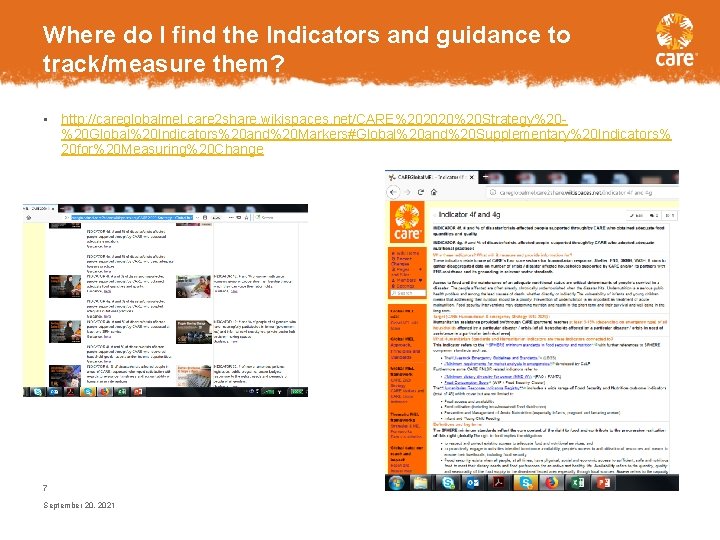
Where do I find the Indicators and guidance to track/measure them? • http: //careglobalmel. care 2 share. wikispaces. net/CARE%202020%20 Strategy%20%20 Global%20 Indicators%20 and%20 Markers#Global%20 and%20 Supplementary%20 Indicators% 20 for%20 Measuring%20 Change 7 September 20, 2021
For questions on the indicators, you can contact: • Humanitarian assistance: Uwe Korus korus@careinternational. org • The Right to Sexual, Reproductive and Maternal Health & a Life Free From Violence: Dora Curry dcurry@care. org and Sarah Eckhoff sarah. eckhoff@care. org • Food & nutrition security and climate change resilience: Emily Janoch ejanoch@care. org; Pranati Mohanraj Pranati. Mohanraj@care. org or Pierre Kadet pierre. kadet@care. ca • Women’s economic empowerment: Hazel Rogers@careinternational. org • Gender equality and Women’s Voice: Sarah Eckhoff sarah. eckhoff@care. org • Inclusive governance: Tom Aston aston@careinternational. org • Resilience: Wouter Bokdam wbokdam@carenederland. org and Wieteke Overbeek@carenederland. org 8 September 20, 2021
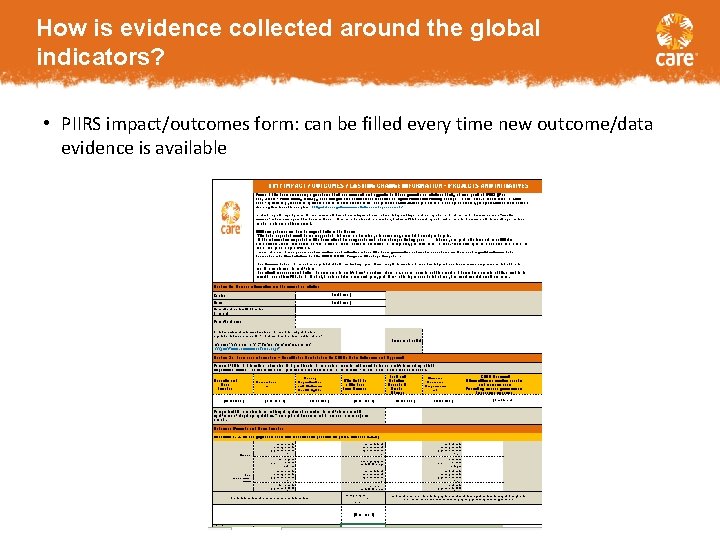
How is evidence collected around the global indicators? • PIIRS impact/outcomes form: can be filled every time new outcome/data evidence is available
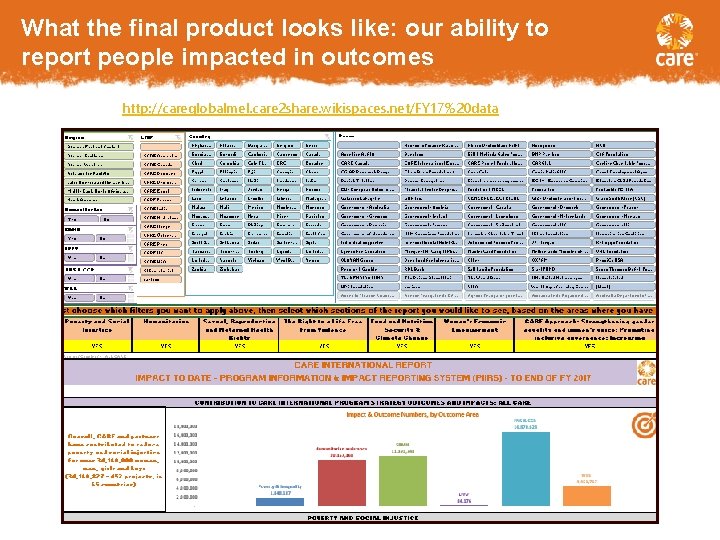
What the final product looks like: our ability to report people impacted in outcomes http: //careglobalmel. care 2 share. wikispaces. net/FY 17%20 data

Questions? 11 September 20, 2021
Examples: short presentations & contributions from the audience
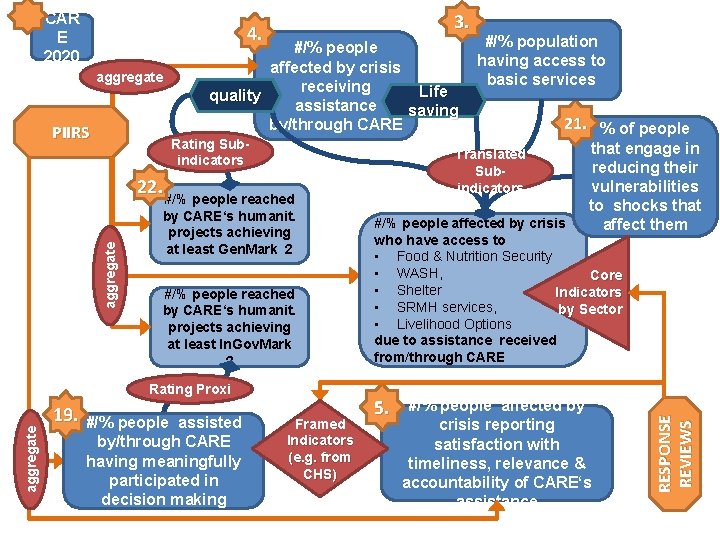
3. 4. aggregate PIIRS #/% people affected by crisis receiving Life quality assistance saving by/through CARE Rating Subindicators Translated Subindicators aggregate 22. #/% people reached by CARE‘s humanit. projects achieving at least Gen. Mark 2 #/% people reached by CARE‘s humanit. projects achieving at least In. Gov. Mark 2 aggregate Rating Proxi 19. #/% people assisted by/through CARE having meaningfully participated in decision making Framed Indicators (e. g. from CHS) #/% population having access to basic services 21. % of people that engage in reducing their vulnerabilities to shocks that affect them #/% people affected by crisis who have access to • Food & Nutrition Security • WASH, Core • Shelter Indicators • SRMH services, by Sector • Livelihood Options due to assistance received from/through CARE 5. #/% people affected by crisis reporting satisfaction with timeliness, relevance & accountability of CARE‘s assistance RESPONSE REVIEWS CAR E 2020
- Slides: 14