
Care Coordination and Interoperable Health IT Unit 3
Care Coordination and Interoperable Health IT Unit 3: Overview of Interoperable Health IT Lecture a – Benefits of Health Care Interoperability This material (Comp 22 Unit 3) was developed by Columbia University, funded by the Department of Health and Human Services, Office of the National Coordinator for Health Information Technology under Award Number 90 WT 0004. This work is licensed under the Creative Commons Attribution-Non. Commercial-Share. Alike 4. 0 International License. To view a copy of this license, visit http: //creativecommons. org/licenses/by-nc-sa/4. 0/.
Overview of Interoperable Health IT Learning Objectives • Objective 1: Define health care interoperability (Lecture a) • Objective 2: Summarize the vision and benefits of interoperable health IT (Lecture a) • Objective 3: Identify and examine several barriers and challenges to obtaining interoperable health IT (Lecture b) • Objective 4: Discuss the U. S. strategy for health interoperability (Lecture c) 2
What is health care interoperability? – Office of National Coordinator (ONC) definition • “the ability of a system to exchange electronic health information with and use electronic health information from other systems without special effort on the part of the user” • Means “making the right electronic health information available to the right people at the right time across products and organizations, in a way that can be relied upon and meaningfully used by recipients” 3

What is health care interoperability? Health Information Management Systems Society (HIMSS) definition • “In health care, interoperability is the ability of different information technology systems and software applications to communicate, exchange data, and use the information that has been exchanged” • “Interoperability means the ability of health information systems to work together within and across organizational boundaries in order to advance the effective delivery of health care for individuals and communities” 4
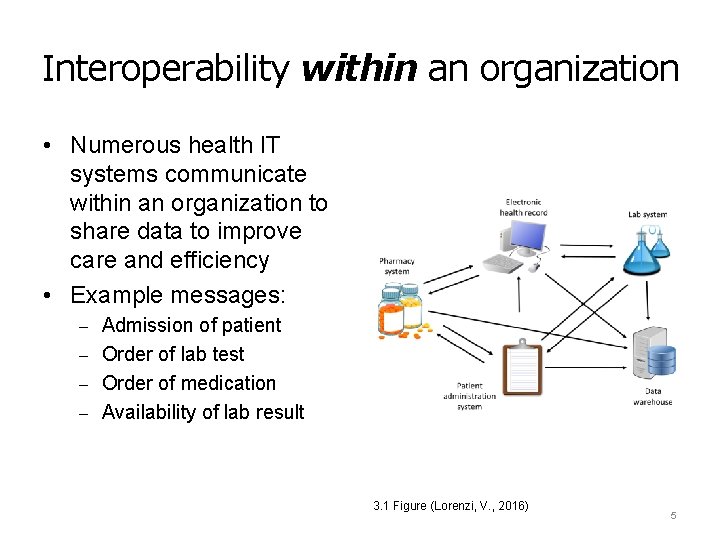
Interoperability within an organization • Numerous health IT systems communicate within an organization to share data to improve care and efficiency • Example messages: – Admission of patient – Order of lab test – Order of medication – Availability of lab result 3. 1 Figure (Lorenzi, V. , 2016) 5
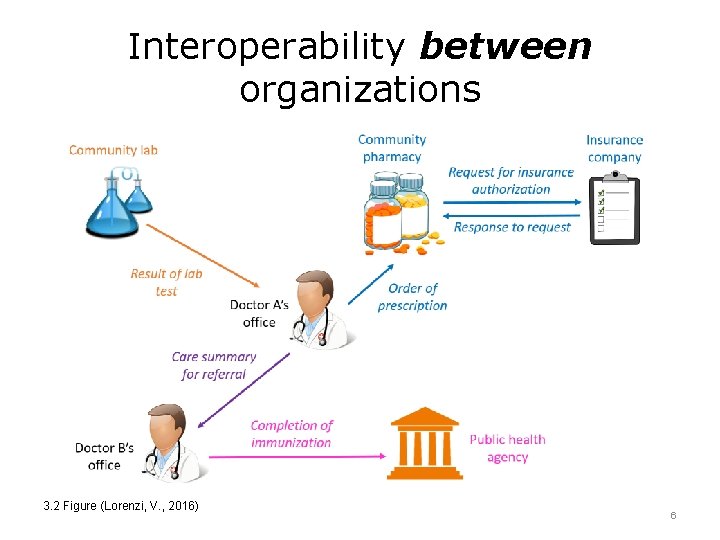
Interoperability between organizations 3. 2 Figure (Lorenzi, V. , 2016) 6

ONC’s national strategy for health care interoperability • Build an interoperable health IT ecosystem that supports a learning health system • This will be discussed in more detail in lecture c. 7
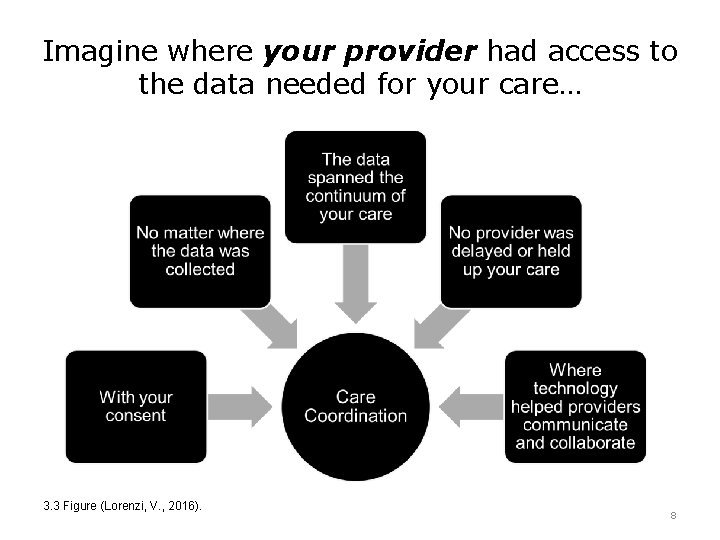
Imagine where your provider had access to the data needed for your care… 3. 3 Figure (Lorenzi, V. , 2016). 8
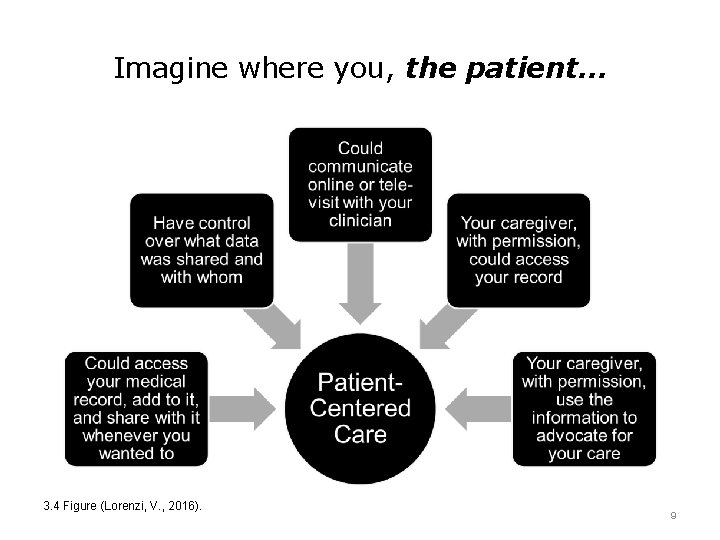
Imagine where you, the patient… 3. 4 Figure (Lorenzi, V. , 2016). 9
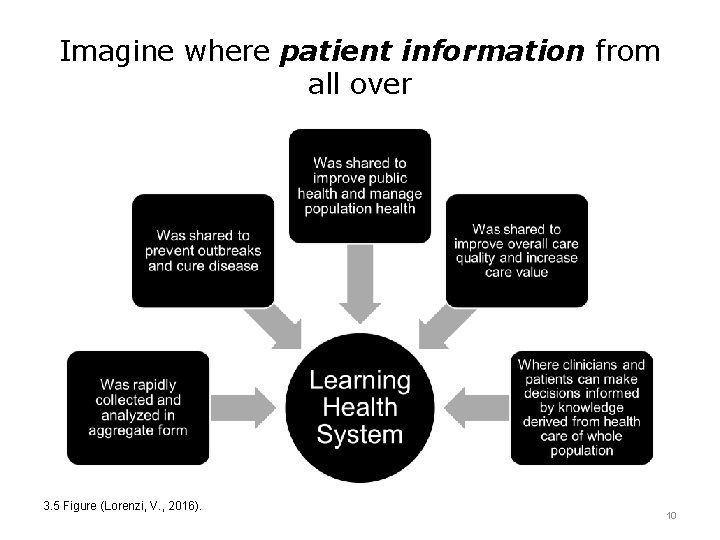
Imagine where patient information from all over 3. 5 Figure (Lorenzi, V. , 2016). 10
ONC’s definition of a learning health system • “A learning health system is an ecosystem where all stakeholders can securely, effectively and efficiently contribute, share and analyze data” • “A learning health system is characterized by continuous learning cycles, which encourage the creation of new knowledge that can be consumed by a wide variety of electronic health information systems” • “This knowledge can support effective decisionmaking and lead to improved health outcomes” 11
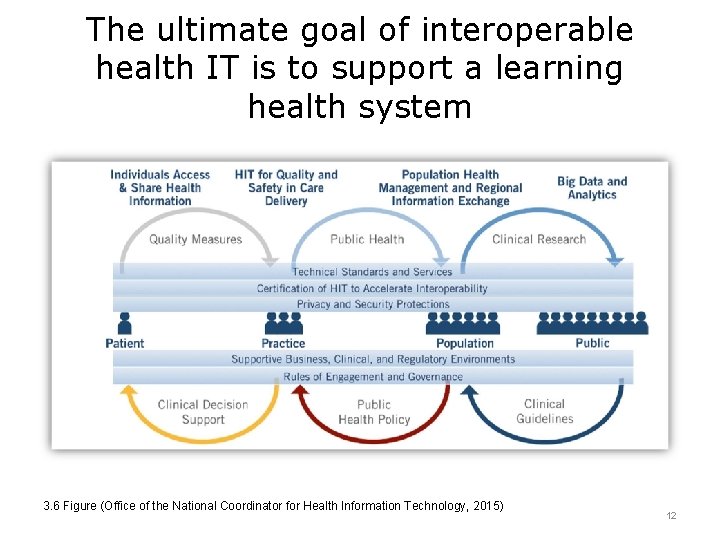
The ultimate goal of interoperable health IT is to support a learning health system 3. 6 Figure (Office of the National Coordinator for Health Information Technology, 2015) 12
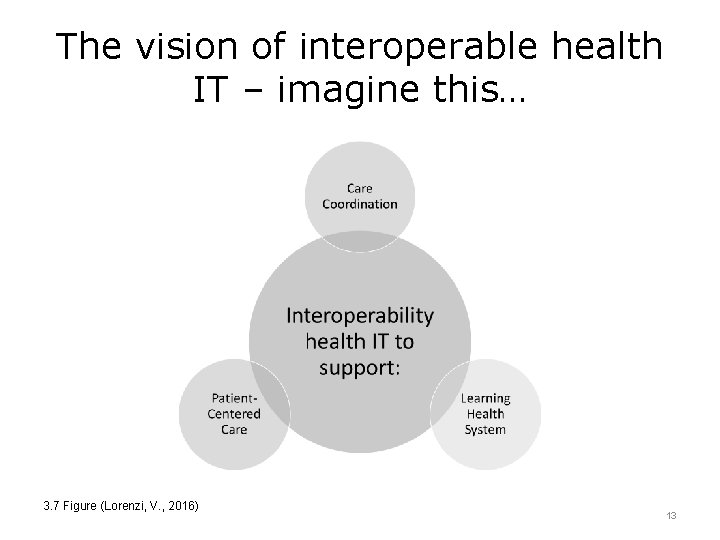
The vision of interoperable health IT – imagine this… 3. 7 Figure (Lorenzi, V. , 2016) 13
Benefits of interoperability • Available information supports improved care – Better coordination among caregivers – More complete data available sooner to aid clinician’s decisions – Data available to more participants in the care process • Patient and caregiver engagement – Timely access to data – Able to contribute data – Able to communicate • More efficient care, more value – Smoother workflow, less delays – Less redundant work • Data available to improve population and public health 14
JASON Report: benefits of interoperable health IT • Satisfy the growing demand of patients for flexible access to their own health information • Offer faster, interoperable access to patient records by health care providers • Reduce errors within individual records and across records • Reduce redundant testing and diagnostic procedures • Produce more complete health records and more accurate health data • Promote better longitudinal tracking of patients and patient groups 15
From the provider perspective, interoperability provides important capabilities: • Data capture for use by clinician and others at point of care • Technology to continuously analyze what is happening when and where (allows for optimization) • Decision support with automatic alerts and notifications • Seamless transfer of information between and within care settings • Assistance for provider to follow their patients throughout their care • Remote delivery of care • Data analysis support for the benefit of the wider population – (National Health Service of England, 2015) 16
Benefits of interoperability: patient perspective – “Steve’s Story” • Steve is a 26 -year-old male, who had a brain tumor removed as a child and is now suffering from frequent headaches • He is referred to many different doctors and health care facilities for treatment – Required to repeat registration information, medical history, allergies, medications, etc. – Required to repeat tests and procedures due to a lack of comparison test results and scans • Steve contracted an infection during a recent hospital visit and is concerned about ongoing and emergency care • He has increasing levels of fear and frustration 17
Steve‘s story in the future • The future: health care in an interoperable world • With Steve’s consent, health care information will be seamlessly and securely exchanged between and among diverse systems across the United States • Adapted from Healthcare Information Technology Standards Panel 2008 webinar 18
Steve‘s story in the future (Cont’d) • His care providers will have instant access to key data from other providers and care settings, including: – Active and past medication list – Allergies – Current and previous problems and diagnoses – Discharge and visit summaries – Lab results and other test results, including images – Registration and insurance information • Steve can also record his own findings and share them electronically with his doctors 19
Unit 3: Overview of Interoperable Health IT, Summary – Lecture a, Benefits of health care interoperability • The national vision of interoperable health IT is to build an interoperable health IT ecosystem that supports a learning health system • The Office of the National Coordinator of Health Information Technology and the Health Information Management Systems Society have definitions for interoperability 20
Unit 3: Overview of Interoperable Health IT, Summary – Lecture a, Benefits of health care interoperability (Cont’d – 1) • A learning health system is an ecosystem where all stakeholders can securely, effectively, and efficiently contribute, share and analyze data and create new knowledge that can be consumed by a wide variety of electronic health information systems to support effective decision-making and lead to improved health outcomes • There are many benefits from interoperability, including: having information available to support improved care and to improve population and public health, engaging patients and caregivers, and having more efficient and value-added care 21
Unit 3: Overview of Interoperable Health IT References – Lecture a References Agency for Healthcare Research and Quality. (2013). A robust health data infrastructure. Available at Office of the National Coordinator of Health Information Technology. De. Salvo, K. B. (2014). Press release: A robust health data infrastructure. Available at Office of the National Coordinator of Health Information Technology. Healthcare Information Technology Standards Panel. (2008). Steve’s story. Available at HITSP 2008 webinar archives. Health Information Management Systems Society. Definition of interoperability. Available at HIMSS. Institute of Electrical and Electronics Engineers. Definition of interoperability. Available at Institute of Electrical and Electronics Engineers website. NHS England, HSCIC, South, Central, and West Commissioning Support Unit. (2015). Interoperability Handbook. Version 1. 0. Office of the National Coordinator for Health Information Technology. (2015). Connecting health and care for the nation: a 10 -year vision to achieve an interoperable health IT infrastructure. 22
Unit 3: Overview of Interoperable Health IT References – Lecture a (Cont’d – 1) References Office of the National Coordinator for Health Information Technology. (2015). Connecting health and care for the nation: a shared nationwide interoperability roadmap. Final version 1. 0. Raiford, R. ONC Health Information Technology Standards Panel Webinar Series. 23
Unit 3: Overview of Interoperable Health IT References – Lecture a (Cont’d – 2) Charts, Figures, Tables 3. 1 Figure: Lorenzi, V. (2016). Interoperability within an organization. Used with permission. 3. 2 Figure: Lorenzi, V. (2016). Interoperability between organizations. Used with permission. 3. 3 Figure: Lorenzi, V. (2016). Vision of interoperability and care coordination. Used with permission. 3. 4 Figure: Lorenzi, V. (2016). Vision of interoperability and patient-centered care. Used with permission. 3. 5 Figure: Lorenzi, V. (2016). Vision of interoperability and learning health system. Used with permission. 3. 6 Figure: Office of the National Coordinator for Health Information Technology. (2015). Health IT ecosystem. 3. 7 Figure: Lorenzi, V. (2016). Vision of interoperable health IT. Used with permission. 24
Unit 3: Overview of Interoperable Health IT, Lecture a – Benefits of Interoperable Health IT This material was developed by Columbia University, funded by the Department of Health and Human Services, Office of the National Coordinator for Health Information Technology under Award Number 90 WT 0004. 25
- Slides: 25