
Care Coordination and Interoperable Health IT Systems Unit
Care Coordination and Interoperable Health IT Systems Unit 4: Principles and Technology of Interoperable Health IT Lecture a – Technical Definitions of Interoperability This material (Comp 22 Unit 4) was developed by Columbia University, funded by the Department of Health and Human Services, Office of the National Coordinator for Health Information Technology under Award Number 90 WT 0004. This work is licensed under the Creative Commons Attribution-Non. Commercial-Share. Alike 4. 0 International License. To view a copy of this license, visit http: //creativecommons. org/licenses/by-nc-sa/4. 0/.
Principles and Technology of Interoperable Health IT Learning Objectives • Objective 1: Name and define types of interoperability (Lecture a) • Objective 2: Explain the complexities of semantic harmonization and the benefits of using standards (Lecture a) • Objective 3: Describe and contrast intra- and inter-organizational interoperability (Lecture b) • Objective 4: Identify and discuss common types of tools and technologies used to solve health interoperability problems (Lecture c) 2
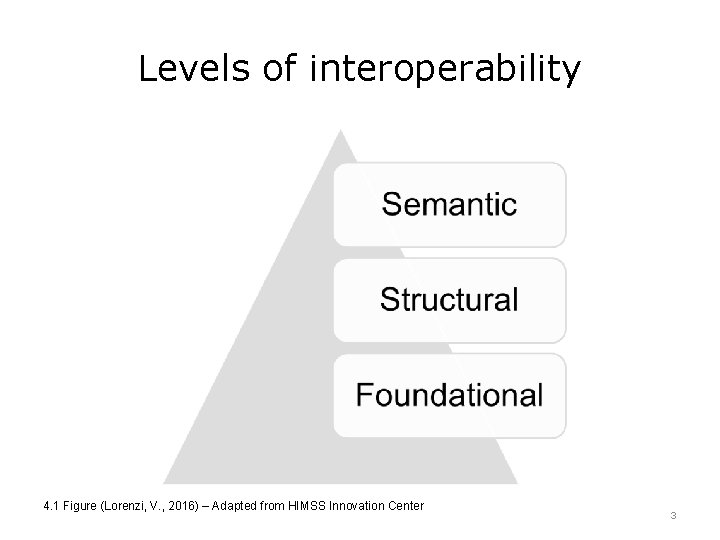
Levels of interoperability 4. 1 Figure (Lorenzi, V. , 2016) – Adapted from HIMSS Innovation Center 3
Foundational interoperability • Allows data exchange from one information technology system to be received by another and does not require the ability for the receiving information technology system to interpret the data – HIMSS Board, April 5, 2013 4
Lower – level interoperability: reliable communication • Both systems must have a way to reliably communicate data – Levels 1 – 6 of the ISO OSI Model o Refer to component nine for more details • A transmission should not be considered complete unless the receiving system acknowledges receipt 5
Structural interoperability • Structural interoperability is an intermediate level that defines the structure or format of data exchange • It ensures that data exchanges between information technology systems can be interpreted at the data field level – HIMSS Board, April 5, 2013 6
Semantic interoperability • Provides interoperability at the highest level • Is the ability of two or more systems or elements to exchange information and understand the information that has been exchanged • Takes advantage of both the structuring of the data exchange and the codification of the data, including vocabulary, so that the receiving information technology systems can interpret the data – Adapted from HIMSS Board definition, April 5, 2013 7

Levels of interoperability: summary 4. 2 Figure (Lorenzi, V. , 2016) 8
Semantic harmonization • Achieving semantic interoperability is difficult without standards because you must first do semantic harmonization • Semantic harmonization is harmonizing definitions of what concepts mean between all parties in the exchange • “User – Centered Semantic Harmonization: A Case Study” by Wang, Gennari, and Fridsma 9
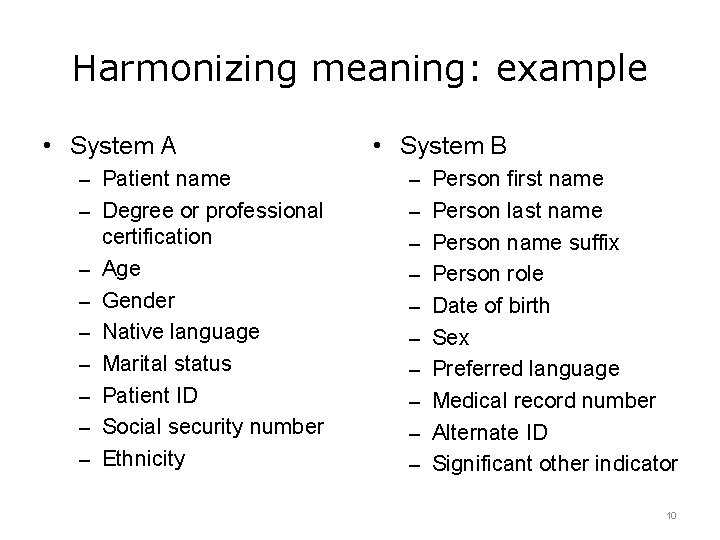
Harmonizing meaning: example • System A • System B – Patient name – Person first name – Degree or professional – Person last name – – – – certification Age Gender Native language Marital status Patient ID Social security number Ethnicity – Person name suffix – Person role – Date of birth – Sex – Preferred language – Medical record number – Alternate ID – Significant other indicator 10
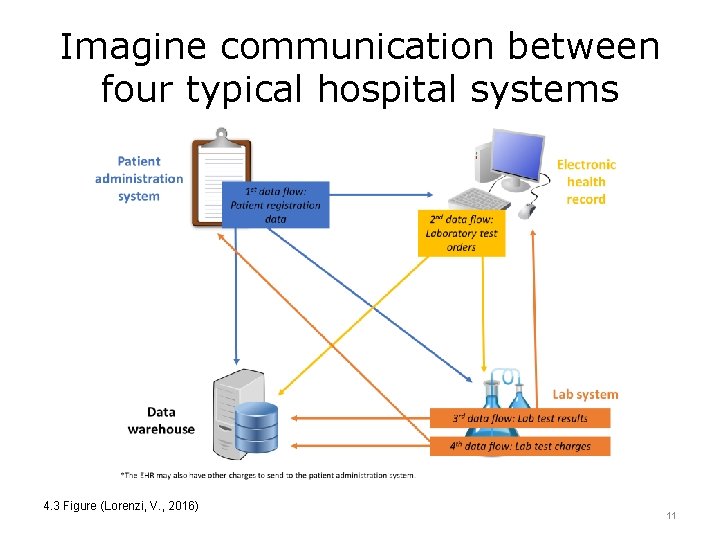
Imagine communication between four typical hospital systems 4. 3 Figure (Lorenzi, V. , 2016) 11
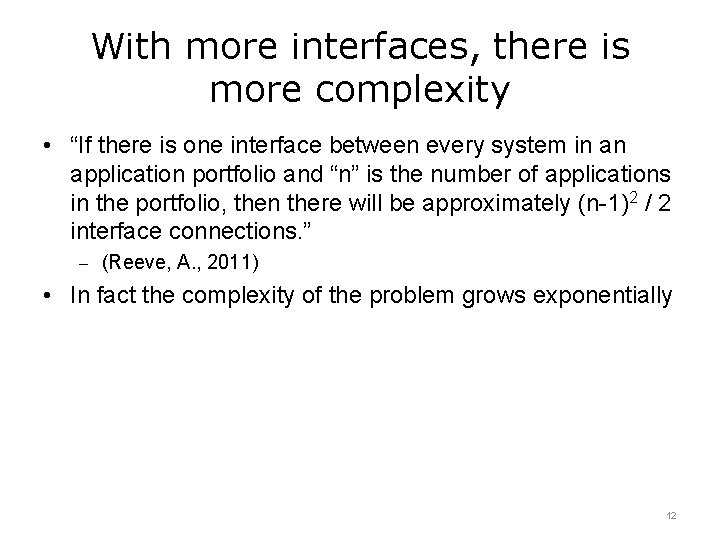
With more interfaces, there is more complexity • “If there is one interface between every system in an application portfolio and “n” is the number of applications in the portfolio, then there will be approximately (n-1)2 / 2 interface connections. ” – (Reeve, A. , 2011) • In fact the complexity of the problem grows exponentially 12
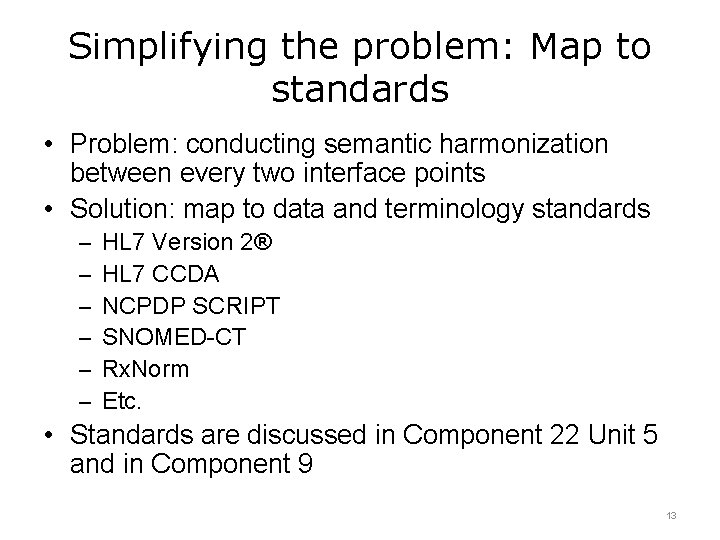
Simplifying the problem: Map to standards • Problem: conducting semantic harmonization between every two interface points • Solution: map to data and terminology standards – HL 7 Version 2® – HL 7 CCDA – NCPDP SCRIPT – SNOMED-CT – Rx. Norm – Etc. • Standards are discussed in Component 22 Unit 5 and in Component 9 13
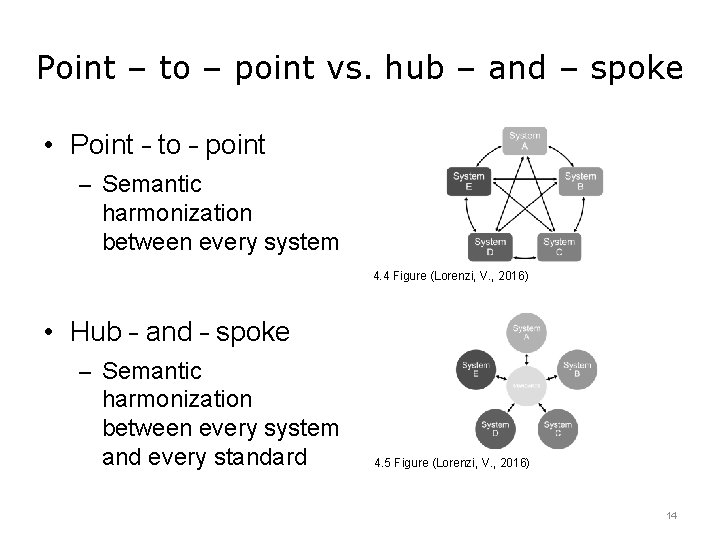
Point – to – point vs. hub – and – spoke • Point – to – point – Semantic harmonization between every system 4. 4 Figure (Lorenzi, V. , 2016) • Hub – and – spoke – Semantic harmonization between every system and every standard 4. 5 Figure (Lorenzi, V. , 2016) 14
Steps to achieving interoperability • Both parties need to obtain health IT • Both systems need to have compatible functionality so that they collect and display congruent information • Both systems need the ability to send and/or receive the information – Basic: communicate using unstructured text – Intermediate: communicate using structured text – Semantic: understand the meaning of the exchanged information • Alternate solution is to share the same system – But the same interoperability problems could still exist 15
Optimal solution: go beyond mapping • In the ideal case, the information is structured and coded in every system using the same standard format and meaning. Then you would not need to even map to a standard. • For example, imagine communicating lab results in an health information exchange (HIE) – Worst case: every hospital sends the HIE its local codes and the HIE most harmonize all the local lab codes – Median case: each system maps local codes to LOINC and sends LOINC codes – Best case: each system uses LOINC codes directly as an identifier for their lab tests 16
The case for standards • The benefit of using standards is significant • Standards organizations, such as HL 7, do the hard work of semantic harmonization so you do not have to • Caveat: many standards still allow for variances in implementations – Such as providing fields that are optional or rules with flexibility that must be agreed to at implementation time – Therefore, an amount of harmonization is still required at each implementation • Standards are covered in more detail in Unit 5 and in Component 9. Implementation is discussed further in Unit 6. 17
Unit 4: Principles and Technology of Interoperable Health IT, Summary – Lecture a, Technical Definitions of Interoperability • There are three levels of interoperability: foundational, structural, and semantic • To achieve semantic interoperability, you need semantic harmonization • Standards are essential for achieving large scale interoperability since they greatly reduce the amount of harmonization required for each implementation. 18
Principles and Technology of Interoperable Health IT References – Lecture a References Reeve, A. (2011). The problem with point to point interfaces. Available at: https: //infocus. emc. com/april_reeve/the-problem-with-point-to-point-interfaces/ Wang, C, Gennari, JH, & Fridsma, DB. (2007). User-centered semantic harmonization: a case study. J Biomed Inform. 40(3): 353 -64 Charts, Tables, Figures 4. 1 Figure: Lorenzi, V. (2016). 4. 2 Figure: Lorenzi, V. (2016). 4. 3 Figure: Lorenzi, V. (2016). 4. 4 Figure: Lorenzi, V. (2016). 4. 5 Figure: Lorenzi, V. (2016). Levels of interoperability. Adapted from HIMSS Innovation Center. Levels of interoperability: summary. Used with permission. Example of interoperability in a hospital. Used with permission. Point-to-point model. Used with permission. Hub-and-spoke model. Used with permission. 19
Unit 4: Principles and Technology of Interoperable Health IT, Lecture a – Technical Definitions of Interoperability This material was developed by Columbia University, funded by the Department of Health and Human Services, Office of the National Coordinator for Health Information Technology under Award Number 90 WT 0004. 20
- Slides: 20