
Care and Clinical Governance Dr Kim Forrester Care



- Slides: 23
Care and Clinical Governance Dr Kim Forrester
Care Governance 1. What is Care Governance? 2. What needs to be in place for good care governance to be effective? 3. Lessons learnt.
What is care governance?
What is care governance ØThe community expects that ‘someone’ is ensuring appropriate systems and processes are in place and working well. Ø Care governance/clinical governance and the expansion, integration and diversity of health and social care services. Ø Effective governance underpins and drives safe, high quality care.
Care Governance Process or system through which the organisation is: Accountable for continuously improving the quality and safety of the care and care services; Safeguarding and assuring high standards; Creating a culture that is transparent and where everyone assumes responsibility and accountability for establishing and maintaining an environment where excellence flourishes. *Scally and Donaldson (1998) National Safety and Quality Health Service Standards and Public Bodies (Joint Working) (Scotland) Act 2014 Clinical and Care Governance Framework
Care Governance Requires the board to have in place a structured system through which the organisation is responsible and accountable for: Ø Supporting the staff in continuously improving the quality and safety of the service, minimising risk and fostering an environment of excellence in care ; through ØRigorously monitoring, assessing, evaluating, reviewing and reporting on the care, outcomes and risks; to ØSpecifically identified roles that are clearly defined and understood; ensuring that ØReliable, safe, high quality standards are established and maintained; so that ØResidents/patient/clients/carers/family/staff/management and board/commission are assured and confident in the standard and quality of the care being delivered.
What needs to be in place for good care governance to be effective?
Metro North Hospital and Health Service 5 hospital sites: RBWH and TPCH: tertiary/quaternary referral facilities providing advanced level of health care; Redcliffe and Caboolture Hospitals: major community hospitals; Kilcoy: regional community hospital; Woodford Correctional Centre. 14 Community Indigenous Sub-acute Services 27 Oral health facilities 14 Mental health facilities Residential and extended care facilities
Elements supporting good care governance Quality and safety of the care should be high profile and a priority- led for excellence. Care governance is separate from other board governance roles – so identify your purpose, scope and goals aimed at improving performance and quality of care Systemic not piece meal approach to achieve positive outcomes and minimise risk – total system and processes in place to support the workforce to provide safe high quality care Clearly communicated and supported (policies, procedures and protocols) Clear lines of responsibility Allocation of resources to achieve the outcome
Elements supporting good care governance There is a focus on the resident/ client/patient/carer/family experience – person centred: Strategies in place to ensure consumers are encouraged and empowered to participate in: their care consultation processes: planning, monitoring, improvements partnerships complaints and compliments development of information resources and communication strategies
Elements supporting good care governance Organisational culture – priortise care Strong leadership and ownership: Need the ‘right’ organisational culture which supports and understands that everyone in the organisation is responsible and accountable for the safety and quality of the care Quality and safety of care is accepted as core business Workforce has appropriate qualifications skills and knowledge required to safely and competently undertake their roles and responsibilities Understand the concept of governance AND participate Supported through committee structures and processes Monitor and review: selection, recruitment, credentialling, qualifications, maintenance of professional education and standards.
Elements supporting good care governance Driven by robust and reliable monitoring, reporting and review processes and systems
Elements supporting good care governance System ensures monitoring and evaluating of performance, quality and risk: Provision of accurate, timely, meaningful data Reactive and proactive Analysis: are you data rich but information poor ? Risk and incident management and improvement strategies and policies are integrated with performance monitoring Recommendations are meaningful and acted on to improve system performance Culture of transparency not individual blame Systems approach to learning from an incident
Data Prioritise – don’t try to cover everything at once; Focus on the core issues and results – don’t get distracted; Communicate with your staff - explain what you want and why it is important. Establish a baseline for monitoring Clarifies what is actually happening Determines whether change is needed and the result of that change – is there an quality improvement ? Enable you to compare your performance/ benchmark Validate
Elements supporting good care governance Compliant with legislation, internal, external, industry, professional mandates and accreditation standards. Review, monitor and respond to external and internal assessments.
Care Governance No one-size-fits-all approach An organisation needs to assure itself that the relevant dimensions for their particular organisation are covered An organisation needs to think through each principle and consider how best to apply it in their circumstances
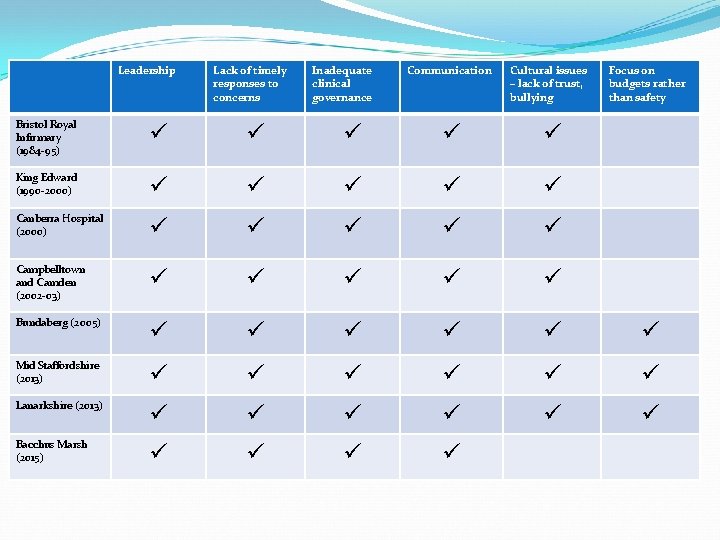
Lessons learnt Health care has a poor safety record: 1 : 1, 000 harmed in an aviation incident 1 : 10 chance of harm during the delivery of health care 20 -40% of all health spending is wasted due to poor quality of care – additional hospitalisation, litigation, infection, disability, loss of productivity, medical expenses. Multiple case studies of clinical governance failure and variable performance
Leadership Lack of timely responses to concerns Inadequate clinical governance Communication Cultural issues – lack of trust, bullying Focus on budgets rather than safety Bristol Royal Infirmary (1984 -95) King Edward (1990 -2000) Canberra Hospital (2000) Campbelltown and Camden (2002 -03) Bundaberg (2005) Mid Staffordshire (2013) Lanarkshire (2013) Bacchus Marsh (2015)
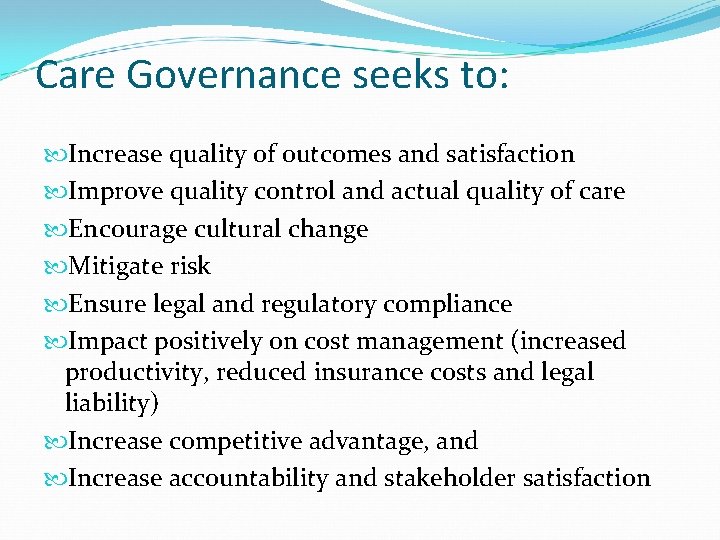
Care Governance seeks to: Increase quality of outcomes and satisfaction Improve quality control and actual quality of care Encourage cultural change Mitigate risk Ensure legal and regulatory compliance Impact positively on cost management (increased productivity, reduced insurance costs and legal liability) Increase competitive advantage, and Increase accountability and stakeholder satisfaction
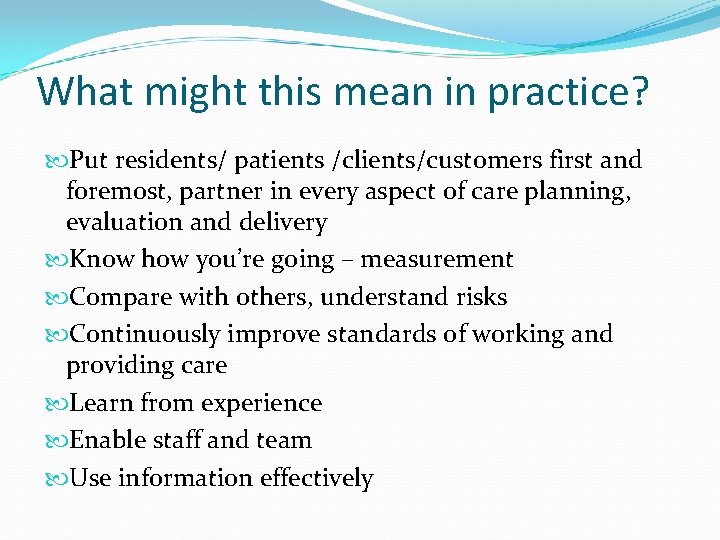
What might this mean in practice? Put residents/ patients /clients/customers first and foremost, partner in every aspect of care planning, evaluation and delivery Know how you’re going – measurement Compare with others, understand risks Continuously improve standards of working and providing care Learn from experience Enable staff and team Use information effectively
Key questions At a governance level, the questions are always: “Do we have a good system? ” and “How do we know? ”
References Anglican Diocese of Brisbane, Community Services Commission, (2015) Care Governance Charter; South Australia Innovation HUB and the Australian Aged care Quality Agency (2015), Effective Governance: a framework for aged care; Australian Commission on Safety and Quality in Health Care (2015), Guide to the National Safety and Quality Health Service Standards for health service organisation boards; Australian Institute of Company Directors (2011), The Board’s role in clinical governance; Forrester Report, Tabled Queensland Parliament 16 April 2013.
THANK YOU