
Cardiovascular System Chapter 9 General The cardiovascular system
- Slides: 33
Cardiovascular System Chapter 9
General • The cardiovascular system is a series of tubes and a muscular pump that provides a ONE-WAY street for blood, oxygen, and nutrients. • Blood and nutrients travel through blood vessels (arteries, veins, and capillaries). 2 Dr Atef Masad Cardiovascular 9/25/2020
• The cardiovascular system is fueled by a muscular pump called the heart. The heart is actually two pumps connected by a SEPTUM. • The right side of the heart pumps blood that is deficient in oxygen to the lungs [Pulmonary Circulation]. • The left side of the heart pumps blood that is rich in oxygen to the body [Systemic Circulation]. 3 Dr Atef Masad Cardiovascular 9/25/2020
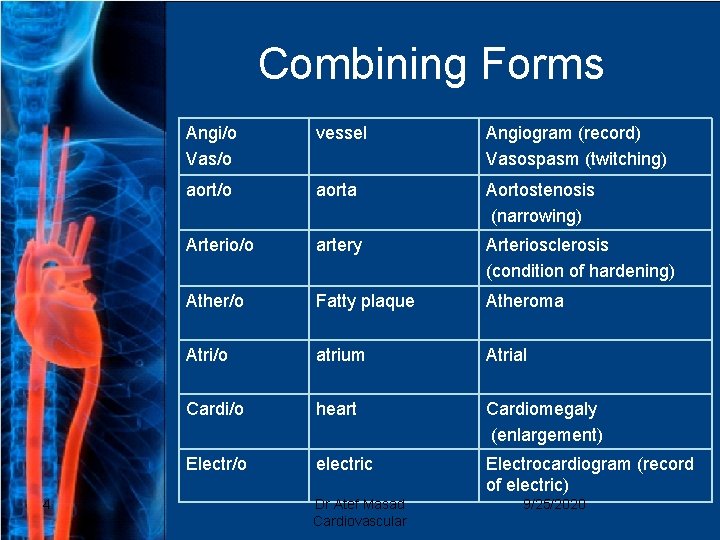
Combining Forms 4 Angi/o Vas/o vessel Angiogram (record) Vasospasm (twitching) aort/o aorta Aortostenosis (narrowing) Arterio/o artery Arteriosclerosis (condition of hardening) Ather/o Fatty plaque Atheroma Atri/o atrium Atrial Cardi/o heart Cardiomegaly (enlargement) Electr/o electric Electrocardiogram (record of electric) Dr Atef Masad Cardiovascular 9/25/2020
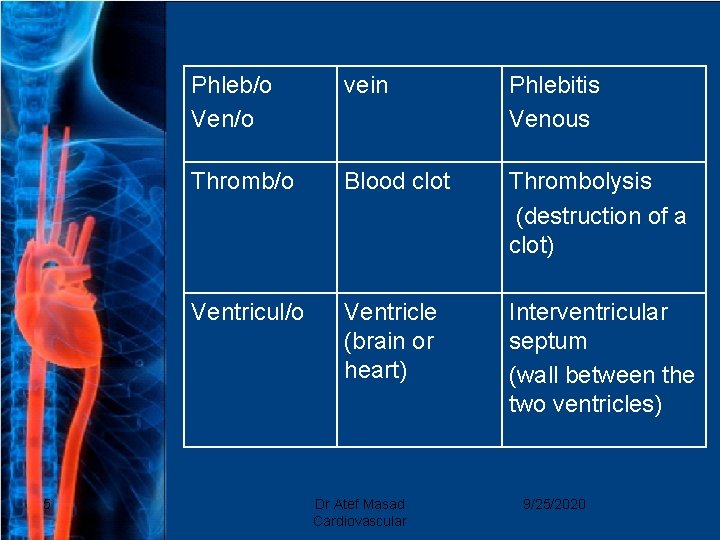
5 Phleb/o Ven/o vein Phlebitis Venous Thromb/o Blood clot Thrombolysis (destruction of a clot) Ventricul/o Ventricle (brain or heart) Interventricular septum (wall between the two ventricles) Dr Atef Masad Cardiovascular 9/25/2020
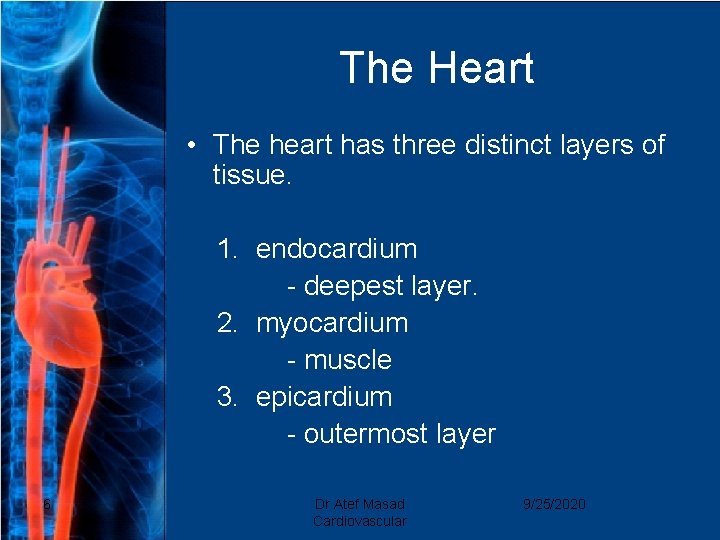
The Heart • The heart has three distinct layers of tissue. 1. endocardium - deepest layer. 2. myocardium - muscle 3. epicardium - outermost layer 6 Dr Atef Masad Cardiovascular 9/25/2020
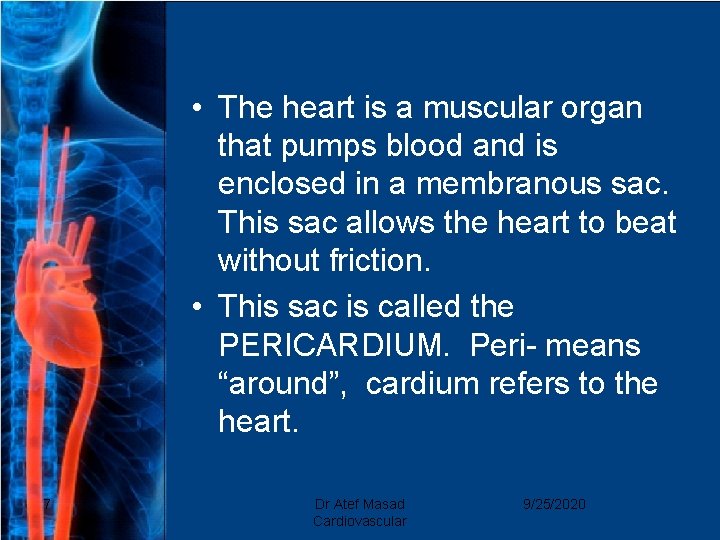
• The heart is a muscular organ that pumps blood and is enclosed in a membranous sac. This sac allows the heart to beat without friction. • This sac is called the PERICARDIUM. Peri- means “around”, cardium refers to the heart. 7 Dr Atef Masad Cardiovascular 9/25/2020
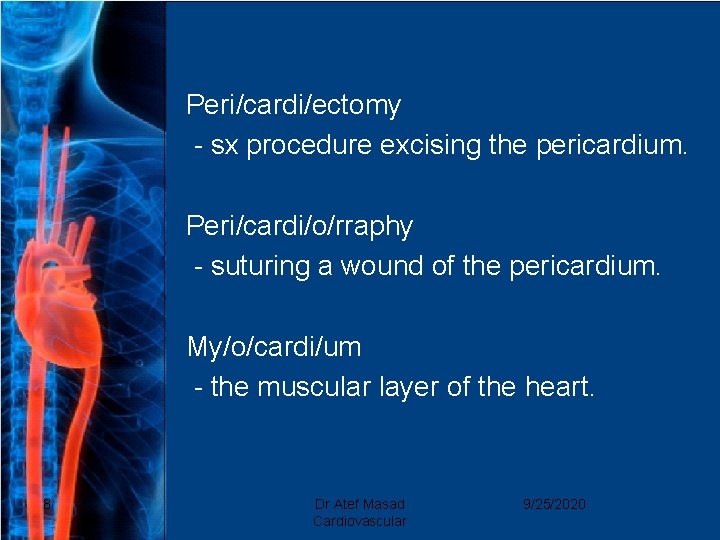
Peri/cardi/ectomy - sx procedure excising the pericardium. Peri/cardi/o/rraphy - suturing a wound of the pericardium. My/o/cardi/um - the muscular layer of the heart. 8 Dr Atef Masad Cardiovascular 9/25/2020
• There are two sides of the heart. • There are two vertical divisions of the heart. • The top compartments are ATRIA • The bottom compartments are VENTRICLES • Therefore, there are right and left atria and right and left ventricles. 9 Dr Atef Masad Cardiovascular 9/25/2020
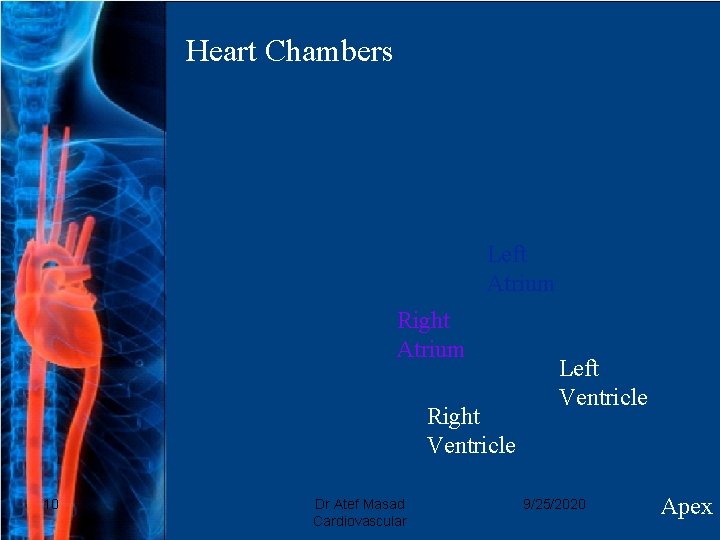
Heart Chambers Left Atrium Right Ventricle 10 Dr Atef Masad Cardiovascular Left Ventricle 9/25/2020 Apex
• Abbreviations for chambers: Right atrium RA Right ventricle RV Left atrium LA Left ventricle LV 11 Dr Atef Masad Cardiovascular 9/25/2020
• The ventricles are larger than the atria. This is because the ventricles are responsible for pumping blood a farther distance than the atria. • Of the two ventricles, the left is larger than the right. This is because the left ventricle must pump blood to the entire body. 12 Dr Atef Masad Cardiovascular 9/25/2020
• A rapid contraction of the atrium or ventricle is known as a FLUTTER. • Atrial flutter can cause chest pain and shortness of breath (SOB). • The rule forming plural words from the singular that end in – um is to drop the –um and add an –a. 13 Dr Atef Masad Cardiovascular 9/25/2020
• The prefix “tachy-” refers to rapid. a rapid heartbeat (pulse): tachycardia • The prefix “brady-” refers to slow. a slow heartbeat (pulse): bradycardia 14 Dr Atef Masad Cardiovascular 9/25/2020
• Arteries bring blood AWAY from the heart. • Veins bring blood TOWARD the heart. • Arteries usually carry blood with much oxygen. • Veins usually carry blood with little oxygen. • The RIGHT ATRIUM receives blood from all tissues of the body through veins. This blood is oxygen poor. 15 Dr Atef Masad Cardiovascular 9/25/2020
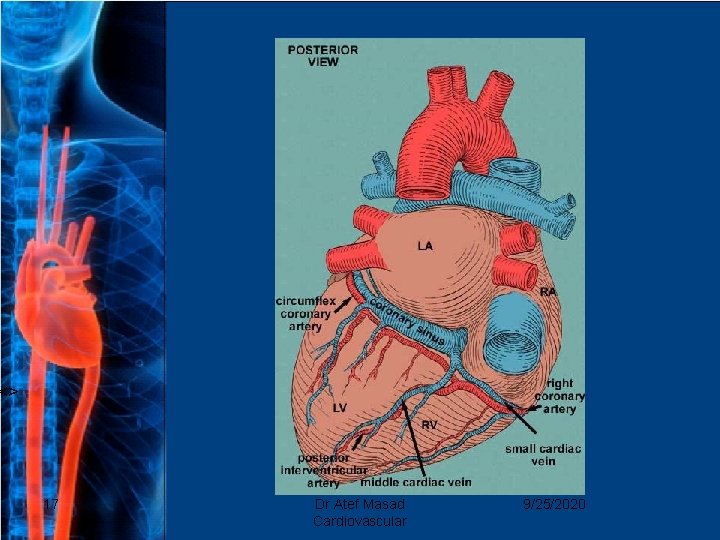
• The blood brought back to the heart comes from three sources: 1. SUPERIOR VENA CAVA (SVC) brings blood from the top part of the body. INFERIOR VENA CAVA (IVC) brings blood from the lower part of the body. CORONARY SINUS brings blood from the heart muscle. 2. 3. All three sources empty into the RIGHT ATRIUM. 16 Dr Atef Masad Cardiovascular 9/25/2020
<> 17 Dr Atef Masad Cardiovascular 9/25/2020
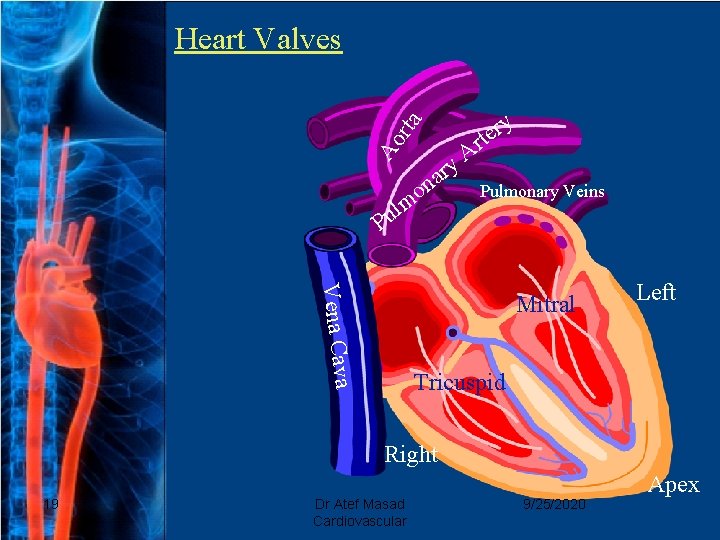
• Once inside the right atrium, the blood must travel to the right ventricle. In order to do this, it must pass through the TRICUSPID VALVE. • The function of all heart valves is to allow one way travel of blood. It would be dangerous to have blood backflow because of different oxygen concentrations. 18 Dr Atef Masad Cardiovascular 9/25/2020
Ao rta Heart Valves P A y ar y r e rt n o ulm Pulmonary Veins Vena Cava Mitral Left Tricuspid Right 19 Dr Atef Masad Cardiovascular 9/25/2020 Apex
• Once inside the right ventricle, the blood passes through the PULMONARY SEMILUNAR VALVE into the PULMONARY ARTERIES. • The pulmonary arteries carry oxygen -deficient blood to the lungs. • Once inside the lungs, the blood vessels branch until they reach one cell layer thick. These CAPILLARIES combine with the ALVEOLI of the lungs for the exchange of oxygen and carbon dioxide. 20 Dr Atef Masad Cardiovascular 9/25/2020
21 • The blood now has much oxygen. It returns to the heart by the PULMONARY VEINS. There are four pulmonary veins that empty into the LEFT ATRIUM. • The blood then must pass through the MITRAL VALVE (BICUSPID VALVE) into the left ventricle. • From the left ventricle the blood passes through the AORTIC SEMILUNAR VALVE in the AORTA. • The aorta is the largest artery of the body. Dr Atef Masad 9/25/2020 Cardiovascular
• The contraction of the left ventricle sends blood rich in oxygen all over the body. There are three arteries that bring blood to the head, neck, and upper extremities. There is one major vessel that brings blood to the abdomen and lower extremities. • Arteries are the large vessels that bring blood away from the heart. These vessels branch into smaller ARTERIOLES which eventually branch into CAPILLARIES which are only one cell thick. 22 Dr Atef Masad Cardiovascular 9/25/2020
• The primary responsibility for initiating the heartbeat is with the SINOATRIAL NODE. This is located on the posterior wall of the right atrium. • Once this electric current is generated, atrial muscle contracts forcing blood into the ventricles. Once this occurs the heartbeat moves to another region called the ATRIOVENTRICULAR NODE. 23 Dr Atef Masad Cardiovascular 9/25/2020
• Once this occurs, the AV node sends electrical impulses through a series of BUNDLE BRANCHES ending in PURKINJE FIBERS that stimulate the ventricles to contract. 24 Dr Atef Masad Cardiovascular 9/25/2020
Blood Supply to Heart • Coronary Artery System – right coronary – left coronary • left anterior descending • circumflex 25 Dr Atef Masad Cardiovascular 9/25/2020
The Cardiac Cycle and Heart Sounds • The CARDIAC CYCLE is the events that occur in one complete heartbeat. • The cardiac cycle has 2 phases: 1. contraction of the heart: SYSTOLE 2. relaxation of the heart: DIASTOLE 26 Dr Atef Masad Cardiovascular 9/25/2020
• The atria and ventricles have different functions during the cardiac cycle. • When the atrium are contracting, blood flows into the ventricles. Therefore, the ventricles have to be relaxing. • When the atria are in systole, the ventricles are in diastole. • Electrical activity of the heart can be measured by an electrocardiogram (EKG or ECG). 27 Dr Atef Masad Cardiovascular 9/25/2020
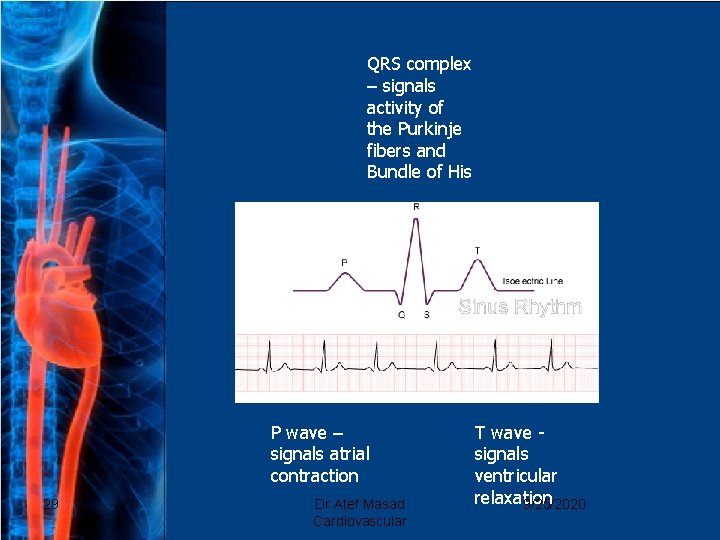
• EKG’s are electrical tracings of each part of the cardiac cycle. • Each time a different part of the heart contracts, an electrical impulse can be recorded from different areas on the thorax. 28 Dr Atef Masad Cardiovascular 9/25/2020
QRS complex – signals activity of the Purkinje fibers and Bundle of His P wave – signals atrial contraction 29 T wave signals ventricular relaxation Dr Atef Masad 9/25/2020 Cardiovascular
Microcardia - small heart Cardiomegaly (megalocardia) - enlargement of heart Myocardial Infarction (MI) - heart attack Hypertension - high blood pressure 30 Dr Atef Masad Cardiovascular 9/25/2020
• ATHEROSCLEROSIS is a form of ARTERIOSCLEROSIS and is characterized by an abnormal accumulation of fat and fibrous tissue (scarring) in a blood vessel. • This leads to a narrowing of the LUMEN which causes a decrease in blood flow to a part of the body. • This condition can lead to NECROSIS, or cellular death. 31 Dr Atef Masad Cardiovascular 9/25/2020
• To prevent blood clots, patients may take an ANTICOAGULANT. These are agents that delay blood coagulation (clotting). • Anticoagulants are used to prevent THROMBUS formation (THROMBOGENESIS). • THROMBOLYSIS is accomplished with THROMBOLYTIC AGENTS or medications that destroy a clot. 32 Dr Atef Masad Cardiovascular 9/25/2020
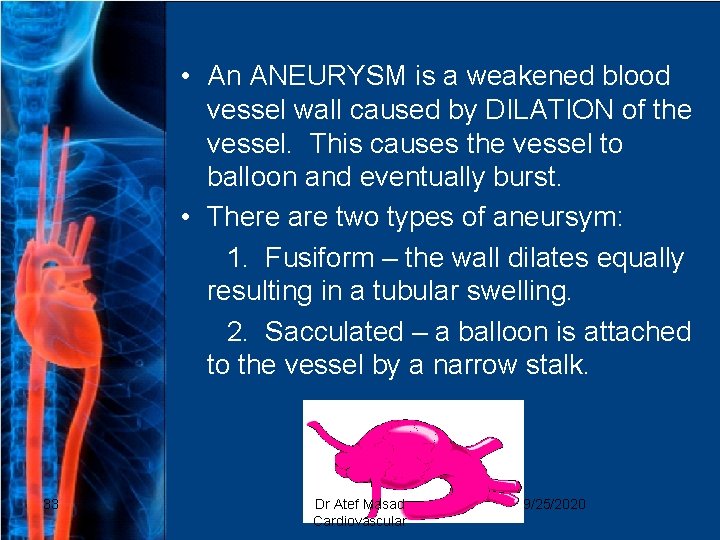
• An ANEURYSM is a weakened blood vessel wall caused by DILATION of the vessel. This causes the vessel to balloon and eventually burst. • There are two types of aneursym: 1. Fusiform – the wall dilates equally resulting in a tubular swelling. 2. Sacculated – a balloon is attached to the vessel by a narrow stalk. 33 Dr Atef Masad Cardiovascular 9/25/2020