
Cardiff 090915 SOCIAL PEDAGOGY An underpinning theoretical framework
![Impact of Social Pedagogy Inter-professional practice: ‘According to [social pedagogy course] participants, the common](https://slidetodoc.com/presentation_image/31a880065d50e68e632ecfb33809c4f3/image-21.jpg "Impact of Social Pedagogy Inter-professional practice: ‘According to [social pedagogy course] participants, the common")
- Slides: 38
Cardiff, 09/09/15 SOCIAL PEDAGOGY An underpinning theoretical framework for caring for children and young people Knowledge Exchange Day David Kingswood & Gabriel Eichsteller dialogue@thempra. org. uk Them. Pra Social Pedagogy Community Interest Company
The Meaning of Pedagogy ‘The term pedagogue derives from the Greek, and refers not to the teacher, but to the watchful [. . . ] guardian whose responsibility [in antique Greece] it was to lead (agogos) the young boy (paides) to school. […] The adult had the task of accompanying the child, of being with the child, of caring for the child. This is a kind of 'leading' that often walks behind the one who is led. ’ (van Manen 1991: 37)
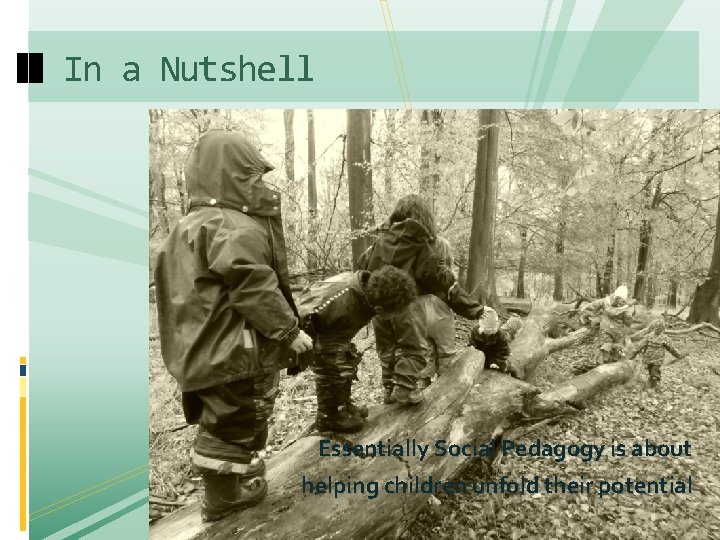
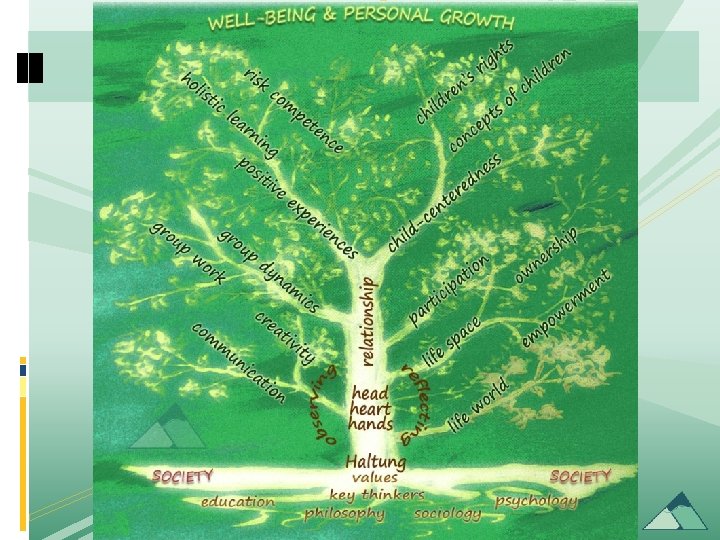
In a Nutshell Essentially Social Pedagogy is about helping children unfold their potential
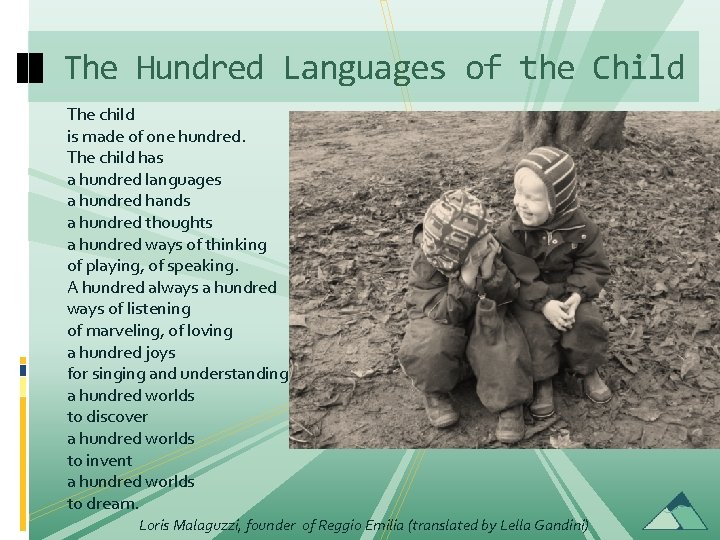
The Hundred Languages of the Child The child is made of one hundred. The child has a hundred languages a hundred hands a hundred thoughts a hundred ways of thinking of playing, of speaking. A hundred always a hundred ways of listening of marveling, of loving a hundred joys for singing and understanding a hundred worlds to discover a hundred worlds to invent a hundred worlds to dream. Loris Malaguzzi, founder of Reggio Emilia (translated by Lella Gandini)
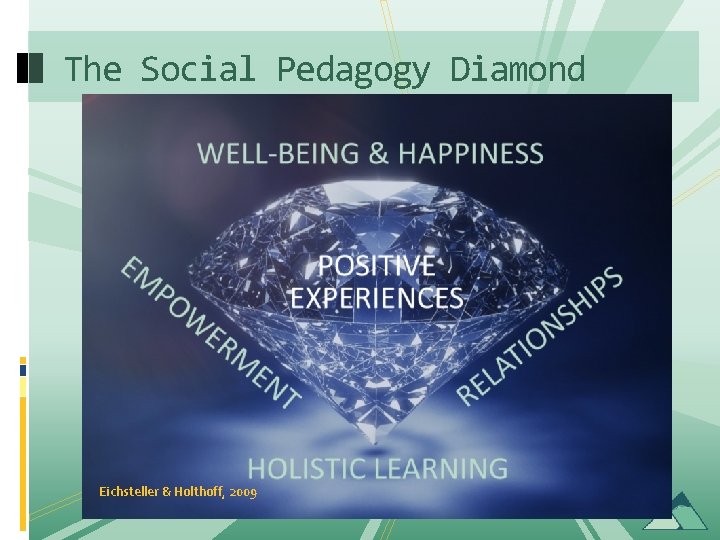
The Social Pedagogy Diamond Eichsteller & Holthoff, 2009
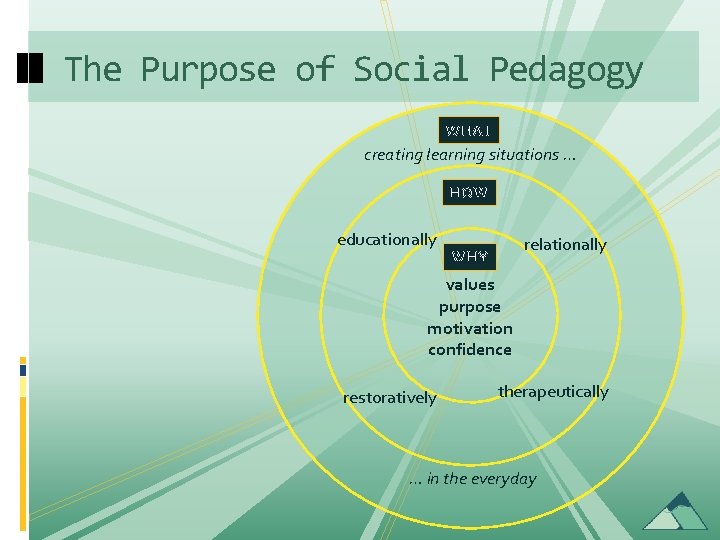
The Purpose of Social Pedagogy WHAT creating learning situations … HOW educationally relationally WHY values purpose motivation confidence restoratively therapeutically … in the everyday
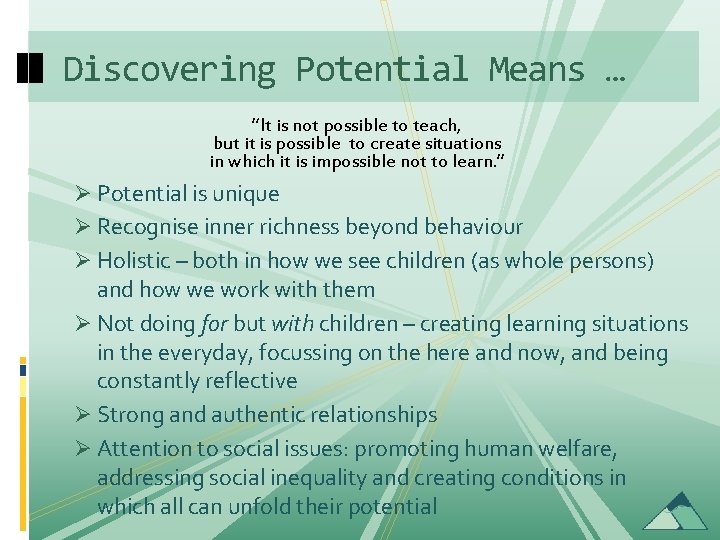
Discovering Potential Means … “It is not possible to teach, but it is possible to create situations in which it is impossible not to learn. ” Ø Potential is unique Ø Recognise inner richness beyond behaviour Ø Holistic – both in how we see children (as whole persons) and how we work with them Ø Not doing for but with children – creating learning situations in the everyday, focussing on the here and now, and being constantly reflective Ø Strong and authentic relationships Ø Attention to social issues: promoting human welfare, addressing social inequality and creating conditions in which all can unfold their potential
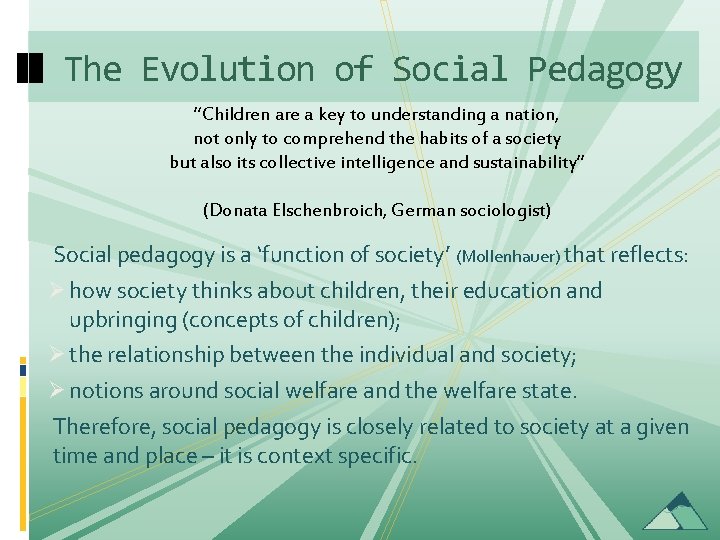
The Evolution of Social Pedagogy “Children are a key to understanding a nation, not only to comprehend the habits of a society but also its collective intelligence and sustainability” (Donata Elschenbroich, German sociologist) Social pedagogy is a ‘function of society’ (Mollenhauer) that reflects: Ø how society thinks about children, their education and upbringing (concepts of children); Ø the relationship between the individual and society; Ø notions around social welfare and the welfare state. Therefore, social pedagogy is closely related to society at a given time and place – it is context specific.
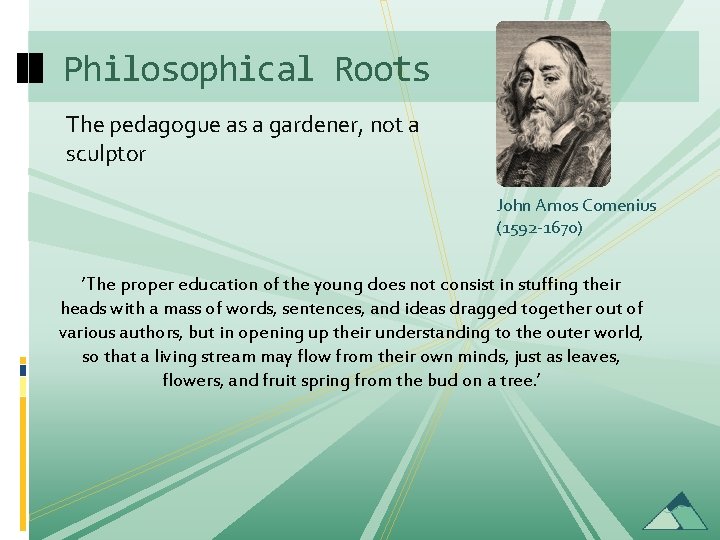
Philosophical Roots The pedagogue as a gardener, not a sculptor John Amos Comenius (1592 -1670) ’The proper education of the young does not consist in stuffing their heads with a mass of words, sentences, and ideas dragged together out of various authors, but in opening up their understanding to the outer world, so that a living stream may flow from their own minds, just as leaves, flowers, and fruit spring from the bud on a tree. ’
Philosophical Roots Jean-Jacques Rousseau (1712 -1778) Upbringing and education in harmony with nature
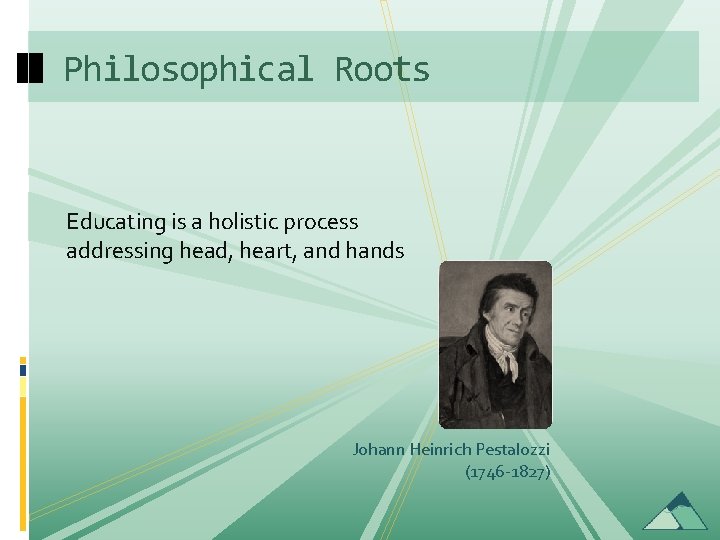
Philosophical Roots Educating is a holistic process addressing head, heart, and hands Johann Heinrich Pestalozzi (1746 -1827)
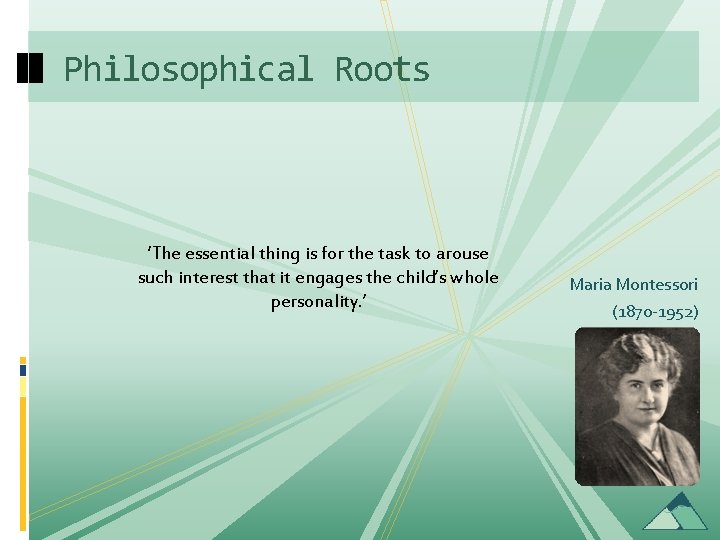
Philosophical Roots ‘The essential thing is for the task to arouse such interest that it engages the child’s whole personality. ’ Maria Montessori (1870 -1952)
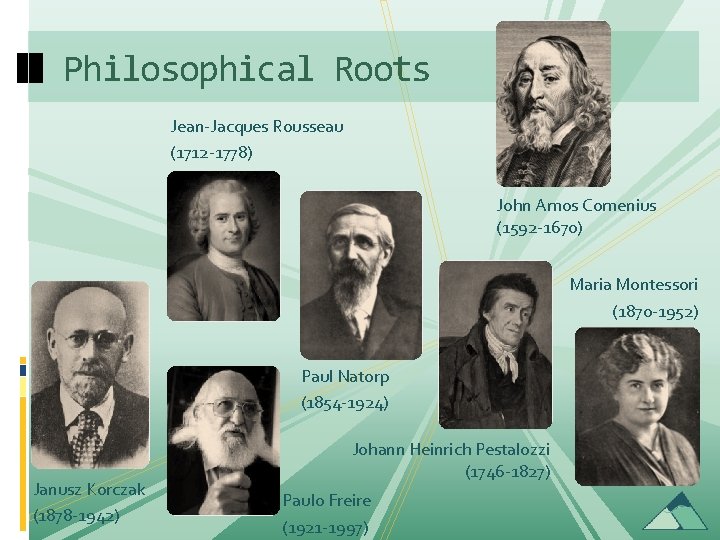
Philosophical Roots Jean-Jacques Rousseau (1712 -1778) John Amos Comenius (1592 -1670) Maria Montessori (1870 -1952) Paul Natorp (1854 -1924) Janusz Korczak (1878 -1942) Johann Heinrich Pestalozzi (1746 -1827) Paulo Freire (1921 -1997)
Social Pedagogy in Europe ØAcross most of Europe, social pedagogy is a discrete discipline with its own educational qualifications. ØSocial pedagogues generally study to degree and often to Masters level, although some more practical jobs can be undertaken with an upper secondary qualification. Even this lower level qualification, however, requires two to three years of study. ØSocial pedagogues are thus significantly better qualified, academically speaking, than their workforce equivalents in the UK, where vocational qualifications are considered sufficient for what are increasingly called social care jobs. Smith (2012)
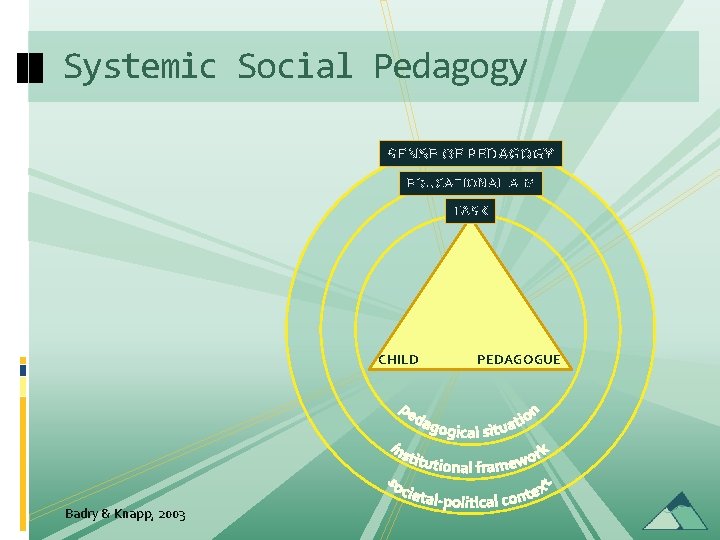
Systemic Social Pedagogy SENSE OF PEDAGOGY EDUCATIONAL AIM TASK CHILD Badry & Knapp, 2003 PEDAGOGUE
Social Pedagogy in the UK ØInterest for over 30 years, mainly in academic circles Ø NCERCC/SET pilot 2006/7 Ø Df. ES/DCSF pilot 2008 -2011 Ø Organisational developments in Ø Statutory: e. g. Essex, Derbyshire, Hackney, Staffordshire, Belfast HSCT, Lancashire, Edinburgh, Orkney, Norfolk, East Ayreshire, Walsall Ø Voluntary: e. g. Aberlour Sycamore Services, Dundee Early Intervention Team, Kibble, CELCIS, Camphill Scotland, St Christopher’s Fellowship , Children in Scotland Ø Private: Capstone Foster Care, Care Visions ØFurther and Higher Education developments Ø MA, BA, Diploma Level 5, level 4, level 3 ØHead, Heart, Hands demonstration programme led by the Fostering Network, 2012 -2016
Impact of Social Pedagogy Developing reflection individually and in teams: One team has reflective group meetings each morning, while the children are at school. These have provided a forum to bring issues and develop practice. They are not just about creating a forum for social pedagogy but are also about being pedagogic with each other. This has helped develop more trust in colleagues and has led to more openness and understanding others’ actions and intentions. One of the results is also that the team is less anxious about getting things wrong but feel they can try out new ideas and make mistakes as part of the process. This has relaxed them and improved the atmosphere. (Children’s home, Essex)
Impact of Social Pedagogy Professional confidence and sense of purpose: ‘Social Pedagogy has provided a liberation in my thinking and very much connected me to why I became a foster carer in the first place. Although I still have lots to learn, Social Pedagogy is really starting to change my thinking about whole life education, myself, other people and ultimately to what it is to really put our foster daughter front and centre and help her to be all she can be. ’ (foster carer, Capstone Foster Care)
Impact of Social Pedagogy Inter-professional practice: ‘According to [social pedagogy course] participants, the common language and understanding of social pedagogy is making the process of developing effective interventions much faster. They also expressed a strong sense of shared purpose as a result of the training. ’ (Orkney social pedagogy evaluation report)
Impact of Social Pedagogy Developing relationships with children and colleagues: ‘I am working with a boy who has attention difficulties in the classroom, and he talked to me for a good half an hour, showing me web pages of boats and saying he’s a skipper and what you have to wear, how you have to move etc. . . And I said to him, “You’ve got other people’s lives in your hands and it’s very important”. And I use that in talking to other people, teachers – who tend to talk very negatively about him – and explain a bit more about who he is and what he does. And they are really surprised, but it changes their perspective on him. ’ (teaching support worker, Orkney)
Impact of Social Pedagogy Creating a shared culture: ‘We’re a family now, and that makes every part equally important. ’ Through social pedagogy teams became more confident to refer to themselves as a family in the widest sense. When picking up their children or going shopping together or being at the GP the children would now call the workers their ‘auntie’ or ‘uncle’ when asked ‘is this your mother’ (or father). Previously the children and adults had felt uncomfortable answering these questions and were concerned about being labelled. They recognised that their role wasn’t to replace the children’s parents but that they still were an important part of the child’s family, of the proverbial village which it takes to raise a child. (children’s home, Essex)
Impact of Social Pedagogy Creating learning opportunities: ‘Billy was escalating in his outbursts and verbal abuse towards those around them. I spent time reflecting with Billy about how upsetting others found this. Billy was also able to appreciate that the behaviour was working against himself and it was counterproductive. I was able to acknowledge that Billy was and could become very angry about his life. I told Billy that I thought this was OK but that he needed to find other ways to express his anger. We spoke about Eminem and how he has used his music to express some of his darker feelings and thoughts about things. Billy and I came up with the idea of a rap pad. This was for Billy’s eyes only and he did go on to treasure this and use this to record his raps and thoughts about things that bothered him. ’ (Residential care worker, Edinburgh)
Impact of Social Pedagogy Focussing on well-being and happiness: ‘We were looking at each other and she stood up and made a silly noise and waved her hands about. I immediately stood up and did the same thing. She laughed and said “copy me”, which I did, and then I said “copy me”, which she did. This went on until her bedtime, and each time we would fall down together on the sofa laughing uncontrollably. As she was going up to bed she called out “that was good, it has made me so happy, I’m going to go to bed happy tonight”. I remained on the sofa and felt a warm glow inside. I felt happy, and this was compounded when I heard what she had said. ’ (Care worker, Essex, about her interaction with a girl at the children’s home)
Impact of Social Pedagogy Changes in communication: ‘Two boys ran through the cafe area, and instead of saying “don’t run” the pedagogue suggested it might be better if we walked fast through the cafe area, which the boys did. A good example of changing the way we say things, I know many children would have reacted differently if the saying was “don’t run”; it would have given rise to back chat. Offering the boys an alternative rather than being told what to do made them stop and think and change their behaviour. ’ (Participant in Leonardo Mobility project about Danish social pedagogy)
Impact of Social Pedagogy Involvement of children using a rights-based approach: ‘Before they started to mention all this “pegagogy” thing, they didn't do as much involving us. Normally, the adults make the decisions but, instead, they let us help the adults to make the decisions. ’ (10 -year-old boy living in Essex children’s home)
The Art of Being … ‘Social Pedagogy, it could be argued, is all about ‘being’ – about being with others and forming relationships, being in the presence and focussing on initiating learning processes, being authentic and genuine, using one’s own personality, and about being there in a supportive, empowering manner. Social pedagogy is like an art form; it’s not just a skill to learn but needs to be brought to life through the social pedagogue’s ‘Haltung’ (her mind set or attitude). In other words, social pedagogy is not so much about what you do, but ‘how’ you do it. This perspective of social pedagogy means that it is dynamic, creative and process-orientated rather than mechanical, procedural and automated. This means it requires a social pedagogue to not be just a pair of hands, but a whole person. ’ Eichsteller & Bird (2011)
Haltung “The true measure of a man is how he treats someone who can do him absolutely no good. ” Samuel Johnson, English essayist & poet
The Importance of Love “I seek education for humanity, and this only emanates through love. ” Johann Heinrich Pestalozzi, Swiss pedagogue
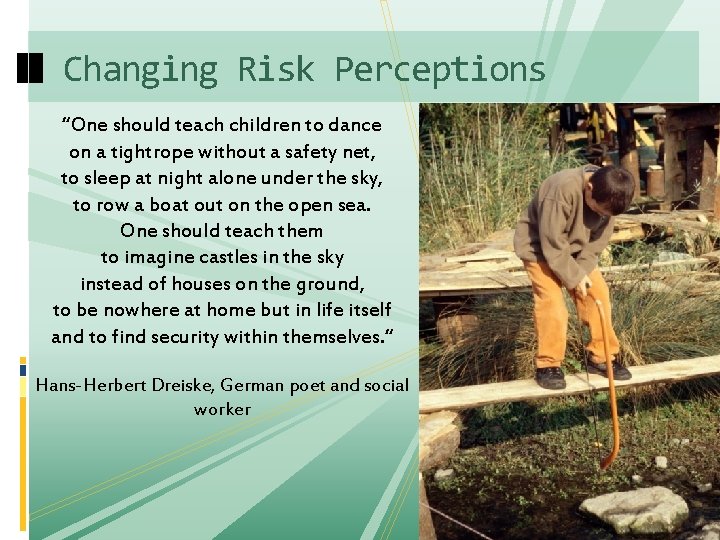
Changing Risk Perceptions “One should teach children to dance on a tightrope without a safety net, to sleep at night alone under the sky, to row a boat out on the open sea. One should teach them to imagine castles in the sky instead of houses on the ground, to be nowhere at home but in life itself and to find security within themselves. “ Hans-Herbert Dreiske, German poet and social worker
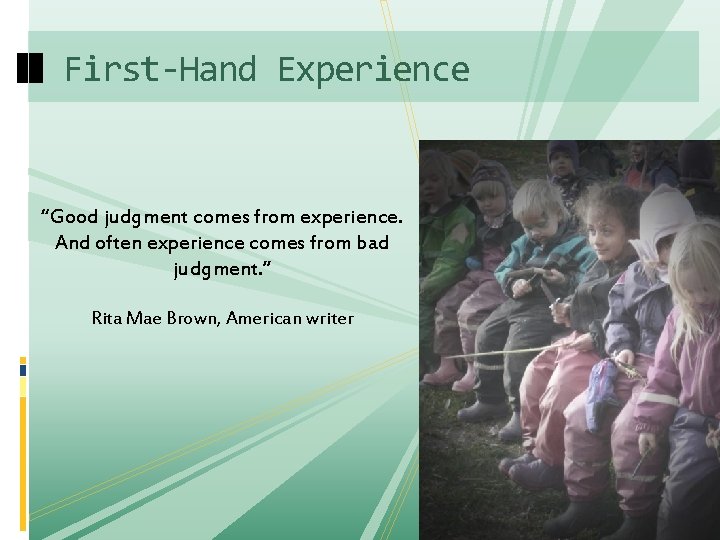
First-Hand Experience “Good judgment comes from experience. And often experience comes from bad judgment. ” Rita Mae Brown, American writer
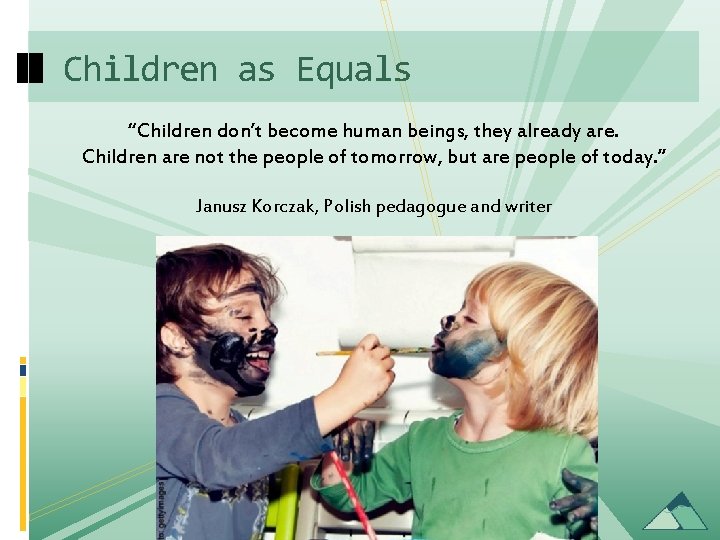
Children as Equals “Children don’t become human beings, they already are. Children are not the people of tomorrow, but are people of today. ” Janusz Korczak, Polish pedagogue and writer
Community Matters “It takes a village to raise a child. ” African proverb
C 4 EO Review Report ‘Social Pedagogy appears to offer some promise and, in the context of this review, would exemplify a mode of professional practice that recognises the role of education in both care and learning contexts. ’ Centre for Excellence and Outcomes in Children and Young People’s Services (2009). Improving educational outcomes for looked-after children and young people – Research Report.
ADCS Position Statement ‘Children’s Trust partnerships should consider adopting a consistent and holistic approach to underpin the commissioning and provision of support for children and young people across the age range, and their families. One option might be to adopt a system-wide social pedagogical approach to every aspect of intervention and service provision in children’s services including in the professional development of the children’s services workforce. Social Pedagogy is not an evidence-based programme but a conceptual model which can be used as a way of thinking and working across complex systems which in turn could help to further integrate local services - from schools, to healthcare, to specialist care provision - with a common outcomes focus. ’ Recommendation 5. 3 from ADCS Position Statement ‘What is Care for: Alternative Models of Care for Adolescents’ (April 2013, p. 9)
References Badry, E. & Knapp, R. (2003). Grundlagen und Grundfragen des Pädagogischen. In E. Badry, M. Buchka & R. Knapp (Eds. ): Pädagogik – Grundlagen und Sozialpädagogische Arbeitsfelder (Munich: Luchterhand). Bird, V. & Eichsteller, G. (2011). The Relevance of Social Pedagogy in Working with Young People in Residential Care. Good. Enough. Caring Journal 9 (available at http: //www. goodenoughcaring. com/Journal. Index. aspx) Boyce, N. (2010). Social Pedagogy in Essex. Children Webmag (available at http: //www. childrenwebmag. com/articles/social-pedagogy-in-essex) Eichsteller G (2010). The Notion of 'Haltung' in Social Pedagogy. Children Webmag (available at http: //www. childrenwebmag. com/articles/social-pedagogy/the-notion-of%E 2%80%98 haltung-in-social-pedagogy) Eichsteller, G. & Holthoff, S. (2009). The Diamond Model (available at www. thempra. org. uk/concepts_diamond). Eichsteller, G. & Holthoff, S. (2012). The Art of Being a Social Pedagogue: Developing Cultural Change in Children’s Homes in Essex. International Journal of Social Pedagogy, 1(1), 30 -46 (available at http: //www. internationaljournalofsocialpedagogy. com)
References Smith, M. (2012). Social Pedagogy from a Scottish Perspective. International Journal of Social Pedagogy, 1(1), 46 -55 (available at http: //www. internationaljournalofsocialpedagogy. com/index. php? journal=ijsp&page=article& op=view&path[]=3&path[]=8 ) van Manen, M. (1991) The Tact of Teaching: The Meaning of Pedagogical Thoughtfulness (Albany: State University of New York Press). Vrouwenfelder, E. , Milligan, I. , & Merrell, M. (2012). Social pedagogy and inter-professional practice: evaluation of Orkney Islands training programme. Glasgow: Centre for Excellence for Looked-After Children in Scotland (available at http: //www. celcis. org/resources/entry/social_pedagogy_and_inter_professional_practice_eval uation_of_orkney_island)