
Cardiac stress testing NISHA THEKKEDAM MS AGACNPBC objectives
Cardiac stress testing NISHA THEKKEDAM, MS, AGACNP-BC

objectives Able to choose the right cardiac stress testing for the patients Able to identify indications & contraindications for each type of stress test Able to explain the basics of each type of cardiac stress testing and the diagnostic accuracy of the testing.
Cardiac stress testing is an important diagnostic and prognostic tool in the evaluation and management of patients with coronary artery disease. A main objective of stress testing is to assess the functional or physiological consequences of anatomic coronary artery disease (CAD).
INDICATIONS FOR STRESS TESTING Patients with symptoms suggesting angina/chest pain Patients with a recent ACS Patients with known CHD and new or worsening symptoms/ prior coronary revascularization. Patients with valvular heart disease Patients with newly diagnosed heart failure or cardiomyopathy whether the myocardium is viable and to plan for revascularization. Patients with select arrhythmias Patients undergoing non-cardiac surgery
Types of stress testing Exercise v Exercise only v Exercise + echo v Exercise + Nuclear Pharmacological v Vasodilator 1. regadenoson 2. Adenosine 3. dipyridamole v Dobutamine
The choice of stress testing modality depends on many factors Ability to perform adequate exercise Resting ECG Clinical indication for performing the test Patient's body habitus History of prior coronary revascularization
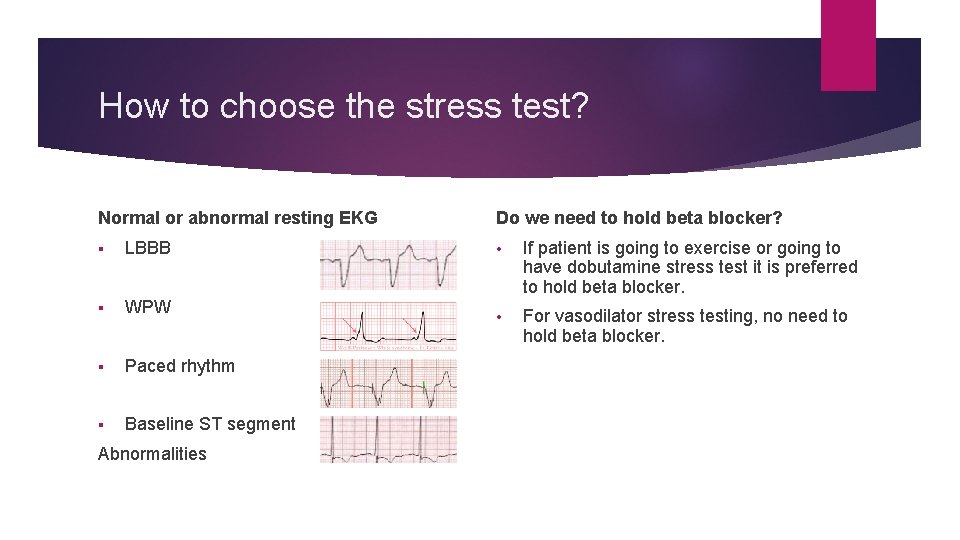
How to choose the stress test? Normal or abnormal resting EKG § LBBB § WPW § Paced rhythm § Baseline ST segment Abnormalities Do we need to hold beta blocker? • If patient is going to exercise or going to have dobutamine stress test it is preferred to hold beta blocker. • For vasodilator stress testing, no need to hold beta blocker.
CHOOSING THE OPTIMAL STRESS TEST Ø Can the patient exercise to a satisfactory workload? Exercise stress test (+imaging modality) Ø Patient cannot exercise pharmacological stress test. Ø Does the patient have an abnormal baseline ECG? Pharmacological stress test Ø Systems considerations and patient preferences
Treadmill exercise stress test v Endpoint: heart rate, blood pressure, exercise capacity, symptoms, EKG changes v Target he art rate: 220 -Hr X. 85 v Protocols: q Achieve 85% MPHR for an optimal test q Hold beta blocker therapy for 24 to 48 hours Bruce, modified bruce, Naughton
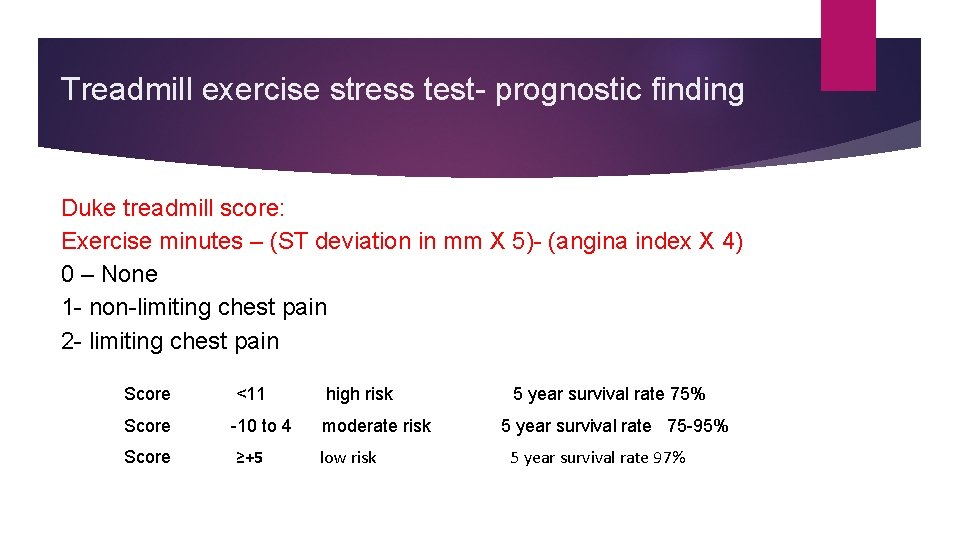
Treadmill exercise stress test- prognostic finding Duke treadmill score: Exercise minutes – (ST deviation in mm X 5)- (angina index X 4) 0 – None 1 - non-limiting chest pain 2 - limiting chest pain Score <11 high risk Score -10 to 4 moderate risk Score ≥+5 low risk 5 year survival rate 75% 5 year survival rate 75 -95% 5 year survival rate 97%
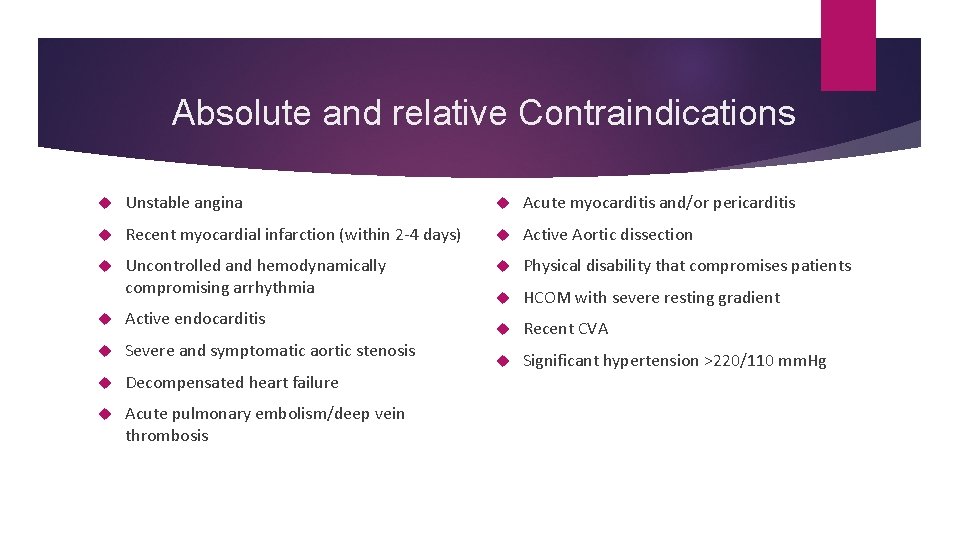
Absolute and relative Contraindications Unstable angina Acute myocarditis and/or pericarditis Recent myocardial infarction (within 2 -4 days) Active Aortic dissection Uncontrolled and hemodynamically compromising arrhythmia Physical disability that compromises patients HCOM with severe resting gradient Recent CVA Significant hypertension >220/110 mm. Hg Active endocarditis Severe and symptomatic aortic stenosis Decompensated heart failure Acute pulmonary embolism/deep vein thrombosis
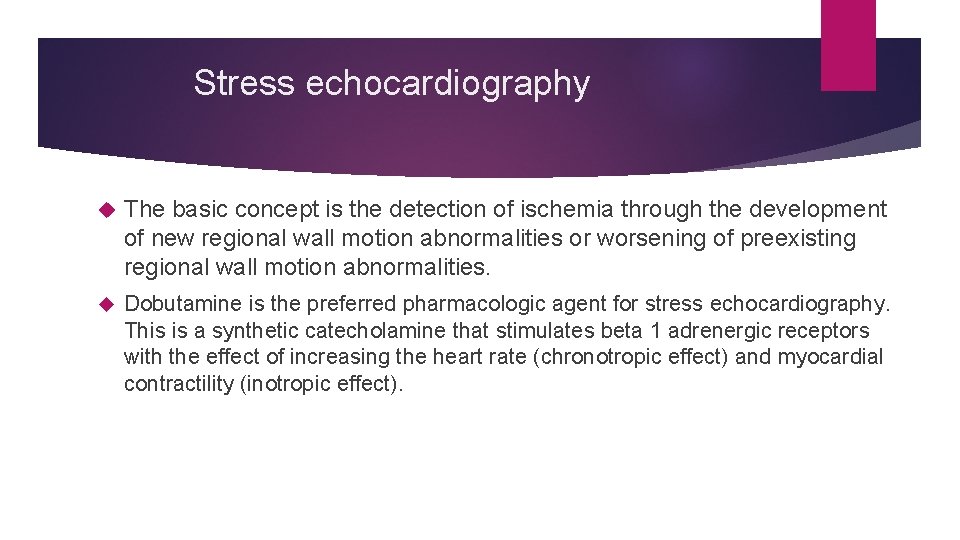
Stress echocardiography The basic concept is the detection of ischemia through the development of new regional wall motion abnormalities or worsening of preexisting regional wall motion abnormalities. Dobutamine is the preferred pharmacologic agent for stress echocardiography. This is a synthetic catecholamine that stimulates beta 1 adrenergic receptors with the effect of increasing the heart rate (chronotropic effect) and myocardial contractility (inotropic effect).
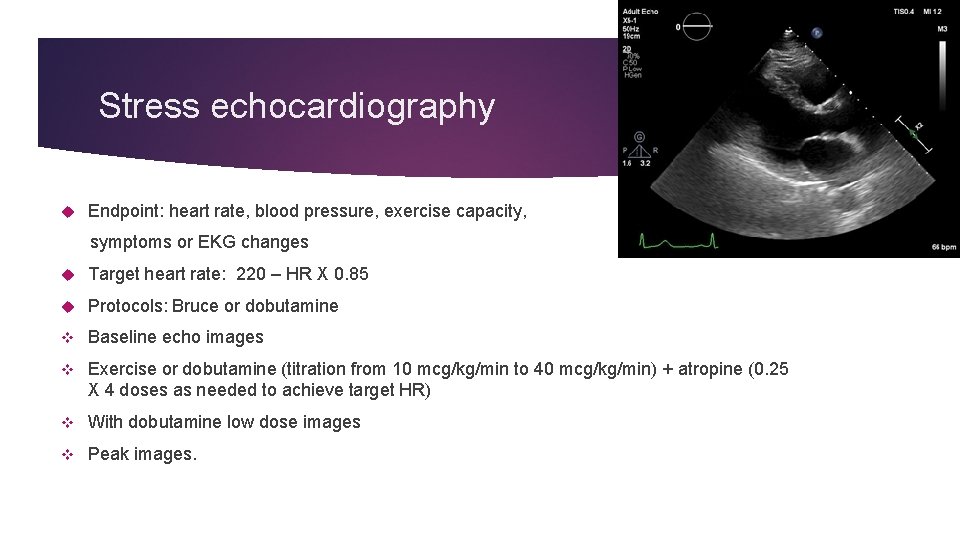
Stress echocardiography Endpoint: heart rate, blood pressure, exercise capacity, symptoms or EKG changes Target heart rate: 220 – HR X 0. 85 Protocols: Bruce or dobutamine v Baseline echo images v Exercise or dobutamine (titration from 10 mcg/kg/min to 40 mcg/kg/min) + atropine (0. 25 X 4 doses as needed to achieve target HR) v With dobutamine low dose images v Peak images.
Dobutamine stress test Contraindications Sustained or frequent ventricular arrhythmia and atrial fibrillation with RVR Recent MI or unstable angina Hemodynamically significant LVOT Aortic dissection Moderate to severe hypertension (resting SBP>180)
Nuclear stress test The basic concept of stress radionuclide MPI is the visual assessment of relative myocardial blood flow or perfusion (via the radioactive tracer) between the resting and stressed states. Myocardial segments that demonstrates preserved myocardial perfusion at rest but decreased during stress considered to be indicative of ischemia where as matched reduction in perfusion between the rest and stress is suggestive of a myocardial infarction.
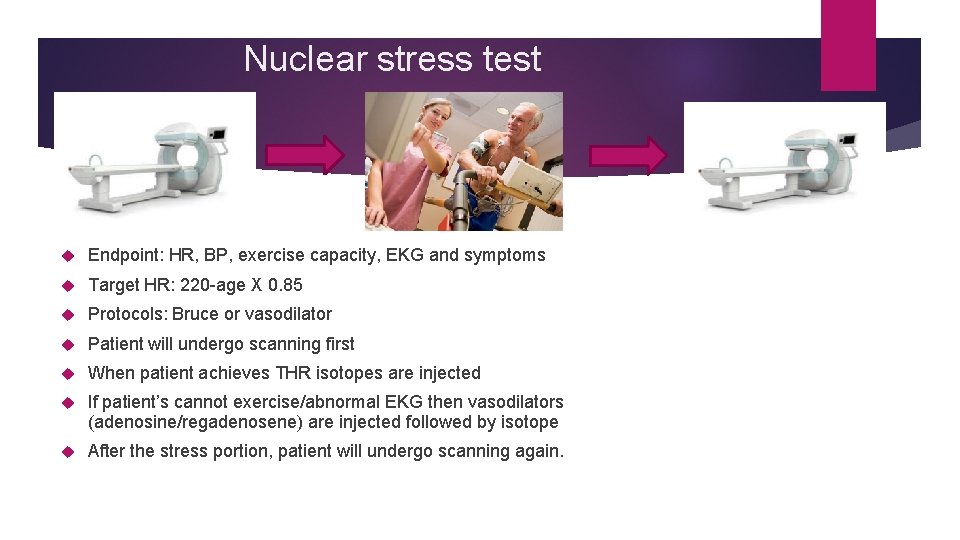
Nuclear stress test Endpoint: HR, BP, exercise capacity, EKG and symptoms Target HR: 220 -age X 0. 85 Protocols: Bruce or vasodilator Patient will undergo scanning first When patient achieves THR isotopes are injected If patient’s cannot exercise/abnormal EKG then vasodilators (adenosine/regadenosene) are injected followed by isotope After the stress portion, patient will undergo scanning again.
Contraindications for MPI Bronchospastic airway disease Sinus node dysfunction Significant hypotension Unstable angina or ACS (increased risk of ischemic events is present with all stress modalities) Theophylline and caffeine should be withheld 48 and 12 hours prior to the procedures as these agents can decrease the effectiveness of vasodilators.
Exceptions Baseline LBBB may undergo exercise stress test along with imaging, but preferably MPI if patients has baseline asynchronous left ventricular contraction. For markedly obese patients, may limit interpretation of both stress echo and MPI.
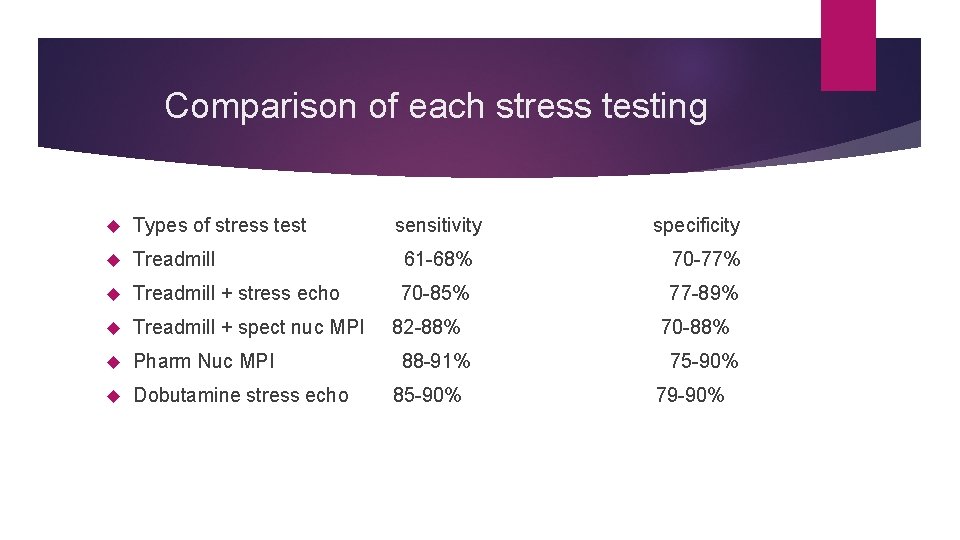
Comparison of each stress testing Types of stress test sensitivity Treadmill 61 -68% 70 -77% Treadmill + stress echo 70 -85% 77 -89% Treadmill + spect nuc MPI Pharm Nuc MPI Dobutamine stress echo 82 -88% 88 -91% 85 -90% specificity 70 -88% 75 -90% 79 -90%
Case scenario A 68 year old female with a history of DM, HTN, HLD, arthritis who was recently evaluated by family medicine for worsening shortness of breath for the past 2 weeks. Which cardiac stress test would be most appropriate? q A treadmill exercise q Treadmill + stress echo q Treadmill + Nuclear perfusion scan q Pharmacological nuclear perfusion scan q Dobutamine stress echo q Coronary angiography

Thank you
- Slides: 21