
Cardiac Output Thermodilution Andr C Lapeyre III M

- Slides: 14
Cardiac Output Thermodilution André C. Lapeyre, III, M. D. Andre Lapeyre, MD © Mayo Clinic
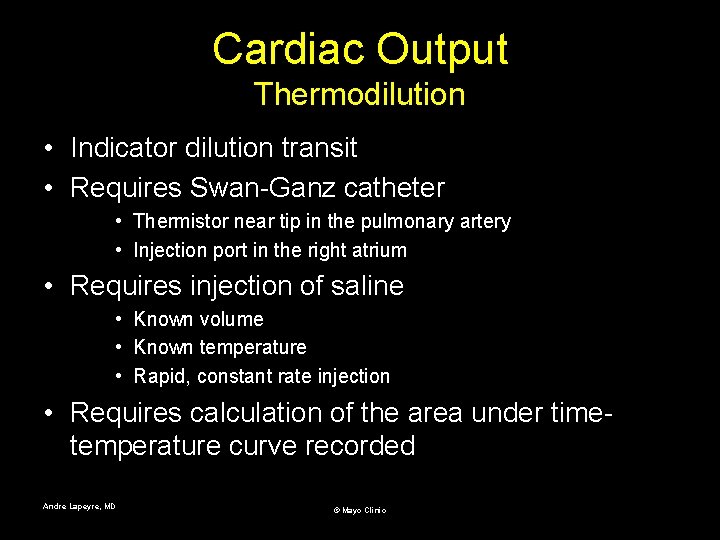
Cardiac Output Thermodilution • Indicator dilution transit • Requires Swan-Ganz catheter • Thermistor near tip in the pulmonary artery • Injection port in the right atrium • Requires injection of saline • Known volume • Known temperature • Rapid, constant rate injection • Requires calculation of the area under timetemperature curve recorded Andre Lapeyre, MD © Mayo Clinic
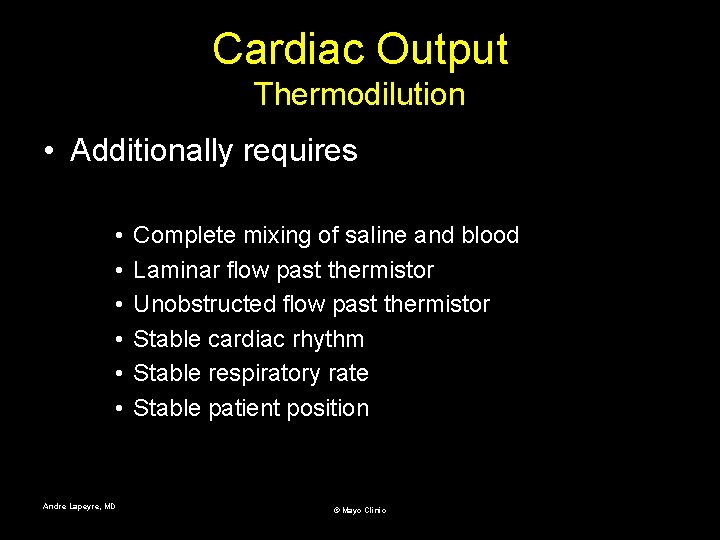
Cardiac Output Thermodilution • Additionally requires • • • Andre Lapeyre, MD Complete mixing of saline and blood Laminar flow past thermistor Unobstructed flow past thermistor Stable cardiac rhythm Stable respiratory rate Stable patient position © Mayo Clinic
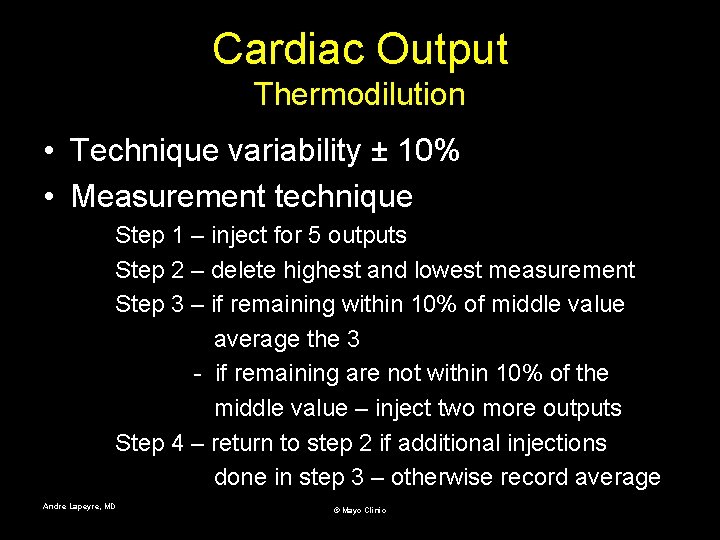
Cardiac Output Thermodilution • Technique variability ± 10% • Measurement technique Step 1 – inject for 5 outputs Step 2 – delete highest and lowest measurement Step 3 – if remaining within 10% of middle value average the 3 - if remaining are not within 10% of the middle value – inject two more outputs Step 4 – return to step 2 if additional injections done in step 3 – otherwise record average Andre Lapeyre, MD © Mayo Clinic
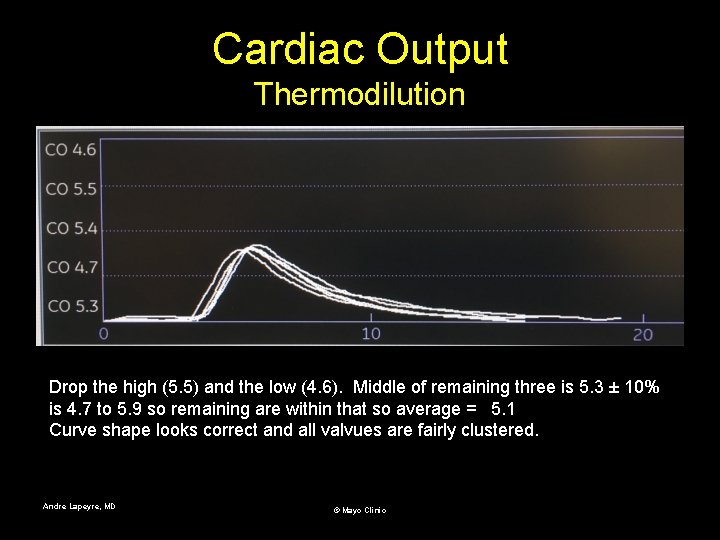
Cardiac Output Thermodilution Drop the high (5. 5) and the low (4. 6). Middle of remaining three is 5. 3 ± 10% is 4. 7 to 5. 9 so remaining are within that so average = 5. 1 Curve shape looks correct and all valvues are fairly clustered. Andre Lapeyre, MD © Mayo Clinic
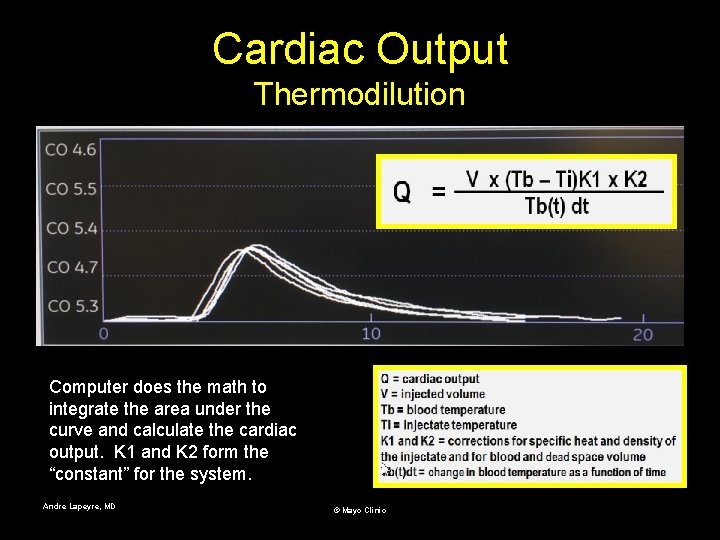
Cardiac Output Thermodilution Computer does the math to integrate the area under the curve and calculate the cardiac output. K 1 and K 2 form the “constant” for the system. Andre Lapeyre, MD © Mayo Clinic
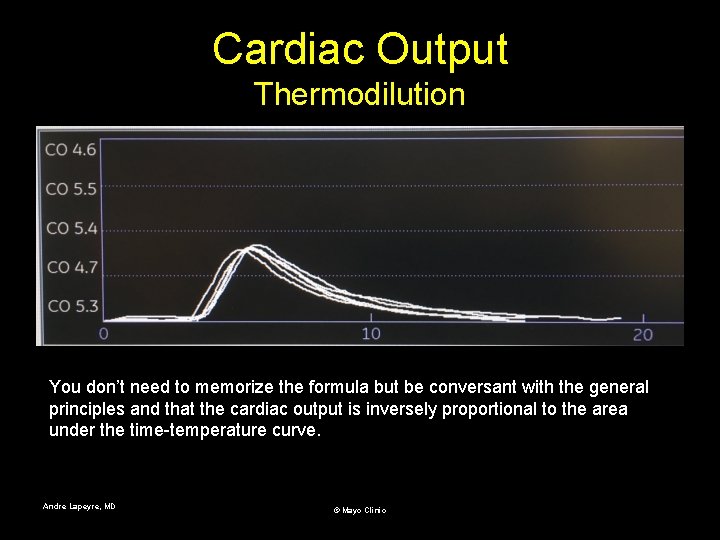
Cardiac Output Thermodilution You don’t need to memorize the formula but be conversant with the general principles and that the cardiac output is inversely proportional to the area under the time-temperature curve. Andre Lapeyre, MD © Mayo Clinic
Cardiac Output Thermodilution Pitfalls & common mistakes • Personal bias – throwing out single measurements that don’t “fit” what you think is correct • Injecting medications or flushing catheter(s) at the same time as injecting saline for output • Marked variability in saline injection technique (often seen with hand injections) • Loose connection somewhere in the saline injection lines • Wrong “constant” or volume for calculation • Long time between saline injections – saline in catheter warms to body temp ~ 2 cc of injectate Andre Lapeyre, MD © Mayo Clinic
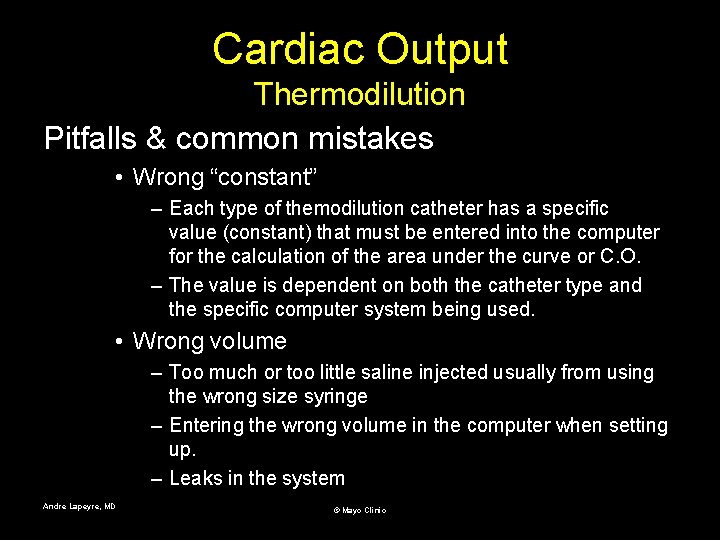
Cardiac Output Thermodilution Pitfalls & common mistakes • Wrong “constant” – Each type of themodilution catheter has a specific value (constant) that must be entered into the computer for the calculation of the area under the curve or C. O. – The value is dependent on both the catheter type and the specific computer system being used. • Wrong volume – Too much or too little saline injected usually from using the wrong size syringe – Entering the wrong volume in the computer when setting up. – Leaks in the system Andre Lapeyre, MD © Mayo Clinic
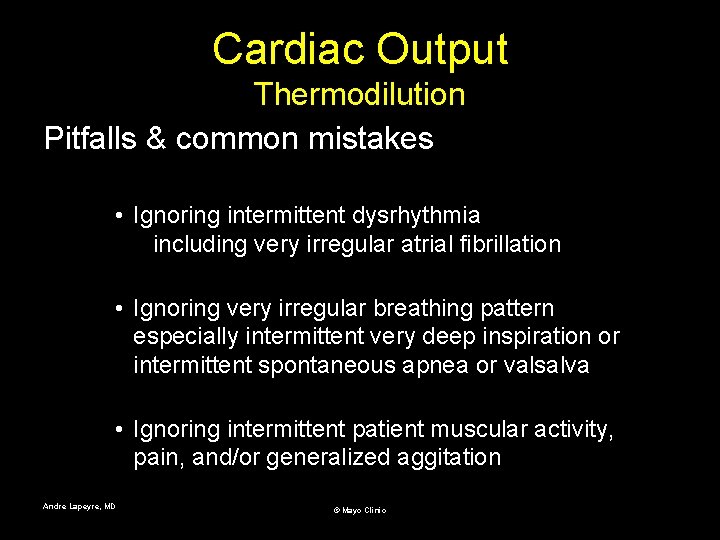
Cardiac Output Thermodilution Pitfalls & common mistakes • Ignoring intermittent dysrhythmia including very irregular atrial fibrillation • Ignoring very irregular breathing pattern especially intermittent very deep inspiration or intermittent spontaneous apnea or valsalva • Ignoring intermittent patient muscular activity, pain, and/or generalized aggitation Andre Lapeyre, MD © Mayo Clinic
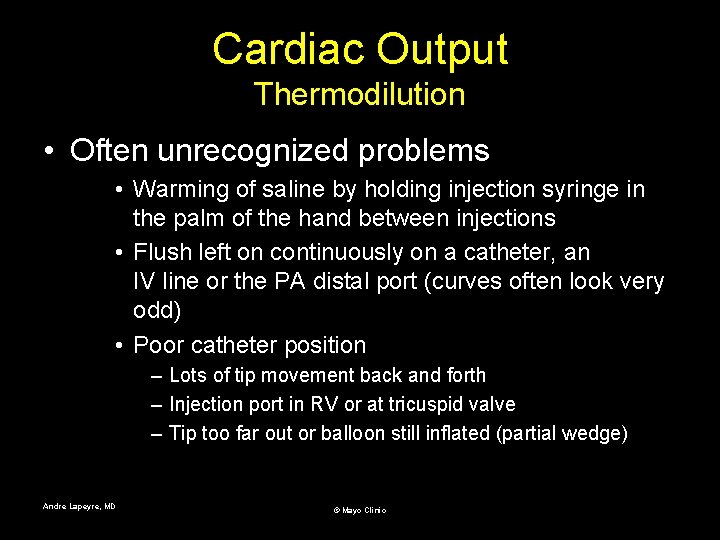
Cardiac Output Thermodilution • Often unrecognized problems • Warming of saline by holding injection syringe in the palm of the hand between injections • Flush left on continuously on a catheter, an IV line or the PA distal port (curves often look very odd) • Poor catheter position – Lots of tip movement back and forth – Injection port in RV or at tricuspid valve – Tip too far out or balloon still inflated (partial wedge) Andre Lapeyre, MD © Mayo Clinic
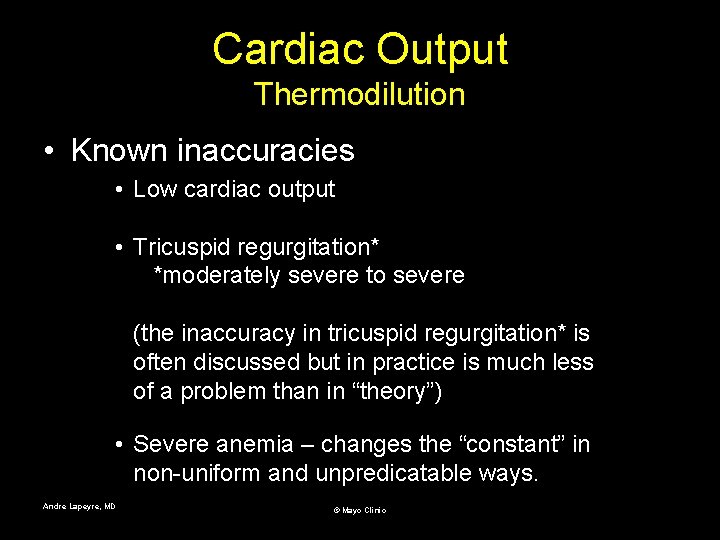
Cardiac Output Thermodilution • Known inaccuracies • Low cardiac output • Tricuspid regurgitation* *moderately severe to severe (the inaccuracy in tricuspid regurgitation* is often discussed but in practice is much less of a problem than in “theory”) • Severe anemia – changes the “constant” in non-uniform and unpredicatable ways. Andre Lapeyre, MD © Mayo Clinic
Cardiac Output Thermodilution • Keys to accuracy • Attention to detail • Consistency in methodology • Awareness of and avoidance of sources of error Andre Lapeyre, MD © Mayo Clinic
- End of this slide set - Andre Lapeyre, MD © Mayo Clinic