
Cardiac Output Fick Andre C Lapeyre MD Charanjit




- Slides: 22
Cardiac Output Fick Andre C. Lapeyre, MD Charanjit S. Rihal, MD © Mayo Clinic – Mayo Foundation © 2016 MFMER | slide-
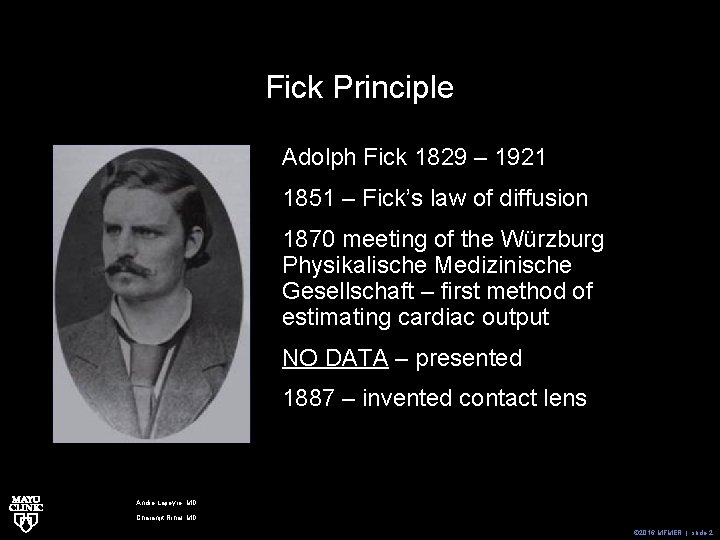
Fick Principle Adolph Fick 1829 – 1921 1851 – Fick’s law of diffusion 1870 meeting of the Würzburg Physikalische Medizinische Gesellschaft – first method of estimating cardiac output NO DATA – presented 1887 – invented contact lens Andre Lapeyre, MD Charanjit Rihal, MD © 2016 MFMER | slide-2
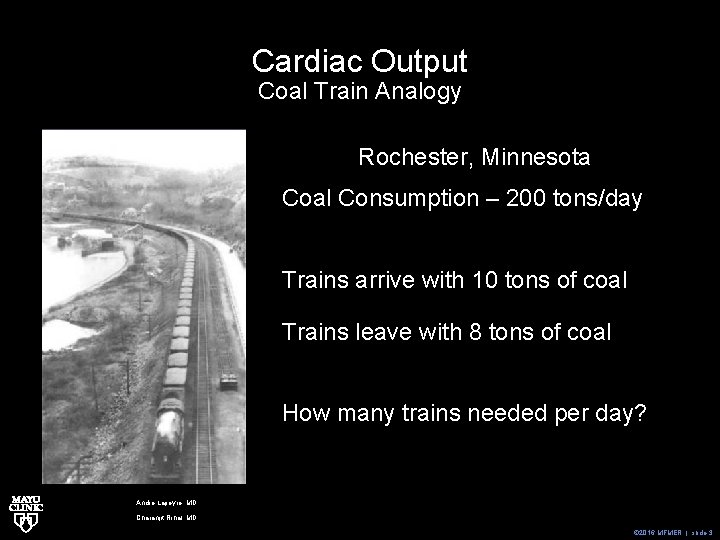
Cardiac Output Coal Train Analogy Rochester, Minnesota Coal Consumption – 200 tons/day Trains arrive with 10 tons of coal Trains leave with 8 tons of coal How many trains needed per day? Andre Lapeyre, MD Charanjit Rihal, MD © 2016 MFMER | slide-3
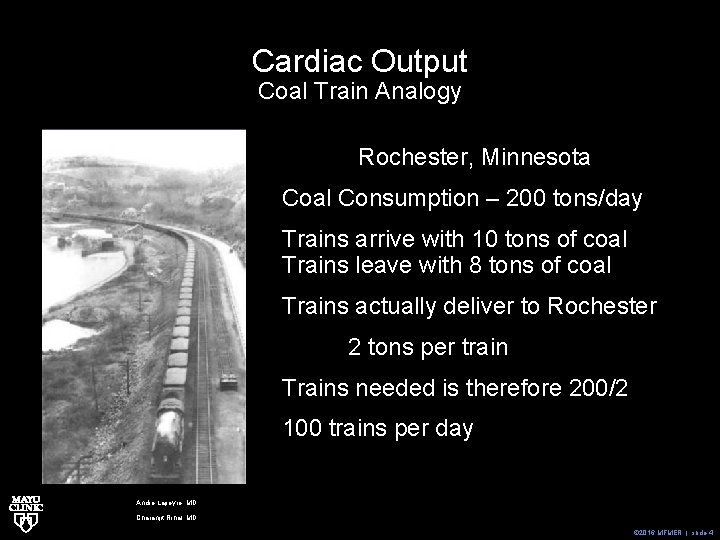
Cardiac Output Coal Train Analogy Rochester, Minnesota Coal Consumption – 200 tons/day Trains arrive with 10 tons of coal Trains leave with 8 tons of coal Trains actually deliver to Rochester 2 tons per train Trains needed is therefore 200/2 100 trains per day Andre Lapeyre, MD Charanjit Rihal, MD © 2016 MFMER | slide-4
Cardiac Output Coal Train Analogy Rochester = Patient Coal = oxygen Coal/day = oxygen/minute Trains = ml of blood Trains arrive = incoming blood* Trains leave = outgoing blood* * from circulatory area in question Train load = blood oxygen content/ml Delivery = incoming – outgoing Reloading = outgoing - incoming Andre Lapeyre, MD Charanjit Rihal, MD © 2016 MFMER | slide-5
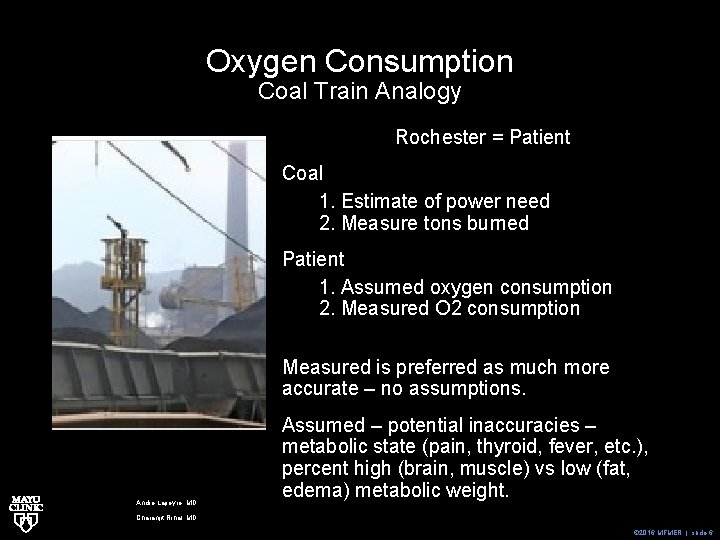
Oxygen Consumption Coal Train Analogy Rochester = Patient Coal 1. Estimate of power need 2. Measure tons burned Patient 1. Assumed oxygen consumption 2. Measured O 2 consumption Measured is preferred as much more accurate – no assumptions. Andre Lapeyre, MD Assumed – potential inaccuracies – metabolic state (pain, thyroid, fever, etc. ), percent high (brain, muscle) vs low (fat, edema) metabolic weight. Charanjit Rihal, MD © 2016 MFMER | slide-6
Oxygen Content (car load) of Blood Oxygen carrying capacity of blood • On room air • Most of blood oxygen is on hemoglobin • Plasma dissolved oxygen can be ignored • Hemoglobin an carry 1. 36 ml O 2 / gm Hb • Measure hemoglobin (gm/dl) = (10*gm/L) • Measure hemoglobin saturation % • Calculation example If – Hb=14 gm/dl, O 2 saturation= 98% 14*1. 36*. 98 = 18. 6 ml O 2 / dl 14*1. 36*10*0. 98 = 186 ml O 2 / liter Andre Lapeyre, MD Charanjit Rihal, MD © 2016 MFMER | slide-7
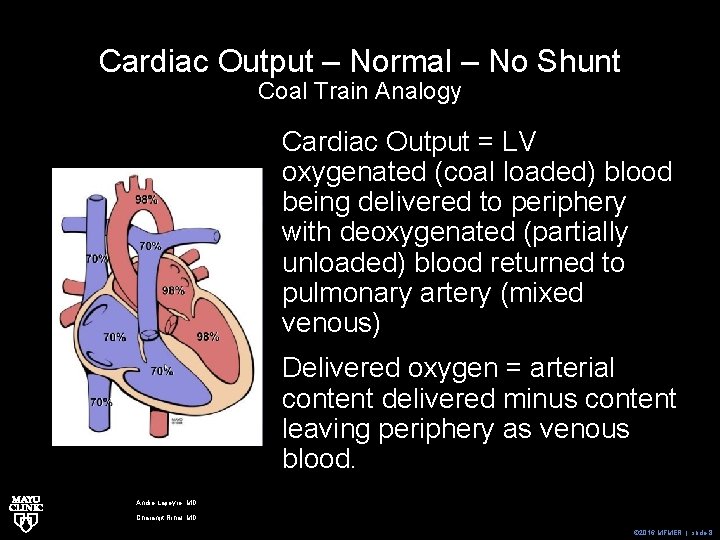
Cardiac Output – Normal – No Shunt Coal Train Analogy Cardiac Output = LV oxygenated (coal loaded) blood being delivered to periphery with deoxygenated (partially unloaded) blood returned to pulmonary artery (mixed venous) Delivered oxygen = arterial content delivered minus content leaving periphery as venous blood. Andre Lapeyre, MD Charanjit Rihal, MD © 2016 MFMER | slide-8
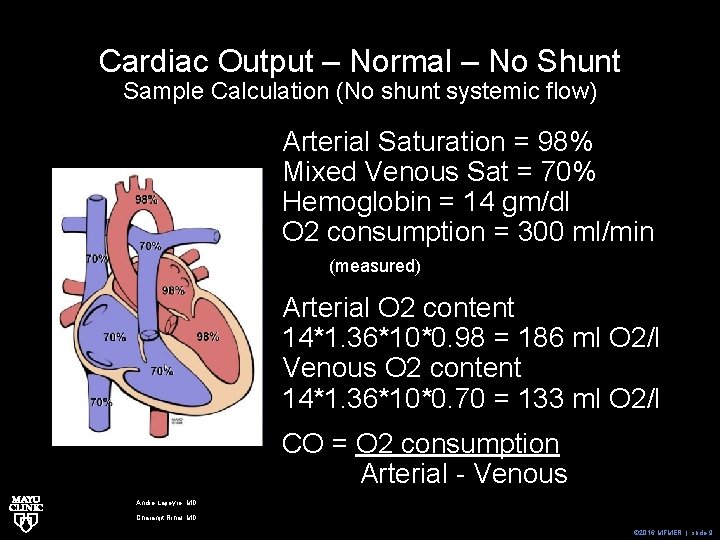
Cardiac Output – Normal – No Shunt Sample Calculation (No shunt systemic flow) Arterial Saturation = 98% Mixed Venous Sat = 70% Hemoglobin = 14 gm/dl O 2 consumption = 300 ml/min (measured) Arterial O 2 content 14*1. 36*10*0. 98 = 186 ml O 2/l Venous O 2 content 14*1. 36*10*0. 70 = 133 ml O 2/l CO = O 2 consumption Arterial - Venous Andre Lapeyre, MD Charanjit Rihal, MD © 2016 MFMER | slide-9
Cardiac Output – Normal – No Shunt Sample Calculation (No shunt systemic flow) CO = ___O 2 consumption____ Arterial – Venous Content ____300_____ 14*1. 36*10*(0. 98 -0. 70) ____300_____ 53 CO = 5. 7 liters / minute Andre Lapeyre, MD Charanjit Rihal, MD © 2016 MFMER | slide-10
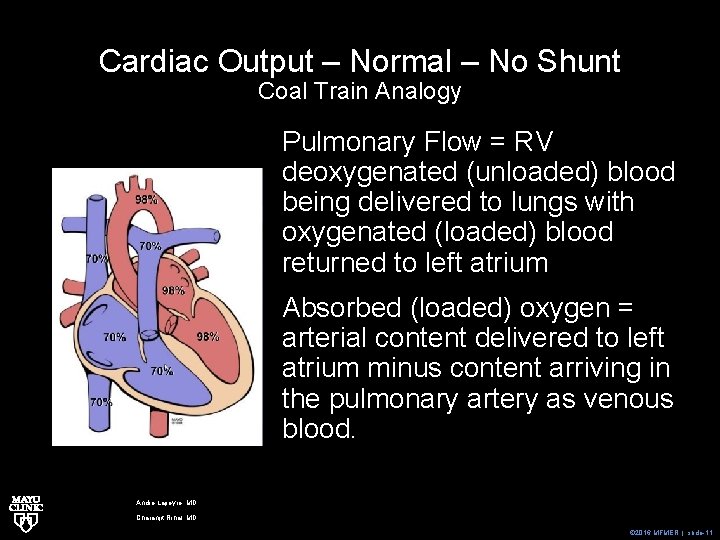
Cardiac Output – Normal – No Shunt Coal Train Analogy Pulmonary Flow = RV deoxygenated (unloaded) blood being delivered to lungs with oxygenated (loaded) blood returned to left atrium Absorbed (loaded) oxygen = arterial content delivered to left atrium minus content arriving in the pulmonary artery as venous blood. Andre Lapeyre, MD Charanjit Rihal, MD © 2016 MFMER | slide-11
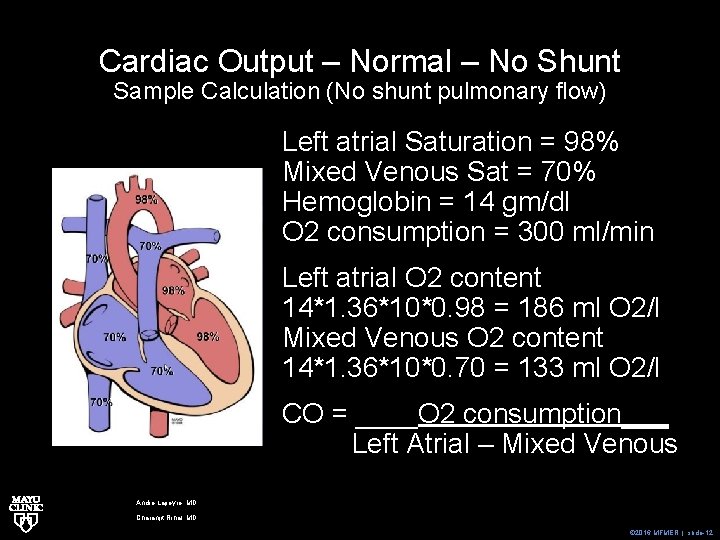
Cardiac Output – Normal – No Shunt Sample Calculation (No shunt pulmonary flow) Left atrial Saturation = 98% Mixed Venous Sat = 70% Hemoglobin = 14 gm/dl O 2 consumption = 300 ml/min Left atrial O 2 content 14*1. 36*10*0. 98 = 186 ml O 2/l Mixed Venous O 2 content 14*1. 36*10*0. 70 = 133 ml O 2/l CO = ____O 2 consumption___ Left Atrial – Mixed Venous Andre Lapeyre, MD Charanjit Rihal, MD © 2016 MFMER | slide-12
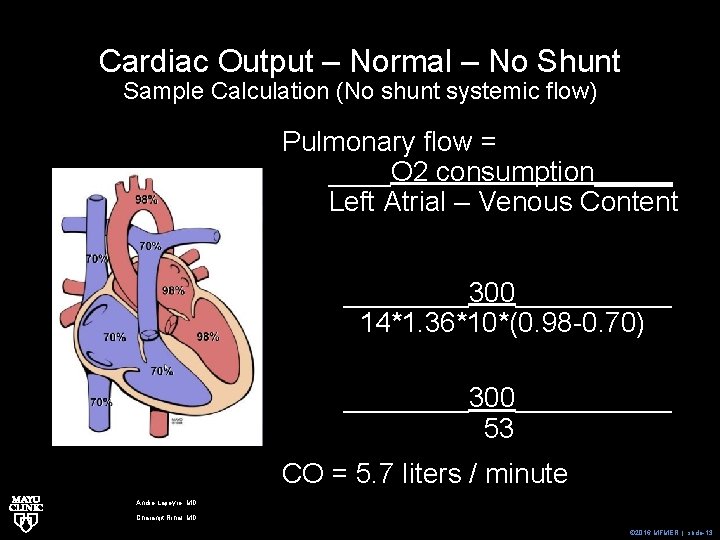
Cardiac Output – Normal – No Shunt Sample Calculation (No shunt systemic flow) Pulmonary flow = ____O 2 consumption_____ Left Atrial – Venous Content ____300_____ 14*1. 36*10*(0. 98 -0. 70) ____300_____ 53 CO = 5. 7 liters / minute Andre Lapeyre, MD Charanjit Rihal, MD © 2016 MFMER | slide-13
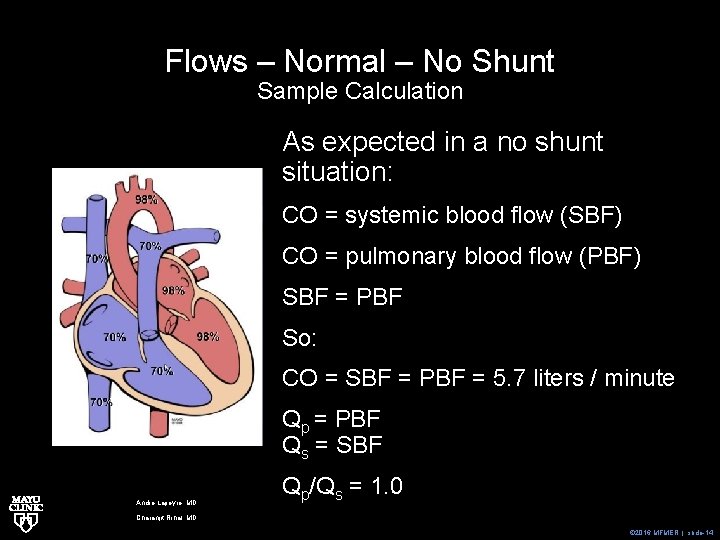
Flows – Normal – No Shunt Sample Calculation As expected in a no shunt situation: CO = systemic blood flow (SBF) CO = pulmonary blood flow (PBF) SBF = PBF So: CO = SBF = PBF = 5. 7 liters / minute Qp = PBF Qs = SBF Andre Lapeyre, MD Qp/Qs = 1. 0 Charanjit Rihal, MD © 2016 MFMER | slide-14
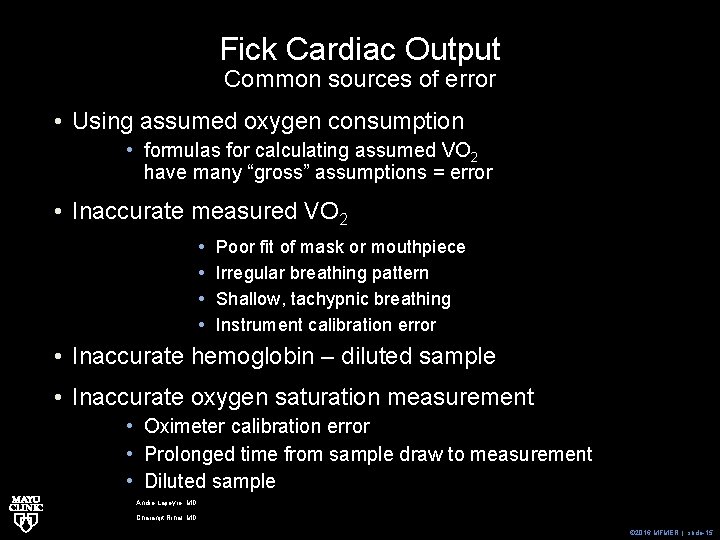
Fick Cardiac Output Common sources of error • Using assumed oxygen consumption • formulas for calculating assumed VO 2 have many “gross” assumptions = error • Inaccurate measured VO 2 • • Poor fit of mask or mouthpiece Irregular breathing pattern Shallow, tachypnic breathing Instrument calibration error • Inaccurate hemoglobin – diluted sample • Inaccurate oxygen saturation measurement • Oximeter calibration error • Prolonged time from sample draw to measurement • Diluted sample Andre Lapeyre, MD Charanjit Rihal, MD © 2016 MFMER | slide-15
The next slide is sample data for you to practice calculating a Fick cardiac output and calculating the pulmonary flow. Please do all your own calculations before proceeding to the answers. Andre Lapeyre, MD Charanjit Rihal, MD © 2016 MFMER | slide-16
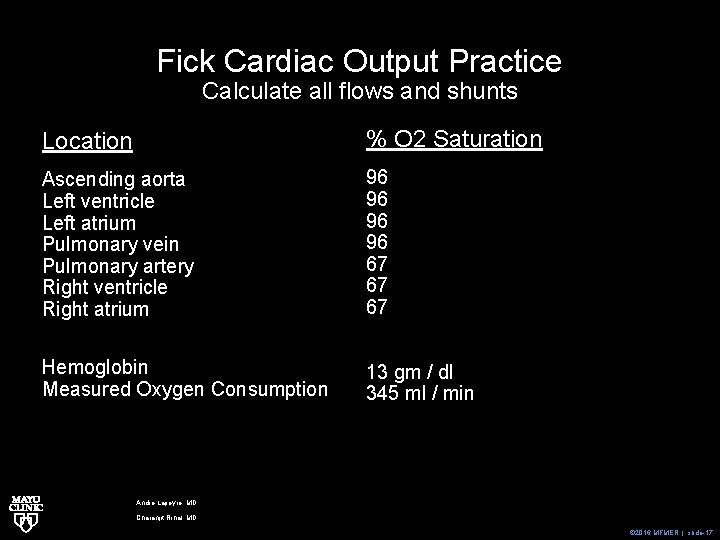
Fick Cardiac Output Practice Calculate all flows and shunts Location % O 2 Saturation Ascending aorta Left ventricle Left atrium Pulmonary vein Pulmonary artery Right ventricle Right atrium 96 96 67 67 67 Hemoglobin Measured Oxygen Consumption 13 gm / dl 345 ml / min Andre Lapeyre, MD Charanjit Rihal, MD © 2016 MFMER | slide-17
Answer slides follow this slide please do all your own calculations before proceeding to the answers. Andre Lapeyre, MD Charanjit Rihal, MD © 2016 MFMER | slide-18
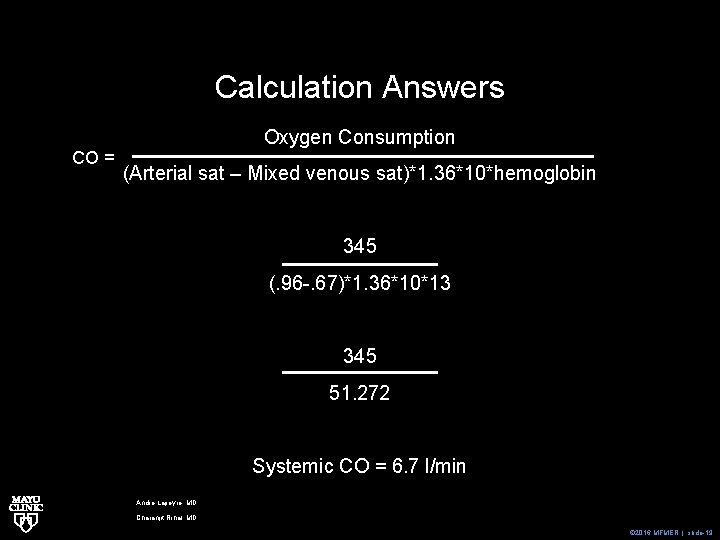
Calculation Answers CO = Oxygen Consumption (Arterial sat – Mixed venous sat)*1. 36*10*hemoglobin 345 (. 96 -. 67)*1. 36*10*13 345 51. 272 Systemic CO = 6. 7 l/min Andre Lapeyre, MD Charanjit Rihal, MD © 2016 MFMER | slide-19
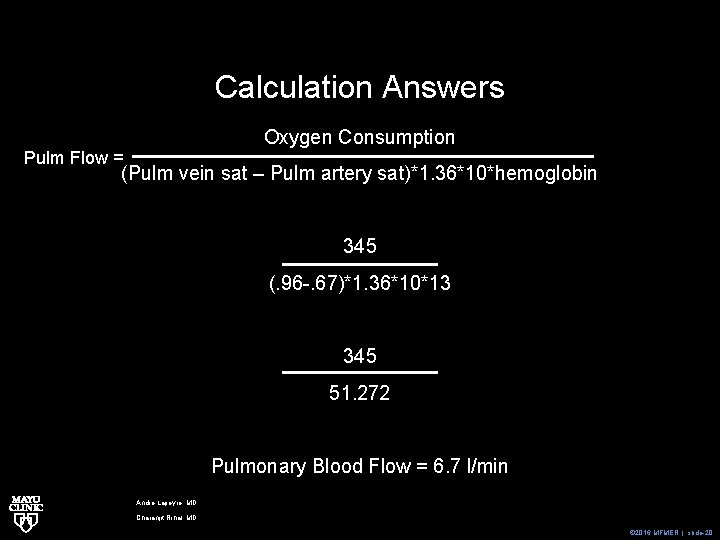
Calculation Answers Oxygen Consumption Pulm Flow = (Pulm vein sat – Pulm artery sat)*1. 36*10*hemoglobin 345 (. 96 -. 67)*1. 36*10*13 345 51. 272 Pulmonary Blood Flow = 6. 7 l/min Andre Lapeyre, MD Charanjit Rihal, MD © 2016 MFMER | slide-20
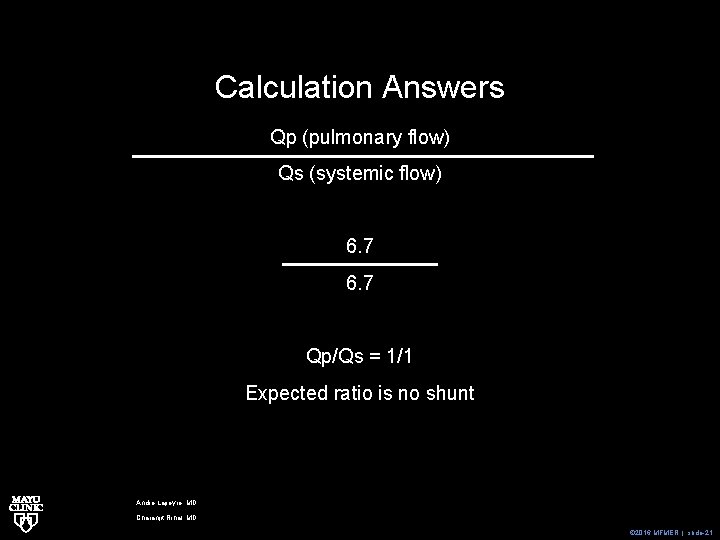
Calculation Answers Qp (pulmonary flow) Qs (systemic flow) 6. 7 Qp/Qs = 1/1 Expected ratio is no shunt Andre Lapeyre, MD Charanjit Rihal, MD © 2016 MFMER | slide-21
- End of this slide set © 2016 MFMER | slide-22