
Cardiac Examination Dr Will Ricketts Clinical Teaching Fellow





- Slides: 48
Cardiac Examination Dr Will Ricketts Clinical Teaching Fellow, Bart’s Health Honorary Lecturer, QMUL
Standard Order � Getting Started � Patient’s Road Map � Order of the Examination � Tying it All Together
Standard Order � Getting Started � Patient’s Road Map � Order of the Examination � Tying it All Together
Getting Started - WIPER � Wash Hands � Introduce (& Consent) � Position (on couch, sat at 45°) � Expose (from waist up) � Retreat to Observe
Order of the Examination �Retreat to Observe ◦ End of Bed �Age/General Appearance (Well/Unwell) �Paraphernalia (Oxygen, Drugs etc) �Pacemaker �Obvious Oedema �Syndromes ◦ Close Up �Scars (Chest/Legs) �Hands
Standard Order � Getting Started � Patient’s Road Map � Order of the Examination � Tying it All Together
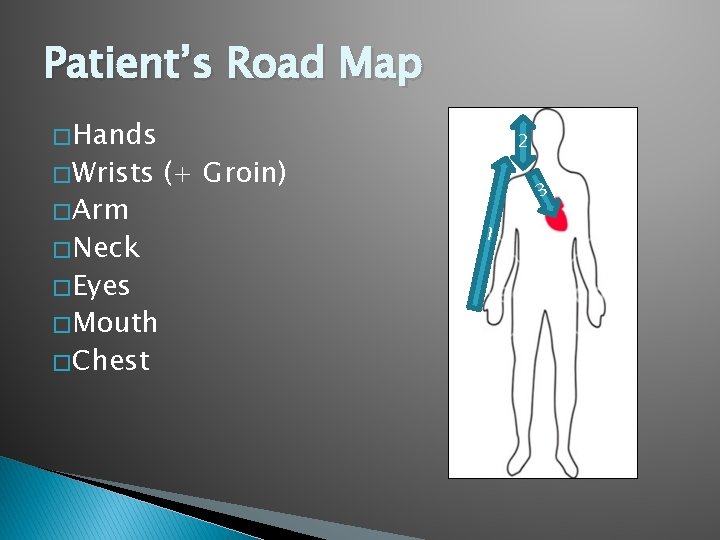
Patient’s Road Map � Hands � Wrists � Arm � Neck � Eyes � Mouth � Chest 2 (+ Groin) 3 1
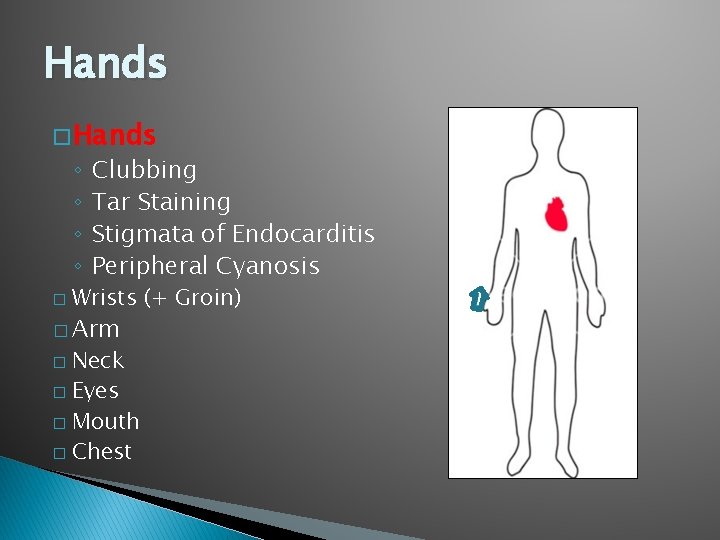
Hands � Hands ◦ ◦ � Clubbing Tar Staining Stigmata of Endocarditis Peripheral Cyanosis Wrists (+ Groin) � Arm Neck � Eyes � Mouth � Chest � 1
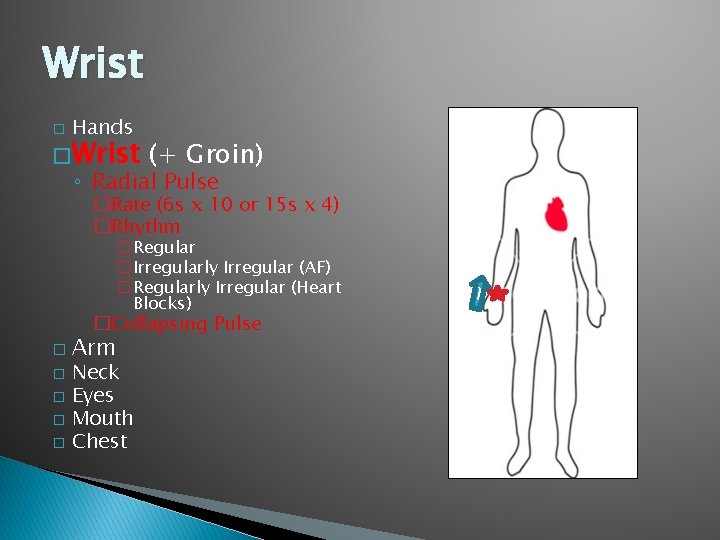
Wrist � Hands � Wrist (+ Groin) ◦ Radial Pulse �Rate (6 s x 10 or 15 s x 4) �Rhythm �Regular �Irregularly Irregular (AF) �Regularly Irregular (Heart Blocks) �Collapsing Pulse � � � Arm Neck Eyes Mouth Chest 1
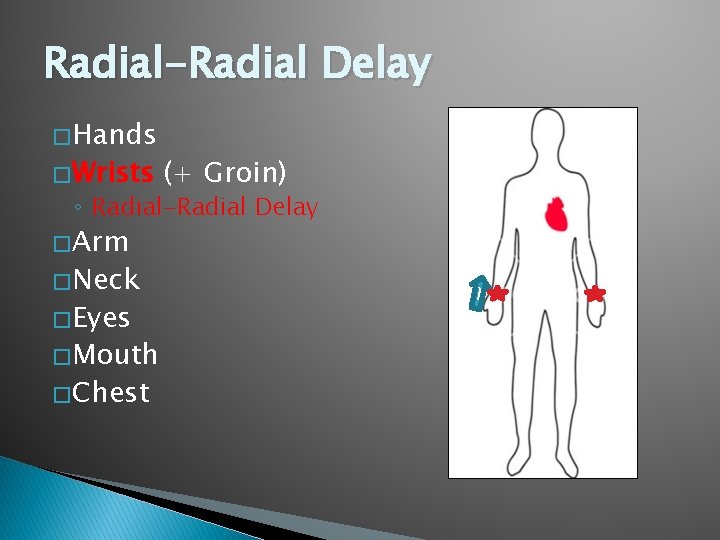
Radial-Radial Delay � Hands � Wrists (+ Groin) ◦ Radial-Radial Delay � Arm � Neck � Eyes � Mouth � Chest 1
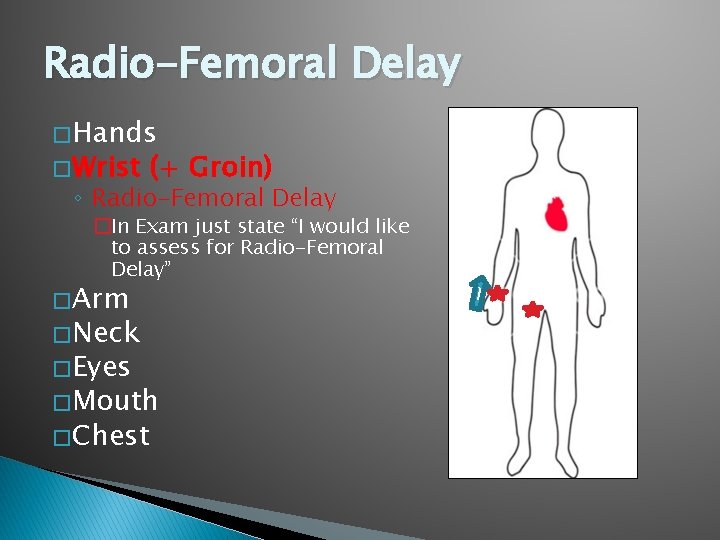
Radio-Femoral Delay � Hands � Wrist (+ Groin) ◦ Radio-Femoral Delay �In Exam just state “I would like to assess for Radio-Femoral Delay” � Arm � Neck � Eyes � Mouth � Chest 1
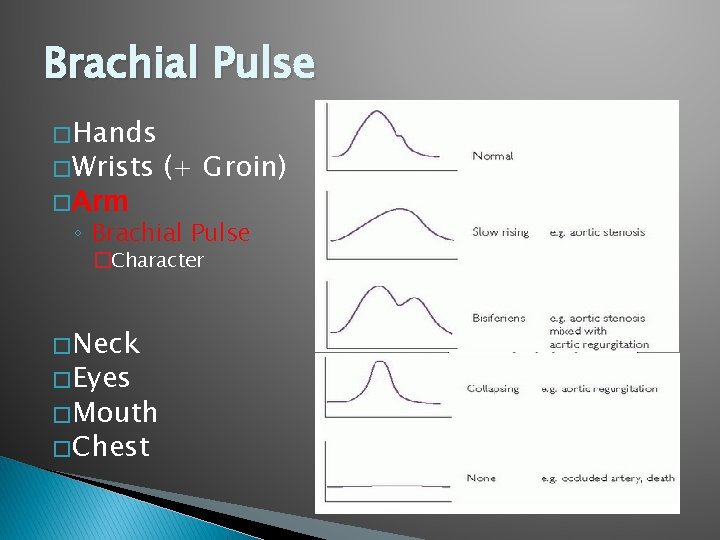
Brachial Pulse � Hands � Wrists � Arm (+ Groin) ◦ Brachial Pulse �Character � Neck � Eyes � Mouth � Chest 1
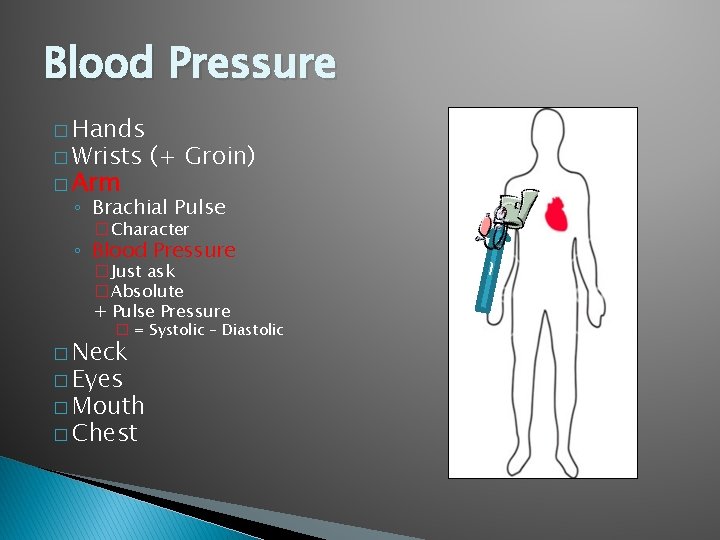
Blood Pressure � Hands � Wrists � Arm (+ Groin) ◦ Brachial Pulse �Character ◦ Blood Pressure �Just ask �Absolute + Pulse Pressure � = Systolic – Diastolic � Neck � Eyes � Mouth � Chest 1
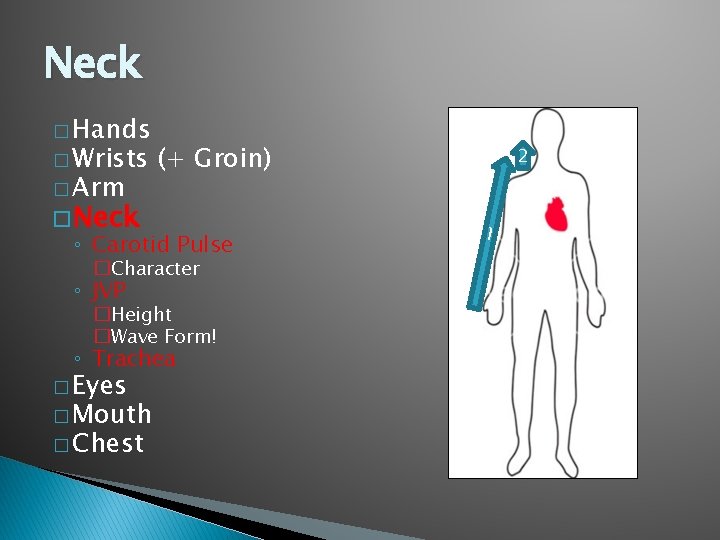
Neck � Hands � Wrists � Arm (+ Groin) � Neck ◦ Carotid Pulse �Character ◦ JVP �Height �Wave Form! ◦ Trachea � Eyes � Mouth � Chest 2 1
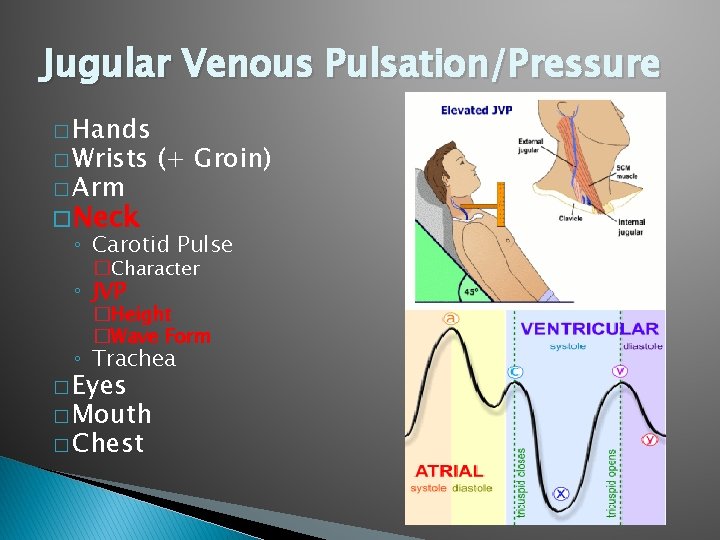
Jugular Venous Pulsation/Pressure � Hands � Wrists � Arm (+ Groin) � Neck ◦ Carotid Pulse �Character ◦ JVP �Height �Wave Form ◦ Trachea � Eyes � Mouth � Chest 2 1
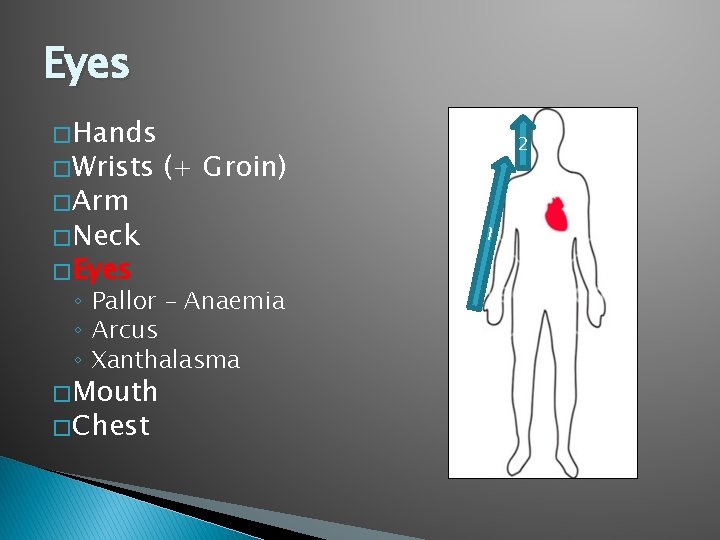
Eyes � Hands � Wrists � Arm (+ Groin) � Neck � Eyes ◦ Pallor – Anaemia ◦ Arcus ◦ Xanthalasma � Mouth � Chest 2 1
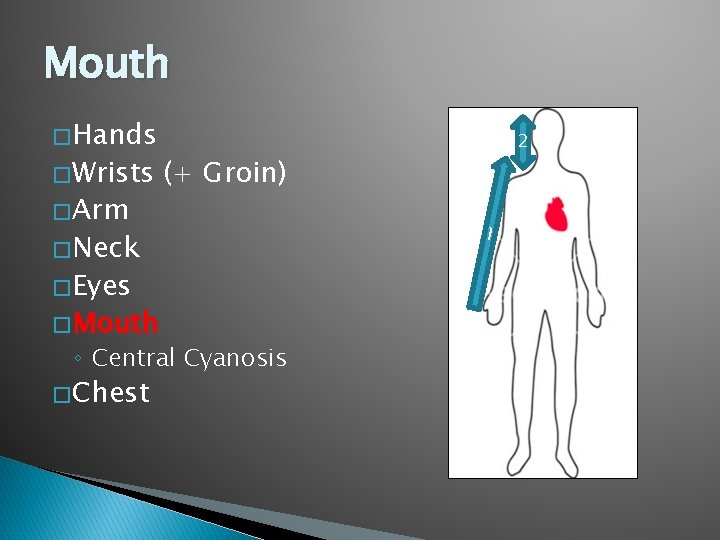
Mouth � Hands � Wrists � Arm (+ Groin) � Neck � Eyes � Mouth ◦ Central Cyanosis � Chest 2 1
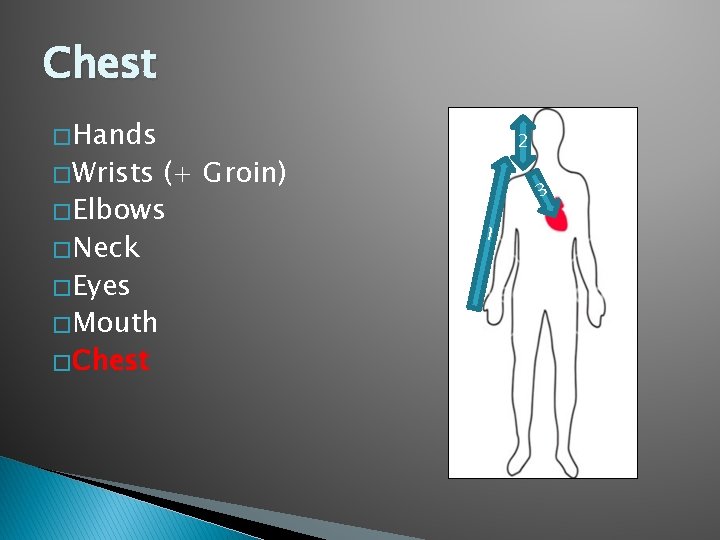
Chest � Hands (+ Groin) � Elbows � Neck � Eyes � Mouth � Chest 2 � Wrists 3 1
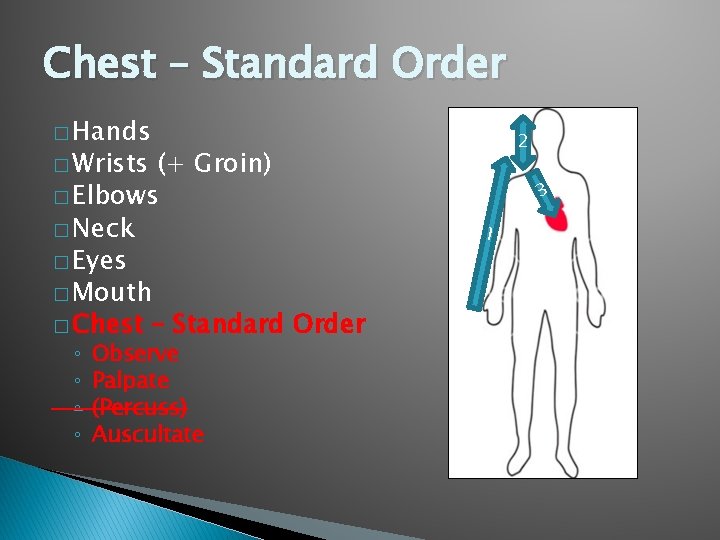
Chest – Standard Order � Hands (+ Groin) � Elbows � Neck � Eyes � Mouth � Chest – Standard Order 2 � Wrists ◦ ◦ Observe Palpate (Percuss) Auscultate 3 1
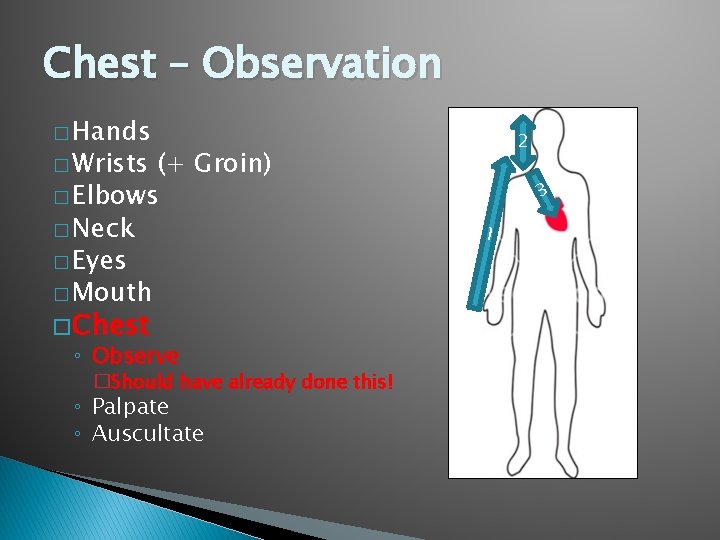
Chest – Observation � Hands (+ Groin) � Elbows � Neck � Eyes � Mouth 2 � Wrists � Chest ◦ Observe �Should have already done this! ◦ Palpate ◦ Auscultate 3 1
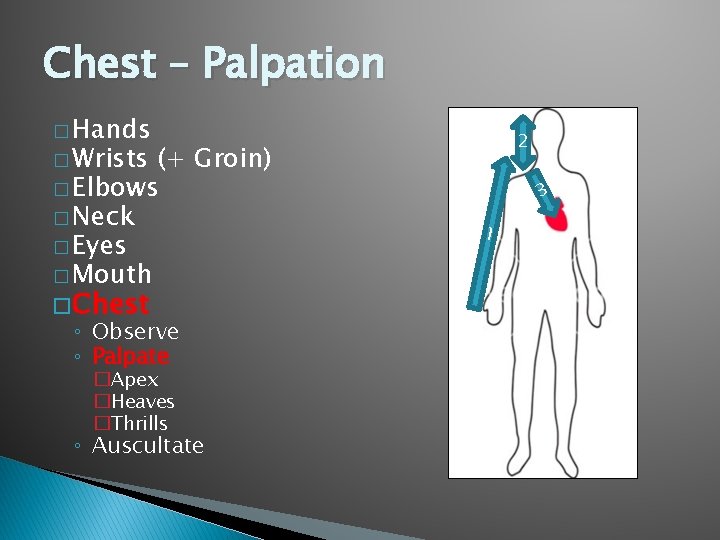
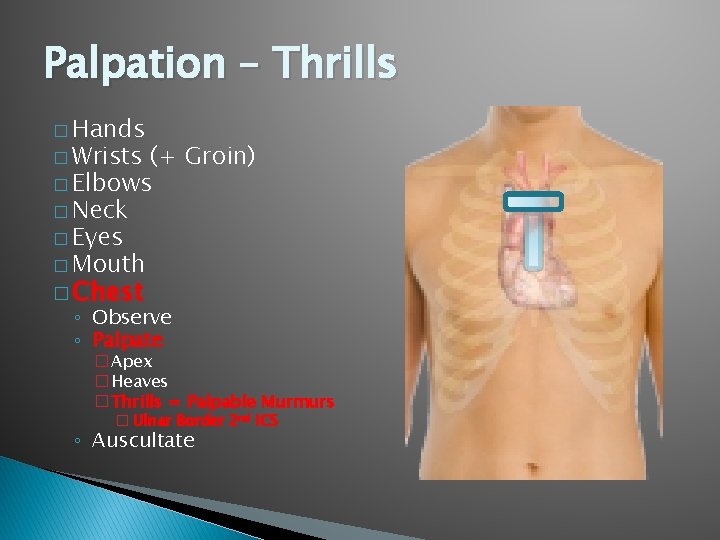
Chest – Palpation � Hands (+ Groin) � Elbows � Neck � Eyes � Mouth 2 � Wrists � Chest ◦ Observe ◦ Palpate �Apex �Heaves �Thrills ◦ Auscultate 3 1
Palpation – Apex Beat � Apex = ◦ Most Inferior-Lateral point cardiac impulse can be palpated � Palpate with radial border of index finger � Mark out location ◦ Start at Manubriosternal angle = 2 nd Costal Space � Normal ◦ 5 th ICS ◦ MCL =
Palpation – Heaves � � � Hands Wrists (+ Groin) Elbows Neck Eyes Mouth � Chest ◦ Observe ◦ Palpate �Apex �Heaves � Ulnar Border of Hand � Left Sternal Edge � Parasternal Heave = RVH �Thrills ◦ Auscultate
Palpation – Thrills � Hands � Wrists (+ Groin) � Elbows � Neck � Eyes � Mouth � Chest ◦ Observe ◦ Palpate �Apex �Heaves �Thrills = Palpable Murmurs � Ulnar Border 2 nd ICS ◦ Auscultate
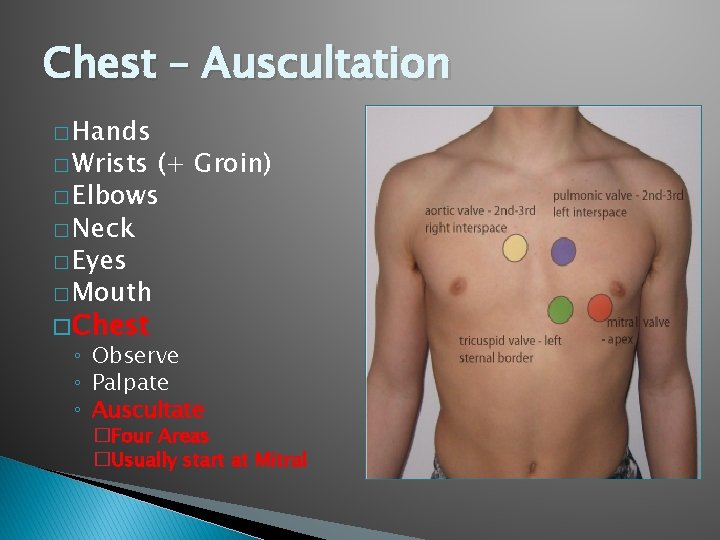
Chest – Auscultation � Hands (+ Groin) � Elbows � Neck � Eyes � Mouth 2 � Wrists � Chest ◦ Observe ◦ Palpate ◦ Auscultate �Four Areas �Usually start at Mitral 3 1
Auscultation � Heat Sounds = Valves Snapping Shut ◦ S 1(with pulse) = Mitral + Tricuspid Closing ◦ S 2 (between pulses) = Aortic + Pulmonary Closing � Are the heart sounds normal? ◦ Additional Sounds? ◦ Split Sounds? � Is there silence between the sounds? ◦ If not = Murmur
Standard Order � Getting Started � Patient’s Road Map � Order of the Examination � Tying it All Together
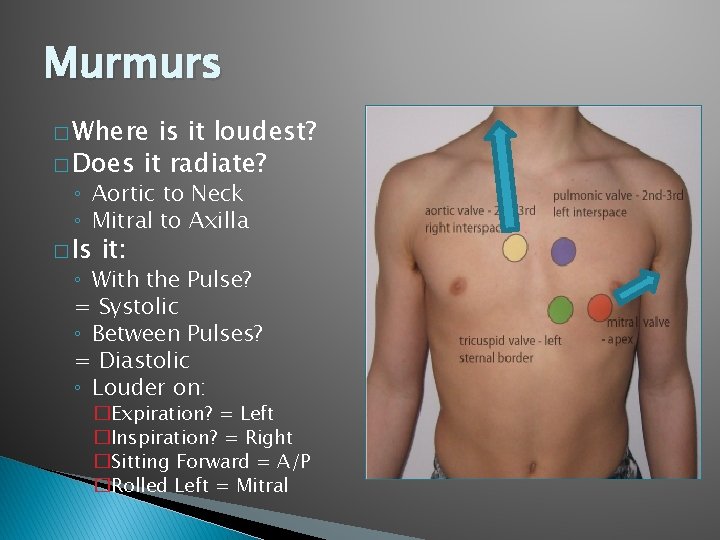
Murmurs � Where is it loudest? � Does it radiate? ◦ Aortic to Neck ◦ Mitral to Axilla � Is it: ◦ With the Pulse? = Systolic ◦ Between Pulses? = Diastolic ◦ Louder on: �Expiration? = Left �Inspiration? = Right �Sitting Forward = A/P �Rolled Left = Mitral
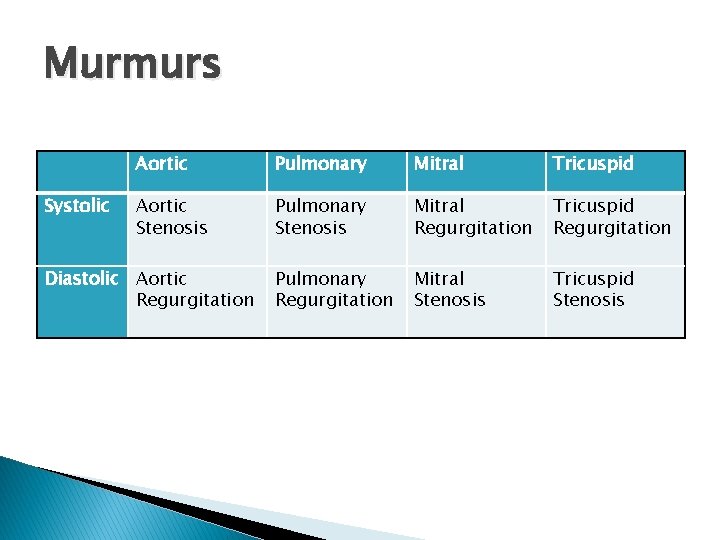
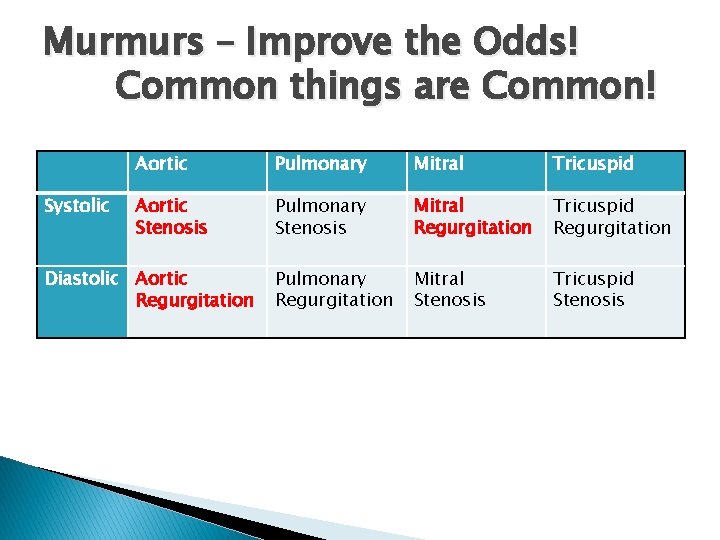
Murmurs Systolic Aortic Pulmonary Mitral Tricuspid Aortic Stenosis Pulmonary Stenosis Mitral Regurgitation Tricuspid Regurgitation Pulmonary Regurgitation Mitral Stenosis Tricuspid Stenosis Diastolic Aortic Regurgitation
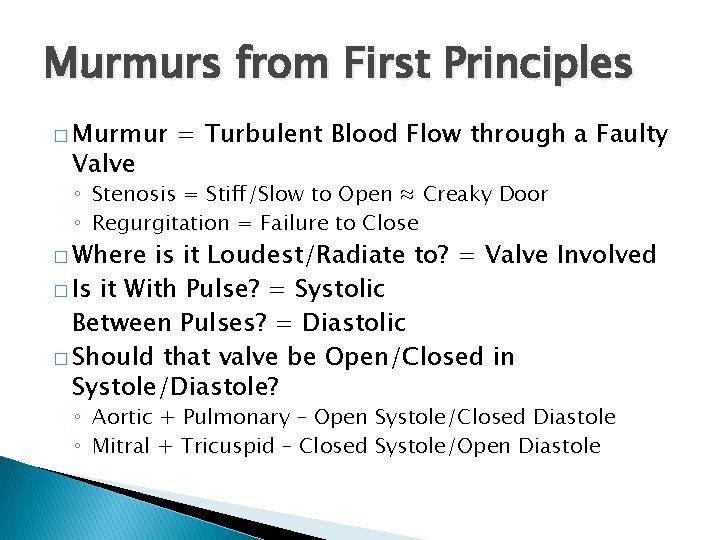
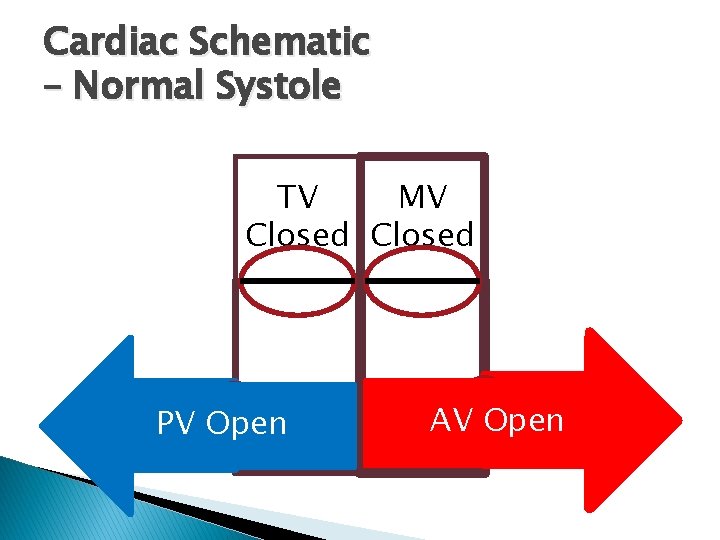
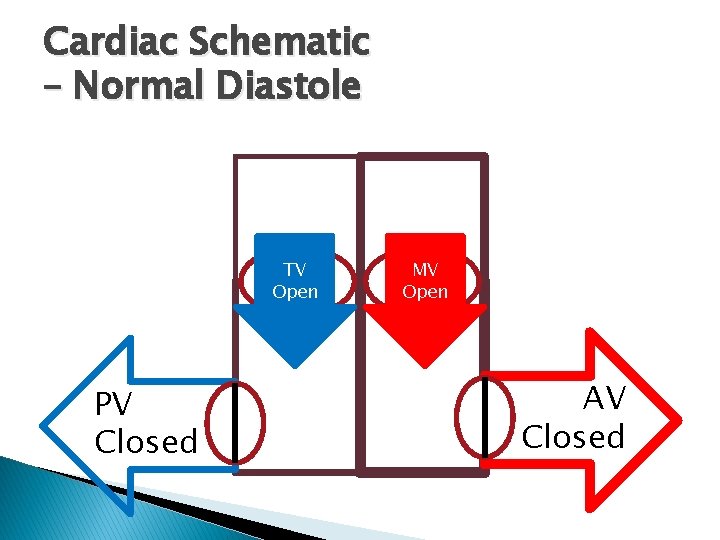
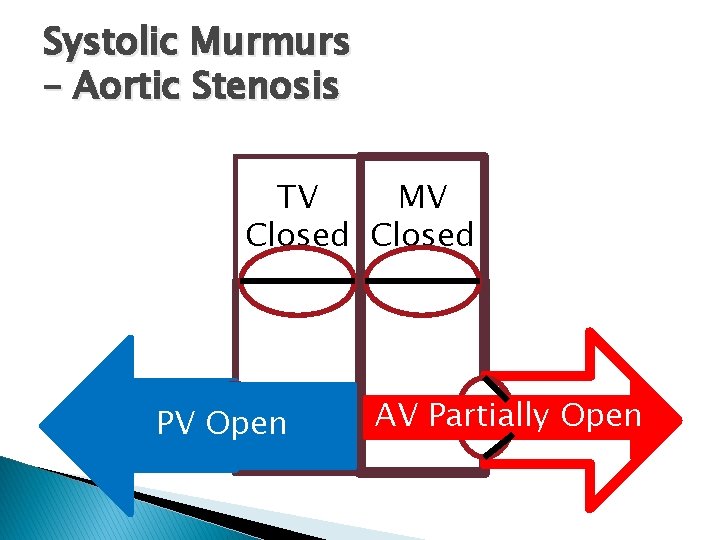
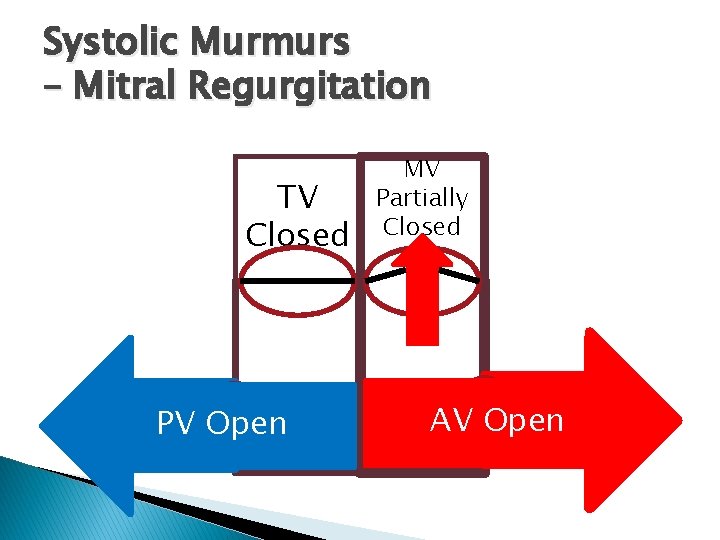
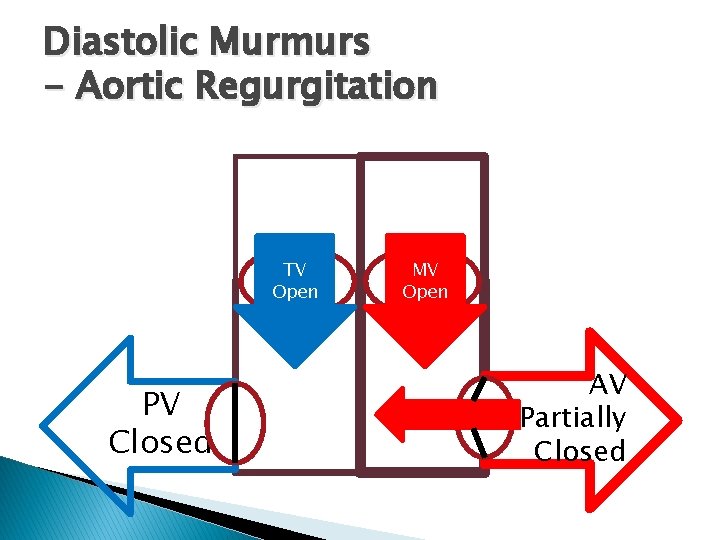
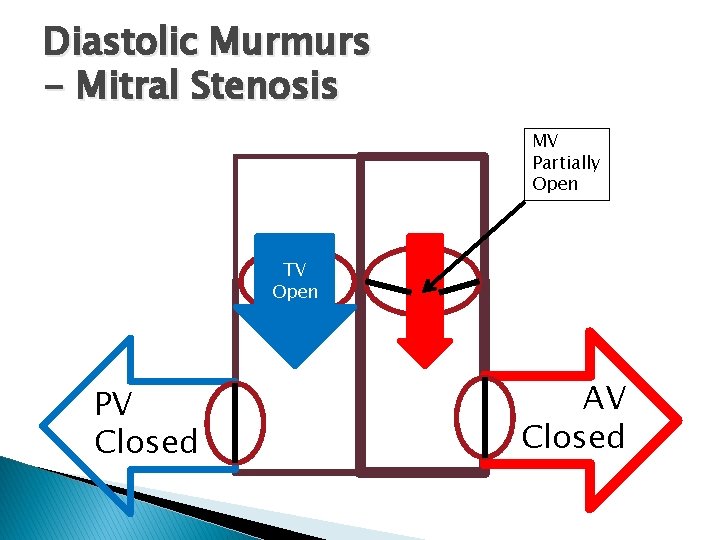
Murmurs from First Principles � Murmur Valve = Turbulent Blood Flow through a Faulty ◦ Stenosis = Stiff/Slow to Open ≈ Creaky Door ◦ Regurgitation = Failure to Close � Where is it Loudest/Radiate to? = Valve Involved � Is it With Pulse? = Systolic Between Pulses? = Diastolic � Should that valve be Open/Closed in Systole/Diastole? ◦ Aortic + Pulmonary – Open Systole/Closed Diastole ◦ Mitral + Tricuspid – Closed Systole/Open Diastole
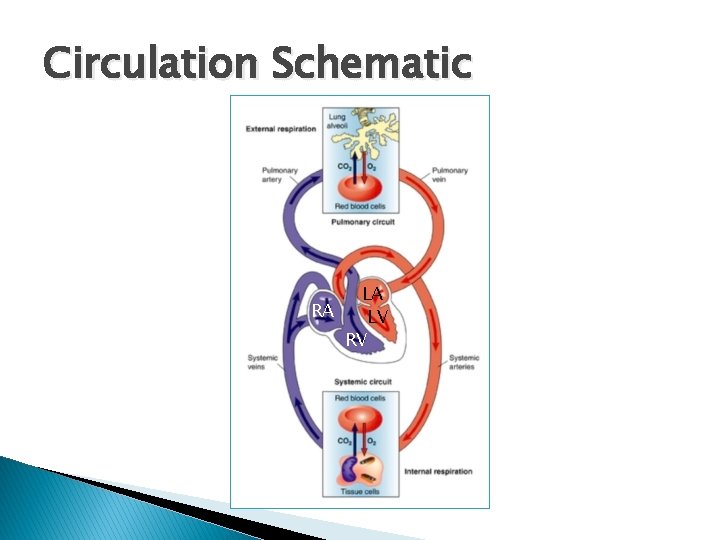
Circulation Schematic LA RA LV RV
Cardiac Schematic RA LA RV LV
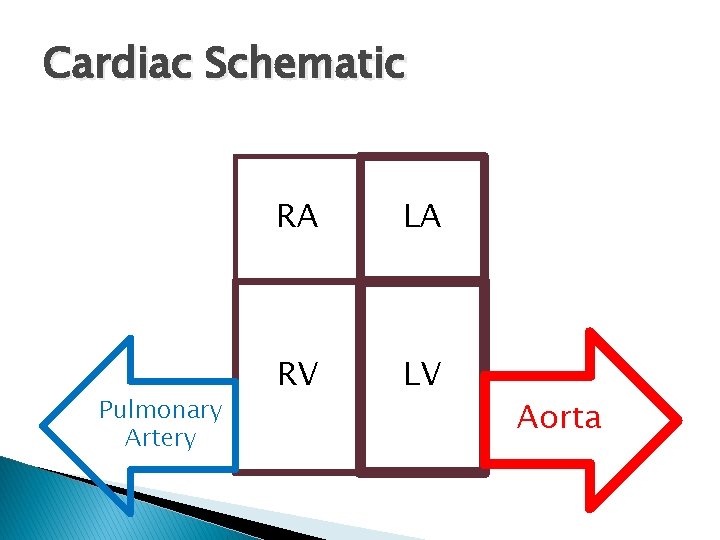
Cardiac Schematic Pulmonary Artery RA LA RV LV Aorta
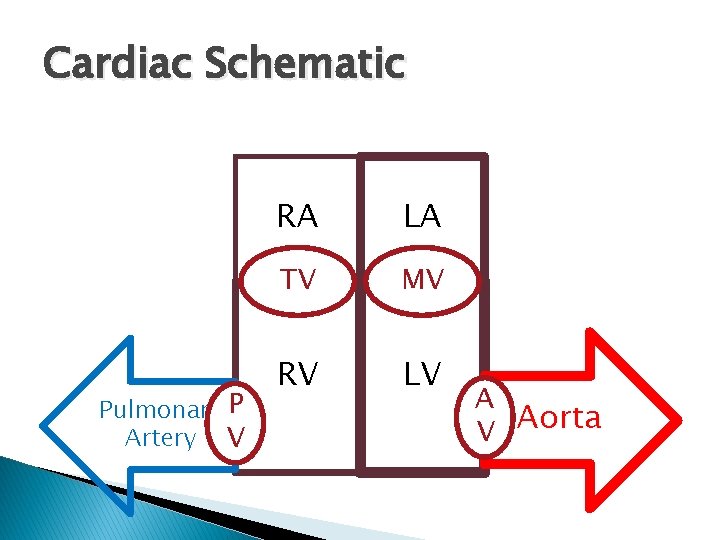
Cardiac Schematic Pulmonary P Artery V RA LA TV MV RV LV A V Aorta
Cardiac Schematic – Normal Systole TV MV Closed PV Open AV Open
Cardiac Schematic – Normal Diastole TV Open PV Closed MV Open AV Closed
Systolic Murmurs – Aortic Stenosis TV MV Closed PV Open AV Partially Open
Systolic Murmurs – Mitral Regurgitation TV Closed PV Open MV Partially Closed AV Open
Diastolic Murmurs - Aortic Regurgitation TV Open PV Closed MV Open AV Partially Closed
Diastolic Murmurs - Mitral Stenosis MV Partially Open TV Open PV Closed AV Closed
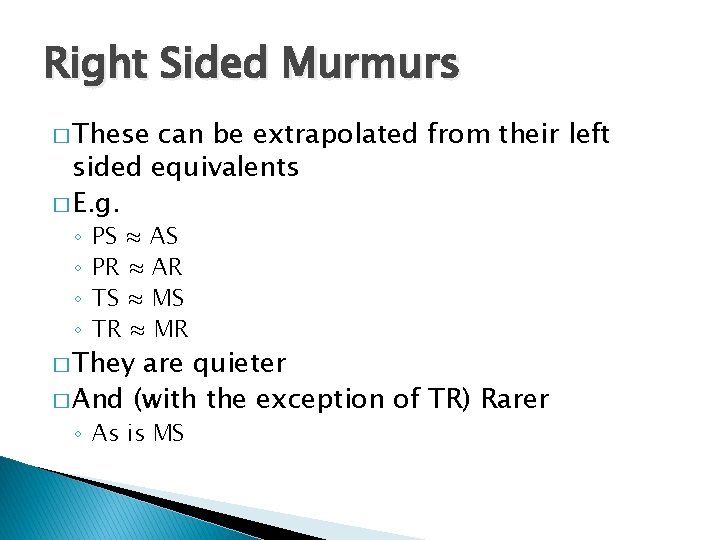
Right Sided Murmurs � These can be extrapolated from their left sided equivalents � E. g. ◦ ◦ PS ≈ AS PR ≈ AR TS ≈ MS TR ≈ MR � They are quieter � And (with the exception of TR) Rarer ◦ As is MS
Murmurs – Improve the Odds! Common things are Common! Systolic Aortic Pulmonary Mitral Tricuspid Aortic Stenosis Pulmonary Stenosis Mitral Regurgitation Tricuspid Regurgitation Pulmonary Regurgitation Mitral Stenosis Tricuspid Stenosis Diastolic Aortic Regurgitation
Remember the Systems � Getting Started � Patient’s Road Map � Order of the Examination � Tying it All Together
Remember the Systems � Getting Started � Patient’s Road Map � Order of the Examination � Tying it All Together ◦ Does your murmur fit with the rest of your findings?
Remember the Systems � Getting Started � Patient’s Road Map � Order of the Examination � Tying it All Together ◦ Does your murmur fit with the rest of your findings? ◦ Completing your examination �Peripheral Oedema �Pulmonary Oedema
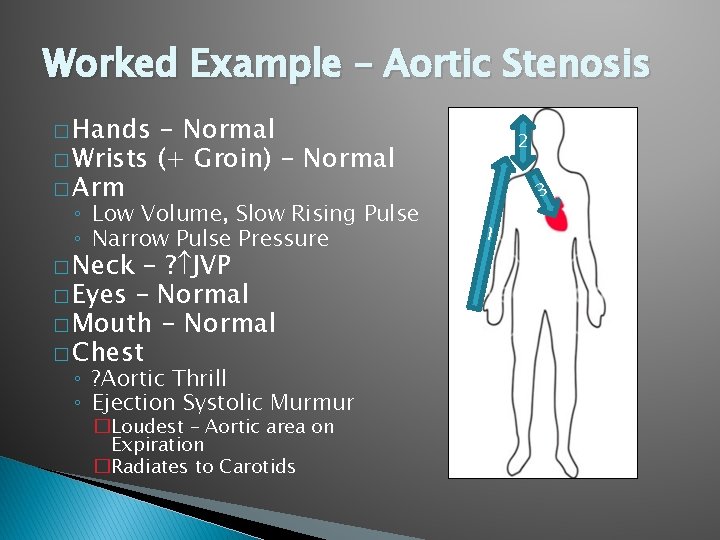
Worked Example – Aortic Stenosis � Hands - Normal � Wrists (+ Groin) - Normal � Arm ◦ Low Volume, Slow Rising Pulse ◦ Narrow Pulse Pressure � Neck - ? JVP � Eyes – Normal � Mouth - Normal � Chest ◦ ? Aortic Thrill ◦ Ejection Systolic Murmur �Loudest – Aortic area on Expiration �Radiates to Carotids 2 3 1
Summary � Getting ◦ WIPER Started � Patient’s Road Map � Standard Order ◦ ◦ Observe Palpate (Percuss) Auscultate � Tying it All Together 2 3 1
Video