
cardellis linker Daniel Jackson MIT Lab for Computer

cardelli’s linker Daniel Jackson MIT Lab for Computer Science 6898: Advanced Topics in Software Design March 11, 2002

cardelli’s motivation separate compilation › vital for writing, delivering, maintaining libraries › but often things go wrong › module designers lost sight of original aims linking has become complicated › so develop a formal model to help reason › treat linking outside the programming language Luca Cardelli. Program Fragments, Linking & Modularization. POPL 1997 2
separate compilation goofs missing language features › no interface/impl distinction, esp. in untyped languages global analysis required › multimethods, overloading, ML modules can’t compile library without client › templates in C++, Ada, Modula-3 › overloading in Java (David Griswold) runtime type errors despite static types › covariance in Eiffel › may link with old library by mistake › class loading problems 3
our motivation Units: a new modularity mechanism › will be presented on wednesday by Findler › have much in common with Cardelli’s model nice example of simple theory › shows how to capture essence of a problem › use as reference model for more complex systems challenge: a nice final project › recast Cardelli’s theory in Alloy › might be simpler: no decl ordering › check theorems automatically › explore variants 4
key ideas focus on type checking: the hardest part › work at source code level › compilation is fragmenting bindings › linking is substitution (ie, inlining) linksets: a simple configuration language › a linkset is a collection of fragments to be linked › each fragment has a name a list of imports an export › a linkset has an external interface its imports and exports empty for a program, non-empty for a library 5
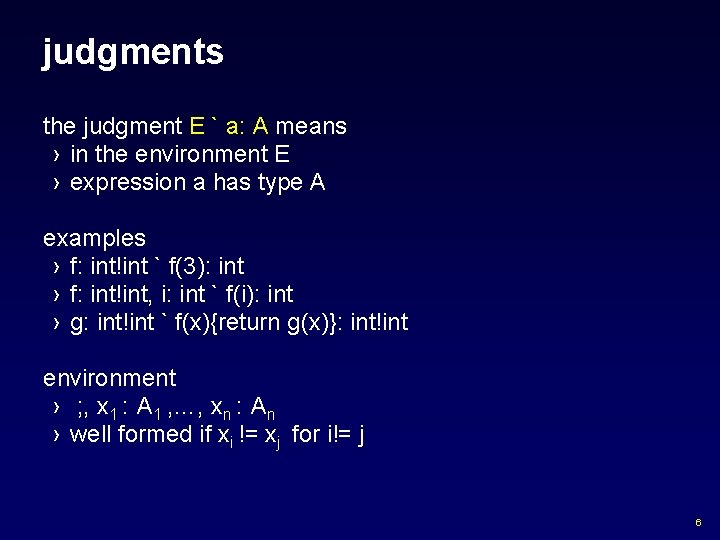
judgments the judgment E ` a: A means › in the environment E › expression a has type A examples › f: int!int ` f(3): int › f: int!int, i: int ` f(i): int › g: int!int ` f(x){return g(x)}: int!int environment › ; , x 1 : A 1 , …, xn : An › well formed if xi != xj for i!= j 6
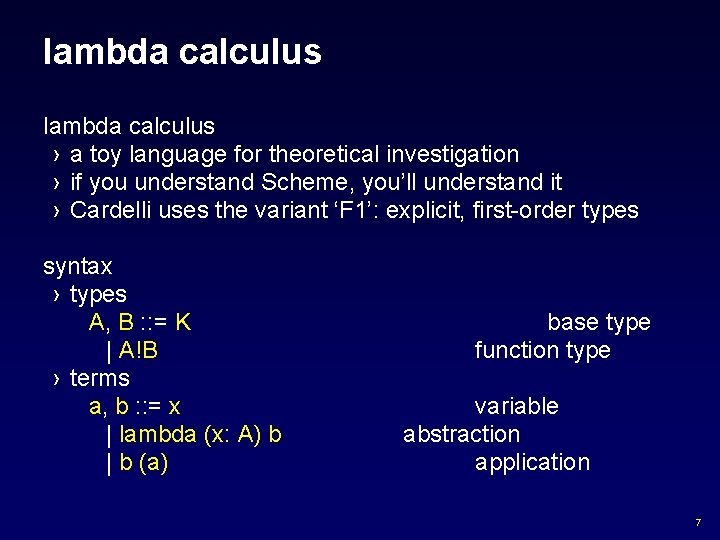
lambda calculus › a toy language for theoretical investigation › if you understand Scheme, you’ll understand it › Cardelli uses the variant ‘F 1’: explicit, first-order types syntax › types A, B : : = K | A!B › terms a, b : : = x | lambda (x: A) b | b (a) base type function type variable abstraction application 7
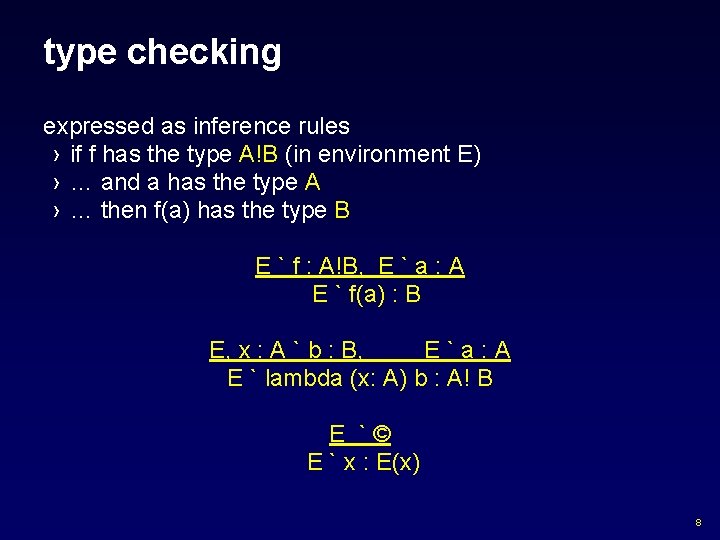
type checking expressed as inference rules › if f has the type A!B (in environment E) › … and a has the type A › … then f(a) has the type B E ` f : A!B, E ` a : A E ` f(a) : B E, x : A ` b : B, E`a: A E ` lambda (x: A) b : A! B E `© E ` x : E(x) 8
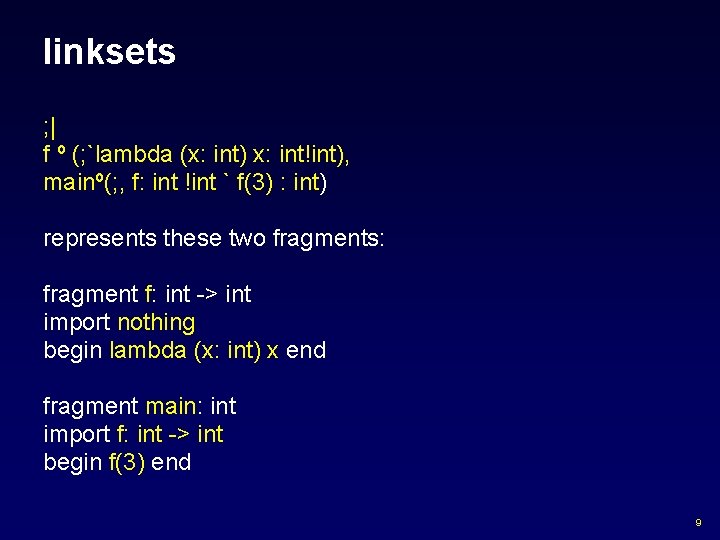
linksets ; | f º (; `lambda (x: int) x: int!int), mainº(; , f: int !int ` f(3) : int) represents these two fragments: fragment f: int -> int import nothing begin lambda (x: int) x end fragment main: int import f: int -> int begin f(3) end 9
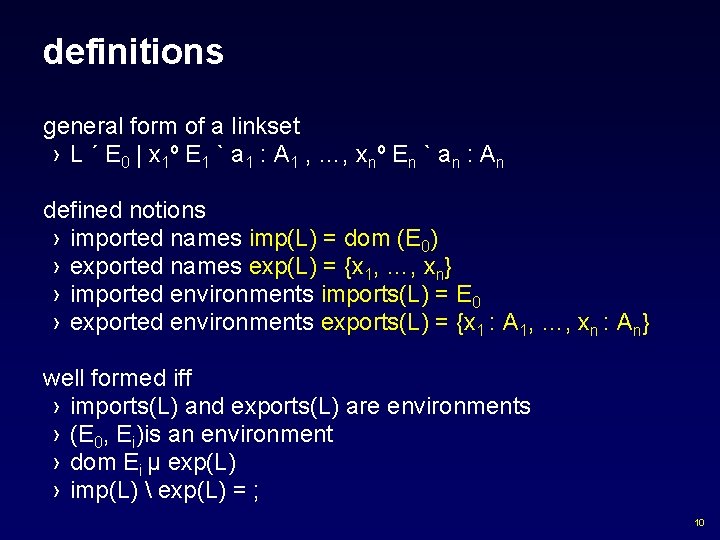
definitions general form of a linkset › L ´ E 0 | x 1º E 1 ` a 1 : A 1 , …, xnº En ` an : An defined notions › imported names imp(L) = dom (E 0) › exported names exp(L) = {x 1, …, xn} › imported environments imports(L) = E 0 › exported environments exports(L) = {x 1 : A 1, …, xn : An} well formed iff › imports(L) and exports(L) are environments › (E 0, Ei)is an environment › dom Ei µ exp(L) › imp(L) exp(L) = ; 10
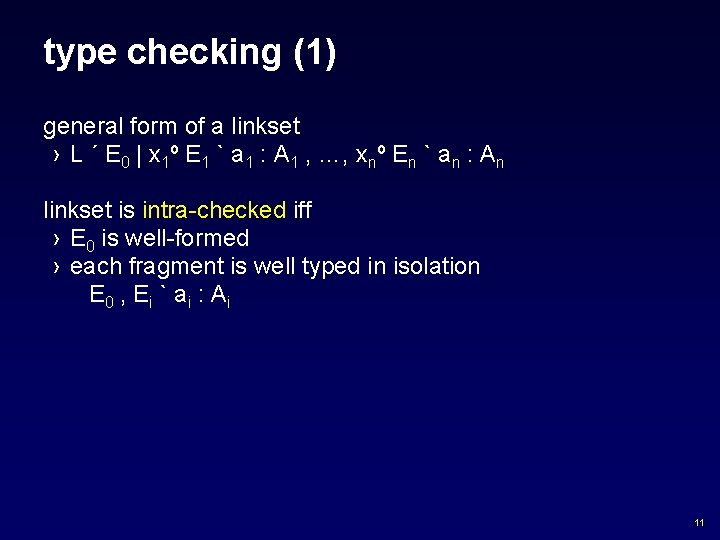
type checking (1) general form of a linkset › L ´ E 0 | x 1º E 1 ` a 1 : A 1 , …, xnº En ` an : An linkset is intra-checked iff › E 0 is well-formed › each fragment is well typed in isolation E 0 , E i ` ai : A i 11
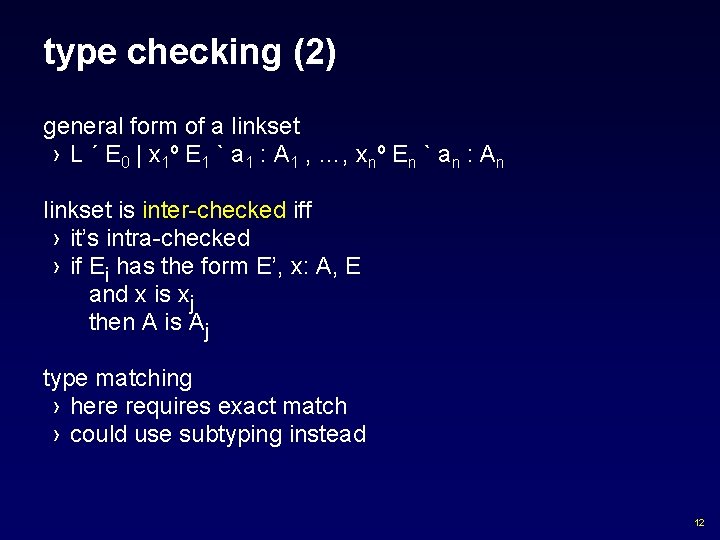
type checking (2) general form of a linkset › L ´ E 0 | x 1º E 1 ` a 1 : A 1 , …, xnº En ` an : An linkset is inter-checked iff › it’s intra-checked › if Ei has the form E’, x: A, E and x is xj then A is Aj type matching › here requires exact match › could use subtyping instead 12
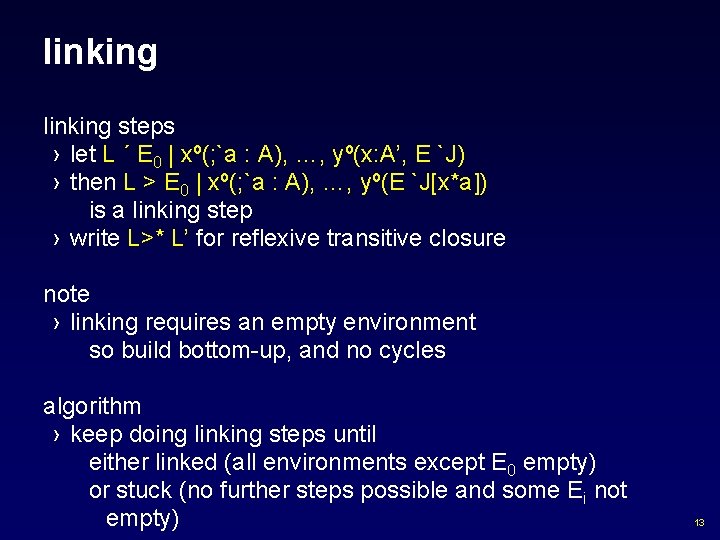
linking steps › let L ´ E 0 | xº(; `a : A), …, yº(x: A’, E `J) › then L > E 0 | xº(; `a : A), …, yº(E `J[x*a]) is a linking step › write L>* L’ for reflexive transitive closure note › linking requires an empty environment so build bottom-up, and no cycles algorithm › keep doing linking steps until either linked (all environments except E 0 empty) or stuck (no further steps possible and some Ei not empty) 13
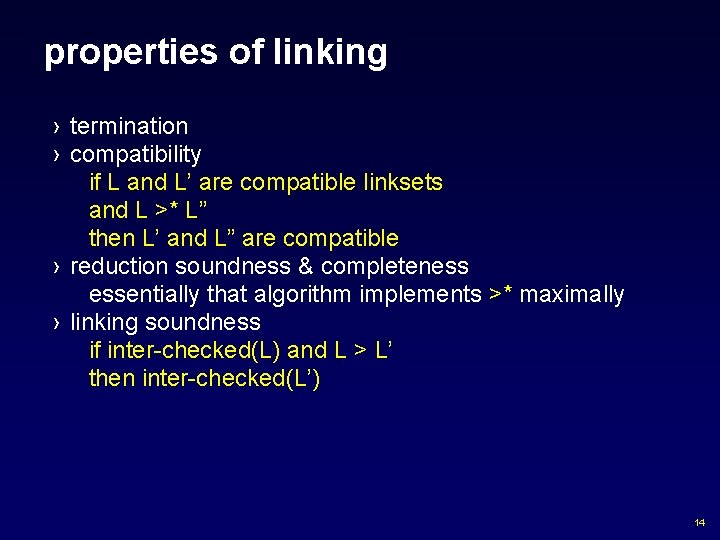
properties of linking › termination › compatibility if L and L’ are compatible linksets and L >* L” then L’ and L” are compatible › reduction soundness & completeness essentially that algorithm implements >* maximally › linking soundness if inter-checked(L) and L > L’ then inter-checked(L’) 14
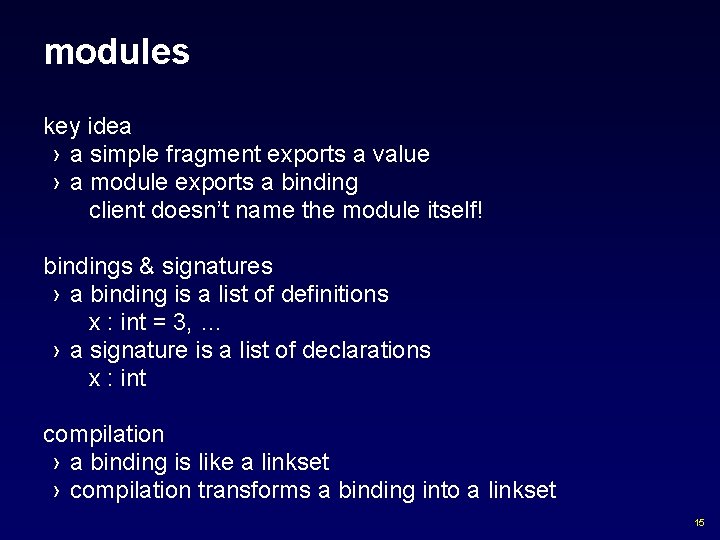
modules key idea › a simple fragment exports a value › a module exports a binding client doesn’t name the module itself! bindings & signatures › a binding is a list of definitions x : int = 3, … › a signature is a list of declarations x : int compilation › a binding is like a linkset › compilation transforms a binding into a linkset 15
separate compilation key theorem › given two modules whose interfaces are compatible › their compiled linksets are inter-checked 16
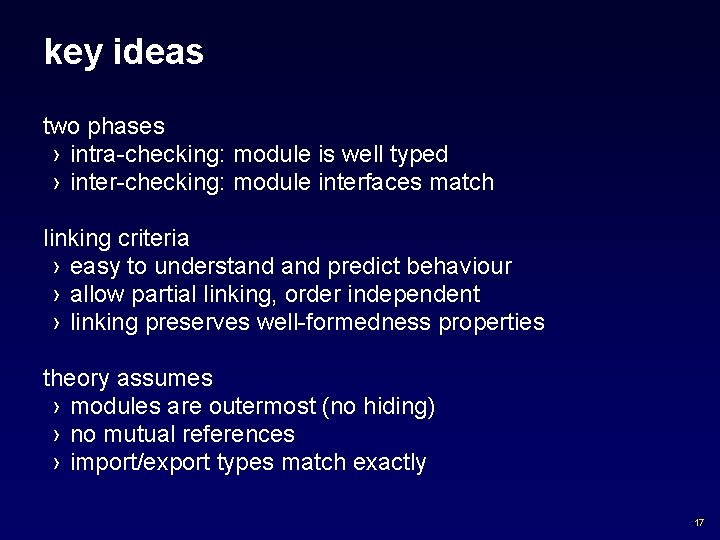
key ideas two phases › intra-checking: module is well typed › inter-checking: module interfaces match linking criteria › easy to understand predict behaviour › allow partial linking, order independent › linking preserves well-formedness properties theory assumes › modules are outermost (no hiding) › no mutual references › import/export types match exactly 17
- Slides: 17