
Card Games Cards 4 Playing cards were invented
- Slides: 24
Card Games
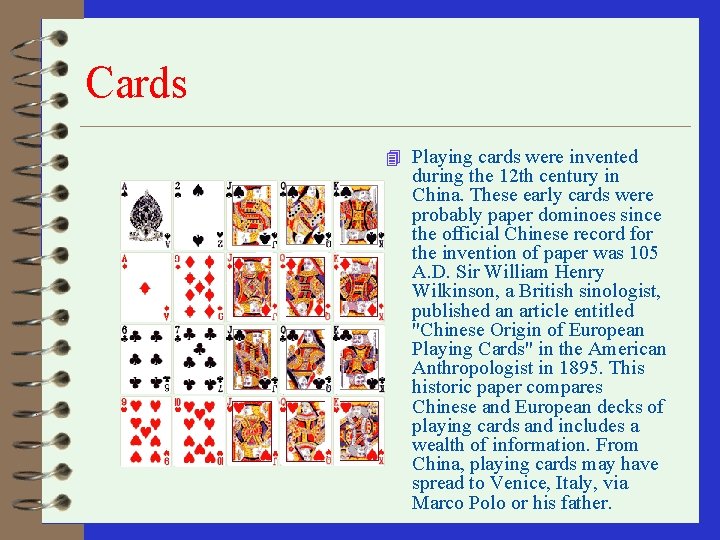
Cards 4 Playing cards were invented during the 12 th century in China. These early cards were probably paper dominoes since the official Chinese record for the invention of paper was 105 A. D. Sir William Henry Wilkinson, a British sinologist, published an article entitled "Chinese Origin of European Playing Cards" in the American Anthropologist in 1895. This historic paper compares Chinese and European decks of playing cards and includes a wealth of information. From China, playing cards may have spread to Venice, Italy, via Marco Polo or his father.
Mass Production of Cards 4 From Venice, cards made their way to other European countries. There are many mentions of cards from Ulm, Germany, in the late 1300 s and early 1400 s. Even though no actual card packs exist from this time, it is certain that woodcuts would have been used in their production by this time. The invention of the removable-type printing press made mass production of playing cards possible around 1440.
Cards used for gambling 4 Playing cards also became very popular for gambling. Preachers denounced card playing and the conduct that followed "poor losers" who exhibited bad behavior and emotional outbursts. It was declared immoral and prohibitions sprang up in many cities. Ulm, Germany, had a prohibition against card playing in 1397. Other prohibitions and ordinances against card playing occurred in Paris, France, in 1377; St. Gallen, Switzerland, in 1379; Lille, France, in 1382; Barcelona, Spain, in 1382; and, again, in Paris, France, in 1397 forbidding working people to play cards on working days.
Cards and suits 4 Some card decks from China featured only three "suits. " The four suits used in present-day playing cards (spades, hearts, diamonds & clubs) are derived from the Middle Ages where the Tarot deck reflected the societies of Medieval times. The king ruled a world in which there were four classes: the church, military, merchants, and farmers. These four classes were featured as suits on the cards in the forms of cups (the church), swords (military), pentacles or five-pointed stars (merchants), and batons (farmers). When card popularity spread throughout Europe and, particularly, into Germany during the 15 th century, the cups became hearts, the swords became spades, the pentacles became diamonds, and the batons became clubs.
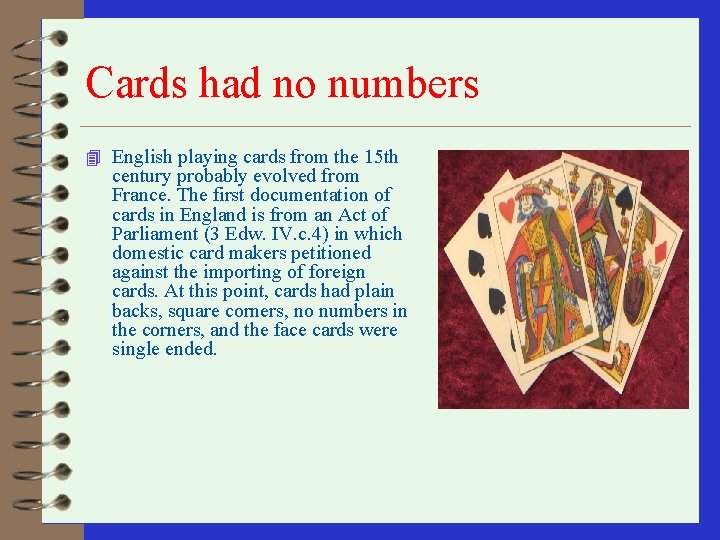
Cards had no numbers 4 English playing cards from the 15 th century probably evolved from France. The first documentation of cards in England is from an Act of Parliament (3 Edw. IV. c. 4) in which domestic card makers petitioned against the importing of foreign cards. At this point, cards had plain backs, square corners, no numbers in the corners, and the face cards were single ended.
Christopher Columbus and Cards 4 It is thought that Christopher Columbus' expedition brought playing cards to what is now Latin America. Cards were later brought to the New World by Jamestown settlers. In the American colonies, Puritan children were not allowed to play cards and the sale of cards was prohibited in their communities. In the Puritan Colony Laws of 1656, children and servants were to be "publicly whipped" for second offenses of playing cards. The county records of Plymouth, Massachusetts, show that in 1633 two heathens were fined two pounds each for card playing. The colonists did, however, enjoy playing cards. When Captain James Cook returned from England to Jamestown, Virginia, he found the colonists starving, but still playing with cards!
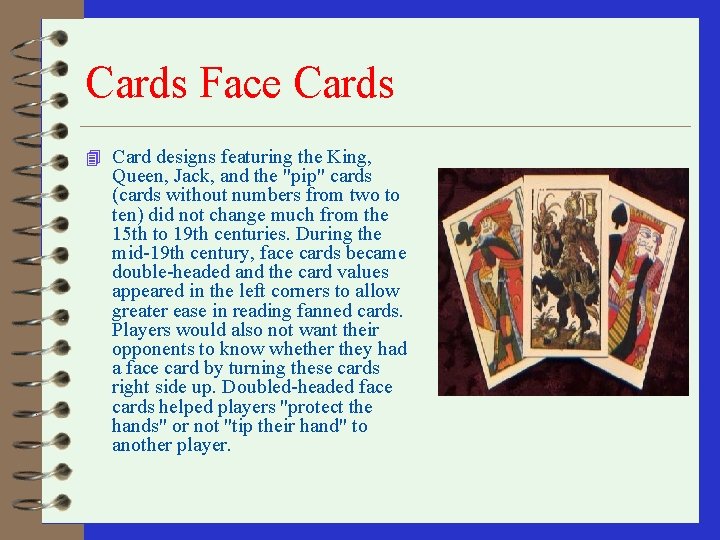
Cards Face Cards 4 Card designs featuring the King, Queen, Jack, and the "pip" cards (cards without numbers from two to ten) did not change much from the 15 th to 19 th centuries. During the mid-19 th century, face cards became double-headed and the card values appeared in the left corners to allow greater ease in reading fanned cards. Players would also not want their opponents to know whether they had a face card by turning these cards right side up. Doubled-headed face cards helped players "protect the hands" or not "tip their hand" to another player.
Plain Backs to Printed backs 4 Up until 1850, most playing cards had plain backs. Because this plain side could become soiled or "marked" and used for cheating, design patterns began to appear on the backs of cards. In some American cities further inland, this type of card deck with plain backs was used longer than 1850 simply because it took a while for the other cards to migrate to western states and territories. After cards were played with a number of times, the square corners rubbed off and, so, rounded corners became the new standard. After all, cards were made from only heavy paper then and did not have the plastic-coated finish we see on today's cards.
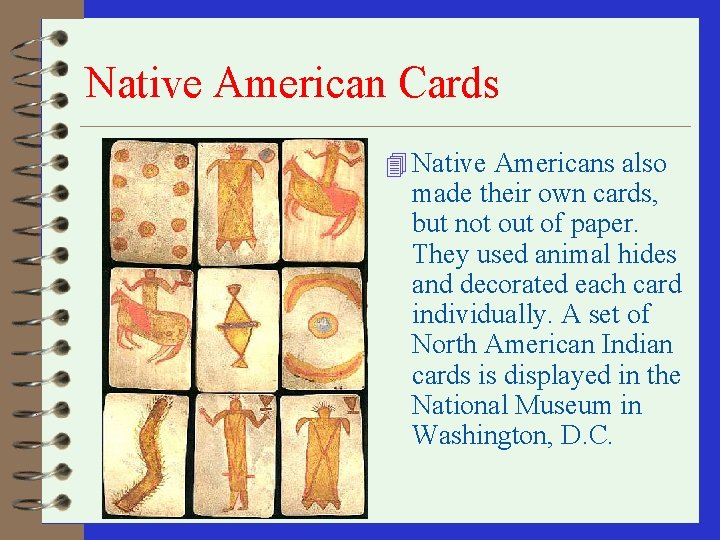
Native American Cards 4 Native Americans also made their own cards, but not out of paper. They used animal hides and decorated each card individually. A set of North American Indian cards is displayed in the National Museum in Washington, D. C.
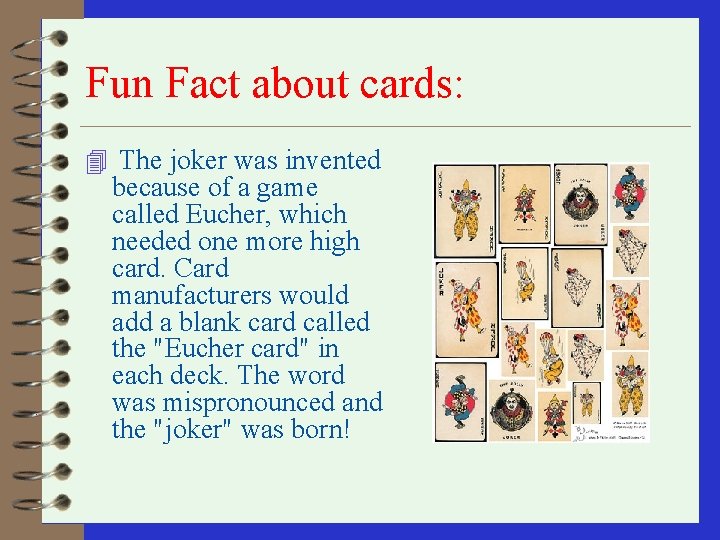
Fun Fact about cards: 4 The joker was invented because of a game called Eucher, which needed one more high card. Card manufacturers would add a blank card called the "Eucher card" in each deck. The word was mispronounced and the "joker" was born!
Card Terms 4 4 4 4 Call – To declare, bid or pass. Deal – To distribute the cards. Face Card – Any King, Queen or Jack. Hand – Term for the cards a player holds in his hand before they are played. Pairs – two matching face cards or two playing cards of the same rank. Sequence – Two or more cards of adjacent rank (example, 2, 3, 4). Set – A group of 3 or 4 cards of the same number or rank, or a sequence of 3 or more cards of the same unit. 4 4 4 shuffle - To mix up the order of cards in the pack. Stock- An undealt portion of the deck of cards. Suit – There are 4 suits in a standard deck of 52 cards. Spades, Clubs, Hearts and Diamonds. Trick – A round of cards, during the play, one card being contributed by each player. trump - 1) A superior suit, any card of which will beat that of any other suit played to the trick; 2) To play a trump card waste-pile - A stack of discarded cards, usually face up Wild Card – A card that is specified by the holder to be any rank or suit. 4 4
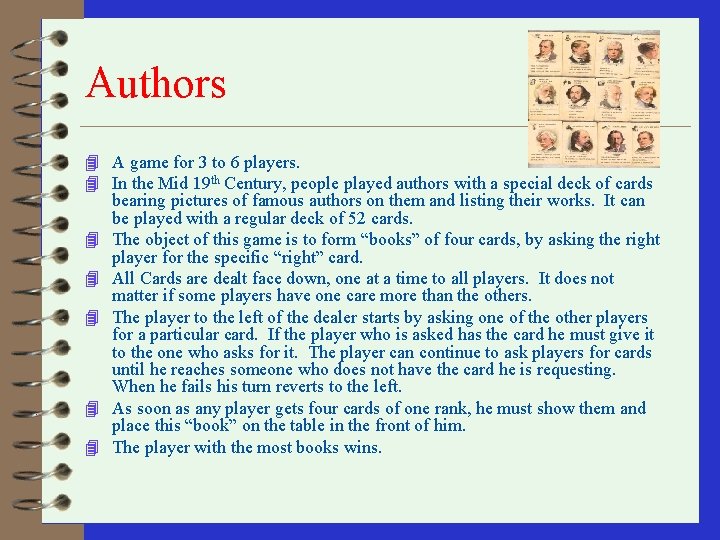
Authors 4 A game for 3 to 6 players. 4 In the Mid 19 th Century, people played authors with a special deck of cards 4 4 4 bearing pictures of famous authors on them and listing their works. It can be played with a regular deck of 52 cards. The object of this game is to form “books” of four cards, by asking the right player for the specific “right” card. All Cards are dealt face down, one at a time to all players. It does not matter if some players have one care more than the others. The player to the left of the dealer starts by asking one of the other players for a particular card. If the player who is asked has the card he must give it to the one who asks for it. The player can continue to ask players for cards until he reaches someone who does not have the card he is requesting. When he fails his turn reverts to the left. As soon as any player gets four cards of one rank, he must show them and place this “book” on the table in the front of him. The player with the most books wins.
My Ship Sails 4 My Ship Sails – A game for 4 -7 players using one standard deck. The object of the game is to be the first player to collect 7 cards of the same suit. Deal – The cards are dealt face down, one at a time, until each player has 7 cards. The rest of the cards are not used. Play- Each player sorts the cards in his hand into suits and decides which suit he has the most cards. A player may change his mind, however, during the course of the play. Card Exchange- Each player takes one card that he does not want to keep and places it face down on the table. When all the players are ready, they pass their cards to the next person to the right. Each player picks up his new card, decides on another card to discard, and then passes the card in the same manner. End of the Game- All players continue to exchange cards until one player collects 7 cards of the same suit. He then declares “My Ship Sails!” and wins the game.
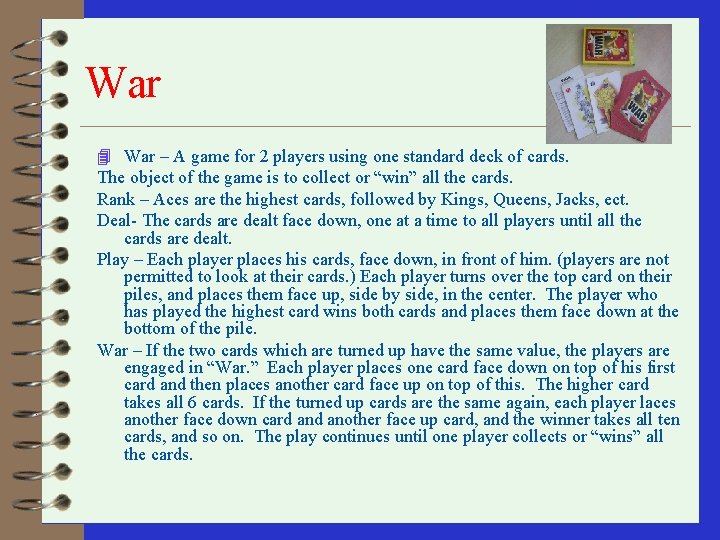
War 4 War – A game for 2 players using one standard deck of cards. The object of the game is to collect or “win” all the cards. Rank – Aces are the highest cards, followed by Kings, Queens, Jacks, ect. Deal- The cards are dealt face down, one at a time to all players until all the cards are dealt. Play – Each player places his cards, face down, in front of him. (players are not permitted to look at their cards. ) Each player turns over the top card on their piles, and places them face up, side by side, in the center. The player who has played the highest card wins both cards and places them face down at the bottom of the pile. War – If the two cards which are turned up have the same value, the players are engaged in “War. ” Each player places one card face down on top of his first card and then places another card face up on top of this. The higher card takes all 6 cards. If the turned up cards are the same again, each player laces another face down card another face up card, and the winner takes all ten cards, and so on. The play continues until one player collects or “wins” all the cards.
Concentration 4 A game for any number of players. 4 One to two decks are used depending on the number of 4 4 players. Object of the game is for each player attempts to collect as many cards as possible by turning over pairs of the same rank. The deck of cards is shuffled and then placed face down on the playing surface so no two cards touch. The player to the left starts by turning two cards over. If they match the player gets to keep the pair. If they do not match the turn goes to the next player. Play continues until all the cards are matched and the player with the most matches wins.
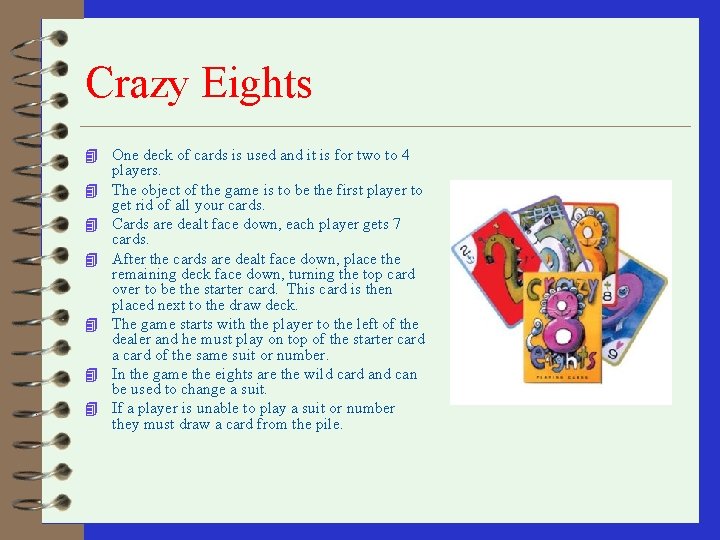
Crazy Eights 4 One deck of cards is used and it is for two to 4 4 4 4 players. The object of the game is to be the first player to get rid of all your cards. Cards are dealt face down, each player gets 7 cards. After the cards are dealt face down, place the remaining deck face down, turning the top card over to be the starter card. This card is then placed next to the draw deck. The game starts with the player to the left of the dealer and he must play on top of the starter card a card of the same suit or number. In the game the eights are the wild card and can be used to change a suit. If a player is unable to play a suit or number they must draw a card from the pile.
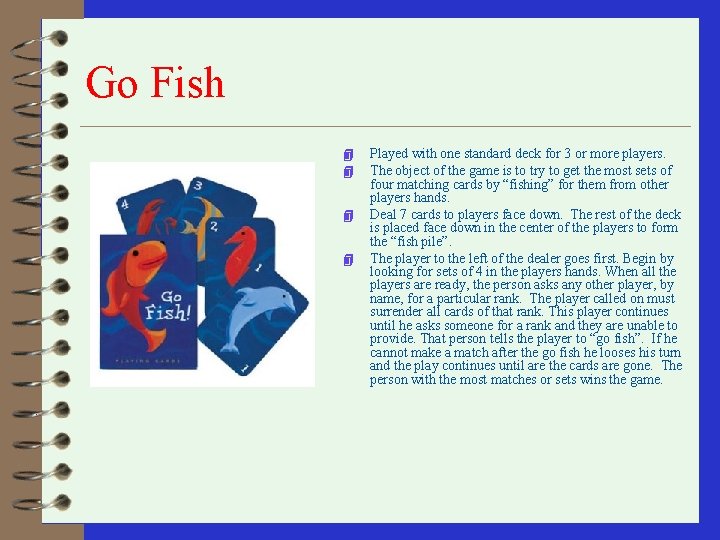
Go Fish 4 4 Played with one standard deck for 3 or more players. The object of the game is to try to get the most sets of four matching cards by “fishing” for them from other players hands. Deal 7 cards to players face down. The rest of the deck is placed face down in the center of the players to form the “fish pile”. The player to the left of the dealer goes first. Begin by looking for sets of 4 in the players hands. When all the players are ready, the person asks any other player, by name, for a particular rank. The player called on must surrender all cards of that rank. This player continues until he asks someone for a rank and they are unable to provide. That person tells the player to “go fish”. If he cannot make a match after the go fish he looses his turn and the play continues until are the cards are gone. The person with the most matches or sets wins the game.
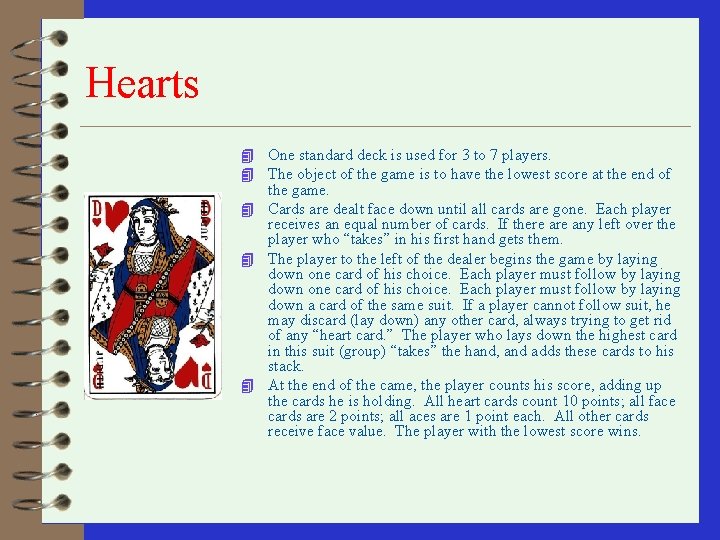
Hearts 4 One standard deck is used for 3 to 7 players. 4 The object of the game is to have the lowest score at the end of the game. 4 Cards are dealt face down until all cards are gone. Each player receives an equal number of cards. If there any left over the player who “takes” in his first hand gets them. 4 The player to the left of the dealer begins the game by laying down one card of his choice. Each player must follow by laying down a card of the same suit. If a player cannot follow suit, he may discard (lay down) any other card, always trying to get rid of any “heart card. ” The player who lays down the highest card in this suit (group) “takes” the hand, and adds these cards to his stack. 4 At the end of the came, the player counts his score, adding up the cards he is holding. All heart cards count 10 points; all face cards are 2 points; all aces are 1 point each. All other cards receive face value. The player with the lowest score wins.
I doubt it 4 4 4 4 A game for 3 to 5 players using 1 deck of cards. The object of the game is to be the first player to get rid of all his cards. The cards are dealt face down. Doesn’t matter if one player has more cards. The player to the left of the dealer goes first and places 1 to 4 cards of the same rank face down in a stack in the center. The player calls the rank as he does so. (In fact, the cards need not be what was declared. The player is not compelled to tell the truth-see cheating) The play continues to the left. Subsequent players must then play-or claim that they are playing – one to four cards, one higher than those played by the preceding player. Cheating- There are two ways of cheating 1) the player may put down more or fewer cards than he claims. 2) The player may put down cards other than the rank he has declared as long as he pretends they are all the same, and of the next highest value to those just played. (Note: If a player doesn’t have the cards of the required value, he has no choice but to do this. ) Calling the Bluff – If one player suspects another player in “Bluffing” or “Cheating, ” he can challenge the play by saying “I Doubt It’ before the suspicious cards are then covered by those of the next player. The challenge cards are then turned over for inspection. If the player who proclaimed “I Doubt It” is correct the person who bluffed has to pick up all the cards and add them to his hand. If he did not bluff or cheat then the challenger must pick up the cards and add them to their pile. The winner is the first player who succeeds in playing his last card. This happens when: 1) the player withstands a challenge from another player. 2) the players cards are covered by the next player, before another player challenges him.
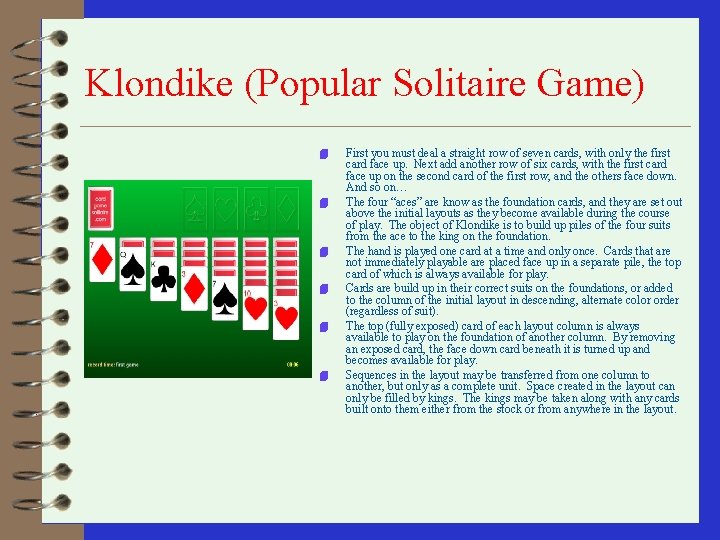
Klondike (Popular Solitaire Game) 4 4 4 First you must deal a straight row of seven cards, with only the first card face up. Next add another row of six cards, with the first card face up on the second card of the first row, and the others face down. And so on… The four “aces” are know as the foundation cards, and they are set out above the initial layouts as they become available during the course of play. The object of Klondike is to build up piles of the four suits from the ace to the king on the foundation. The hand is played one card at a time and only once. Cards that are not immediately playable are placed face up in a separate pile, the top card of which is always available for play. Cards are build up in their correct suits on the foundations, or added to the column of the initial layout in descending, alternate color order (regardless of suit). The top (fully exposed) card of each layout column is always available to play on the foundation of another column. By removing an exposed card, the face down card beneath it is turned up and becomes available for play. Sequences in the layout may be transferred from one column to another, but only as a complete unit. Space created in the layout can only be filled by kings. The kings may be taken along with any cards built onto them either from the stock or from anywhere in the layout.
Old Maid 4 4 4 3 or more players. Remove all Queens except the clubs from the deck of cards. Deal the remainder of the cards to all participating. It doesn’t matter if the cards are even. Each player attempts to get rid of his cards by discarding pairs of rank. The player who is left with the “old maid” (queen-clubs) when the play ends is the loser. If a player has any pairs he can lay them down. Or if he has 4 cards he can put those down. When everyone has discarded all their pairs, the play begins. The player to the left of the dealer begins, offering his cards to the player on his left. The player who is offered the cards must take one of the cards and add it to his own cards. If that card makes a pair, he discards that pair. If it does not, he adds the new card to the cards in his hand. In either case, he then fans out his cards and offers them to the player on the left. The play continues in this manner until all cards but the “Old Maid”
Rummy 4 One standard deck is used and is played by 2 to 4 players. 4 The object of the game is to form the hand into “sets” (A set is two 4 4 types: a group of 3 or 4 cards of the same rank, or a sequence of 3 or 4 cards in the same suit. ) The cards are dealt face down until all the players have six cards. The remaining deck are placed face down on the table. Turn the top card over and place it face up, next to the deck. This will serve as the discard pile. If a player has 3 or more cards of the same rank or sequence of 3 or more cards, he may place them face up on the table as a “set. ” A player may also lay down a card that belongs to a set he has already played, or one that has been put don by another player. Each player must place one card on the discard pile as his turn ends. Any player who plays all his cards during his turn does not have to discard and will win the game.
Snap Game for 2 to 4 players with one deck of cards preferably old ones. The object of the game is to win all the cards. The cards are dealt down until all the cards are dealt, Each player places his cards in a stack in front of him. Players are not permitted to look at his cards. The play begins with the player to the left of the dealer. Each player, in turn, takes the top card of his stack and places it face up in front of him, forming a new pile of “face up” cards. Before placing the card on the table, each player should hold up his card (away from himself) facing the other players. 4 Whenever a matched pair appears (two cards of the same rank), the first player to say “SNAP” takes all the other players cards along with any cards underneath. These cards and any that he has already played are placed underneath his main stack. 4 If both players call “snap” at the same time, both lots of cards are placed in the center of the table. The first player to call “snap” on the next turn takes both lots of cards. 4 Any player calling “snap” in error places all his turned over cards in the center of the table. 4 4