
Carboxylic acids Properties of carboxylic acids Preparation of
Carboxylic acids Properties of carboxylic acids Preparation of carboxylic acids Reactions of carboxylic acids
Introduction • • • Carboxylic acids are organic compounds with a –COOH group. These are weak acids that reacts with metals, alkali and carbonates. Carboxylic acids react with alcohols to form esters. Carboxylic acids are reduced to primary alcohols. Carboxylic acids react with phosphorous (V) chloride to form acyl chlorides.
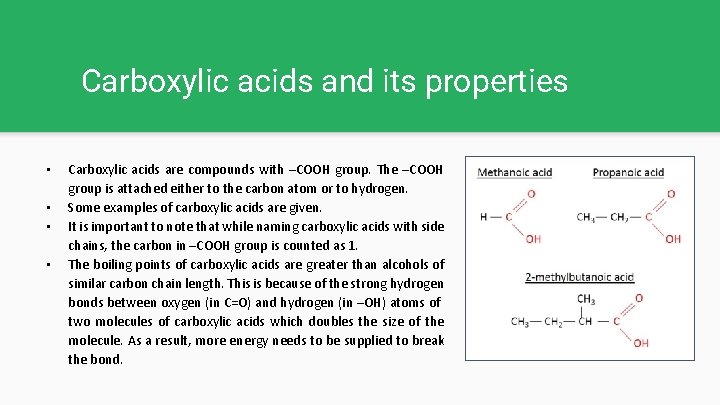
Carboxylic acids and its properties • • Carboxylic acids are compounds with –COOH group. The –COOH group is attached either to the carbon atom or to hydrogen. Some examples of carboxylic acids are given. It is important to note that while naming carboxylic acids with side chains, the carbon in –COOH group is counted as 1. The boiling points of carboxylic acids are greater than alcohols of similar carbon chain length. This is because of the strong hydrogen bonds between oxygen (in C=O) and hydrogen (in –OH) atoms of two molecules of carboxylic acids which doubles the size of the molecule. As a result, more energy needs to be supplied to break the bond.
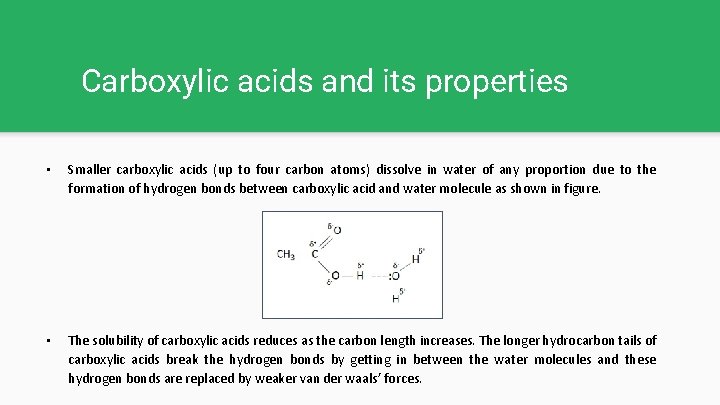
Carboxylic acids and its properties • Smaller carboxylic acids (up to four carbon atoms) dissolve in water of any proportion due to the formation of hydrogen bonds between carboxylic acid and water molecule as shown in figure. • The solubility of carboxylic acids reduces as the carbon length increases. The longer hydrocarbon tails of carboxylic acids break the hydrogen bonds by getting in between the water molecules and these hydrogen bonds are replaced by weaker van der waals’ forces.
Preparation of carboxylic acids: Oxidation of alcohols ● ● ● Alcohols are oxidised by potassium dichromate solution (K 2 Cr 2 O 7), acidified with dilute sulphuric acid. The reaction mixture needs to be warmed before the oxidation takes place. Alcohols are of three types: primary, secondary and tertiary. The products formed during oxidation depends on the type of alcohol. Potassium dichromate solution is in orange colour. When reduced in reaction with alcohols, the solution changes to green colour.
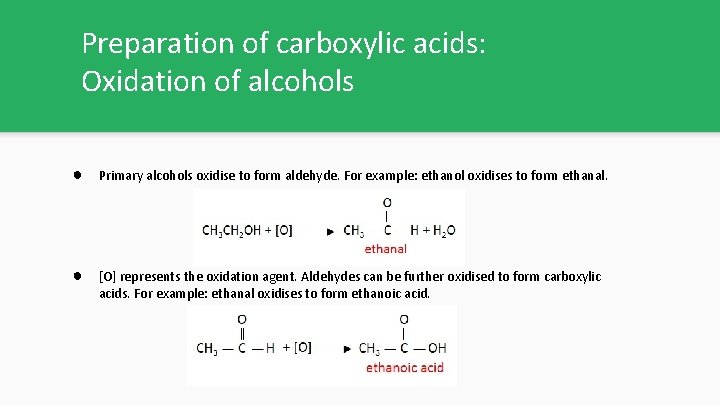
Preparation of carboxylic acids: Oxidation of alcohols ● Primary alcohols oxidise to form aldehyde. For example: ethanol oxidises to form ethanal. ● [O] represents the oxidation agent. Aldehydes can be further oxidised to form carboxylic acids. For example: ethanal oxidises to form ethanoic acid.
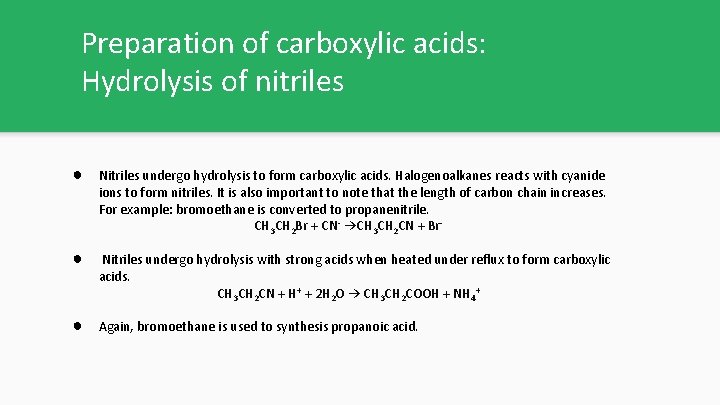
Preparation of carboxylic acids: Hydrolysis of nitriles ● Nitriles undergo hydrolysis to form carboxylic acids. Halogenoalkanes reacts with cyanide ions to form nitriles. It is also important to note that the length of carbon chain increases. For example: bromoethane is converted to propanenitrile. CH 3 CH 2 Br + CN- →CH 3 CH 2 CN + Br- ● Nitriles undergo hydrolysis with strong acids when heated under reflux to form carboxylic acids. CH 3 CH 2 CN + H+ + 2 H 2 O → CH 3 CH 2 COOH + NH 4+ ● Again, bromoethane is used to synthesis propanoic acid.
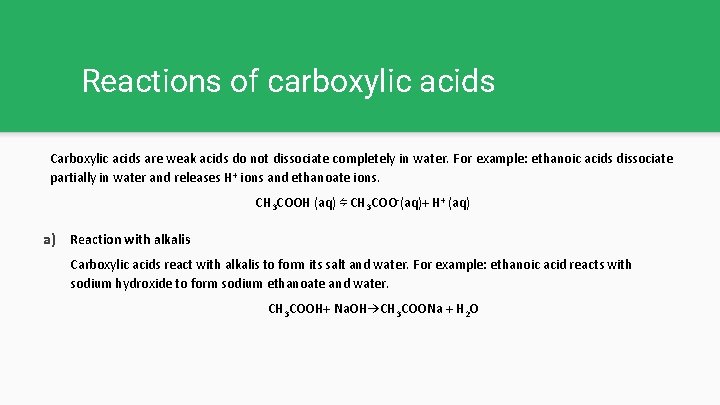
Reactions of carboxylic acids Carboxylic acids are weak acids do not dissociate completely in water. For example: ethanoic acids dissociate partially in water and releases H+ ions and ethanoate ions. CH 3 COOH (aq) ⇋ CH 3 COO-(aq)+ H+ (aq) a) Reaction with alkalis Carboxylic acids react with alkalis to form its salt and water. For example: ethanoic acid reacts with sodium hydroxide to form sodium ethanoate and water. CH 3 COOH+ Na. OH→CH 3 COONa + H 2 O
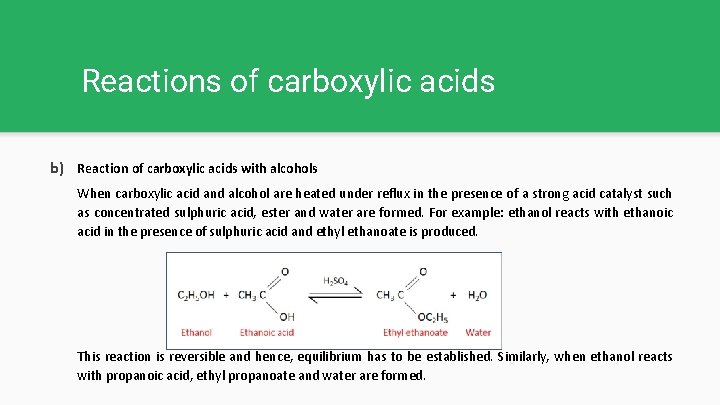
Reactions of carboxylic acids b) Reaction of carboxylic acids with alcohols When carboxylic acid and alcohol are heated under reflux in the presence of a strong acid catalyst such as concentrated sulphuric acid, ester and water are formed. For example: ethanol reacts with ethanoic acid in the presence of sulphuric acid and ethyl ethanoate is produced. This reaction is reversible and hence, equilibrium has to be established. Similarly, when ethanol reacts with propanoic acid, ethyl propanoate and water are formed.
Reactions of carboxylic acids c) Reduction of carboxylic acids Carboxylic acids are reduced to primary alcohols by reacting with lithium tetrahydrioaluminate (Li. Al. H 4) at room temperature and pressure. For example: Propanoic acid is reduced to propanol. H 3 C-CH 2 -COOH + 4[H] → H 3 C-CH 2 -OH + H 2 O d) Reaction of carboxylic acids with phosphorous (V) chloride Carboxylic acids react with phosphorous (V) chloride and is converted to acyl chlorides. This reaction is also used as test for carboxylic acids. White fumes of hydrogen chloride gas is released in this reaction. CH 3 COOH+ PCl 5→CH 3 COCl + POCl 3 + HCl
- Slides: 10