
Carboxylic acids and their derivatives www assignmentpoint com
Carboxylic acids and their derivatives www. assignmentpoint. com
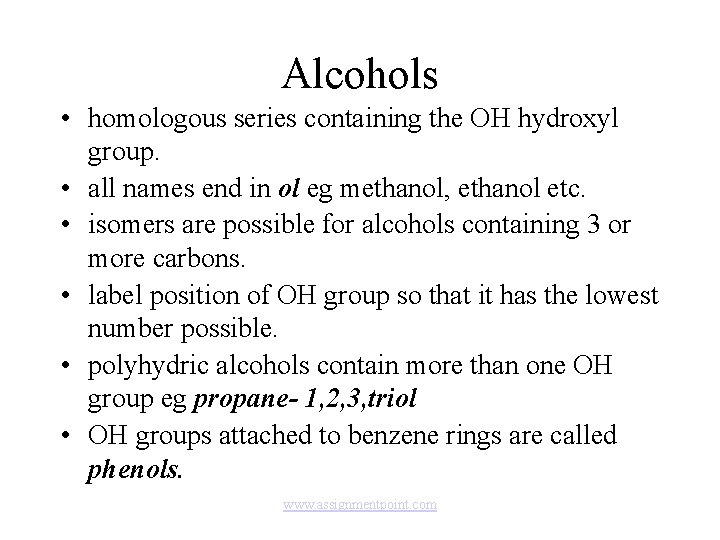
Alcohols • homologous series containing the OH hydroxyl group. • all names end in ol eg methanol, ethanol etc. • isomers are possible for alcohols containing 3 or more carbons. • label position of OH group so that it has the lowest number possible. • polyhydric alcohols contain more than one OH group eg propane- 1, 2, 3, triol • OH groups attached to benzene rings are called phenols. www. assignmentpoint. com
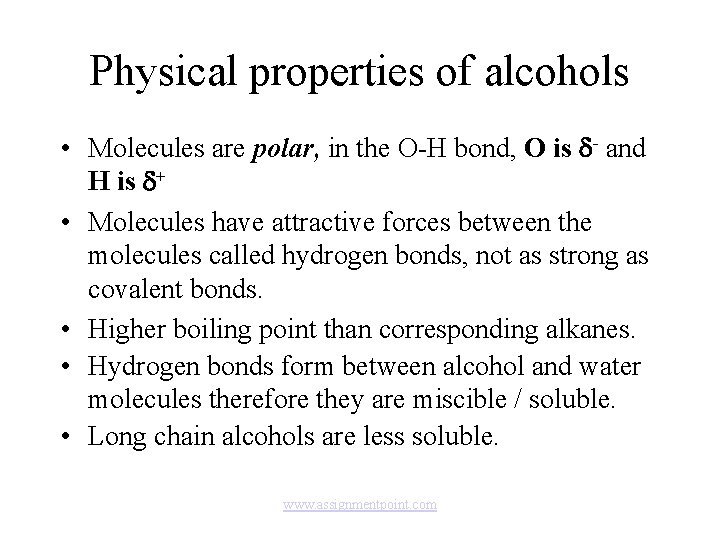
Physical properties of alcohols • Molecules are polar, in the O-H bond, O is - and H is + • Molecules have attractive forces between the molecules called hydrogen bonds, not as strong as covalent bonds. • Higher boiling point than corresponding alkanes. • Hydrogen bonds form between alcohol and water molecules therefore they are miscible / soluble. • Long chain alcohols are less soluble. www. assignmentpoint. com
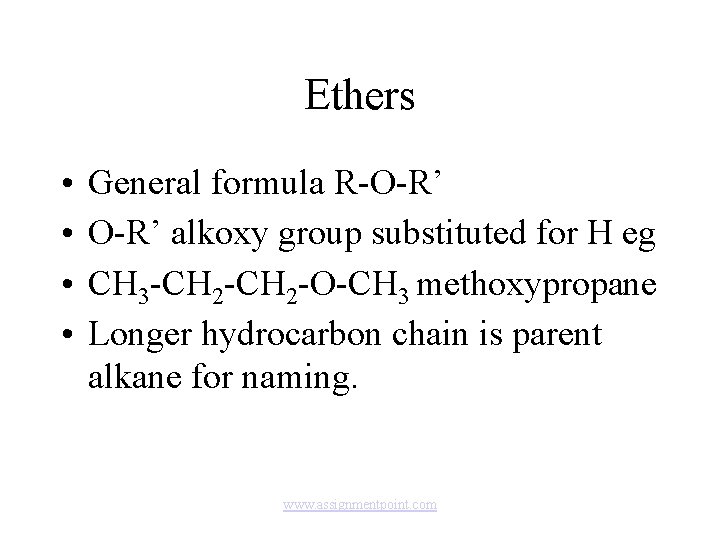
Ethers • • General formula R-O-R’ alkoxy group substituted for H eg CH 3 -CH 2 -O-CH 3 methoxypropane Longer hydrocarbon chain is parent alkane for naming. www. assignmentpoint. com
Physical properties of ethers • Molecules only slightly polar. • No hydrogen on the oxygen atoms to form hydrogen bonds – only weak forces of attraction between molecules. • Boiling points similar to corresponding alkane. • Lower ethers, very volatile, highly flammable. • Only slightly soluble in water, mix well with other non-polar solvents eg alkanes. (Like dissolves like). www. assignmentpoint. com
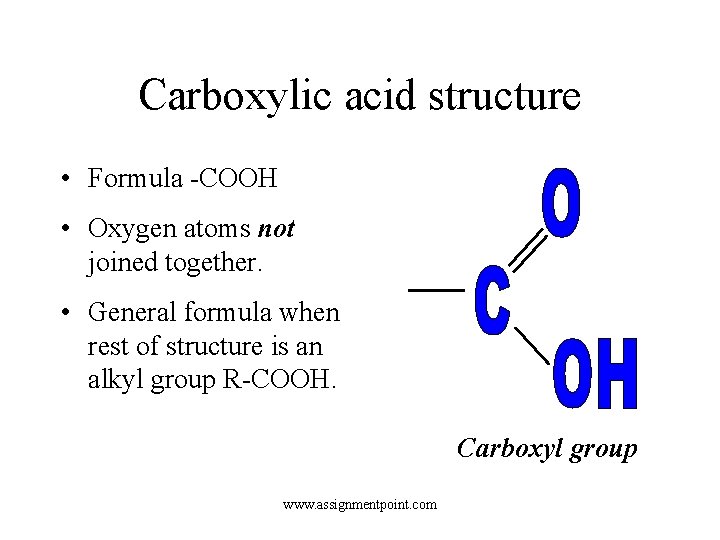
Carboxylic acid structure • Formula -COOH • Oxygen atoms not joined together. • General formula when rest of structure is an alkyl group R-COOH. Carboxyl group www. assignmentpoint. com
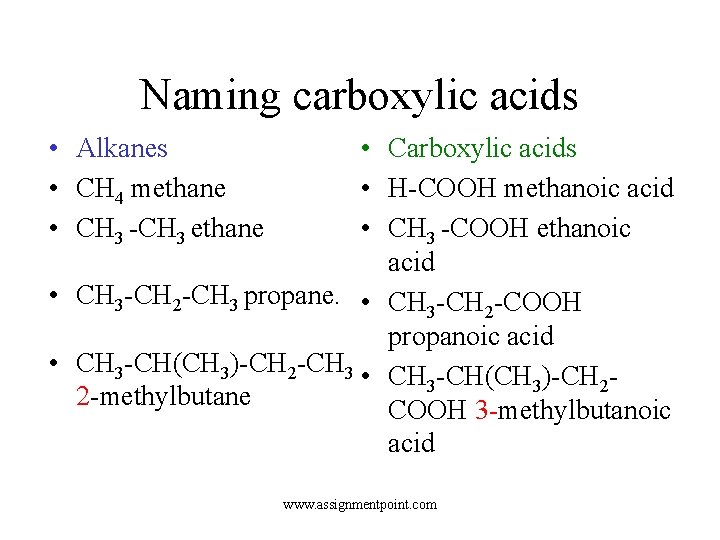
Naming carboxylic acids • Alkanes • CH 4 methane • CH 3 -CH 3 ethane • Carboxylic acids • H-COOH methanoic acid • CH 3 -COOH ethanoic acid • CH 3 -CH 2 -CH 3 propane. • CH 3 -CH 2 -COOH propanoic acid • CH 3 -CH(CH 3)-CH 2 -CH 3 • CH -CH(CH )-CH 3 3 2 2 -methylbutane COOH 3 -methylbutanoic acid www. assignmentpoint. com
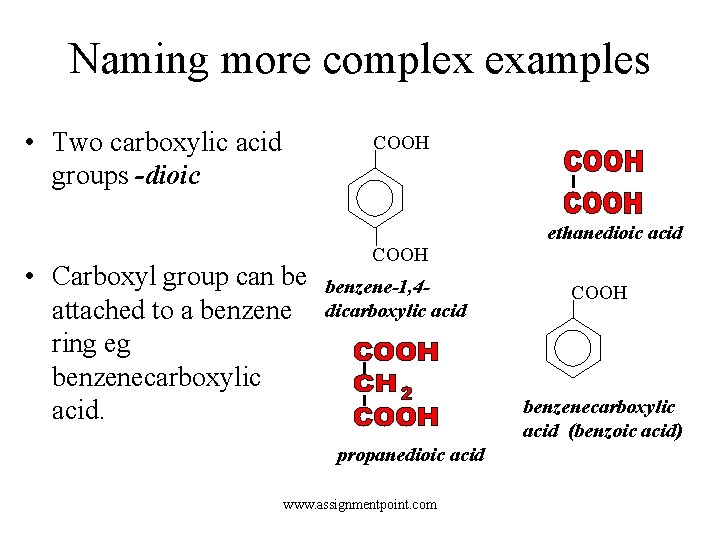
Naming more complex examples • Two carboxylic acid groups -dioic COOH • Carboxyl group can be attached to a benzene ring eg benzenecarboxylic acid. COOH benzene-1, 4 dicarboxylic acid ethanedioic acid COOH benzenecarboxylic acid (benzoic acid) propanedioic acid www. assignmentpoint. com
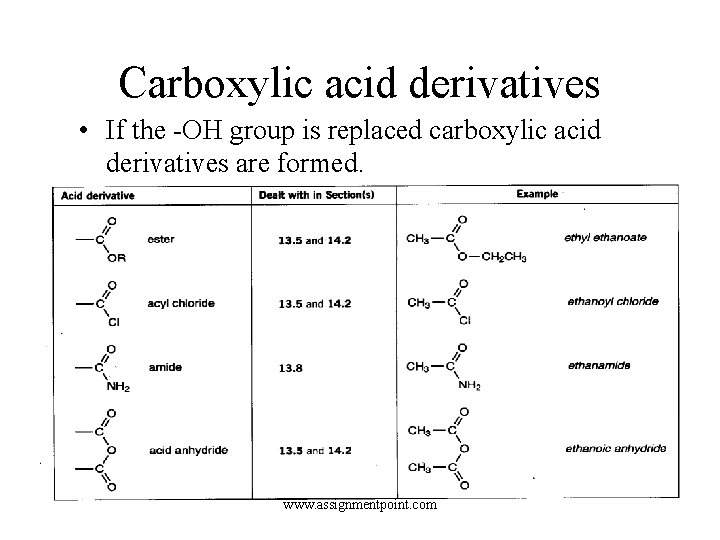
Carboxylic acid derivatives • If the -OH group is replaced carboxylic acid derivatives are formed. www. assignmentpoint. com
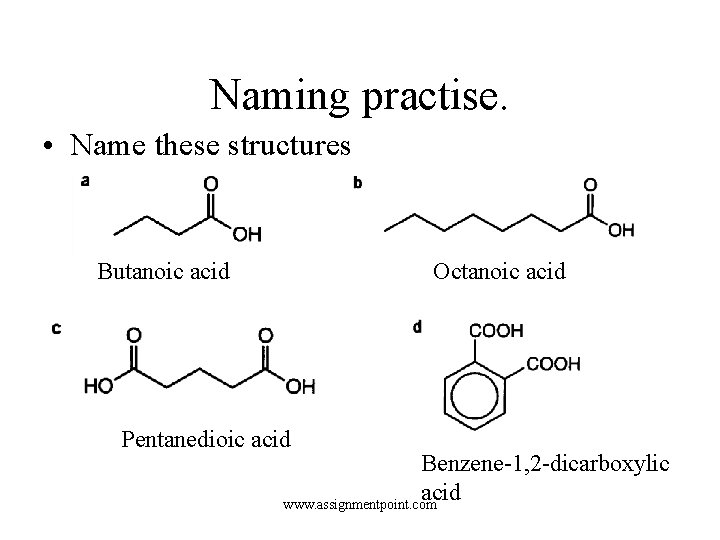
Naming practise. • Name these structures Butanoic acid Octanoic acid Pentanedioic acid Benzene-1, 2 -dicarboxylic acid www. assignmentpoint. com

This powerpoint was kindly donated to www. worldofteaching. com http: //www. worldofteaching. com is home to over a thousand powerpoints submitted by teachers. This is a completely free site and requires no registration. Please visit and I hope it will help in your teaching. www. assignmentpoint. com
- Slides: 11