
Carbonate System Alkalinity Lecture 21 TOTH TOTH is
Carbonate System Alkalinity Lecture 21

TOTH • TOTH is the total amount of component H+, rather than the total of the species H+. • o Every species containing H+ contributes positively to TOTH while every species formed by subtracting H+ contributes negatively to TOTH. For pure water: TOTH = [H+] - [OH–] o Of course in pure water [H+] = [OH–] so TOTH = 0. • Now we dissolve Ca. CO 3 to our solution and chose Ca 2+ and CO 32 - as components. • o In near neutral p. H, almost all the CO 32 - will react to form HCO 3–: CO 3+ + H 2 O = HCO 3 - + OH– o some Ca 2+ (though generally not much) will form Ca(OH)+, so our mole balance equation will be TOTH = [H+] - [OH–] + [HCO 3–] - [Ca(OH)+] Since we have not added [H+], TOTH remains 0.
TOTH • Now we dissolve CO 2 in our solution: H 2 O + CO 2 ⇋ H 2 CO 3 o In near neutral p. H, almost all the H 2 CO 3 will react to form HCO 3–: H 2 CO 3 = HCO 3 - + H+ o If we chose CO 2 as our component, HCO 3– = CO 2 + H 2 O - H+ TOTH = [H+] - [OH–] - [HCO 3–] • This time HCO 3 - contributes negatively. • • ? Every species containing H+ contributes positively to TOTH while every species formed by subtracting H+ contributes negatively to TOTH. How we write the TOTH equation depends on how we defined components. • Since we have not added [H+], TOTH remains 0.
Conservation Equations • Remember our problem set problem on the dissolution of galena: Pb. S + 2 H+ ⇋ Pb 2+ + H 2 S • We used mass balance to solve this. • A number of other reactions are possible: H 2 S ⇋ H+ + HS– ⇋ H+ + S 2 Pb 2+ + S 2– ⇋ Pb. S aq • However, we may still write a conservation equation • ΣS = Pb. Saq + H 2 S + HS– + S 2– • And if galena is the only source of Pb and S, then ΣPb = ΣS • Mass balance, or conservation, equations can be useful constraints on our system. However, they often come with caveats, like the above (galena the only source of Pb and S).
Charge Balance • Aqueous solutions are always electrically neutral (period, no caveats). • Thus the following constraint always holds: • Often, however, charge and mass conservation equations end up being the same (since we can only add electrically neutral substances to our solution).
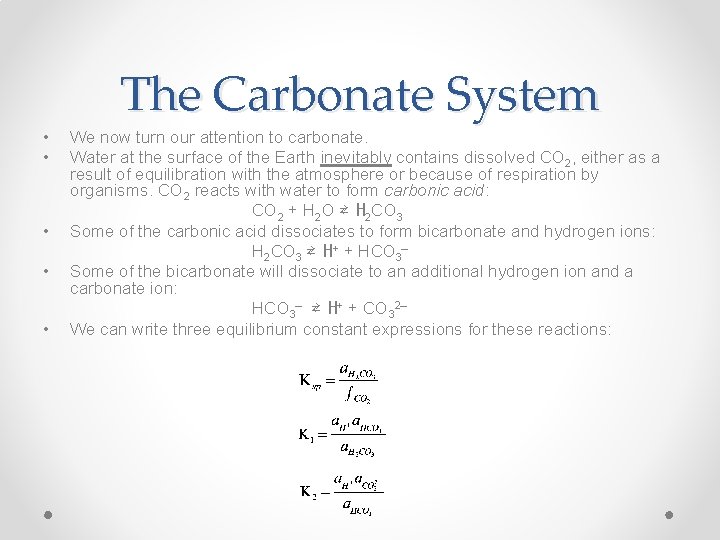
The Carbonate System • • • We now turn our attention to carbonate. Water at the surface of the Earth inevitably contains dissolved CO 2, either as a result of equilibration with the atmosphere or because of respiration by organisms. CO 2 reacts with water to form carbonic acid: CO 2 + H 2 O ⇄ H 2 CO 3 Some of the carbonic acid dissociates to form bicarbonate and hydrogen ions: H 2 CO 3 ⇄ H+ + HCO 3– Some of the bicarbonate will dissociate to an additional hydrogen ion and a carbonate ion: HCO 3– ⇄ H+ + CO 32– We can write three equilibrium constant expressions for these reactions:
Carbonate Minerals • Another important reaction in the carbonate system is precipitation of carbonate minerals (mainly calcite) in veins in rocks, in soils (caliche), as shells, on your faucet, etc. , and dissolution of carbonate, as in limestone caverns and sinkholes: Ca. CO 3 ⇄ Ca 2+ + CO 32 -
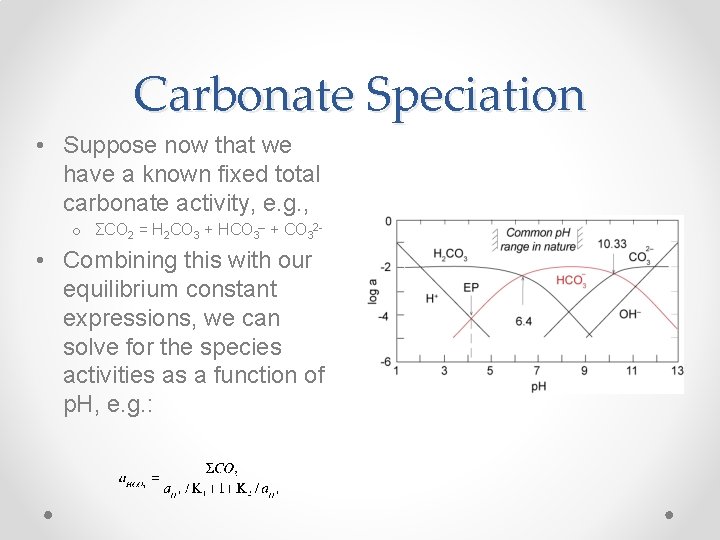
Carbonate Speciation • Suppose now that we have a known fixed total carbonate activity, e. g. , o ΣCO 2 = H 2 CO 3 + HCO 3– + CO 32 - • Combining this with our equilibrium constant expressions, we can solve for the species activities as a function of p. H, e. g. :
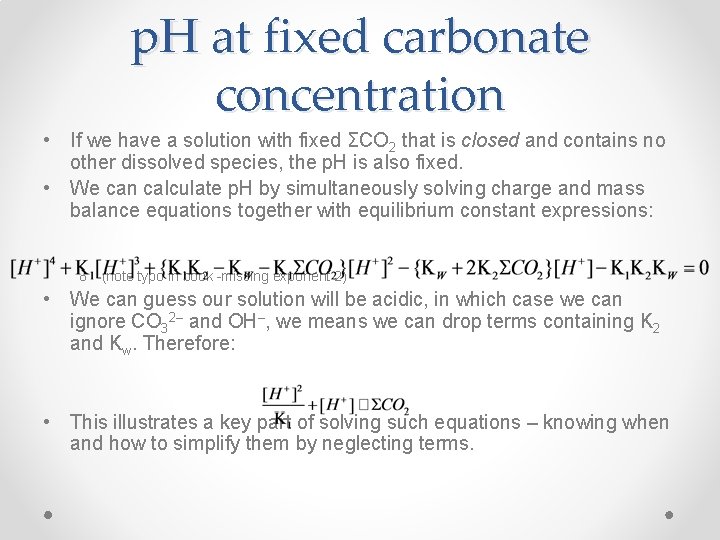
p. H at fixed carbonate concentration • If we have a solution with fixed ΣCO 2 that is closed and contains no other dissolved species, the p. H is also fixed. • We can calculate p. H by simultaneously solving charge and mass balance equations together with equilibrium constant expressions: o (note typo in book -missing exponent 2) • We can guess our solution will be acidic, in which case we can ignore CO 32– and OH–, we means we can drop terms containing K 2 and Kw. Therefore: • This illustrates a key part of solving such equations – knowing when and how to simplify them by neglecting terms.
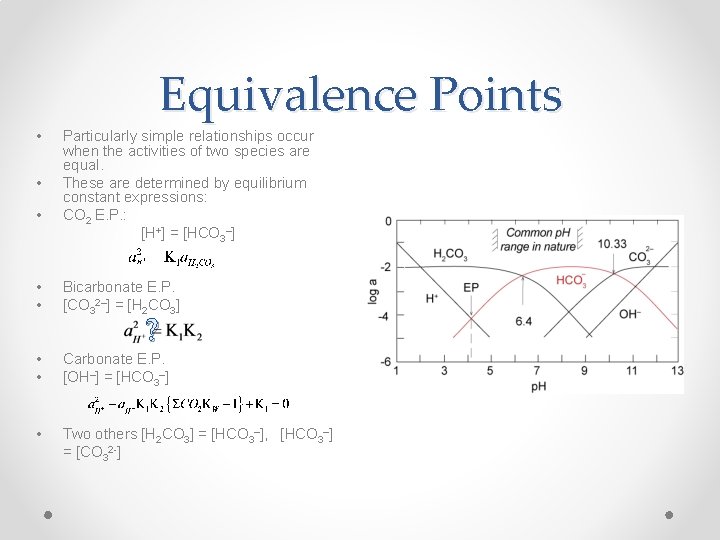
Equivalence Points • • • Particularly simple relationships occur when the activities of two species are equal. These are determined by equilibrium constant expressions: CO 2 E. P. : [H+] = [HCO 3–] • • Bicarbonate E. P. [CO 32–] = [H 2 CO 3] • • Carbonate E. P. [OH–] = [HCO 3–] • Two others [H 2 CO 3] = [HCO 3–], [HCO 3–] = [CO 32 -] ?
Conservative and Non. Conservative Ions • Conservative ions are those whose concentrations are not affected by changes in p. H, temperature, and pressure, assuming no precipitation or dissolution. o In natural waters, the principal conservative ions are Na+, K+, Ca 2+, Mg 2+, Cl–, and. o These ions are conservative because they are fully dissociated from their conjugate acids and bases over the normal range of p. H of natural waters. • Non-conservative ions are those that will undergo association and dissociation reactions in this p. H range. These include the proton, hydroxyl, and carbonate species as well as B(OH)4–, H 3 Si. O 4–, HS–, NH 4 OH, phosphate species, and many organic anions. • Virtually all the non-conservative species are anions, the two principle exceptions being H+ and NH 4 OH.
Alkalinity • Alkalinity is an important and fairly readily measured property of natural waters. • Alkalinity is a measure of acid-neutralizing capacity of a solution and is defined as the sum of the concentration (in equivalents) of bases that are titratable with strong acid. • Mathematically, we define alkalinity as the negative of TOTH when the components are the principal species of the solution at the CO 2 equivalence point (which carbonate species there? ) The acidity can be defined as the negative of alkalinity, and hence equal to TOTH.
Carbonate Alkalinity • Consider a solution containing a fixed total dissolved concentration of Ca. CO 3. At the CO 2 equivalence point, H 2 CO 3 is the principal carbonate species, so we choose our components as H+, H 2 O, CO 2, and Ca 2+. H 2 CO 3 = H 2 O + CO 2 HCO 3 - = H 2 O + CO 2 - H+ CO 32 - = H 2 O + CO 2 - 2 H+ • The proton mole balance equation is then: TOTH = [H+] - [HCO 3 - ] - 2[CO 32 - ] - [OH–] • The alkalinity is then: Alk = -TOTH = -[H+] + [HCO 3 -] + 2[CO 32 - ] + [OH–] • The above is also the carbonate alkalinity: the alkalinity due to the presence of carbonate ions. o In many solutions, carbonate alkalinity is very nearly equal total alkalinity. To be clear, we sometimes call the alkalinity as defined previously Total Alkalinity.
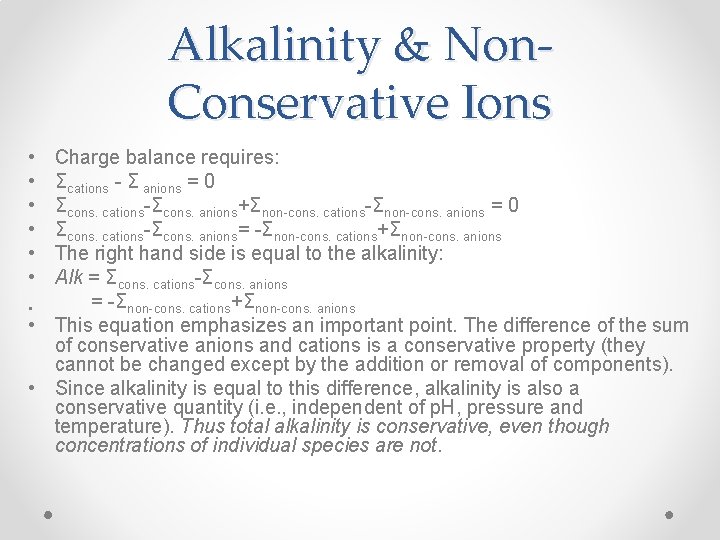
Alkalinity & Non. Conservative Ions • • • Charge balance requires: Σcations - Σ anions = 0 Σcons. cations-Σcons. anions+Σnon-cons. cations-Σnon-cons. anions = 0 Σcons. cations-Σcons. anions= -Σnon-cons. cations+Σnon-cons. anions The right hand side is equal to the alkalinity: Alk = Σcons. cations-Σcons. anions = -Σnon-cons. cations+Σnon-cons. anions • • This equation emphasizes an important point. The difference of the sum of conservative anions and cations is a conservative property (they cannot be changed except by the addition or removal of components). • Since alkalinity is equal to this difference, alkalinity is also a conservative quantity (i. e. , independent of p. H, pressure and temperature). Thus total alkalinity is conservative, even though concentrations of individual species are not.
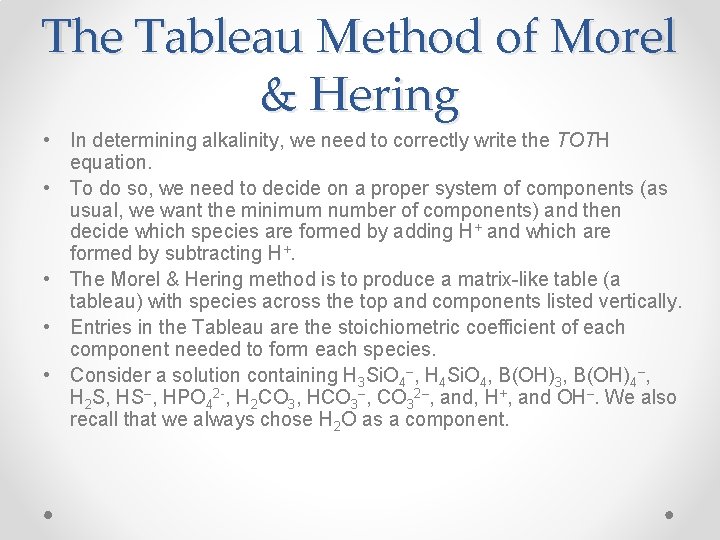
The Tableau Method of Morel & Hering • In determining alkalinity, we need to correctly write the TOTH equation. • To do so, we need to decide on a proper system of components (as usual, we want the minimum number of components) and then decide which species are formed by adding H+ and which are formed by subtracting H+. • The Morel & Hering method is to produce a matrix-like table (a tableau) with species across the top and components listed vertically. • Entries in the Tableau are the stoichiometric coefficient of each component needed to form each species. • Consider a solution containing H 3 Si. O 4–, H 4 Si. O 4, B(OH)3, B(OH)4–, H 2 S, HS–, HPO 42 -, H 2 CO 3, HCO 3–, CO 32–, and, H+, and OH–. We also recall that we always chose H 2 O as a component.
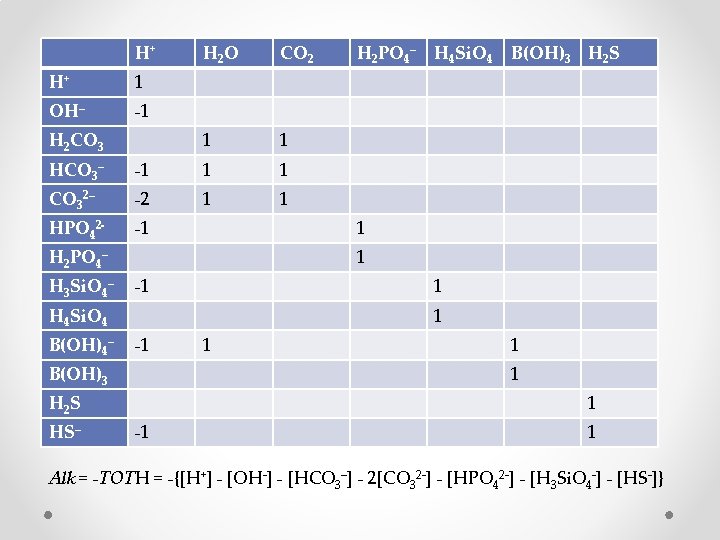
H+ H+ 1 OH– -1 H 2 CO 3 H 2 O CO 2 1 1 HCO 3– -1 1 1 CO 32– -2 1 1 HPO 42 - -1 -1 1 1 -1 B(OH)3 1 1 1 H 2 S HS– B(OH)3 H 2 S 1 H 4 Si. O 4 B(OH)4– H 4 Si. O 4 1 H 2 PO 4– H 3 Si. O 4– H 2 PO 4– 1 -1 1 Alk = -TOTH = -{[H+] - [OH-] - [HCO 3–] - 2[CO 32 -] - [HPO 42 -] - [H 3 Si. O 4 -] - [HS-]}
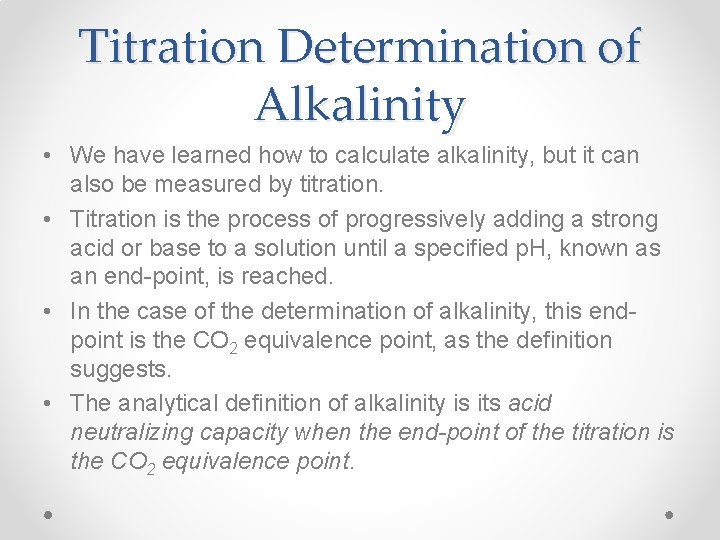
Titration Determination of Alkalinity • We have learned how to calculate alkalinity, but it can also be measured by titration. • Titration is the process of progressively adding a strong acid or base to a solution until a specified p. H, known as an end-point, is reached. • In the case of the determination of alkalinity, this endpoint is the CO 2 equivalence point, as the definition suggests. • The analytical definition of alkalinity is its acid neutralizing capacity when the end-point of the titration is the CO 2 equivalence point.
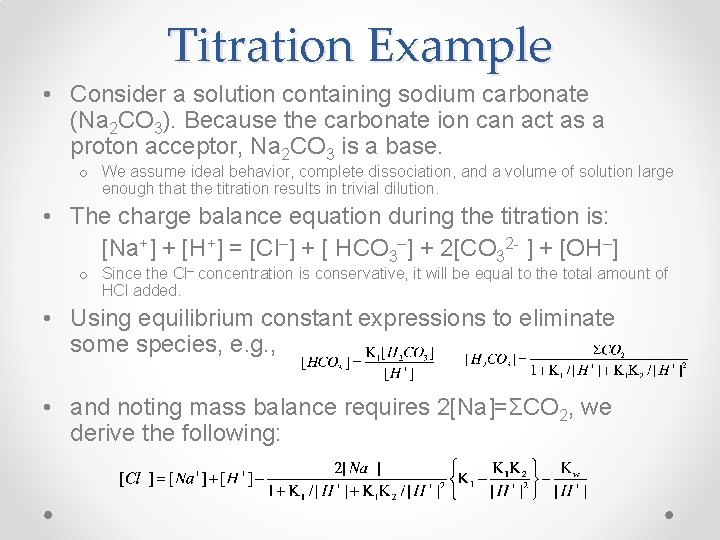
Titration Example • Consider a solution containing sodium carbonate (Na 2 CO 3). Because the carbonate ion can act as a proton acceptor, Na 2 CO 3 is a base. o We assume ideal behavior, complete dissociation, and a volume of solution large enough that the titration results in trivial dilution. • The charge balance equation during the titration is: [Na+] + [H+] = [Cl–] + [ HCO 3–] + 2[CO 32 - ] + [OH–] o Since the Cl– concentration is conservative, it will be equal to the total amount of HCl added. • Using equilibrium constant expressions to eliminate some species, e. g. , • and noting mass balance requires 2[Na]=ΣCO 2, we derive the following:
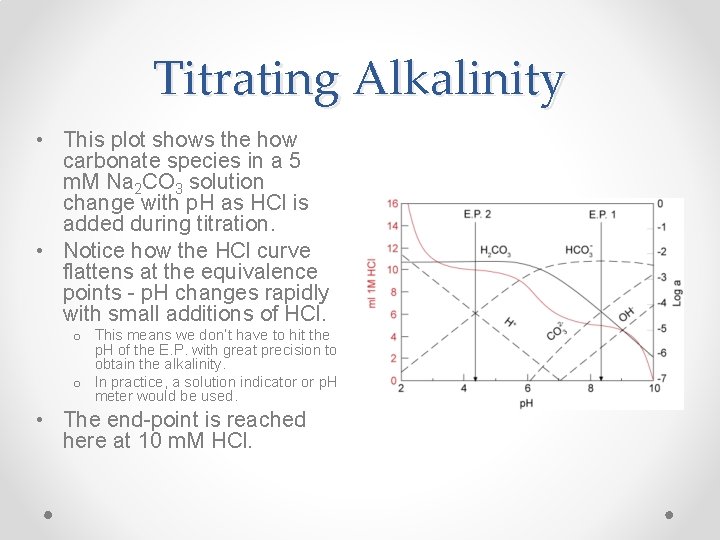
Titrating Alkalinity • This plot shows the how carbonate species in a 5 m. M Na 2 CO 3 solution change with p. H as HCl is added during titration. • Notice how the HCl curve flattens at the equivalence points - p. H changes rapidly with small additions of HCl. o This means we don’t have to hit the p. H of the E. P. with great precision to obtain the alkalinity. o In practice, a solution indicator or p. H meter would be used. • The end-point is reached here at 10 m. M HCl.
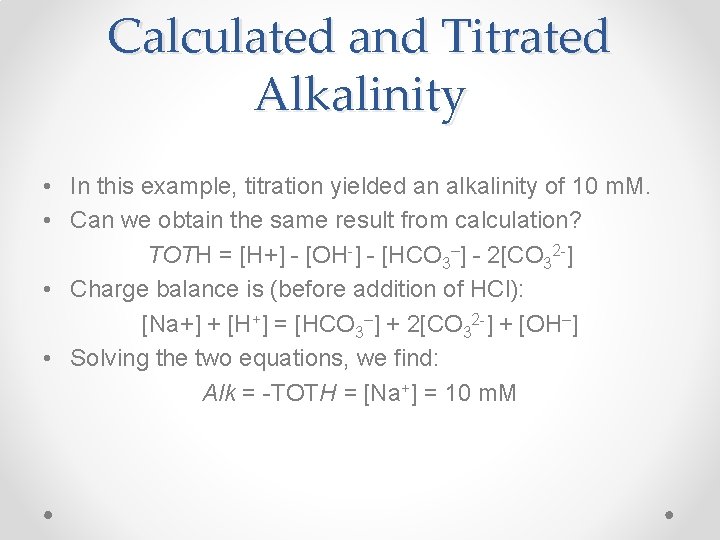
Calculated and Titrated Alkalinity • In this example, titration yielded an alkalinity of 10 m. M. • Can we obtain the same result from calculation? TOTH = [H+] - [OH-] - [HCO 3–] - 2[CO 32 -] • Charge balance is (before addition of HCl): [Na+] + [H+] = [HCO 3–] + 2[CO 32 -] + [OH–] • Solving the two equations, we find: Alk = -TOTH = [Na+] = 10 m. M
- Slides: 20