
Carbon Task Force Meeting Monitoring the Atmospheric Carbon

Carbon Task Force Meeting Monitoring the Atmospheric Carbon Cycle from Space David Crisp (JPL) Ray Nassar (Environment Canada) March 29, 2012 Copyright 2012 California Institute of Technology. Government sponsorship acknowledged. 1
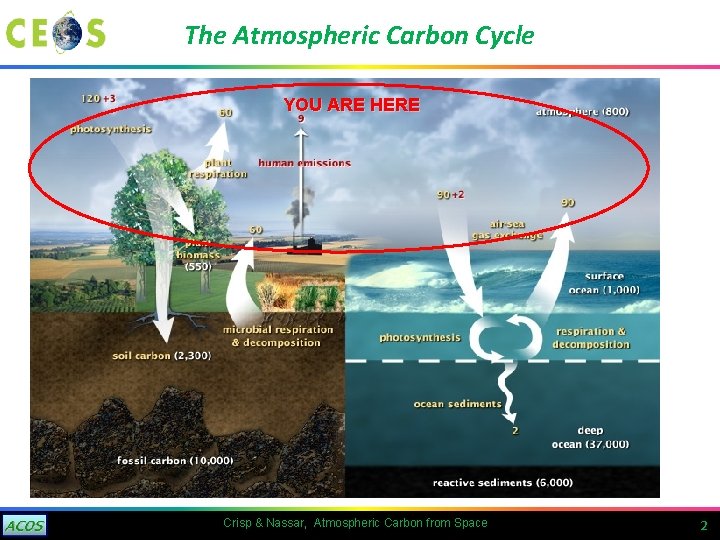
The Atmospheric Carbon Cycle YOU ARE HERE Crisp & Nassar, Atmospheric Carbon from Space 2
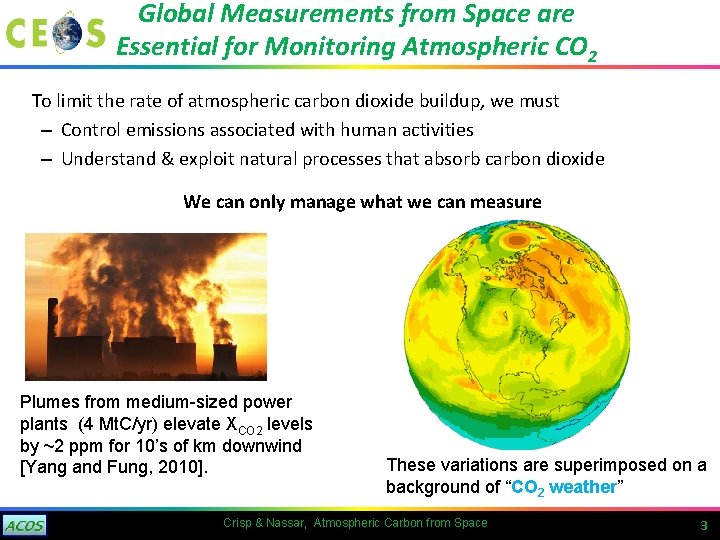
Global Measurements from Space are Essential for Monitoring Atmospheric CO 2 To limit the rate of atmospheric carbon dioxide buildup, we must – Control emissions associated with human activities – Understand & exploit natural processes that absorb carbon dioxide We can only manage what we can measure Plumes from medium-sized power plants (4 Mt. C/yr) elevate XCO 2 levels by ~2 ppm for 10’s of km downwind [Yang and Fung, 2010]. These variations are superimposed on a background of “CO 2 weather” Crisp & Nassar, Atmospheric Carbon from Space 3
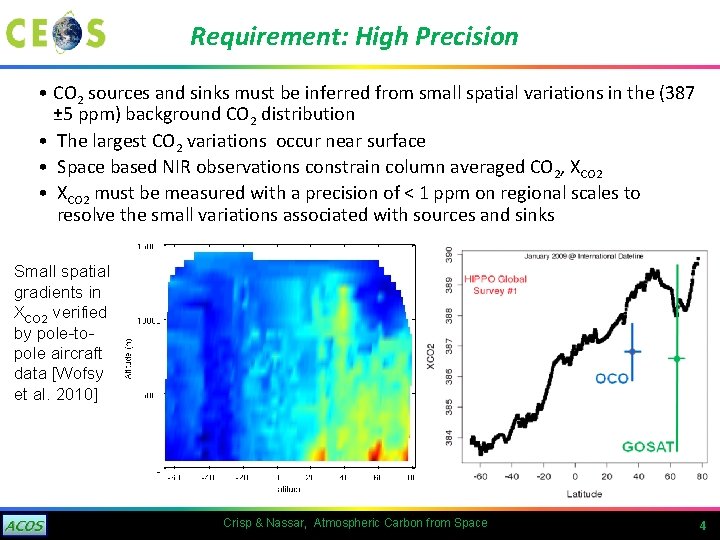
Requirement: High Precision • CO 2 sources and sinks must be inferred from small spatial variations in the (387 ± 5 ppm) background CO 2 distribution • The largest CO 2 variations occur near surface • Space based NIR observations constrain column averaged CO 2, XCO 2 • XCO 2 must be measured with a precision of < 1 ppm on regional scales to resolve the small variations associated with sources and sinks Small spatial gradients in XCO 2 verified by pole-topole aircraft data [Wofsy et al. 2010] 372 380 Crisp & Nassar, Atmospheric Carbon from Space 4
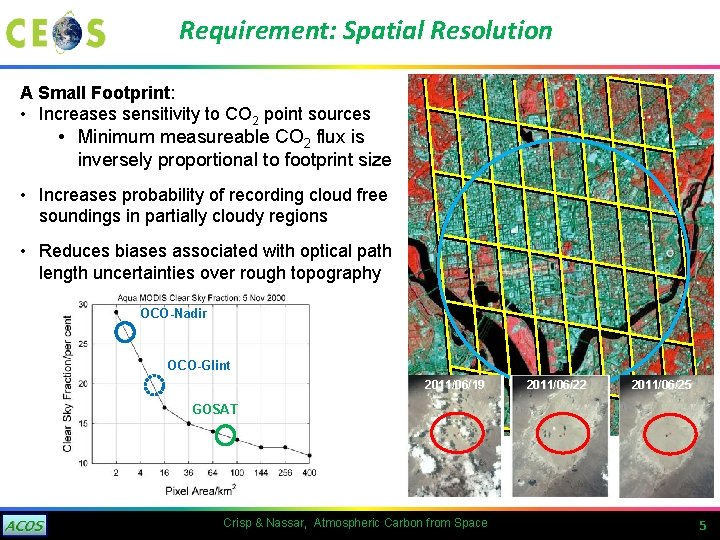
Requirement: Spatial Resolution A Small Footprint: • Increases sensitivity to CO 2 point sources • Minimum measureable CO 2 flux is inversely proportional to footprint size • Increases probability of recording cloud free soundings in partially cloudy regions • Reduces biases associated with optical path length uncertainties over rough topography OCO-Nadir OCO-Glint 2011/06/19 2011/06/22 2011/06/25 GOSAT Crisp & Nassar, Atmospheric Carbon from Space 5

Requirement: Spatial Coverage • Ground based measurements - greater precision and sensitivity to CO 2 near the surface, where sources and sinks are located. • Space-based measurements – improve spatial coverage & resolution. • Source/Sink models - assimilate space and ground-based data to provide global insight into CO 2 sources and sinks Crisp & Nassar, Atmospheric Carbon from Space 6
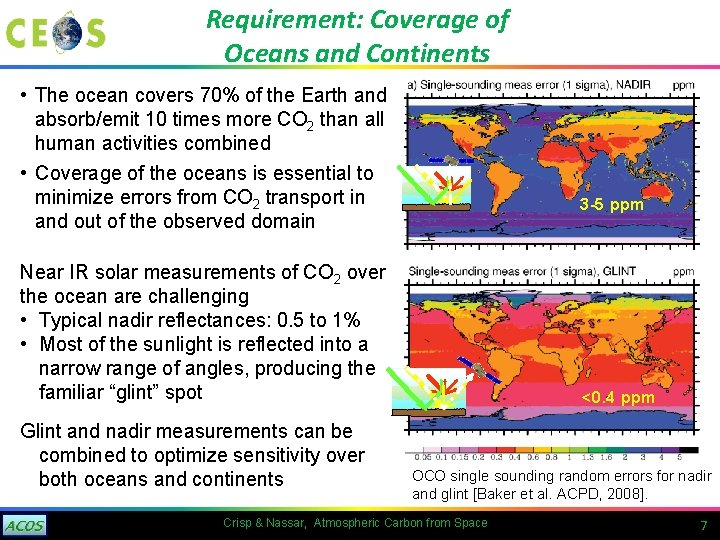
Requirement: Coverage of Oceans and Continents • The ocean covers 70% of the Earth and absorb/emit 10 times more CO 2 than all human activities combined • Coverage of the oceans is essential to minimize errors from CO 2 transport in and out of the observed domain 3 -5 ppm Near IR solar measurements of CO 2 over the ocean are challenging • Typical nadir reflectances: 0. 5 to 1% • Most of the sunlight is reflected into a narrow range of angles, producing the familiar “glint” spot Glint and nadir measurements can be combined to optimize sensitivity over both oceans and continents <0. 4 ppm OCO single sounding random errors for nadir and glint [Baker et al. ACPD, 2008]. Crisp & Nassar, Atmospheric Carbon from Space 7
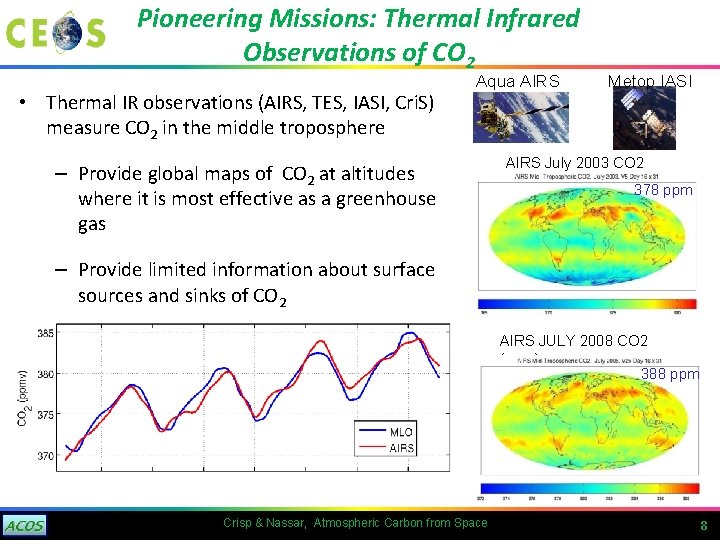
Pioneering Missions: Thermal Infrared Observations of CO 2 • Thermal IR observations (AIRS, TES, IASI, Cri. S) measure CO 2 in the middle troposphere Aqua AIRS – Provide global maps of CO 2 at altitudes where it is most effective as a greenhouse gas Metop IASI AIRS July 2003 CO 2 378 ppm – Provide limited information about surface sources and sinks of CO 2 AIRS JULY 2008 CO 2 (ppm) 388 ppm Crisp & Nassar, Atmospheric Carbon from Space 8
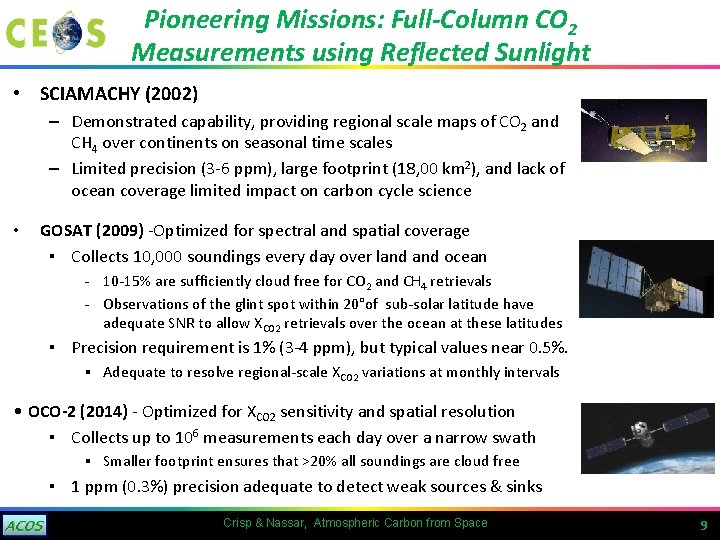
Pioneering Missions: Full-Column CO 2 Measurements using Reflected Sunlight • SCIAMACHY (2002) – Demonstrated capability, providing regional scale maps of CO 2 and CH 4 over continents on seasonal time scales – Limited precision (3 -6 ppm), large footprint (18, 00 km 2), and lack of ocean coverage limited impact on carbon cycle science • GOSAT (2009) -Optimized for spectral and spatial coverage ▪ Collects 10, 000 soundings every day over land ocean - 10 -15% are sufficiently cloud free for CO 2 and CH 4 retrievals - Observations of the glint spot within 20°of sub-solar latitude have adequate SNR to allow XCO 2 retrievals over the ocean at these latitudes ▪ Precision requirement is 1% (3 -4 ppm), but typical values near 0. 5%. ▪ Adequate to resolve regional-scale XCO 2 variations at monthly intervals • OCO-2 (2014) - Optimized for XCO 2 sensitivity and spatial resolution ▪ Collects up to 106 measurements each day over a narrow swath ▪ Smaller footprint ensures that >20% all soundings are cloud free ▪ 1 ppm (0. 3%) precision adequate to detect weak sources & sinks Crisp & Nassar, Atmospheric Carbon from Space 9
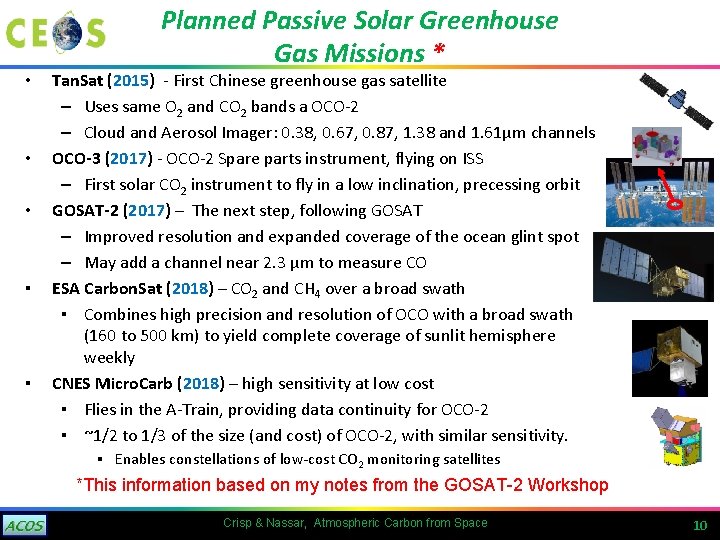
• • • ▪ ▪ Planned Passive Solar Greenhouse Gas Missions * Tan. Sat (2015) - First Chinese greenhouse gas satellite – Uses same O 2 and CO 2 bands a OCO-2 – Cloud and Aerosol Imager: 0. 38, 0. 67, 0. 87, 1. 38 and 1. 61μm channels OCO-3 (2017) - OCO-2 Spare parts instrument, flying on ISS – First solar CO 2 instrument to fly in a low inclination, precessing orbit GOSAT-2 (2017) – The next step, following GOSAT – Improved resolution and expanded coverage of the ocean glint spot – May add a channel near 2. 3 µm to measure CO ESA Carbon. Sat (2018) – CO 2 and CH 4 over a broad swath ▪ Combines high precision and resolution of OCO with a broad swath (160 to 500 km) to yield complete coverage of sunlit hemisphere weekly CNES Micro. Carb (2018) – high sensitivity at low cost ▪ Flies in the A-Train, providing data continuity for OCO-2 ▪ ~1/2 to 1/3 of the size (and cost) of OCO-2, with similar sensitivity. ▪ Enables constellations of low-cost CO 2 monitoring satellites *This information based on my notes from the GOSAT-2 Workshop Crisp & Nassar, Atmospheric Carbon from Space 10
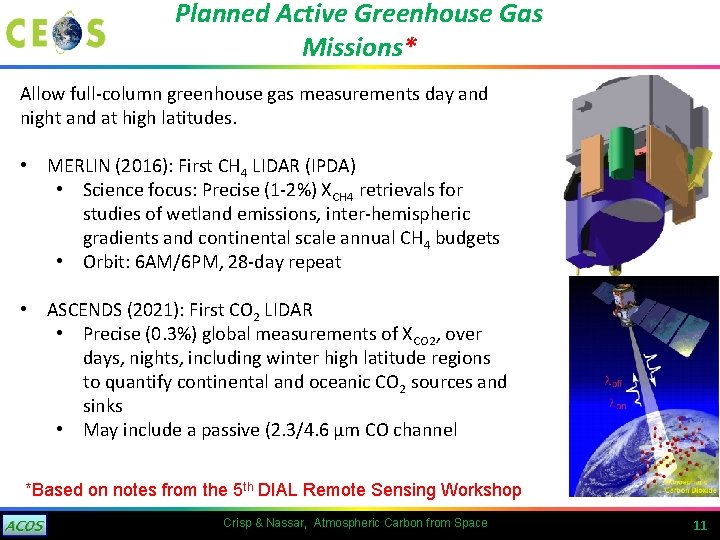
Planned Active Greenhouse Gas Missions* Allow full-column greenhouse gas measurements day and night and at high latitudes. • MERLIN (2016): First CH 4 LIDAR (IPDA) • Science focus: Precise (1 -2%) XCH 4 retrievals for studies of wetland emissions, inter-hemispheric gradients and continental scale annual CH 4 budgets • Orbit: 6 AM/6 PM, 28 -day repeat • ASCENDS (2021): First CO 2 LIDAR • Precise (0. 3%) global measurements of XCO 2, over days, nights, including winter high latitude regions to quantify continental and oceanic CO 2 sources and sinks • May include a passive (2. 3/4. 6 µm CO channel *Based on notes from the 5 th DIAL Remote Sensing Workshop Crisp & Nassar, Atmospheric Carbon from Space 11
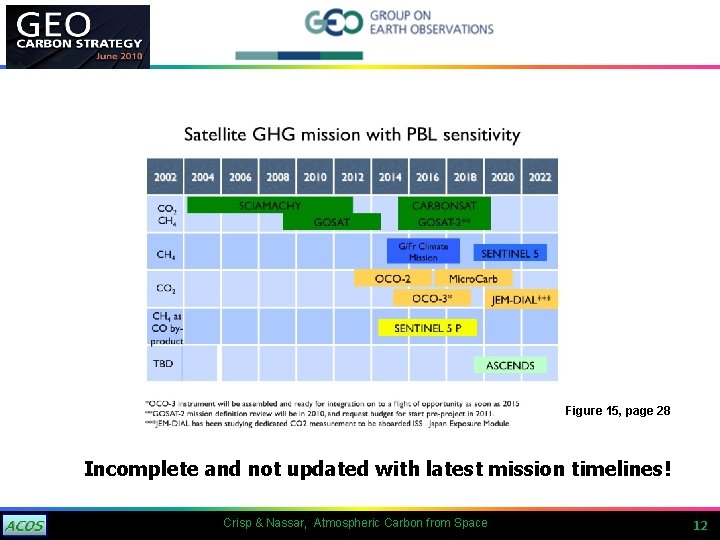
Figure 15, page 28 Incomplete and not updated with latest mission timelines! Crisp & Nassar, Atmospheric Carbon from Space 12
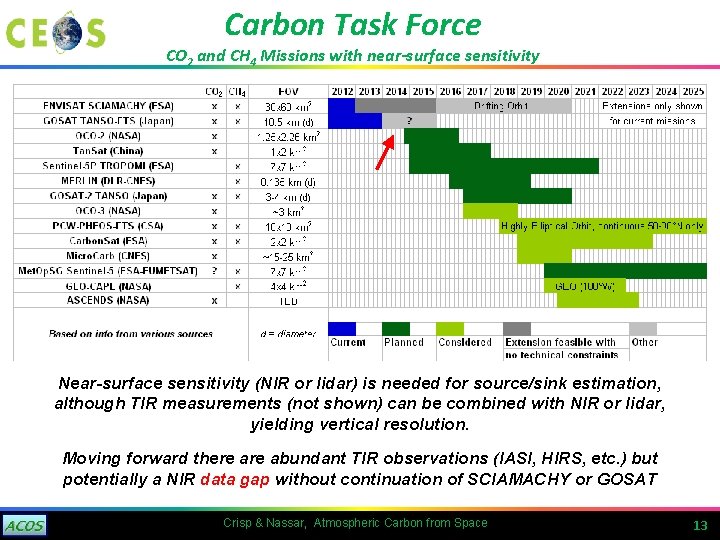
Carbon Task Force CO 2 and CH 4 Missions with near-surface sensitivity Near-surface sensitivity (NIR or lidar) is needed for source/sink estimation, although TIR measurements (not shown) can be combined with NIR or lidar, yielding vertical resolution. Moving forward there abundant TIR observations (IASI, HIRS, etc. ) but potentially a NIR data gap without continuation of SCIAMACHY or GOSAT Crisp & Nassar, Atmospheric Carbon from Space 13
GHG Constellations Moving forward, we also need to have more than one satellite at a time for increased spatial and temporal sampling. LEO and GEO missions each have pros/cons for building a constellation. LEO GEO • Global coverage over many days with one satellite • Multiple satellites needed to achieve continuous observations at one location (depending on swath width) • Lower launch cost per single satellite • Lower risk of spatially-dependent biases in dataset • Temporally continuous observing over limited area • Weaker signal at large distance, but longer integration times are possible to reduce noise • 3 or more satellites needed for full longitudinal coverage • Maximum latitude range of ~55°S-55°N, so must add HEO satellites for continuous coverage of latitudes poleward of ~55°S/N There advantages to combining LEO and GEO due to their complementary nature (as done with missions for operational weather forecasting) when designing an ideal GHG observing system. 14
Collaborative Cal/Val Activities Development / Pre Launch: • Cross calibration of pre-launch radiometric standards • Exchange of gas absorption coefficient and solar databases • Algorithm development/intercomparison • Validation system development (TCCON + Tsukuba FTS? ) • Dual/multi-Satellite OSSE’s – what do you gain with truly coordinated observations Operations / Post Launch: • Cross calibration of solar/lunar/Earth observations • Cross validation: TCCON (possibly adding a validation campaign or two) • Algorithm implementation/intercomparison • Intercomparisons of flux inversions Crisp & Nassar, Atmospheric Carbon from Space 15
Conclusions • Space-based remote sensing observations hold substantial promise for future long-term monitoring of CO 2 and other greenhouse gases • The principal advantages of space based measurements include: – Spatial coverage (especially over oceans and tropical land) – Sampling density (needed to resolve CO 2 weather) • The principal challenge is the need for high precision • To reach their full potential, space based CO 2 measurements must be validated against surface measurements to ensure their accuracy. – The TCCON network is providing the transfer standard • Just as for weather forecasting, a coordinated global network of surface and space-based CO 2 monitoring systems as well as sophisticated models that can assimilate these data are needed to provide insight into the processes controlling atmospheric CO 2 Crisp & Nassar, Atmospheric Carbon from Space 16
- Slides: 16