
Carbon Nanotubes Ninad Mehendale Introduction Carbon Nanotubes CNT
Carbon Nanotubes Ninad Mehendale
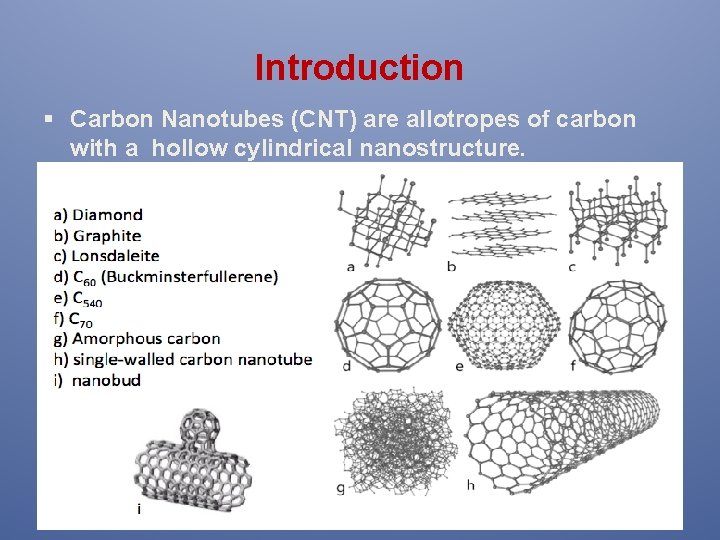
Introduction § Carbon Nanotubes (CNT) are allotropes of carbon with a hollow cylindrical nanostructure.
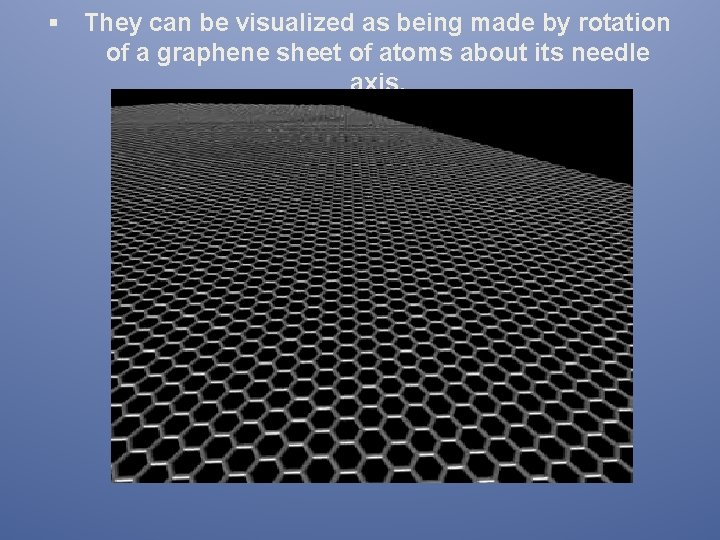
§ They can be visualized as being made by rotation of a graphene sheet of atoms about its needle axis.

§ Discovered by Sumio Iijima and co-workers in 1991 while working at the Nippon Electric Company, Limited in Tokyo, Japan.

§ Two Types: Single-walled and Multiwalled
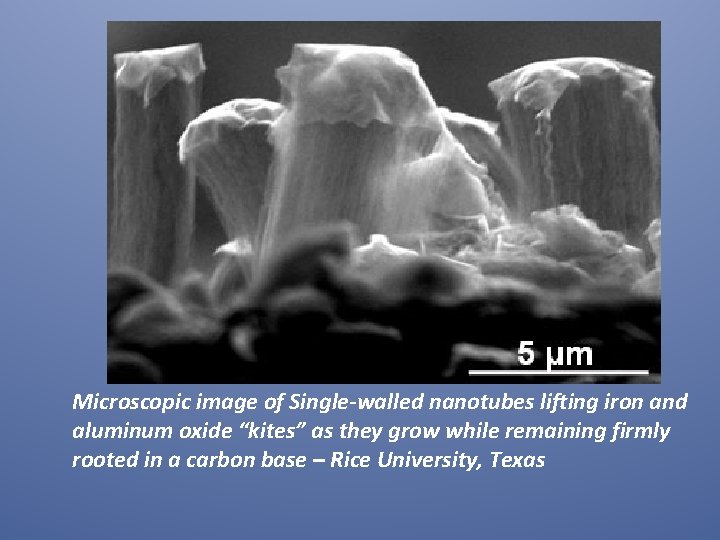
Microscopic image of Single-walled nanotubes lifting iron and aluminum oxide “kites” as they grow while remaining firmly rooted in a carbon base – Rice University, Texas

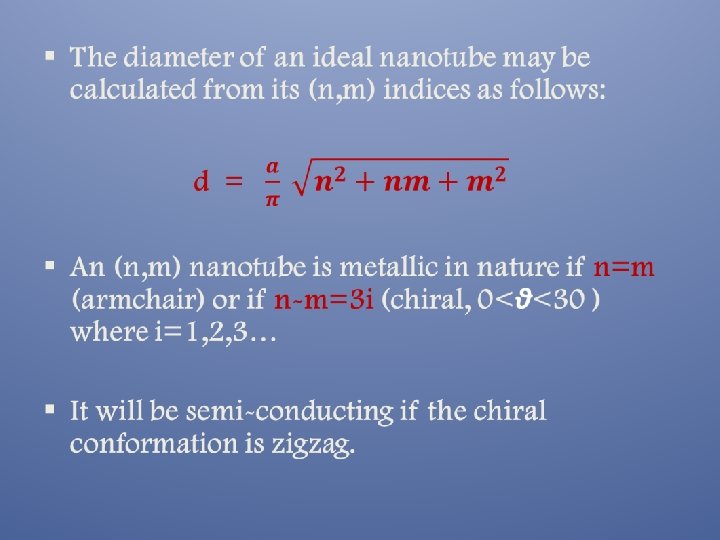
CNT Structure § Carbon Nanotubes can have three chiralities: 1. Armchair 2. Zig-zag 3. Chiral structure.
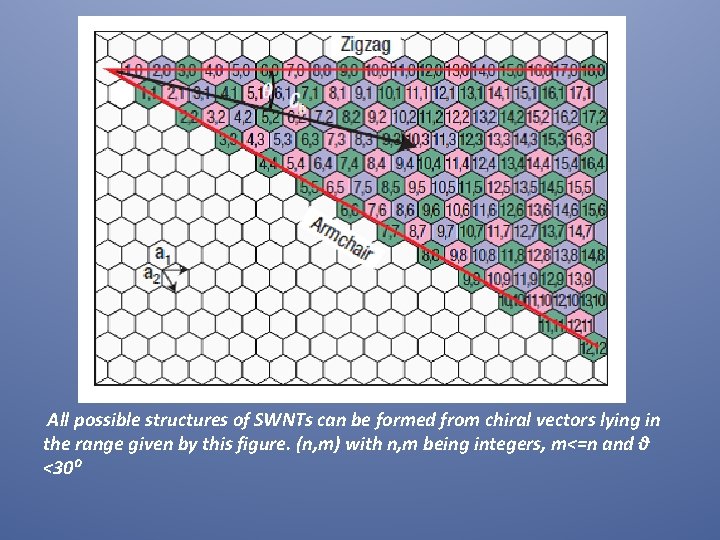
All possible structures of SWNTs can be formed from chiral vectors lying in the range given by this figure. (n, m) with n, m being integers, m<=n and θ <30⁰
§ Two atoms in the graphene sheet are chosen, one of which serves the role as origin. The sheet is rolled until the two atoms coincide. § The vector pointing from the first atom towards the other is called the chiral vector and its length is equal to the circumference of the nanotube. The direction of the nanotube axis is perpendicular to the chiral vector. § SWNTs with different chiral vectors have dissimilar properties such as optical activity, mechanical strength and electrical conductivity.
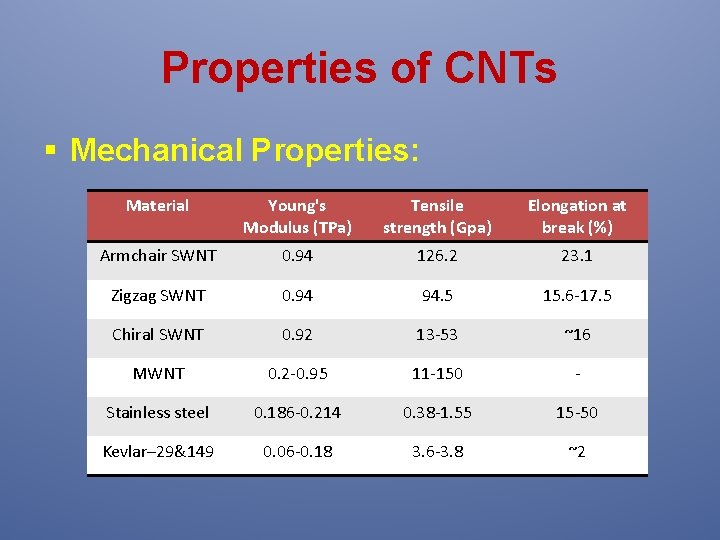
Properties of CNTs § Mechanical Properties: Material Young's Modulus (TPa) Tensile strength (Gpa) Elongation at break (%) Armchair SWNT 0. 94 126. 2 23. 1 Zigzag SWNT 0. 94 94. 5 15. 6 -17. 5 Chiral SWNT 0. 92 13 -53 ~16 MWNT 0. 2 -0. 95 11 -150 - Stainless steel 0. 186 -0. 214 0. 38 -1. 55 15 -50 Kevlar– 29&149 0. 06 -0. 18 3. 6 -3. 8 ~2
§ Electrical conductivity:
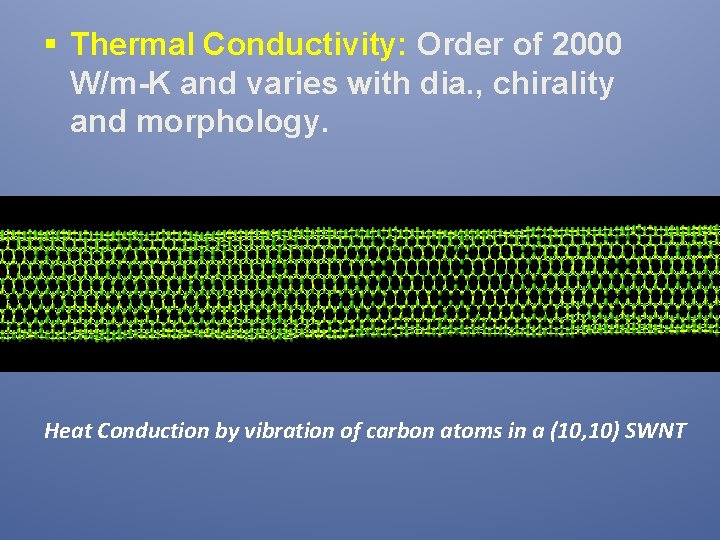
§ Thermal Conductivity: Order of 2000 W/m-K and varies with dia. , chirality and morphology. Heat Conduction by vibration of carbon atoms in a (10, 10) SWNT
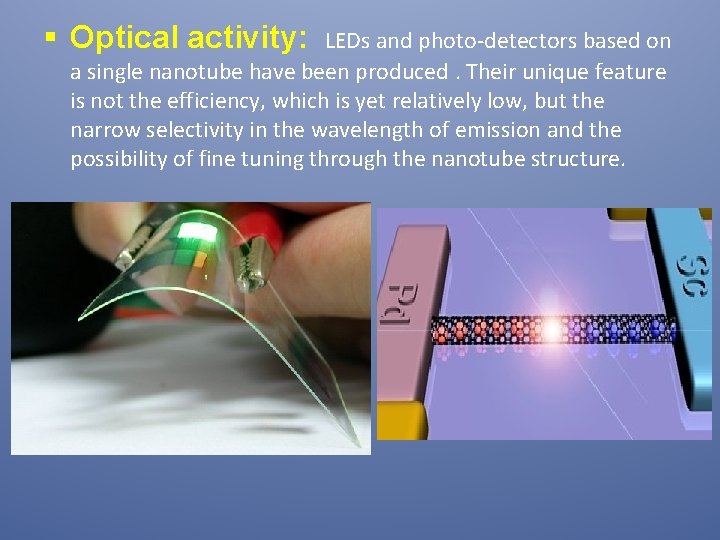
§ Optical activity: LEDs and photo-detectors based on a single nanotube have been produced. Their unique feature is not the efficiency, which is yet relatively low, but the narrow selectivity in the wavelength of emission and the possibility of fine tuning through the nanotube structure.
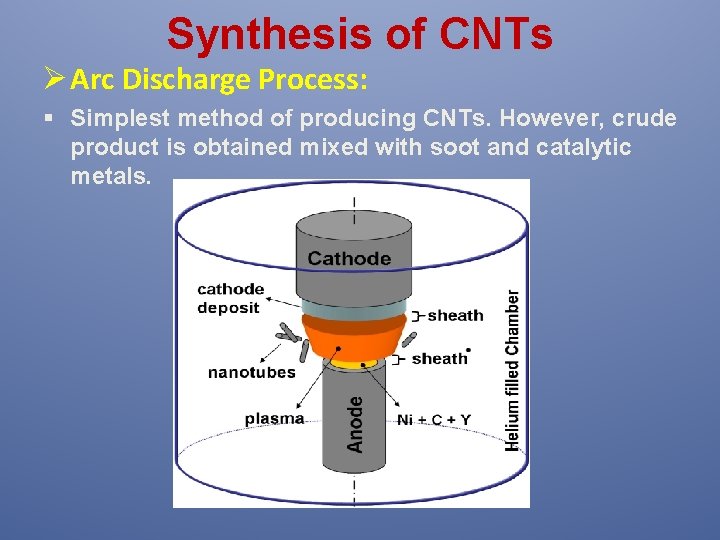
Synthesis of CNTs Ø Arc Discharge Process: § Simplest method of producing CNTs. However, crude product is obtained mixed with soot and catalytic metals.
- Slides: 15