
Carbon Nanotube Composites Presentation by Jason Morejon What

Carbon Nanotube Composites Presentation by Jason Morejon • What are CNT Composites? • How do they work? • What affects how well they work? • Improvement Methods • Measured Effects

What are CNT Composites? • “Distinct” molecules forming a single component • Motivation for using composites • Size • Price of CNTs • Large scale production • Current uses for CNT Composites
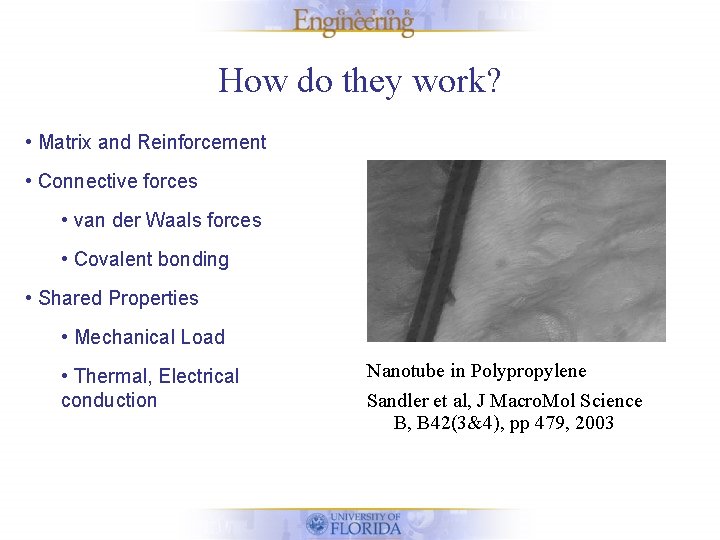
How do they work? • Matrix and Reinforcement • Connective forces • van der Waals forces • Covalent bonding • Shared Properties • Mechanical Load • Thermal, Electrical conduction Nanotube in Polypropylene Sandler et al, J Macro. Mol Science B, B 42(3&4), pp 479, 2003

What affects how they work? • Matrix substance • Concentration • Dispersion • Orientation • Anisotropic material • Type of nanotube • SWNT and MWNT • Surface area vs volume • Defects in nanotubes • Metallic and Semiconductive M. J. Biercuk, M. C. Llaguno, M. Radosavljevic, J. K. Hyun, A. T. Johnson Applied Physics Letters 80 (2002) p. 2767
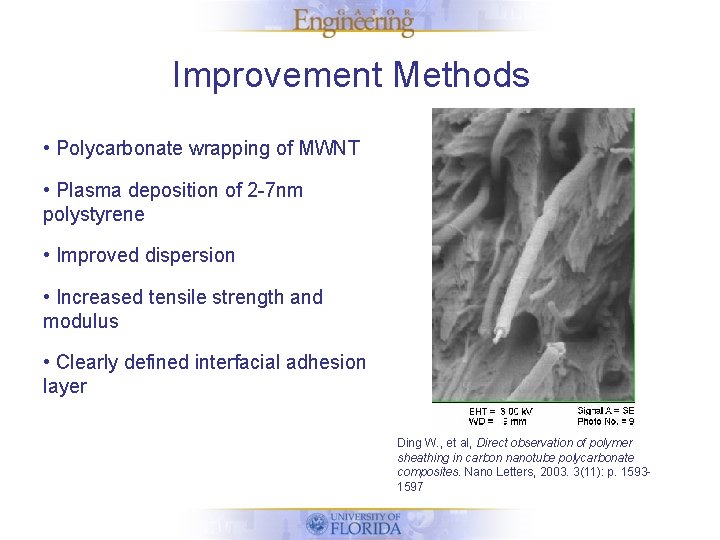
Improvement Methods • Polycarbonate wrapping of MWNT • Plasma deposition of 2 -7 nm polystyrene • Improved dispersion • Increased tensile strength and modulus • Clearly defined interfacial adhesion layer Ding W. , et al, Direct observation of polymer sheathing in carbon nanotube polycarbonate composites. Nano Letters, 2003. 3(11): p. 15931597
Improvement Methods • Dispersion • Overcoming van der Waals interactions • Easier with MWNT (less aggregation due to size) • Alignment • Shown to improve mechanical properties and electrical and thermal conductivity • Ultrasonic dispersion, Melt processing, electrospinning, electric fields, mechanical shear
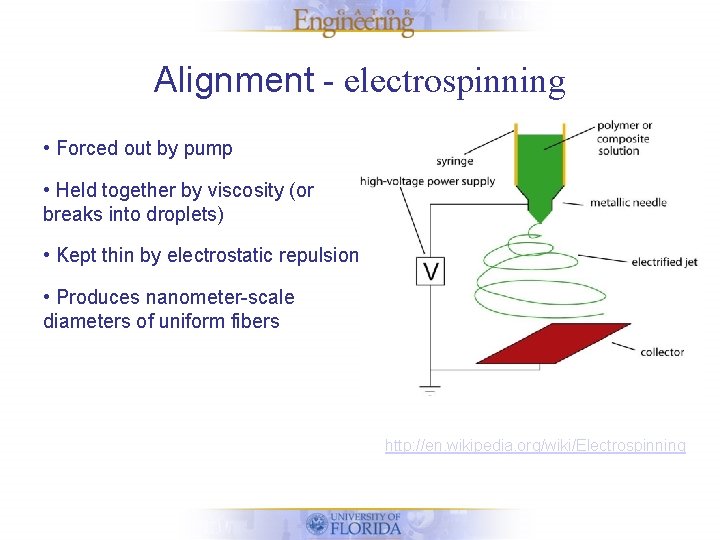
Alignment - electrospinning • Forced out by pump • Held together by viscosity (or breaks into droplets) • Kept thin by electrostatic repulsion • Produces nanometer-scale diameters of uniform fibers http: //en. wikipedia. org/wiki/Electrospinning
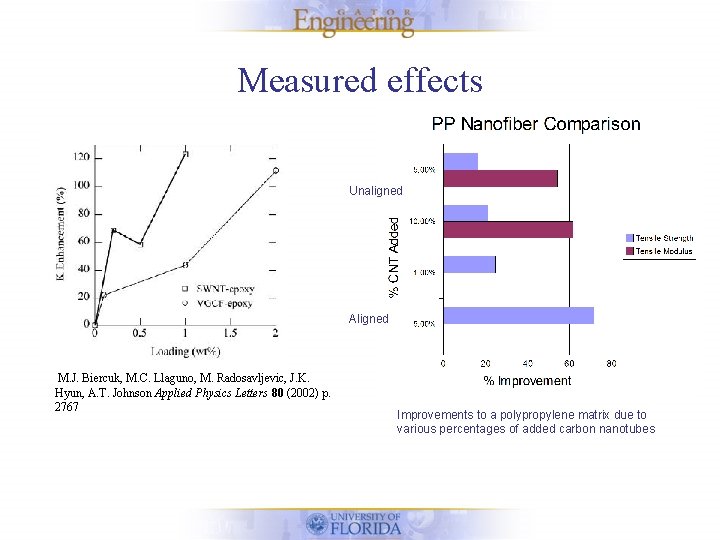
Measured effects Unaligned Aligned M. J. Biercuk, M. C. Llaguno, M. Radosavljevic, J. K. Hyun, A. T. Johnson Applied Physics Letters 80 (2002) p. 2767 Improvements to a polypropylene matrix due to various percentages of added carbon nanotubes
Measured Effects • For 1% CNT a 5 th-order decrease in resistivity achieved • For Melt Blended CNT a 50% and 60% increase in modulus was achieved for 5% and 10% respectively • A tensile strength of 1. 8 GPa has been reached (stronger than steel or spider silk)
![References [0] F. Hussain, M. Hojjati, M. Okamoto, R. Gorga, Journal of Composite Materials](http://slidetodoc.com/presentation_image_h2/0e5d149866c1737448c084fb3fb143e5/image-10.jpg "References [0] F. Hussain, M. Hojjati, M. Okamoto, R. Gorga, Journal of Composite Materials")
References [0] F. Hussain, M. Hojjati, M. Okamoto, R. Gorga, Journal of Composite Materials 40 (2006), p. 1511 [1] R. Andrews, D. Jacques, A. M. Rao, T. Rantell, F. Derbyshire, Applied Physics Letters 75 (1999), p. 1329. [2] M. J. Biercuk, M. C. Llaguno, M. Radosavljevic, J. K. Hyun, A. T. Johnson Applied Physics Letters 80 (2002) p. 2767. [3] A. Dalton, S. Collins, E. Munoz, J. Razal, V. H. Ebron, J. Ferraris, J. Coleman, B. Kim, R. Baughman, Nature 423 (2003), p. 703. [4] A. R. Bhattacharyya, T. V. Sreekumar, Tao Liu, S. Kumar, L. M. Ericson, R. H. Hauge, R. E. Smalley, Polymer 44 (2003), p. 2373. [5] S. Kumar, H. Doshi, M. Srinivasrao, J. O. Park and D. A. Schiraldi, Polymer 43 (2002), p. 1701. [6] S. Kumar, T. D. Dang, F. E. Arnold, A. R. Bhattacharyya, B. G. Min, X. Zhang, R. A. Vaia, C. Park, W. W. Adams, R. H. Hauge, R. E. Smalley, S. Ramesh and P. A. Willis. Macromolecules 35 (2002), p. 9039. [7] W. Feng, X. D. Bai, Y. Q. Liang, X. G. Wang, K. Hoshino. Carbon 41 (2003), p 1551
- Slides: 10