
Carbon Name symbol for Carbon Give group of
Carbon * ** Name symbol for Carbon Give group of Carbon and properties *** Name different types of Carbon and match to
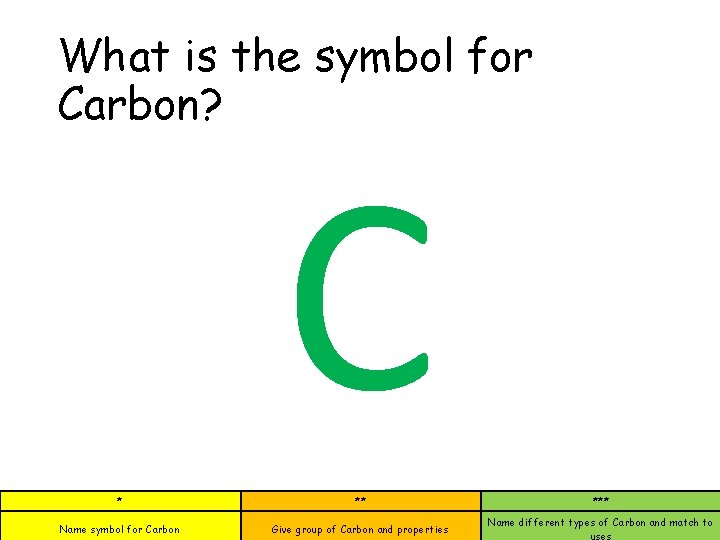
What is the symbol for Carbon? C * ** Name symbol for Carbon Give group of Carbon and properties *** Name different types of Carbon and match to
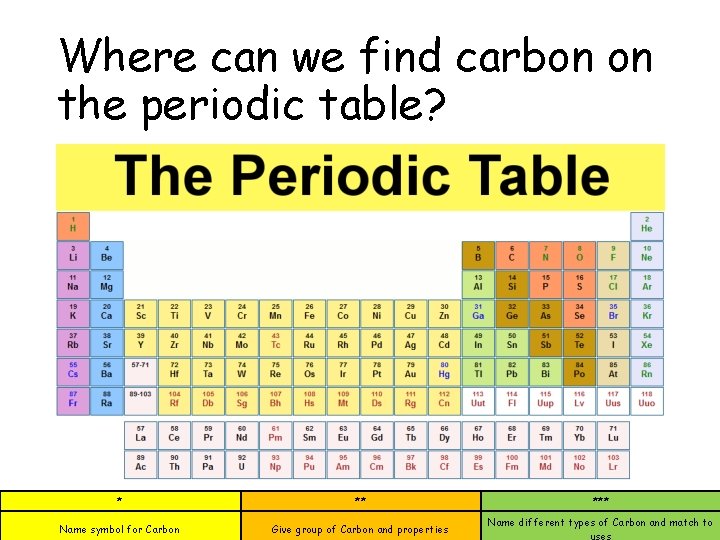
Where can we find carbon on the periodic table? * ** Name symbol for Carbon Give group of Carbon and properties *** Name different types of Carbon and match to
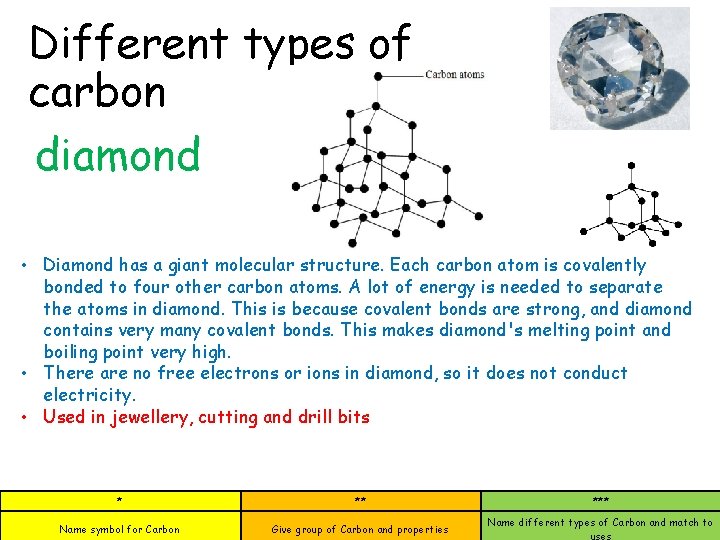
Different types of carbon diamond • Diamond has a giant molecular structure. Each carbon atom is covalently bonded to four other carbon atoms. A lot of energy is needed to separate the atoms in diamond. This is because covalent bonds are strong, and diamond contains very many covalent bonds. This makes diamond's melting point and boiling point very high. • There are no free electrons or ions in diamond, so it does not conduct electricity. • Used in jewellery, cutting and drill bits * ** Name symbol for Carbon Give group of Carbon and properties *** Name different types of Carbon and match to

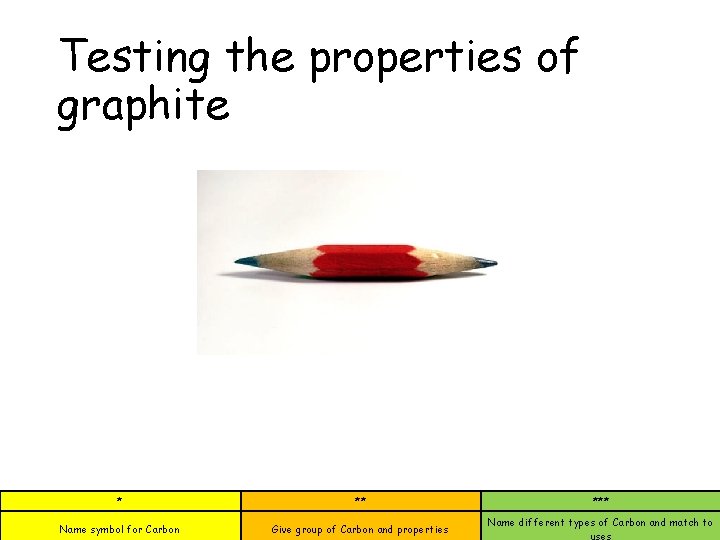
Different types of carbon graphite • • Like diamond, graphite has a giant molecular structure. As its covalent bonds are very strong, and there are many of them, a lot of energy would be needed to separate atoms. This makes graphite's melting point and boiling point very high. However, each carbon atom is only covalently bonded to three other carbon atoms, rather than to four as in diamond. Graphite contains layers of carbon atoms. The layers slide over each other easily because there are only weak forces between them, making graphite slippery. Graphite contains delocalised electrons (free electrons). These electrons can move through the graphite, carrying charge from place to place and allowing graphite to conduct electricity. Used in pencils, dry lubricant and electrodes * ** Name symbol for Carbon Give group of Carbon and properties *** Name different types of Carbon and match to
Testing the properties of graphite * ** Name symbol for Carbon Give group of Carbon and properties *** Name different types of Carbon and match to
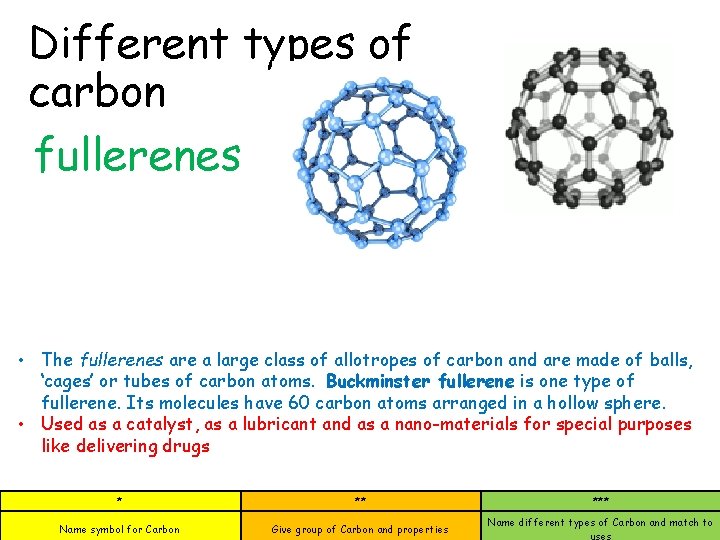
Different types of carbon fullerenes • The fullerenes are a large class of allotropes of carbon and are made of balls, ‘cages’ or tubes of carbon atoms. Buckminster fullerene is one type of fullerene. Its molecules have 60 carbon atoms arranged in a hollow sphere. • Used as a catalyst, as a lubricant and as a nano-materials for special purposes like delivering drugs * ** Name symbol for Carbon Give group of Carbon and properties *** Name different types of Carbon and match to
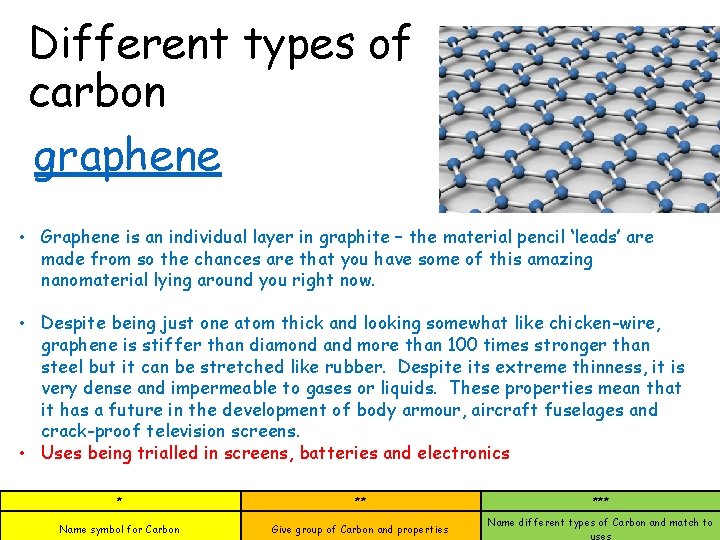
Different types of carbon graphene • Graphene is an individual layer in graphite – the material pencil ‘leads’ are made from so the chances are that you have some of this amazing nanomaterial lying around you right now. • Despite being just one atom thick and looking somewhat like chicken-wire, graphene is stiffer than diamond and more than 100 times stronger than steel but it can be stretched like rubber. Despite its extreme thinness, it is very dense and impermeable to gases or liquids. These properties mean that it has a future in the development of body armour, aircraft fuselages and crack-proof television screens. • Uses being trialled in screens, batteries and electronics * ** Name symbol for Carbon Give group of Carbon and properties *** Name different types of Carbon and match to
Video * ** Name symbol for Carbon Give group of Carbon and properties *** Name different types of Carbon and match to
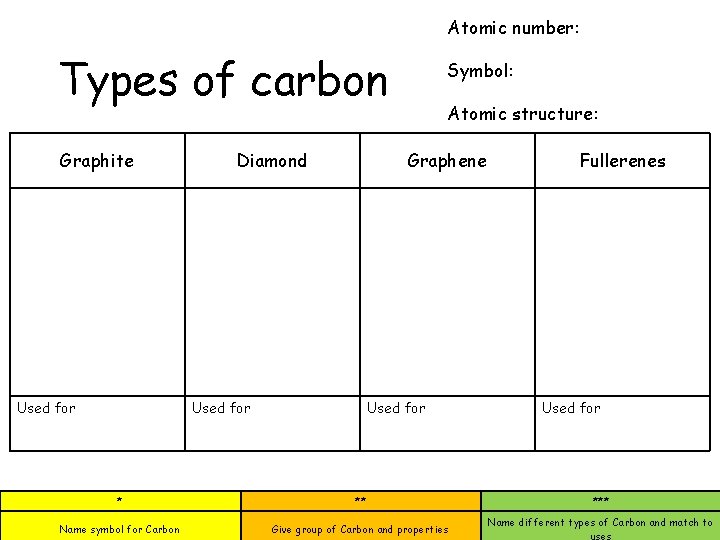
Atomic number: Types of carbon Graphite Used for Diamond Symbol: Atomic structure: Graphene Used for * ** Name symbol for Carbon Give group of Carbon and properties Fullerenes Used for *** Name different types of Carbon and match to
Hangman * ** Name symbol for Carbon Give group of Carbon and properties *** Name different types of Carbon and match to
- Slides: 11