
Carbon monoxide source combustion or methylene chloride exposure
• Carbon monoxide source (combustion or methylene chloride exposure) • Elevated carboxyhemoglobin (COHb) level (up to several hours post exposure) • Flu-like symptoms (e. g. , headache, nausea, dizziness) • Altered mental status (cognitive deficits, confusion, coma) • Syncope (with severe poisoning) • Cardiac ischemia (with severe poisoning) • Family members or coworkers with similar symptoms Essentials
� leading cause of death � CO is so insidious because it is clear, odorless, and nonirritating. With a density of 0. 968 relative to air, it quickly diffuses to equilibrate with any indoor air space. � CO naturally occurs as a by product of the degradation of heme. � Extraneous sources include the combustion of any carbonaceous fuel, such as gasoline, natural gas, kerosene, or oil. INTRODUCTION
� An open ventilated area does not guarantee against CO poisoning, as has been seen in incidents involving boats and tractors. � A reliable rule in winter for targeting COHb levels is to test any patient with flu -like symptoms who has been near gas appliances or if there are cohabitants with similar symptoms. � There are other sources of CO intoxication that may be overlooked. Smoke inhalation survivors are more often than not subject to the deleterious effects of CO. � When combined with hydrogen cyanide toxicity, another common fire intoxicant, both morbidity and mortality are greater than that predicted by CO alone
�versus Methylene chloride, a paint stripper, is metabolized to CO by the liver after inhalation or dermal absorption �The problem with this method of intoxication is that peak COHb levels may be delayed more than 8 hours �Deaths have resulted from this agent, with COHb levels as high as 50 per cent. TOXICOKINETICS
�CO has an affinity for hemoglobin 200 to 250 times that of oxygen. �Adding further insult is the fact that COHb shifts the oxyhemoglobin dissociation curve to the left, making oxygen less available to cells. �Although COHb may cause the acute anoxic-type symptoms characteristic of poisoning, it does not explain all manifestations of this intoxication. This is why COHb levels do not correlate with either acute symptoms or final outcome PATHOPHYSIOLOGY
� CO may further cause damage by binding to myoglobin, with an affinity approximately 60 times greater than oxygen. � CO exposure produces myocardial impairment with subsequent hypotension. � Carboxymyoglobin may explain the dysrhythmias and ischemia that can occur with mild exposures, especially in patients with preexisting heart disease. � Finally, CO can bind to cytochrome oxidase, the enzyme responsible for allowing cells to utilize oxygen. Although not usually bound extensively, this may be exaggerated under hypotensive or hypoxic conditions PATHOPHYSIOLOGY
CLINICAL PRESENTATION
�There is also a ceiling limit of 200 ppm (measured over a 15 -minute period). � Just over 4 hours of exposure to 100 ppm CO can result in COHb levels of over 10 per cent with symptoms. �Vomiting/ Headache/ Ataxia/ Nausea/ Confusion/ Dizziness/ Syncope/ Weakness/ Coma/ Chest pain Seizures/ Dyspnea/ Cardiac dysrhythmias/ Visual changes/ Tachypnea/ Myocardial ischemia Acute Presentation
The differential diagnosis in survivors is between CO and alcohol, as the clinical symptoms of both are quite similar at one stage of the toxic process
�headache, nausea, and lightheadedness �As late as 2 years after a more acute episode, this can lead to subjective complaints, such as paresthesias, headaches, confusion, and movement and memory problems �headache, depression, and confusion after long-term -3 years-exposure to CO at 180 ppm from a faulty furnace Chronic Exposure
�Influenza � Gastroenteritis � Food poisoning � Cerebrovascular event � Myocardial infarction � Asphyxia Parkinsonism (delayed) � Ethanol intoxication � Sedative-hypnotic overdose � Hypothermia � Myxedema coma Differential Diagnosis
�Carboxyhemoglobin Levels �Electrolytes � Blood glucose �Creatine kinase �Computed tomography of the brain �Magnetic resonance imaging LABORATORY EVALUATION
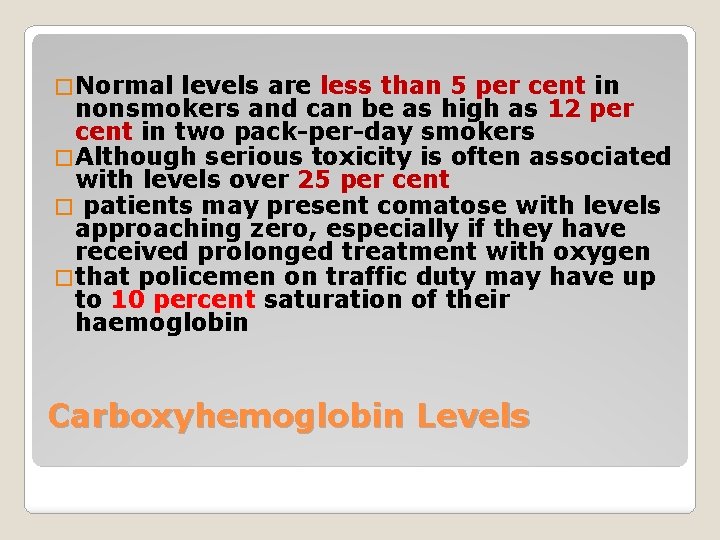
� Normal levels are less than 5 per cent in nonsmokers and can be as high as 12 per cent in two pack-per-day smokers � Although serious toxicity is often associated with levels over 25 per cent � patients may present comatose with levels approaching zero, especially if they have received prolonged treatment with oxygen � that policemen on traffic duty may have up to 10 percent saturation of their haemoglobin Carboxyhemoglobin Levels
�May show low density changes in the globus pallidus and subcortical white matter as early as 4 to 6 hours after severe poisoning �These lesions are associated with a poor clinical outcome computed tomography of the brain
�may be more useful because it is superior to computed tomography in demonstrating CO injury. �Regardless of which neuroimaging modality is used, such tests rarely dictate a change in treatment and are generally reserved for cases that fail to respond to initial treatment or have an unclear diagnosis. Magnetic resonance imaging
�Initial treatment is directed at providing immediate oxygen to a patient who may be suffering from relative hypoxia. �A 100 per cent non-rebreather face mask should be used. In addition to promoting cellular respiration, 100 per cent oxygen will reduce the elimination half-life of COHb from an average 4 to 5 hours to 1 to 2 hours. �Hyperbaric Oxygen TREATMENT
� Any patient with documented syncope or worse, such as seizures or coma, may benefit from an HBO treatment � These patients are at the greatest risk of developing neurologic sequelae. � Any patient with altered mental status, especially if it persists after 2 to 4 hours of oxygen, should also be considered as a treatment indication. Other clinical markers, such as acidosis, cardiac ischemia, or abnormalities on neuropsychological testing cannot be used reliably as indications for HBO treatment because of lack of studies. DISPOSITION
� Memory problems � Aphasia Lack of concentration � Apraxia Lethargy � Incontinence � Headache � Dementia � Movement /disorders /Cortical blindness � Parkinsonism Manifestations of Delayed Neurologic Sequelae
�Pregnancy �Children �Delayed Presentation SPECIAL SITUATIONS
Forensic presentation
�The widespread introduction of natural gas (which contains no CO) as a replacement for ‘coal gas’ as a heating fuel has removed a major source of the poison
�These fatalities are largely caused by CO poisoning, though other lethal gases such as cyanide, phosgene and acroleins are partly responsible �Where such a flame impinges on a cold metal surface or where that surface is coated with soot, partial oxidation of the fuel supply leads to monoxide production
�The classical ‘cherrypink’ colour of carboxyhaemoglobin is usually evident if the saturation of the blood exceeds about 30 per cent �Below this, familiarity and good lighting are needed and below 20 per cent, no colouration is visible �When the victim is anaemic, the colour may be faint or even absent because insufficient haemoglobin is present to display the colour
�In racially pigmented victims the colour may obviously be masked, though may still be seen on the inner aspect of the lips, the nailbeds, tongue, and palms and soles of the hands and feet. It is also seen inside the eyelids, but rarely in the sclera. �Rarely, there may be blistering of the skin of dependent areas, such as the calves and buttocks, and around wrists and knees, similar to the so-called ‘barbiturate blisters
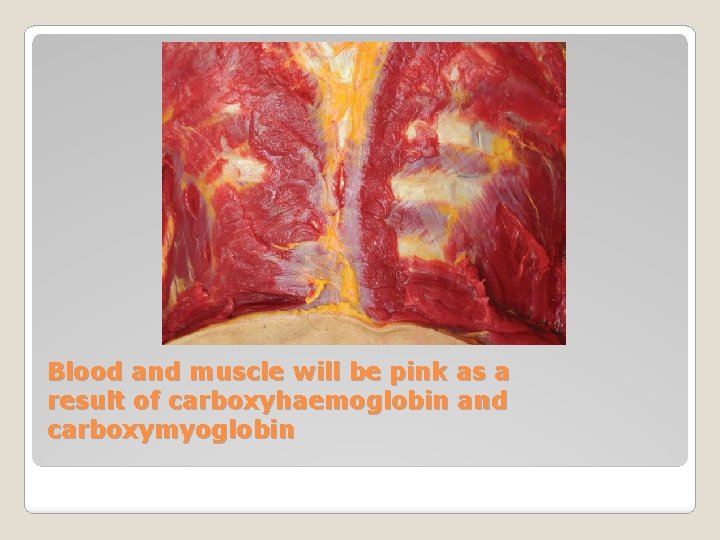
Blood and muscle will be pink as a result of carboxyhaemoglobin and carboxymyoglobin
�It can be enhanced by diluting the blood with water against a white background, as in a porcelain sink or an enamel scalepan, when the pinkness will be more evident � The pinkness of hypothermia or refrigeration is a different colour
�If CO poisoning is suspected at autopsy, a quick test is to add a few drops of blood to some 10 per cent sodium hydroxide solution on a white tile or in a tube against a white background. The normal blood will immediately become brownishgreen but, if significant monoxide is present, the colour will remain pink, as no methaemoglobin is formed
�Necrosis and cavitation of the basal ganglia in the brain, notably the putamen and globus pallidus, has been known for well over a century. �Within about 5 days, histological changes occur here, with ‘gitterzellen’ scavenging cellular debris, the foam cells and microglia presenting an appearance characteristic of tissue breakdown in the central nervous system
�The percentage saturation of the total available haemoglobin that is important rather than an absolute quantity of carboxyhaemoglobin in the blood. �Anaemic persons will not show the external cherry-pink colour if insufficient haemoglobin is available for the monoxide component to become visible
�Old people may die at relatively low concentrations, such as 30 per cent and, in some cases, no other cause can be found when the carboxyhaemoglobin level is only 25 per cent. �Infants also seem to die at relatively low levels, perhaps because their higher respiration rate allows a more rapid absorption
�Bodies burnt after death do not absorb any monoxide and thus a significant level (more than 10 per cent) in a body from a fire means that respiration must have been proceeding whilst the conflagration as in progress
�A minor source of local carboxyhaemoglobin and myohaemoglobin is gunshot wounds, where the propellant gases (which are rich in the compound) are blown into the wound from contact or short-range discharges. The tissues absorb monoxide, especially around the entrance wound

- Slides: 34