
Carbon Fiber Laminate Theory Laminated Plate Theory LBNL
Carbon Fiber Laminate Theory (Laminated Plate Theory) LBNL Composites Workshop February 29 -March 3, 2016
2 Overview Composites in Detectors, and background What are composites and why we use them Very brief introduction to design estimation Common Laminates and Problems—ties to Fabrication Q&A For this discussion: ‘Carbon Fiber’ as a material, is Carbon Fiber Reinforced Plastic (CFRP)—a ‘Composite’. Composites with other fibers and matrices are also broadly mentioned.
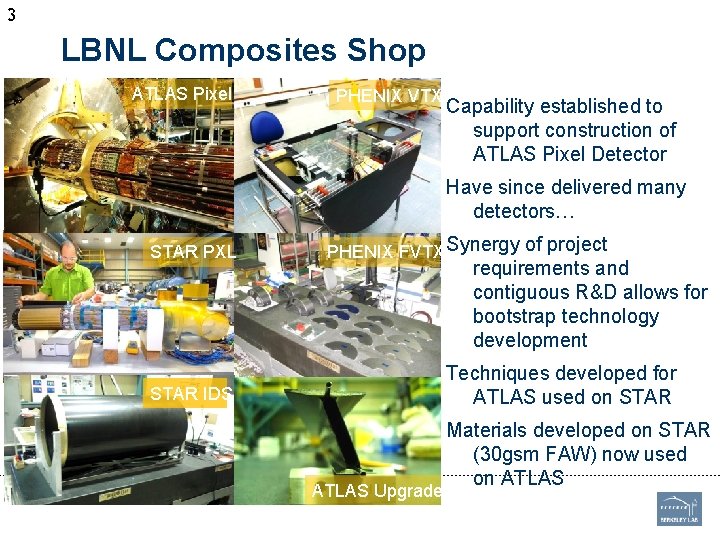
3 LBNL Composites Shop ATLAS Pixel PHENIX VTX Capability established to support construction of ATLAS Pixel Detector Have since delivered many detectors… STAR PXL PHENIX FVTX Synergy of project requirements and contiguous R&D allows for bootstrap technology development Techniques developed for ATLAS used on STAR IDS ATLAS Upgrade Materials developed on STAR (30 gsm FAW) now used on ATLAS
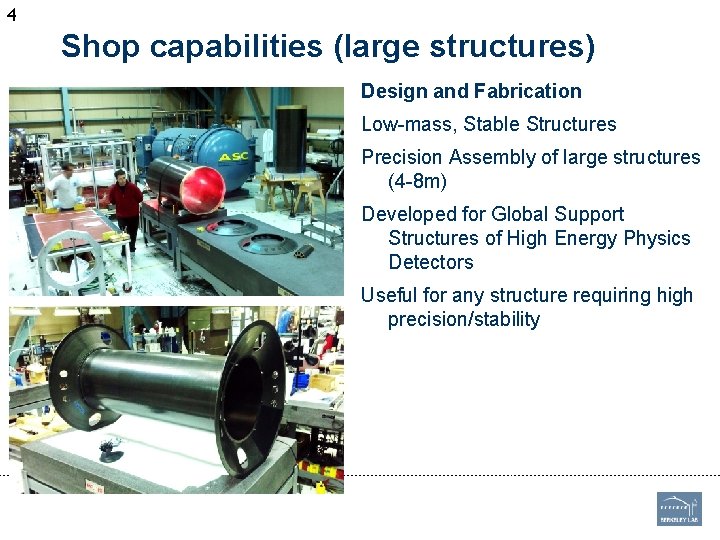
4 Shop capabilities (large structures) Design and Fabrication Low-mass, Stable Structures Precision Assembly of large structures (4 -8 m) Developed for Global Support Structures of High Energy Physics Detectors Useful for any structure requiring high precision/stability
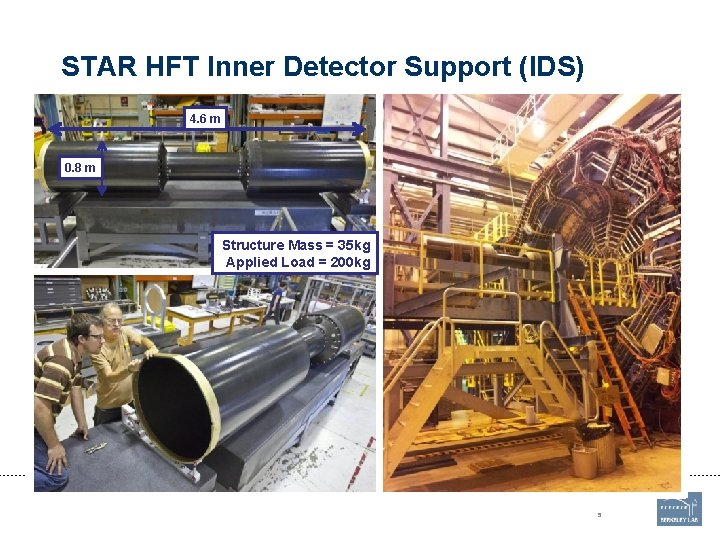
STAR HFT Inner Detector Support (IDS) 4. 6 m 0. 8 m Structure Mass = 35 kg Applied Load = 200 kg 5
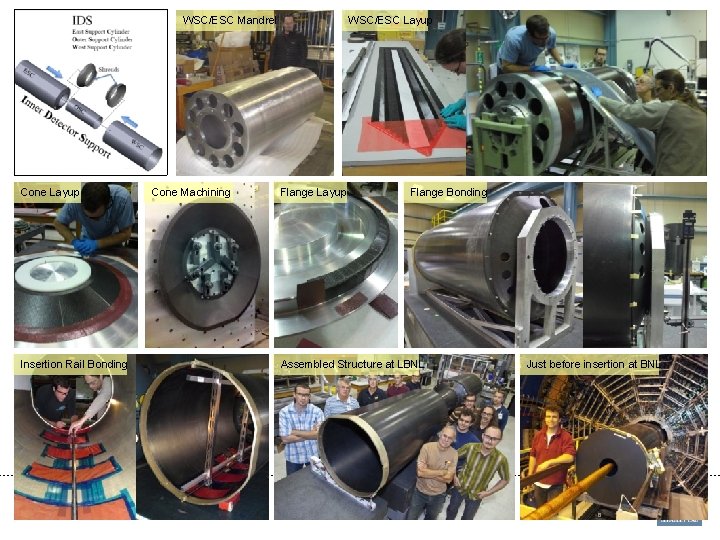
WSC/ESC Mandrel Cone Layup Insertion Rail Bonding Cone Machining WSC/ESC Layup Flange Bonding Assembled Structure at LBNL Just before insertion at BNL 6
Composites are materials developed via a fabrication process Generally 2 components with vastly different properties that when combined yield superior qualities It is impossible to separate material properties from fabrication process in composites Ability to close loop on design, fabrication, and test is an important capability to develop and maintain It is important to understand aspects of fabrication at all stages, from pre-preg to layup to be able to properly specify design variables Over-use of ‘nominal’ values in design is common in our field and is what is taught in typical courses Eric Anderssen LBNL 7
Part manufacture is material design Each of the stages of manufacture have some inter-relation and affect the overall product as deviations from ideal Understanding these deviations allows you to modify the design, tool, and processes to best achieve intent and goals Part and Process Design together are best viewed holistically Of course, design of the laminate can have some peculiar ramifications to the manufacturing process… Aim is to tie design and manufacture together both to show what’s easy to do/control and what’s difficult Much of composite fab/design is simple, but tedious… E. Anderssen LBNL
Some Design Background Simple Lever rules can get you 80% of the way to understanding base properties of composite materials, say zeroth order properties like Moduli, Strength and CTE Laminated Plate Theory is the basis for understanding higher order mechanical properties, and response of stresses on the materials MOST of our laminates are designed ‘Symmetric and Balanced’ and further are designed to be ‘Quasi-Isotropic’ • The sub-class of Symmetric isn’t necessarily Quasi-Isotropic nor Balanced • Symmetric, Balanced, QI (QIBS) laminates have the special property that many off- diagonal elements of the stiffness matrix are identically cancelled • Off-Diagonal elements of the stiffness matrix are responsible for ‘anti-clastic’ behavior —bend-twist, and shear-extension coupling of induced strains Symmetric Balanced Quasi-Isotropic laminates are the easiest to design with, and yield the most predictable parts These terms will make more sense later… E. Anderssen LBNL
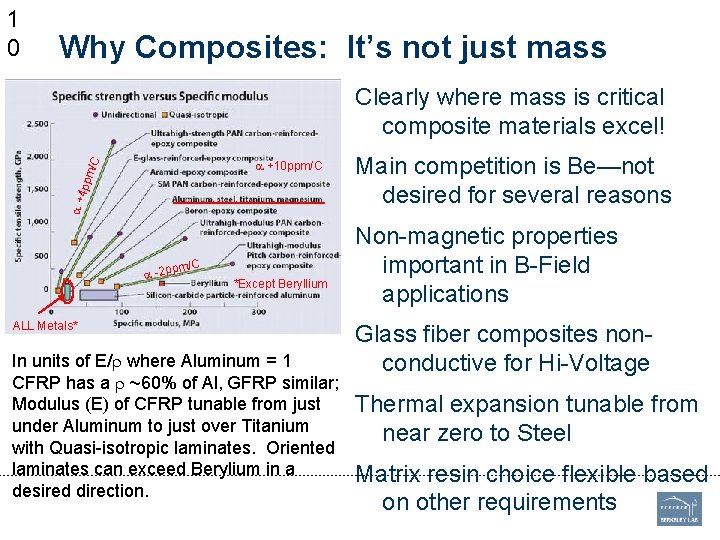
1 0 Why Composites: It’s not just mass Clearly where mass is critical composite materials excel! a + 4 pp m/C a +10 ppm/C a -2 pp *Except Beryllium ALL Metals* In units of E/r where Aluminum = 1 CFRP has a r ~60% of Al, GFRP similar; Modulus (E) of CFRP tunable from just under Aluminum to just over Titanium with Quasi-isotropic laminates. Oriented laminates can exceed Berylium in a desired direction. Main competition is Be—not desired for several reasons Non-magnetic properties important in B-Field applications Glass fiber composites nonconductive for Hi-Voltage Thermal expansion tunable from near zero to Steel Matrix resin choice flexible based on other requirements

1 1 Carbon Fiber Properties Carbon Fiber is not a material, it is a family of materials Other fibers such as Glass, PE, Kevlar, etc have more unique properties (tightly defined) Hi Strength Steel CF properties vary based on their %Graphitization—from mostly ‘glassy’ to ‘crystalline’ Also on ‘precursor’ material e. g. PAN versus Pitch 7075 PAN (Poly Acrylo-Nitrile) is a polymer: (viscose). Pitch is geologic tar, a byproduct of oil extraction with very high carbon content and long polymer chains thus char ratio Chart is for PAN based fibers Pitch based fibers can have modulus in excess of 1000 GPa
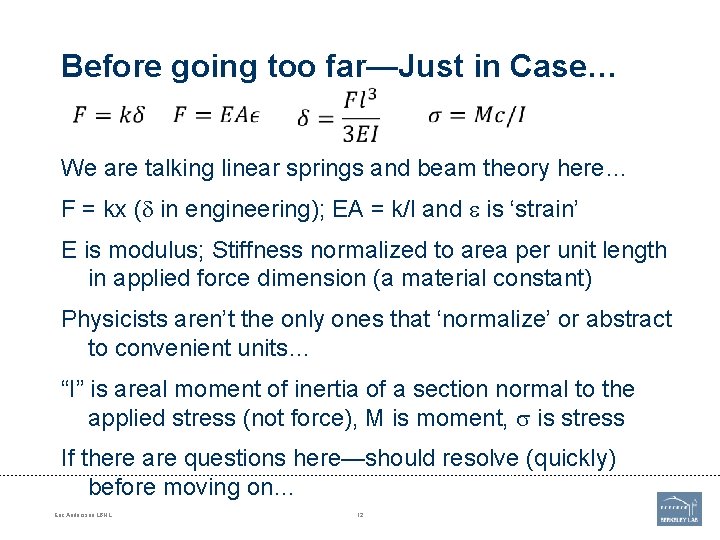
Before going too far—Just in Case… We are talking linear springs and beam theory here… F = kx (d in engineering); EA = k/l and e is ‘strain’ E is modulus; Stiffness normalized to area per unit length in applied force dimension (a material constant) Physicists aren’t the only ones that ‘normalize’ or abstract to convenient units… “I” is areal moment of inertia of a section normal to the applied stress (not force), M is moment, s is stress If there are questions here—should resolve (quickly) before moving on… Eric Anderssen LBNL 12
Specific Language—Just in case… Physics has ‘mass-less’, ‘point mass’, ‘frictionless’, ‘lossless’, etc. all of which convey a set of assumptions via an understanding of a particular phrase They tell you what you can ignore immediately (or should pay attention…) Engineering is the same, and also attributes specific meaning to colloquial terms (just like physics) Strength and Stiffness are not the same; Strength is related to failure envelopes and Stiffness is related to performance in both linear and non-linear regimes ‘Elastic’ implies linear response, and pre-failure response ‘Plastic response’ implies failure and non-linear behavior Composites are Plastics, and some ‘Plastic Behavior’ is expected… Eric Anderssen LBNL 13
1 4 A Brief word on ‘Strength’ We tend to use composites in deflection driven designs, thus tend to use ultra-high modulus fibers These fibers have low failure strains e. g. 0. 3% ‘High Strength’ fibers have failure strains in excess of 1% Matrices range from 1 -5% failure strains Strength models do exist to combine these in laminates, but require testing to use (Tsia-Hill or Tsai-Wu)—strain energy based like Von Mises… For stiffness based designs, laminate strength is rarely an issue, but should be checked Strength of composite materials will not be presented formally, but discussion is welcome
Consider using Fiber Strain as a metric to assess margins of safety This technique is often referred to as ‘First Ply Failure’ and is rather conservate… ACP Will report these values specifically If you are using ANSYS without a composites package, do not use Von-Mises stresses… Reporting principle strain of an isotropic solid is a quick estimate, but not proper. Ultimately a more proper, full orthotropic analysis in ANSYS is required Eric Anderssen LBNL 15
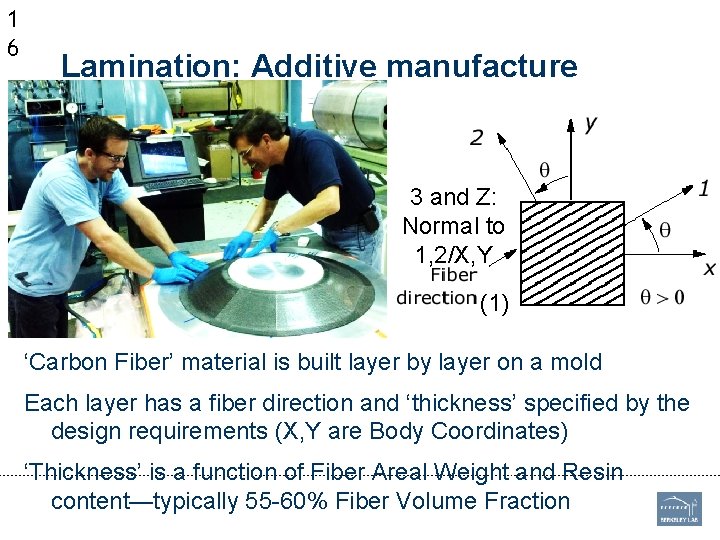
1 6 Lamination: Additive manufacture 3 and Z: Normal to 1, 2/X, Y (1) ‘Carbon Fiber’ material is built layer by layer on a mold Each layer has a fiber direction and ‘thickness’ specified by the design requirements (X, Y are Body Coordinates) ‘Thickness’ is a function of Fiber Areal Weight and Resin content—typically 55 -60% Fiber Volume Fraction
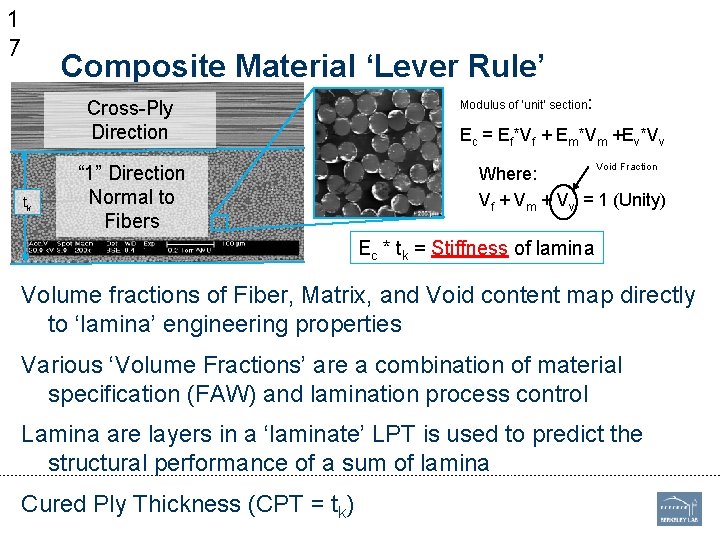
1 7 Composite Material ‘Lever Rule’ Modulus of ‘unit’ section: Cross-Ply Direction tk Ec = Ef*Vf + Em*Vm +Ev*Vv Void Fraction “ 1” Direction Normal to Fibers Where: Vf + Vm + Vv = 1 (Unity) Ec * tk = Stiffness of lamina Volume fractions of Fiber, Matrix, and Void content map directly to ‘lamina’ engineering properties Various ‘Volume Fractions’ are a combination of material specification (FAW) and lamination process control Lamina are layers in a ‘laminate’ LPT is used to predict the structural performance of a sum of lamina Cured Ply Thickness (CPT = tk)
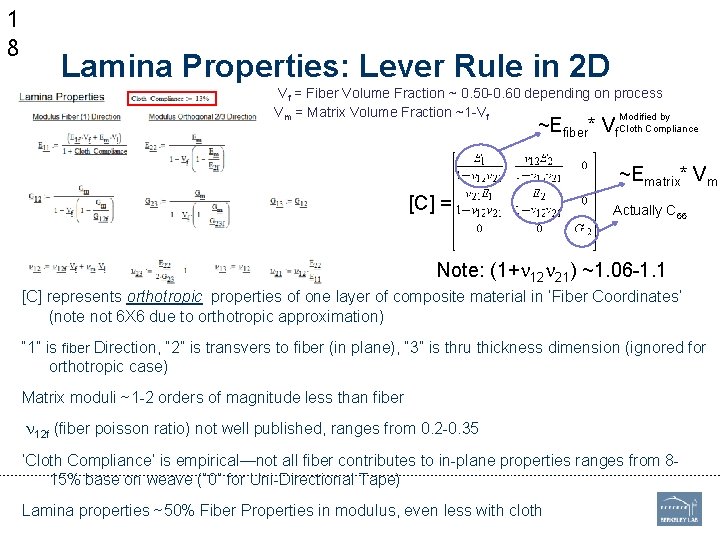
1 8 Lamina Properties: Lever Rule in 2 D Vf = Fiber Volume Fraction ~ 0. 50 -0. 60 depending on process Vm = Matrix Volume Fraction ~1 -Vf Modified by ~Efiber* Vf. Cloth Compliance ~Ematrix* Vm [C] = Actually C 66 Note: (1+n 12 n 21) ~1. 06 -1. 1 [C] represents orthotropic properties of one layer of composite material in ‘Fiber Coordinates’ (note not 6 X 6 due to orthotropic approximation) “ 1” is fiber Direction, “ 2” is transvers to fiber (in plane), “ 3” is thru thickness dimension (ignored for orthotropic case) Matrix moduli ~1 -2 orders of magnitude less than fiber n 12 f (fiber poisson ratio) not well published, ranges from 0. 2 -0. 35 ‘Cloth Compliance’ is empirical—not all fiber contributes to in-plane properties ranges from 815% base on weave (“ 0” for Uni-Directional Tape) Lamina properties ~50% Fiber Properties in modulus, even less with cloth
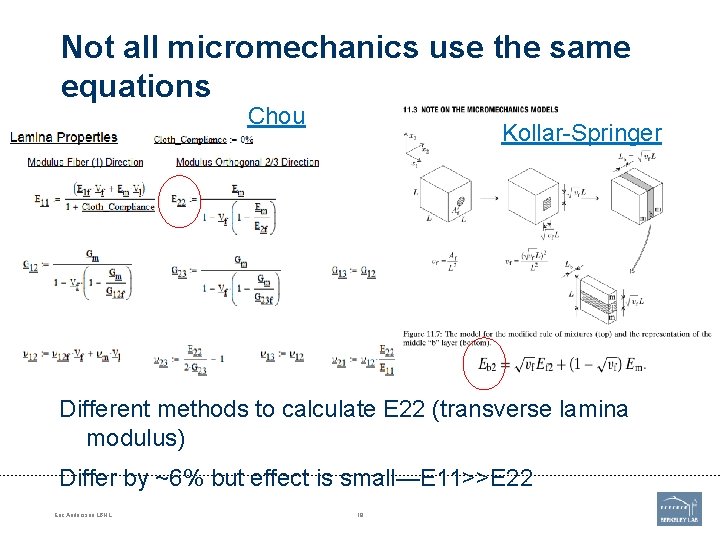
Not all micromechanics use the same equations Chou Kollar-Springer Different methods to calculate E 22 (transverse lamina modulus) Differ by ~6% but effect is small—E 11>>E 22 Eric Anderssen LBNL 19
![2 0 Oriented Lamina Properties: Transform Primary Body Direction (X) Theta Cos^4(Theta) [T] =](http://slidetodoc.com/presentation_image/11a076ab9740e4b1ea8e41379396726e/image-20.jpg "2 0 Oriented Lamina Properties: Transform Primary Body Direction (X) Theta Cos^4(Theta) [T] =")
2 0 Oriented Lamina Properties: Transform Primary Body Direction (X) Theta Cos^4(Theta) [T] = (Properties defined by [C] in fiber coordinates) (Coordinate Transform Matrix) [Cbody] = [T]-1[C][T]T (transpose) works out due to definition of [C] and mapping to ‘engineering strain’ via [R] factor 2 In G 12 term Sensitivity Common Orientations (Degrees) (Value) 5 0. 984 10 0. 941 15 0. 840 45 0. 250 60 0. 063 Transverse Direction 90 0. 000 (matrix) • Transform to ‘Body Coordinates’ (X, Y) is ~ Cos 4(q) • X is primary direction, Y is transverse • Body Coordinates are aligned with physical structure, convention is q = 0 is aligned with X • Sensitivity shows accuracy required during lamination and/or design
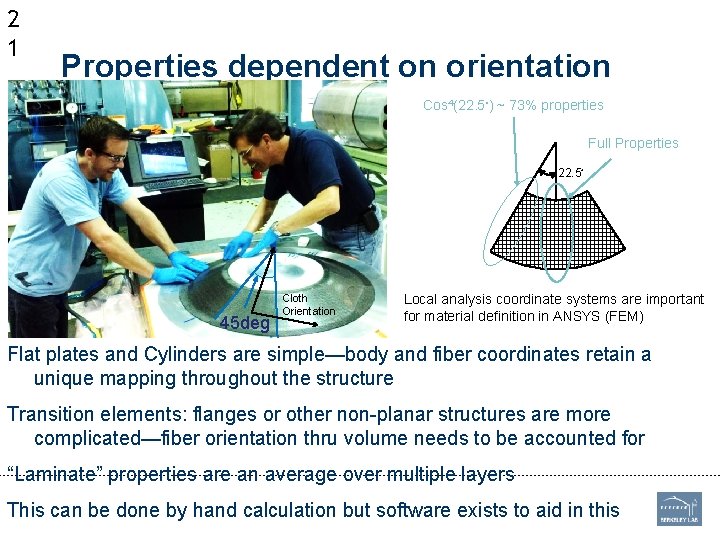
2 1 Properties dependent on orientation Cos 4(22. 5◦) ~ 73% properties Full Properties 22. 5◦ 45 deg Cloth Orientation Local analysis coordinate systems are important for material definition in ANSYS (FEM) Flat plates and Cylinders are simple—body and fiber coordinates retain a unique mapping throughout the structure Transition elements: flanges or other non-planar structures are more complicated—fiber orientation thru volume needs to be accounted for “Laminate” properties are an average over multiple layers This can be done by hand calculation but software exists to aid in this

2 2 Laminate Properties: Multiple Laminate nomenclature describes orientations of layers Generally assumes all layers are the same material Shorthand is not applicable for ‘hybrid’ materials e. g. materials with different fiber/thickness http: //www. quartus. com/resources/white-papers/composites-101/ The above laminate is QIBS “Quasi-Isotropic Balanced Symmetric” ‘Quasi-Isotropic’ modulus in plane ‘Balanced’ about the mid-plane by area ‘Symmetric’ matched orientations about mid-plane [0, 60, -60]s and [0, 90]s are also QIBS Later analysis assumes common material per layer/ply—generalization to hybrid materials is straightforward… Sum of stiffness contributions of each layer: [A] matrix divided by thickness is the Modulus of the laminate This is good for preliminary design
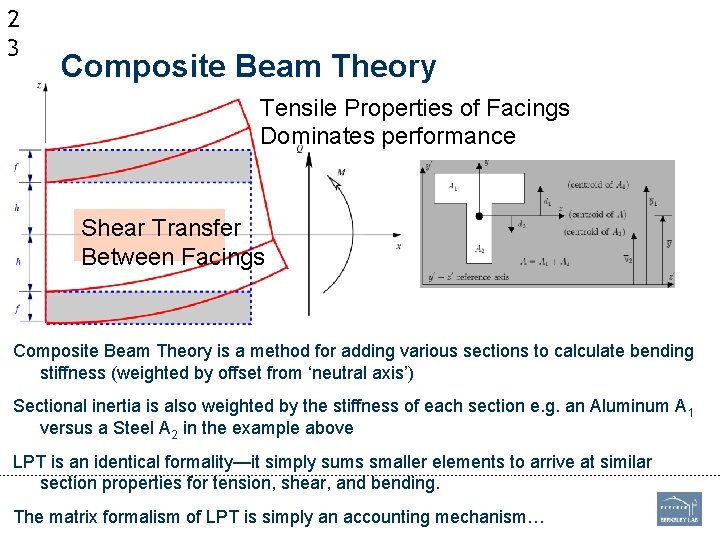
2 3 Composite Beam Theory Tensile Properties of Facings Dominates performance Shear Transfer Between Facings Composite Beam Theory is a method for adding various sections to calculate bending stiffness (weighted by offset from ‘neutral axis’) Sectional inertia is also weighted by the stiffness of each section e. g. an Aluminum A 1 versus a Steel A 2 in the example above LPT is an identical formality—it simply sums smaller elements to arrive at similar section properties for tension, shear, and bending. The matrix formalism of LPT is simply an accounting mechanism…
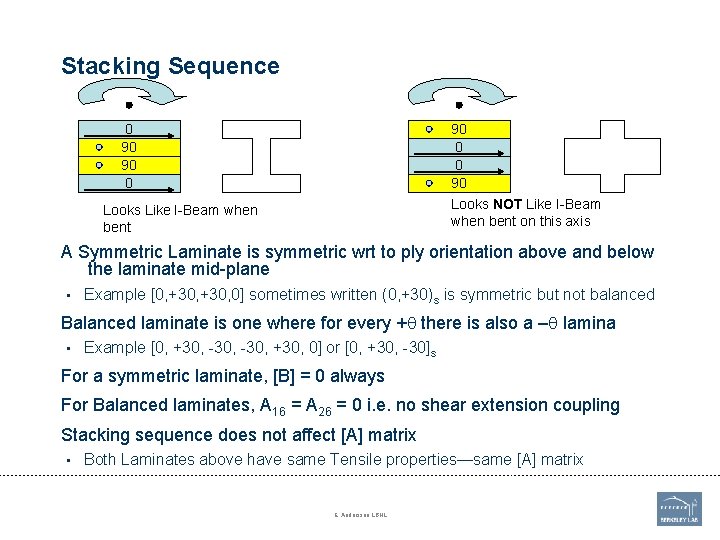
Stacking Sequence 0 90 90 0 0 90 Looks NOT Like I-Beam when bent on this axis Looks Like I-Beam when bent A Symmetric Laminate is symmetric wrt to ply orientation above and below the laminate mid-plane • Example [0, +30, 0] sometimes written (0, +30)s is symmetric but not balanced Balanced laminate is one where for every +q there is also a –q lamina • Example [0, +30, -30, +30, 0] or [0, +30, -30]s For a symmetric laminate, [B] = 0 always For Balanced laminates, A 16 = A 26 = 0 i. e. no shear extension coupling Stacking sequence does not affect [A] matrix • Both Laminates above have same Tensile properties—same [A] matrix E. Anderssen LBNL

2 5 Laminate Plate Theory (nutshell) Note: calculated from mid-plane *NOT* neutral axis… LPT has a matrix formalism which seems overtly complex: • The ‘A’ matrix: Tensile Prop’s • The ‘B’ matrix: Shear Coupling • The ‘D’ Matrix: Plate Bending • These are all about the mid-plane of the laminate (not section) Dhk (ply thickness tk of each ply) is constant here— unimportant for [A], important for [B], and [D]. http: //cae. vaftsycae. com/abd_matrix_composites. html ‘A’ matrix dominates for most ‘beamlike’ structures!
![2 6 Balanced Symmetric laminates: no [B] Ignore for Balanced Symmetric tk is signed:](http://slidetodoc.com/presentation_image/11a076ab9740e4b1ea8e41379396726e/image-26.jpg "2 6 Balanced Symmetric laminates: no [B] Ignore for Balanced Symmetric tk is signed:")
2 6 Balanced Symmetric laminates: no [B] Ignore for Balanced Symmetric tk is signed: Negative below Geometric mid-plane Positive above Balanced Symmetric Identically cancels all [B] matrix elements! [B] is un-fun to deal without specific expertise Balanced Symmetric laminates render [A] and [D] essentially independent B and D are second, even third, order problems for most structures—they mostly come into consideration for ‘local’ loading of structures [A] (tensile properties) dominate for most applications
![2 [A] 7 Matrix properties (Tensile Properties) Theta Cos^4(Theta) (Value) (Degrees) (Value) 0 1](http://slidetodoc.com/presentation_image/11a076ab9740e4b1ea8e41379396726e/image-27.jpg "2 [A] 7 Matrix properties (Tensile Properties) Theta Cos^4(Theta) (Value) (Degrees) (Value) 0 1")
2 [A] 7 Matrix properties (Tensile Properties) Theta Cos^4(Theta) (Value) (Degrees) (Value) 0 1 60 0. 063 45 0. 250 -60 0. 063 90 0 -60 0. 063 -45 0. 250 0 1 90 0 Average: 0. 375 45 0. 250 0 1 Average: 0. 375 Theta Cos^4(Theta) (Degrees) 6 -ply QIBS Laminate 8 -ply QIBS Laminate Average assumes all layers are equal thickness thus stiffness in the laminate coordinates Both examples are QIBS: *ALL* examples of QIBS will have the same body modulus Tables indicate orientation knockdown—still need to include Fiber Volume Fraction (Vf) knockdown Tables above show fractional contributions of each layer in “X” direction (body coordinate) based on orientation “q” of fibers to body Each layer should also be knocked down by Vf ~50 -60% Including Vf, Ex and EY for a QIBS laminate range from 18 -22% of Efiber QIBS laminates can be estimated as ‘black’ metal with some caveats
2 8 ‘Black Aluminum’ and other estimates ‘High Strength’ CF ranges from 220 -300 GPa ‘Intermediate Modulus’ CF from 280 -500 GPa Pitch based fibers start at 500 and goes to ~1000 GPa Considering the QIBS estimate of ~20% fiber modulus there exists both an Al and Ti equivalent quite trivially ‘Black Aluminum’ is a pejorative term aimed at a design that took no other advantage other than density by using a CFRP component (since the early ‘ 80’s) On the other hand, using an Aluminum or Titanium analog (with lower density) in analysis is a quick way to asses if a composite structure is beneficial in an FEM As with any mechanical assembly, it’s usually the joints and local loads that screw with the design…
![2 9 Global versus Local Deflections Distributed point Loads D Loads in Shell: [D]](http://slidetodoc.com/presentation_image/11a076ab9740e4b1ea8e41379396726e/image-29.jpg "2 9 Global versus Local Deflections Distributed point Loads D Loads in Shell: [D]")
2 9 Global versus Local Deflections Distributed point Loads D Loads in Shell: [D] Loads in Shell: [A] L End Load equivalent Moment Load applied to shell Deflections may be dominated by local flexure for thin walled structures L / D > 8 is required for ‘beam like’ behavior; else: ‘shear’ properties dominate global deflection relative to supports Introducing loads into thin shells requires some expertise
3 0 Expert advice: when it’s needed Use of ‘Black’ isotropic analogs are useful for design studies • Approximations are truly valid for tensile (in-plane) loads • Conceptual design studies, nominal sizing, first order mass… • Feature or load rich locales are where approximations break Normal loads/local moments need expertise to asses • Localized load transfer into shell is important to understand Joint compliance is significant for bolted/mechanical joints • More than expected compared to metallic grips, however metallic joints are not frequently modelled properly… Composites cannot always replace metallic solutions An intermediate goal is to disseminate what’s easy to do, but also what’s hard…
3 1 Composites Engineering at LBNL As with many disciplines at the lab; expert resources are matrixed, but available Similarly, Composite Design is not broadly taught in an engineering curriculum (more in the past decade) Cryogenics and Vacuum technology are similar examples: • Engineering and Technical staff new to the lab become proficient quickly thru exposure • Training is available both off and on-site • Some problems still require an expert to solve—knowing who to talk to is important onsite and within the industry Eng Div is looking to put together some seminars at various technical levels to teach Composite Design/Fab
3 2 Conclusion The material is intended to give an idea of whether composites are useful for a design Also, with the limitation of when to seek experts Hand Calculations will get you rather close, but ultimately detailed FEA is required to ‘get to the next level’ Resources are available at LBNL, CERN
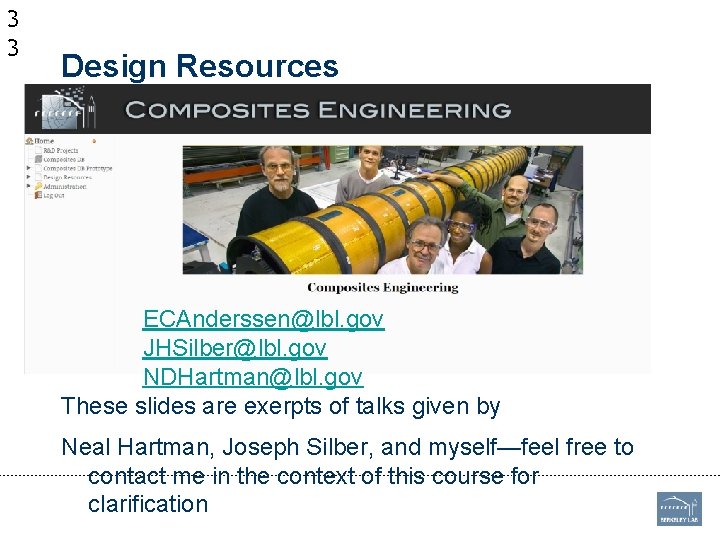
3 3 Design Resources ECAnderssen@lbl. gov JHSilber@lbl. gov NDHartman@lbl. gov These slides are exerpts of talks given by Neal Hartman, Joseph Silber, and myself—feel free to contact me in the context of this course for clarification
- Slides: 33