
Carbon Dioxide In Solution The Baking Soda Example
Carbon Dioxide In Solution The Baking Soda Example
CO 2 Gas is In Equilibrium with Aqueous CO 2 g ↔ CO 2 aq l [CO 2]aq is proportional to the partial pressure of CO 2 l Reduce gas pressure, it comes out of solution (soda) l Increase p. CO 2, it goes into water (green house effect on oceans) l
Aqueous CO 2 is In Equilibrium with Carbonic Acid H 2 CO 3 CO 2 aq + H 2 O ↔ H 2 CO 3 l CO 2 is an acid anhydride (add water, you get acid!) l Equilibrium lies far to the left l Carbonic anhydrase l
Carbonic Acid H 2 CO 3 is In Equilibrium with Bicarbonate Ion HCO 3 l H 2 CO 3 ↔ HCO 3 - + H+ l Bicarbonate is the conjugate base of the free acid carbonic acid l At low p. H H 2 CO 3 is formed, but rapidly breaks down to give CO 2 gas l At neutral p. H HCO 3 - is predominant and no gas is observed
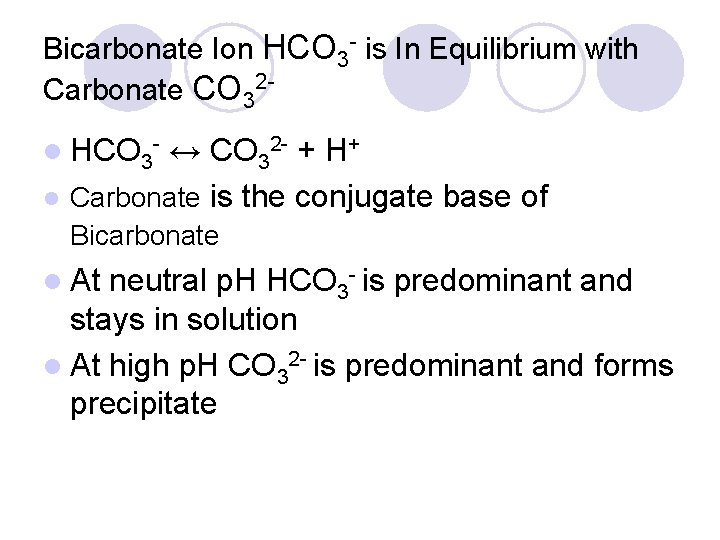
Bicarbonate Ion HCO 3 - is In Equilibrium with Carbonate CO 32 l HCO 3 l ↔ CO 32 - + H+ Carbonate is the conjugate base of Bicarbonate l At neutral p. H HCO 3 - is predominant and stays in solution l At high p. H CO 32 - is predominant and forms precipitate
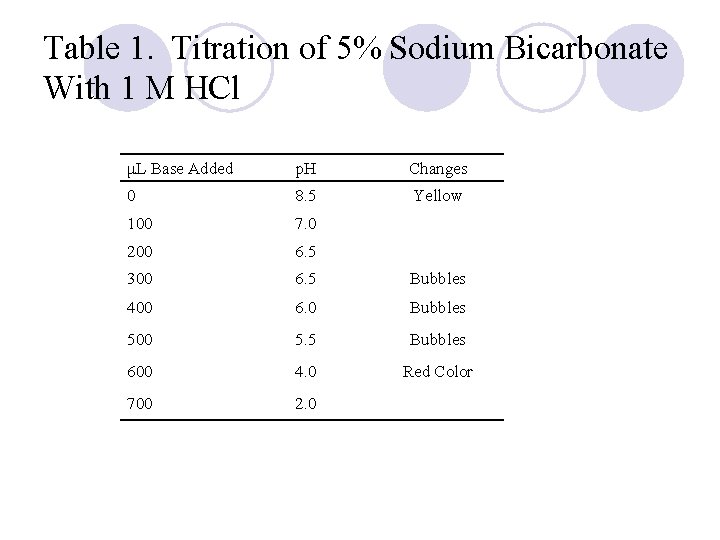
Table 1. Titration of 5% Sodium Bicarbonate With 1 M HCl μL Base Added p. H Changes 0 8. 5 Yellow 100 7. 0 200 6. 5 300 6. 5 Bubbles 400 6. 0 Bubbles 500 5. 5 Bubbles 600 4. 0 Red Color 700 2. 0
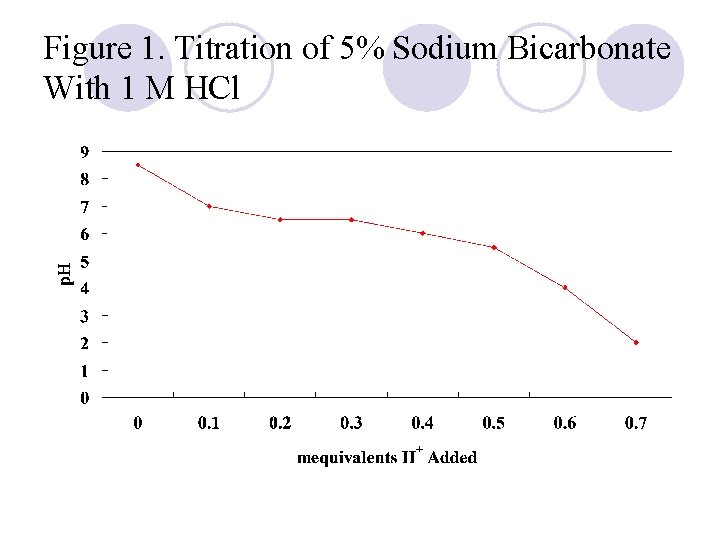
Figure 1. Titration of 5% Sodium Bicarbonate With 1 M HCl
![Figure 1. Titration of 5% Sodium Bicarbonate With 1 M HCl [HCO 3 -]](http://slidetodoc.com/presentation_image_h2/3e77fc367f6db07d63d81d125d4ad8ad/image-8.jpg "Figure 1. Titration of 5% Sodium Bicarbonate With 1 M HCl [HCO 3 -]")
Figure 1. Titration of 5% Sodium Bicarbonate With 1 M HCl [HCO 3 -] = [H 2 CO 3] rapidly dissociates to CO 2 gas and water
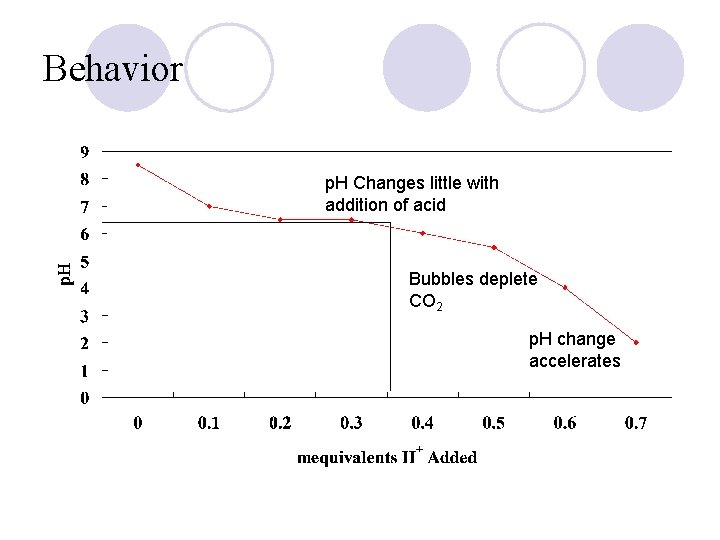
Behavior p. H Changes little with addition of acid Bubbles deplete CO 2 p. H change accelerates
- Slides: 9