
Carbon Cycle Data Assimilation with a Variational Approach
Carbon Cycle Data Assimilation with a Variational Approach (“ 4 -D Var”) David Baker CGD/TSS with Scott Doney, Dave Schimel, Britt Stephens, and Roger Dargaville 24 Sept 2004
Outline • The problem: estimate CO 2 sources and sinks at fine space/time scales (2° x 2. 5°, hourly/daily) • Method: – Why use 4 -D Var? (Kalman) filtering, smoothing, and variational methods – pros and cons – Mathematical background of 4 -D Var applied to atmospheric trace gases • Some 4 -D Var results using simulated truth • Additional topics to ponder: – 100 descent iterations 100 ensemble members? – Error estimates: 4 -D Var vs. ensemble filters
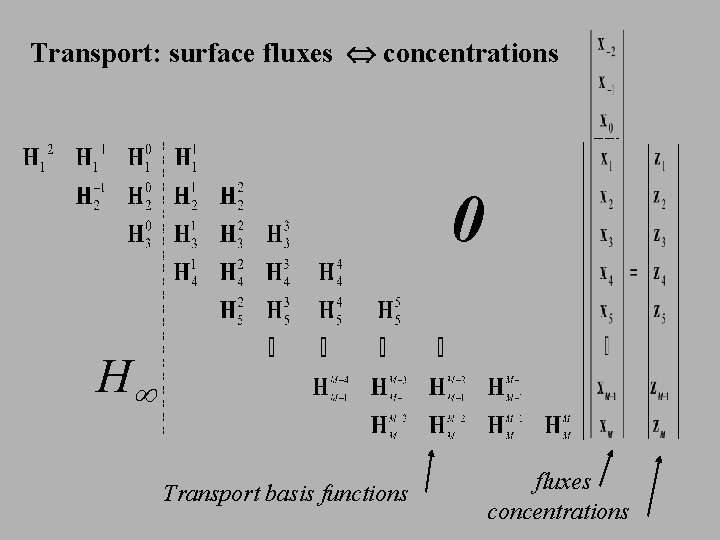
Transport: surface fluxes concentrations 0 H Transport basis functions fluxes concentrations
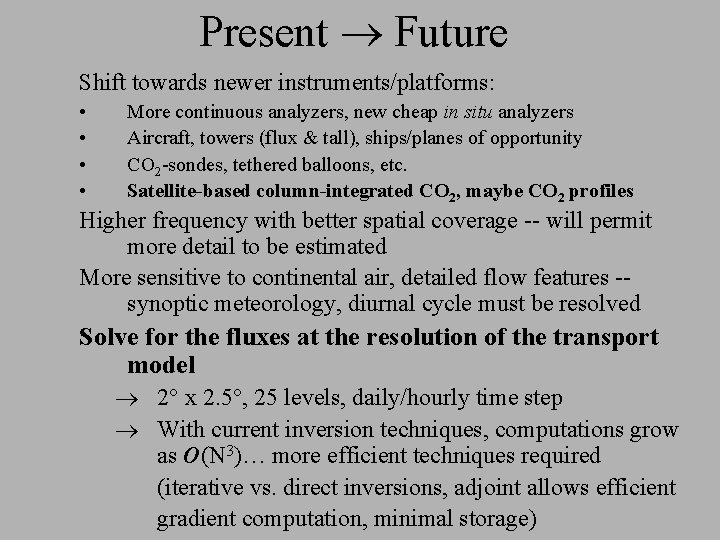
Present Future Shift towards newer instruments/platforms: • • More continuous analyzers, new cheap in situ analyzers Aircraft, towers (flux & tall), ships/planes of opportunity CO 2 -sondes, tethered balloons, etc. Satellite-based column-integrated CO 2, maybe CO 2 profiles Higher frequency with better spatial coverage -- will permit more detail to be estimated More sensitive to continental air, detailed flow features -synoptic meteorology, diurnal cycle must be resolved Solve for the fluxes at the resolution of the transport model 2° x 2. 5°, 25 levels, daily/hourly time step With current inversion techniques, computations grow as O(N 3)… more efficient techniques required (iterative vs. direct inversions, adjoint allows efficient gradient computation, minimal storage)
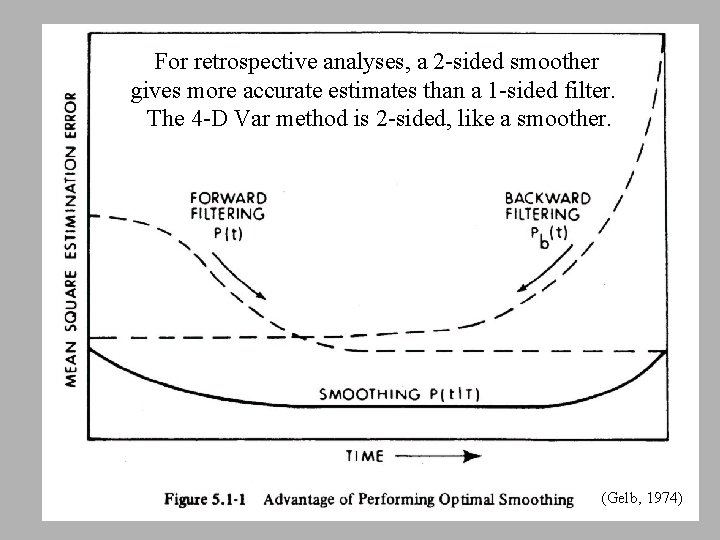
For retrospective analyses, a 2 -sided smoother gives more accurate estimates than a 1 -sided filter. The 4 -D Var method is 2 -sided, like a smoother. (Gelb, 1974)
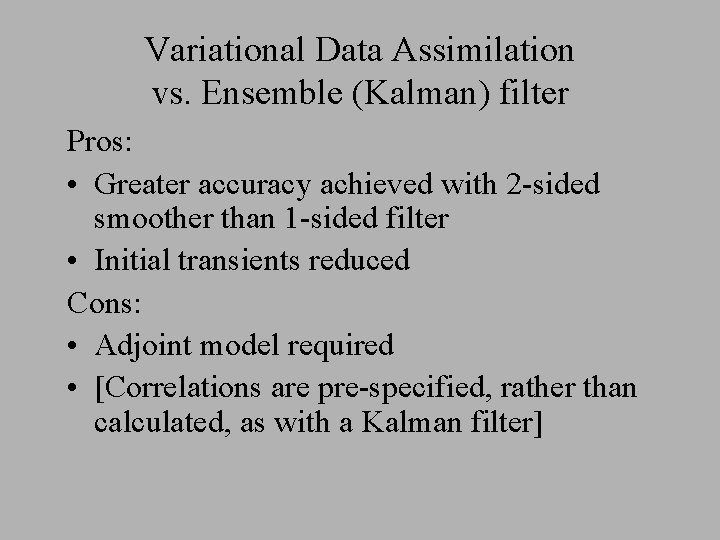
Variational Data Assimilation vs. Ensemble (Kalman) filter Pros: • Greater accuracy achieved with 2 -sided smoother than 1 -sided filter • Initial transients reduced Cons: • Adjoint model required • [Correlations are pre-specified, rather than calculated, as with a Kalman filter]
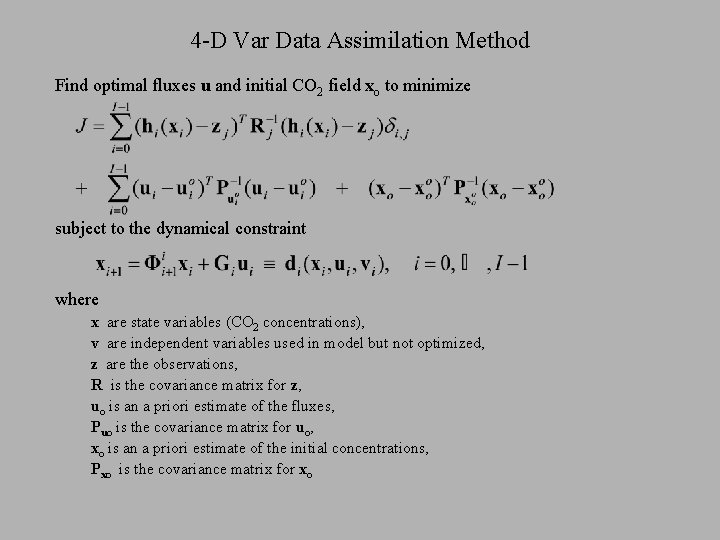
4 -D Var Data Assimilation Method Find optimal fluxes u and initial CO 2 field xo to minimize subject to the dynamical constraint where x are state variables (CO 2 concentrations), v are independent variables used in model but not optimized, z are the observations, R is the covariance matrix for z, uo is an a priori estimate of the fluxes, Puo is the covariance matrix for uo, xo is an a priori estimate of the initial concentrations, Pxo is the covariance matrix for xo
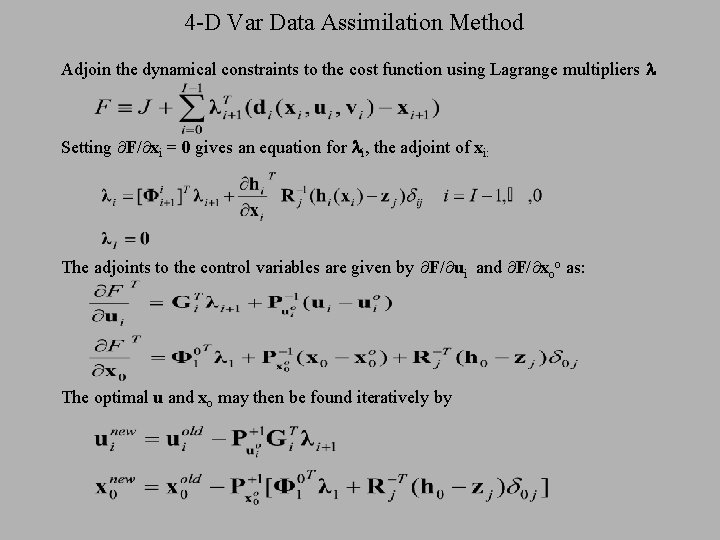
4 -D Var Data Assimilation Method Adjoin the dynamical constraints to the cost function using Lagrange multipliers Setting F/ xi = 0 gives an equation for i, the adjoint of xi: The adjoints to the control variables are given by F/ ui and F/ xoo as: The optimal u and xo may then be found iteratively by
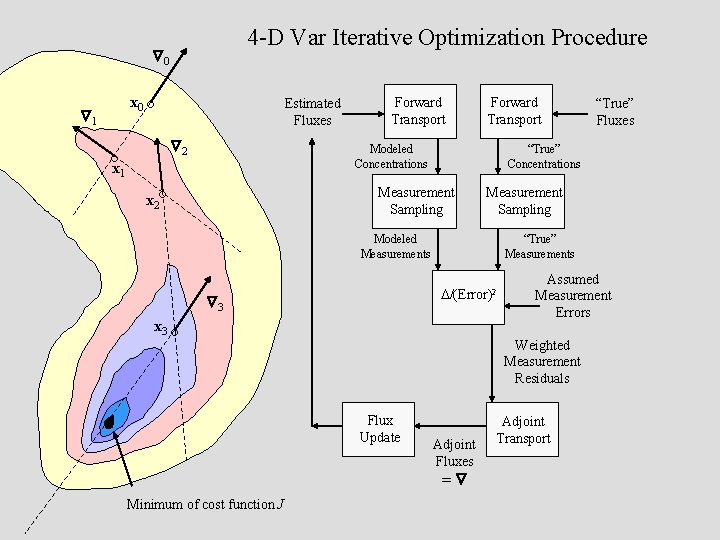
4 -D Var Iterative Optimization Procedure 0 x 0 1 ° Estimated Fluxes 2 °x 1 Forward Transport Modeled Concentrations “True” Concentrations Measurement Sampling x 2° Measurement Sampling Modeled Measurements x 3 “True” Measurements D/(Error)2 3 ° Adjoint Fluxes = Minimum of cost function J Assumed Measurement Errors Weighted Measurement Residuals Flux Update “True” Fluxes Adjoint Transport
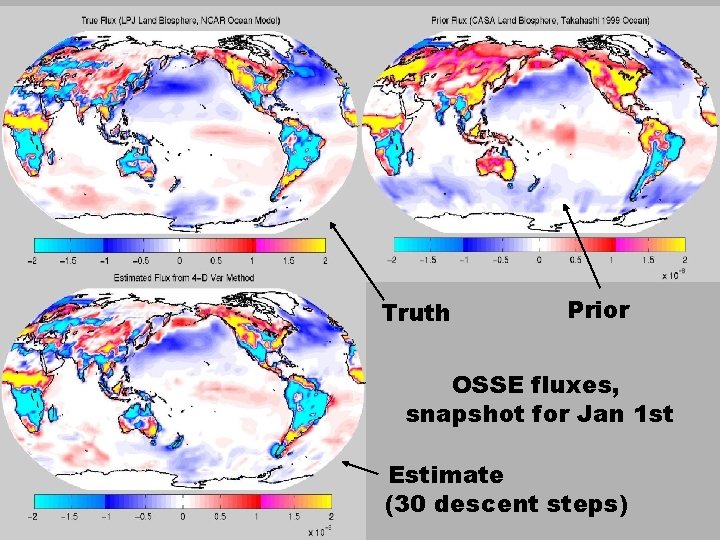
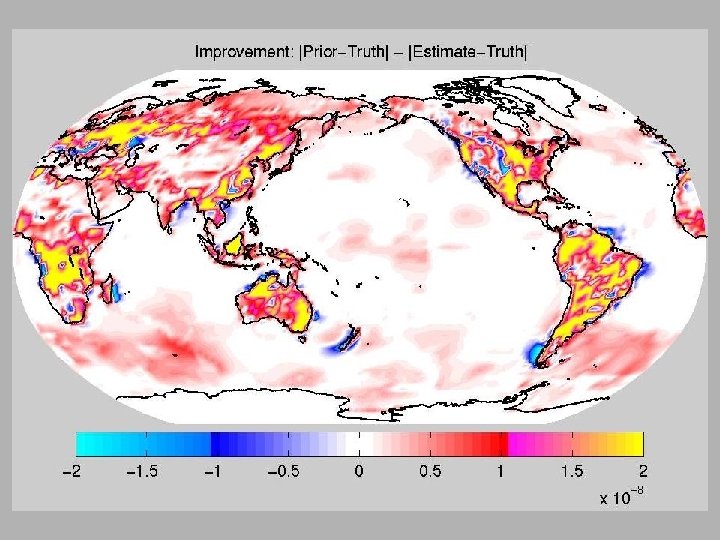
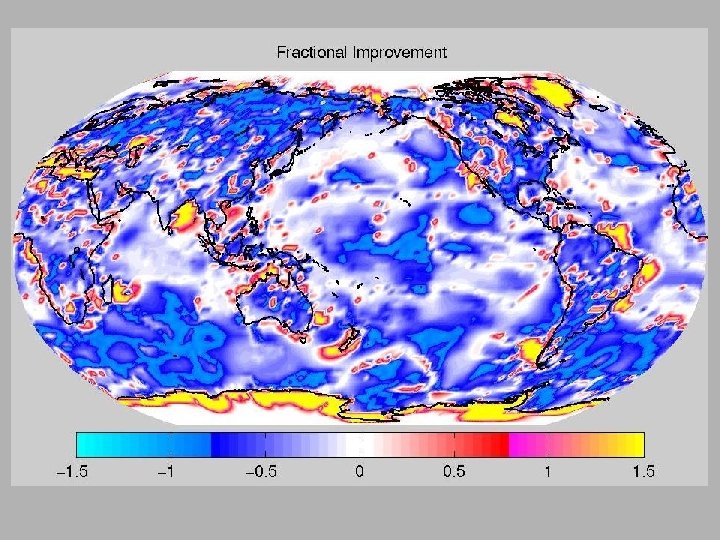
Truth Prior OSSE fluxes, snapshot for Jan 1 st Estimate (30 descent steps)
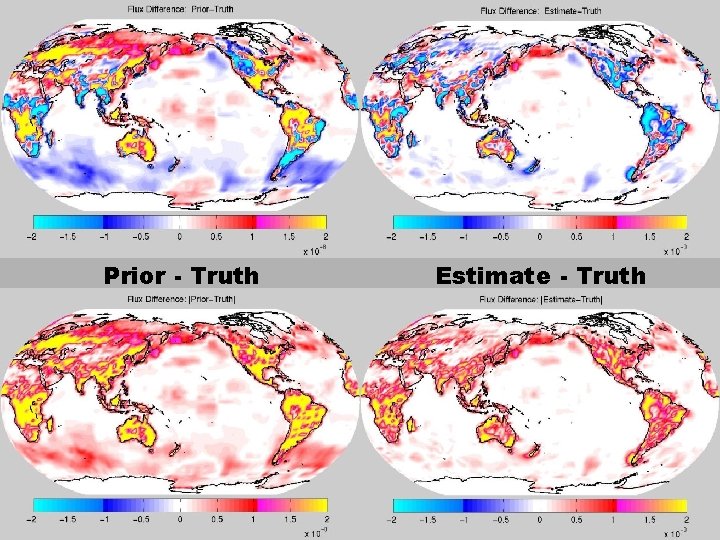
Prior - Truth Estimate - Truth
Future Plans for CO 2 • Assimilate remotely-sensed data • Finer resolution (1º x 1º, or regional) • Improve predictive capability of carbon cycle models (in two steps) by – Tying fluxes to remotely-sensed patterns – Estimating parameters in ocean and land biosphere models using remotely-sensed fields directly as data
Atmospheric transport model NASA/GSFC DAO ‘PCTM’ model: – Lin-Rood advection – Vertical diffusion – Simple cloud convection • Driven by saved wind & mixing fields from DAO analyses • 6 -hourly winds interpolated to 15 minute time step • 2º x 2. 5º resolution, 25 vertical levels Adjoint: • Coded manually; straight-forward because of – Linearity of CO 2 transport – Simplicity of vertical mixing routines • Runs as fast as forward code
- Slides: 16