
CARBON COMPOUNDS Chapter 4 Section 2 KEY CONCEPTS
CARBON COMPOUNDS Chapter 4 Section 2
KEY CONCEPTS • What are some properties of organic compounds? • What are some properties of hydrocarbons? • What kind of structures and bonding do hydrocarbons have? • What are some characteristics of substituted hydrocarbons, esters, and polymers
KEY TERMS • • • Organic compound Hydrocarbon Structural formula Isomer Saturated hydrocarbon Unsaturated hydrocarbon Hydroxyl group Alcohol Organic acid Ester Polymer monomer
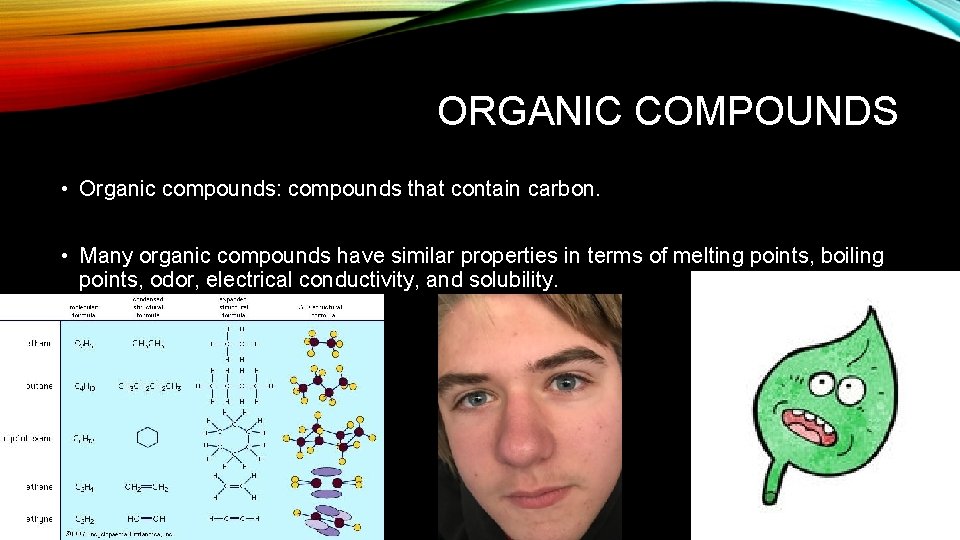
ORGANIC COMPOUNDS • Organic compounds: compounds that contain carbon. • Many organic compounds have similar properties in terms of melting points, boiling points, odor, electrical conductivity, and solubility.
FUN FACT • Skin and other tissues in the body are made with carbon

HYDROCARBONS • Hydrocarbon: a compound that contains only the elements carbon and hydrogen. • Properties of hydrocarbons: • Like many other organic compounds, hydrocarbons mix poorly with water. • All hydrocarbons are flammable. • Chemical formulas of hydrocarbons • The simplest hydrocarbon is methane. • A hydrocarbon with two carbon atoms is ethane. • A hydrocarbon with three atoms is propane.
STRUCTURE AND BONDING IN HYDROCARBONS • The carbon chains in a hydrocarbon may be straight, branched, or ring-shaped. • Structural formula: shows the kind, number, and arrangement of atoms in a molecule. • Isomers: compounds with the same chemical formula but different structures. • In addition to forming a single bond, two carbon atoms can form a double or triple bond. • Saturated hydrocarbons: a hydrocarbon in which all the bonds between carbon atoms are single bonds. • Unsaturated hydrocarbons: a hydrocarbon in which one or more of the bonds between carbon atoms is double or triple.
SUBSTITUTED HYDROCARBONS • If just one atom of another elements is substituted for a hydrogen atom in a hydrocarbon, a different compound is created • Substituted hydrocarbon: atoms of other elements replace one or more hydrogen atom in a hydrocarbon • Compounds containing halogens • Alcohols: the -OH group can also substitute for hydrogen atoms in hydrocarbons. • Hydroxyl group: each oh made of an oxygen atom and a hydrogen atom (-OH). • Organic acids: a subsitituted hydrocarbon that contains one or more carboxyl groups. • Carboxyl group: -COOH
ESTERS AND POLYMERS • Esters: A compound mace by chemically combining an alcohol and an organic acid. • Many esters have pleasant, fruity smell. • Polymer: a very large molecule made of a chain of many smaller molecules bonded together • Monomers: the smaller molecules of the polymer • Organic compounds, such as alcohols, esters, and others, can be linked together to build polymers with thousands to millions of atoms.
- Slides: 9