
Carbon Capture and Storage CCS Current Status and
Carbon Capture and Storage (CCS): Current Status and Outlook Carbon Management Canada Calgary, Alberta, Canada February 9, 2015 Howard Herzog / MIT Energy Initiative
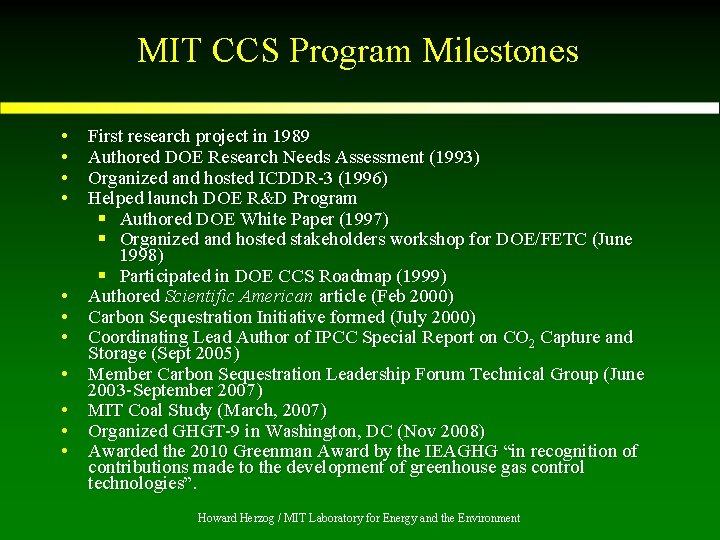
MIT CCS Program Milestones • • • First research project in 1989 Authored DOE Research Needs Assessment (1993) Organized and hosted ICDDR-3 (1996) Helped launch DOE R&D Program § Authored DOE White Paper (1997) § Organized and hosted stakeholders workshop for DOE/FETC (June 1998) § Participated in DOE CCS Roadmap (1999) Authored Scientific American article (Feb 2000) Carbon Sequestration Initiative formed (July 2000) Coordinating Lead Author of IPCC Special Report on CO 2 Capture and Storage (Sept 2005) Member Carbon Sequestration Leadership Forum Technical Group (June 2003 -September 2007) MIT Coal Study (March, 2007) Organized GHGT-9 in Washington, DC (Nov 2008) Awarded the 2010 Greenman Award by the IEAGHG “in recognition of contributions made to the development of greenhouse gas control technologies”. Howard Herzog / MIT Laboratory for Energy and the Environment
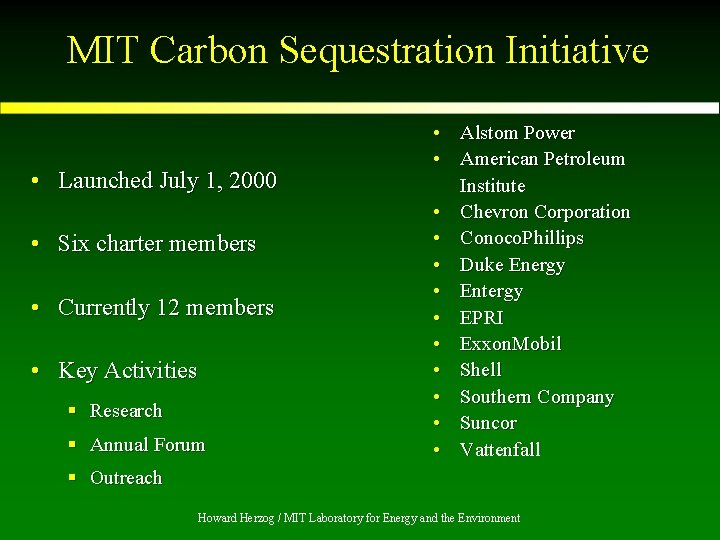
MIT Carbon Sequestration Initiative • Launched July 1, 2000 • Six charter members • Currently 12 members • Key Activities § Research § Annual Forum • Alstom Power • American Petroleum Institute • Chevron Corporation • Conoco. Phillips • Duke Energy • Entergy • EPRI • Exxon. Mobil • Shell • Southern Company • Suncor • Vattenfall § Outreach Howard Herzog / MIT Laboratory for Energy and the Environment
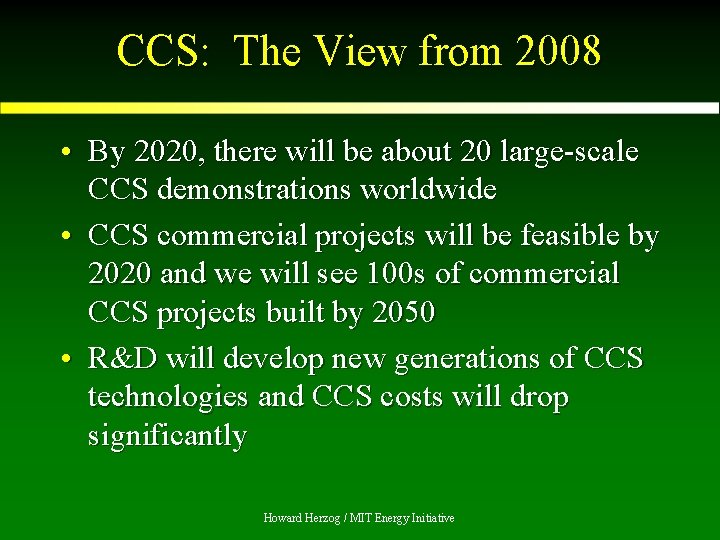
CCS: The View from 2008 • By 2020, there will be about 20 large-scale CCS demonstrations worldwide • CCS commercial projects will be feasible by 2020 and we will see 100 s of commercial CCS projects built by 2050 • R&D will develop new generations of CCS technologies and CCS costs will drop significantly Howard Herzog / MIT Energy Initiative

IEA CCS roadmap (2009) Howard Herzog / MIT Energy Initiative

The View from 2015 • Large-scale CCS demonstrations are extremely difficult to build and we are seeing many cancellations worldwide. There is only one operational large-scale CCS demonstration at a power plant (two more are under construction). • CCS will not be commercial by 2020 – the cost will be higher than the market can bear • New generation technologies are still in the lab. Cost reductions will be primarily from removing first mover costs. Howard Herzog / MIT Energy Initiative
What Happened • Primary Reason § Weak or non-existent climate policy • Contributing factors § Weak economic growth, budget deficits § Low natural gas prices (in North America) § Escalating capital costs Howard Herzog / MIT Energy Initiative
Major Demonstration Projects My View of History • Phase 1 – Pioneer Projects § Sleipner, In Salah, Weyborn, Snovit, Schwarze Pumpe, Labarge • Phase 2 – CCS RD&D Programs § US – Kemper, Petra Nova (formerly NRG Parish), Air Products, ADM, TCEP § Canada – Boundary Dam, Quest, Alberta Trunk Line § Norway – Mongstad § UK – White Rose, Peterhead • Phase 3 - ? ? ? Howard Herzog / MIT Energy Initiative
Major Demonstration Projects Recent Headlines • Positive Headlines § Boundary Dam goes on-line § Petra Nova starts construction • Negative Headlines § Number of projects on GCCSI list drops from 65 to 55 (15% drop) § Future. Gen Cancelled Howard Herzog / MIT Energy Initiative

CCS Projects In the Pipeline (from GCCSI) • Execute (9) § § § US – Kemper, ADM, Petra Nova Canada – Quest, Alberta Trunk (2) Other – Gorgon, Abu Dhabi, EOR (Saudi Arabia) • Define (13) § § § US – TCEP, HECA, Medicine Bow, Sargas UK – White Rose, Peterhead, Don Valley Other – ROAD (Netherlands), Spectra (Canada), China (4) Howard Herzog / MIT Energy Initiative
Technology Status • Post-combustion capture is most advanced commercially § Many improvements over past 15 years (e. g. , solvent technology) • Pre-combustion, once thought the future, is struggling § High capital costs, complexity • Oxy-combustion, the least studied approach, is slowly moving forward § Chemical Looping and Ionic Transport Membranes could revolutionize this approach Howard Herzog / MIT Energy Initiative
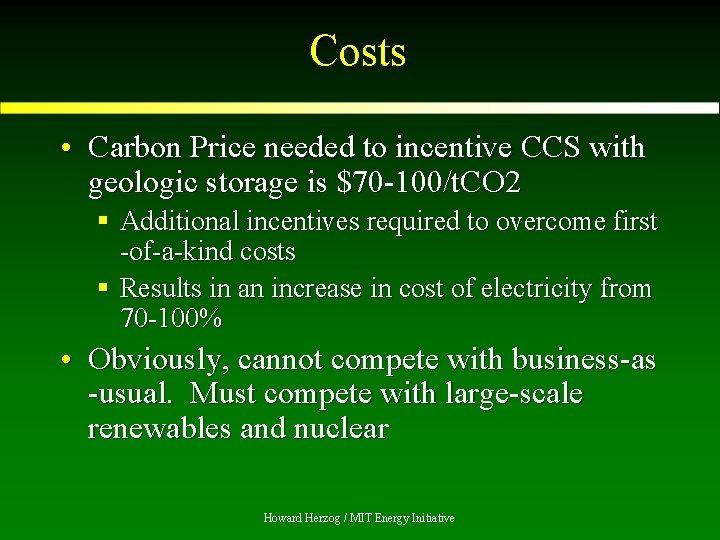
Costs • Carbon Price needed to incentive CCS with geologic storage is $70 -100/t. CO 2 § Additional incentives required to overcome first -of-a-kind costs § Results in an increase in cost of electricity from 70 -100% • Obviously, cannot compete with business-as -usual. Must compete with large-scale renewables and nuclear Howard Herzog / MIT Energy Initiative
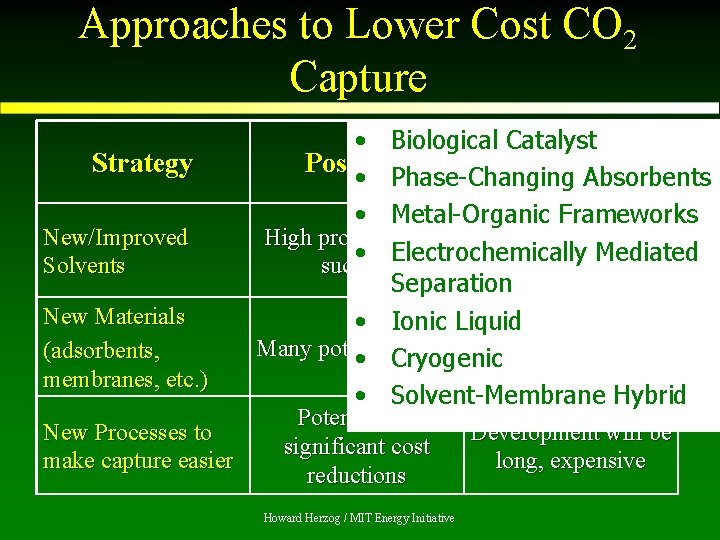
Approaches to Lower Cost CO 2 Capture Strategy New/Improved Solvents New Materials (adsorbents, membranes, etc. ) New Processes to make capture easier • Biological Catalyst Positives Limitations • Phase-Changing Absorbents • Metal-Organic Frameworks Evolutionary High probability of change, Mediated not • Electrochemically success Separationrevolutionary Low probability of • Ionic Liquid Many potential ideas success for any • Cryogenic given project • Solvent-Membrane Hybrid Potential for significant cost reductions Howard Herzog / MIT Energy Initiative Development will be long, expensive
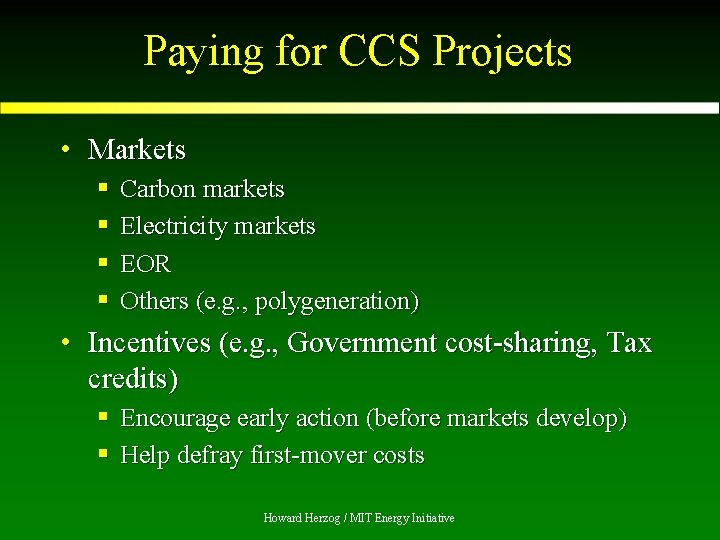
Paying for CCS Projects • Markets § § Carbon markets Electricity markets EOR Others (e. g. , polygeneration) • Incentives (e. g. , Government cost-sharing, Tax credits) § Encourage early action (before markets develop) § Help defray first-mover costs Howard Herzog / MIT Energy Initiative
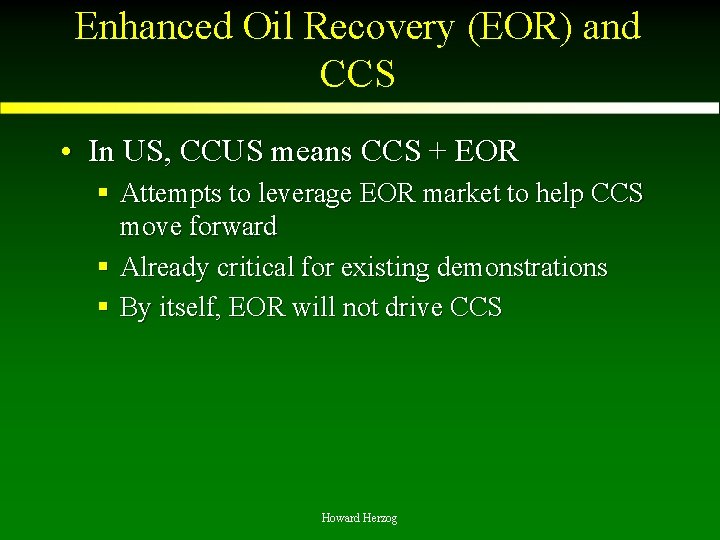
Enhanced Oil Recovery (EOR) and CCS • In US, CCUS means CCS + EOR § Attempts to leverage EOR market to help CCS move forward § Already critical for existing demonstrations § By itself, EOR will not drive CCS Howard Herzog
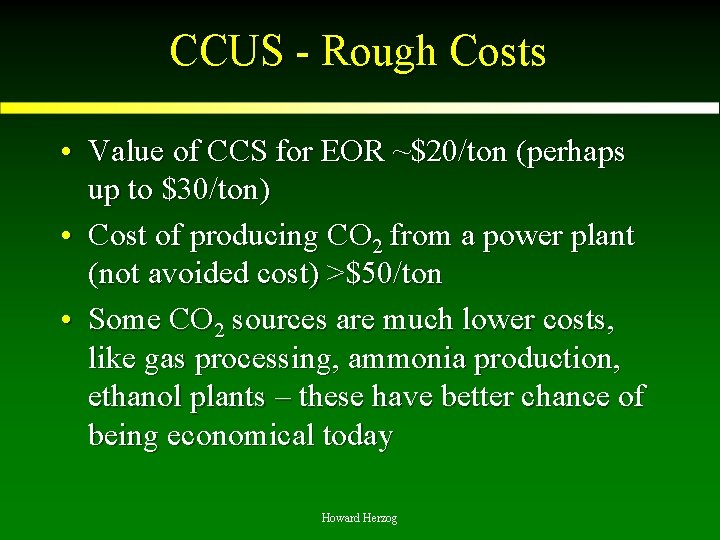
CCUS - Rough Costs • Value of CCS for EOR ~$20/ton (perhaps up to $30/ton) • Cost of producing CO 2 from a power plant (not avoided cost) >$50/ton • Some CO 2 sources are much lower costs, like gas processing, ammonia production, ethanol plants – these have better chance of being economical today Howard Herzog
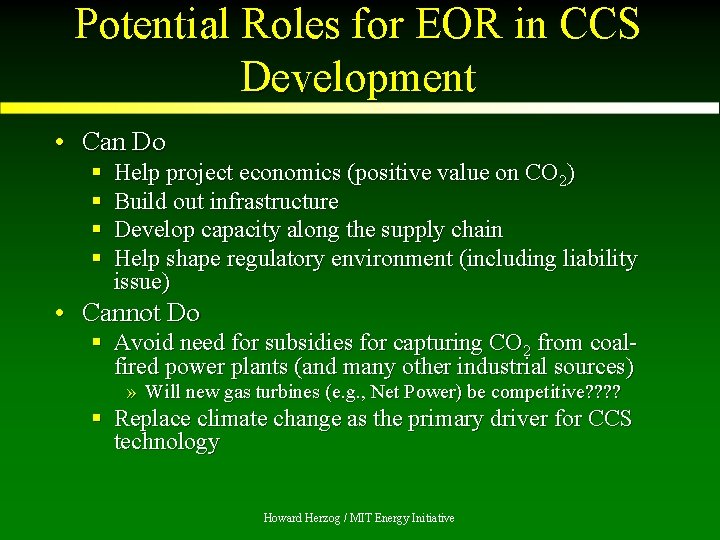
Potential Roles for EOR in CCS Development • Can Do § § Help project economics (positive value on CO 2) Build out infrastructure Develop capacity along the supply chain Help shape regulatory environment (including liability issue) • Cannot Do § Avoid need for subsidies for capturing CO 2 from coalfired power plants (and many other industrial sources) » Will new gas turbines (e. g. , Net Power) be competitive? ? § Replace climate change as the primary driver for CCS technology Howard Herzog / MIT Energy Initiative
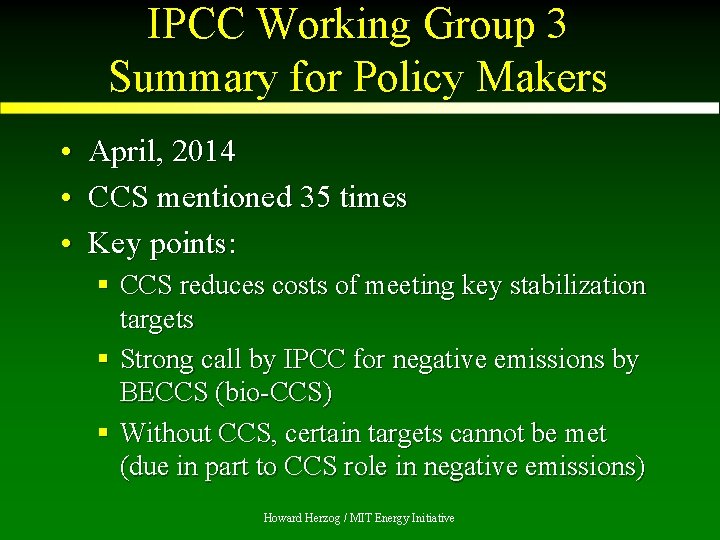
IPCC Working Group 3 Summary for Policy Makers • April, 2014 • CCS mentioned 35 times • Key points: § CCS reduces costs of meeting key stabilization targets § Strong call by IPCC for negative emissions by BECCS (bio-CCS) § Without CCS, certain targets cannot be met (due in part to CCS role in negative emissions) Howard Herzog / MIT Energy Initiative
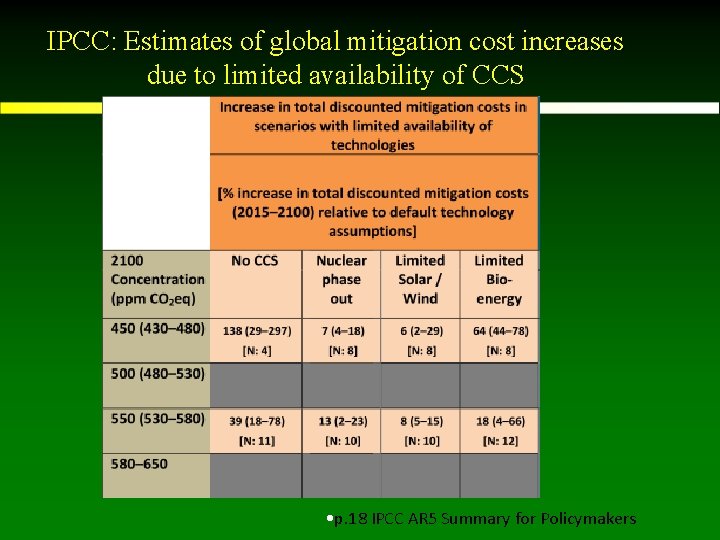
IPCC: Estimates of global mitigation cost increases due to limited availability of CCS • p. 18 IPCC AR 5 Summary for Policymakers
CCS and Climate Policy • Of all the major mitigation options, only CCS has climate change mitigation as it’s sole reason for being developed. • As goes climate policy, so goes CCS Howard Herzog / MIT Energy Initiative
CCS Low Lights • Germany § “The past five years have shown CCS to be a failure, " said Christian von Hirschhausen, DIW's [German Institute for Economic Research] research director for industrial economics. From: http: //www. de/carbon-capturetechnology-loses-out-in-germany/a-16999567 • Vattenfall § May 6, 2014 - Vattenfall has eliminated its CCS research department in a cost cutting measure. They said that CCS technology has proven to be complex and expensive, especially in Europe where very low carbon prices have dramatically decreased profitability. • Australia § New government eliminates carbon tax § Call for “direct action” Howard Herzog / MIT Energy Initiative
CCS Bright Lights • UK • Norway • Alberta/Saskatchewan (Canada) Howard Herzog / MIT Energy Initiative
Political Situation in the US today and in the future • Political gridlock on climate change legislation • States enacting climate policy in lieu of federal government • Fossil projects in US becoming targets if they have a large carbon footprint • Major administration thrust is through the EPA under the Clean Air Act Howard Herzog
Fossil Projects Under Attack • • Keystone pipeline Coal export terminals on US West Coast Hydraulic Fracturing LNG export terminals Howard Herzog
Final Thoughts • In order to meet the stated goal of significant cuts (50%-80%) in greenhouse gas emissions by 2050 § CCS is not a silver bullet § However, it may be a keystone technology • For CCS (or any mitigation technology) to be relevant, it will need to operate at the Gt scale Howard Herzog / MIT Energy Initiative
Contact Information Howard Herzog Senior Research Engineer Massachusetts Institute of Technology (MIT) Energy Initiative Room E 19 -370 L Cambridge, MA 02139 Phone: 617 -253 -0688 E-mail: hjherzog@mit. edu Web Site: sequestration. mit. edu Howard Herzog / MIT Energy Initiative
- Slides: 26