
Carbon Capture and Sequestration Analysis of Options West
Carbon Capture and Sequestration Analysis of Options West Coast Regional Carbon Sequestration Partnership Kickoff Meeting October 1, 2003 Howard Herzog, David Cheng MIT
MIT’s Carbon Capture and Sequestration Technologies Program • Annual Forum • Research § § Technology Assessments and Development Economic Modeling Geographic Information System (GIS) Modeling Environmental/Social/Political Assessments • Outreach § Publications § Committees and Workshops § Press Howard Herzog and David Cheng / MIT Laboratory for Energy and the Environment
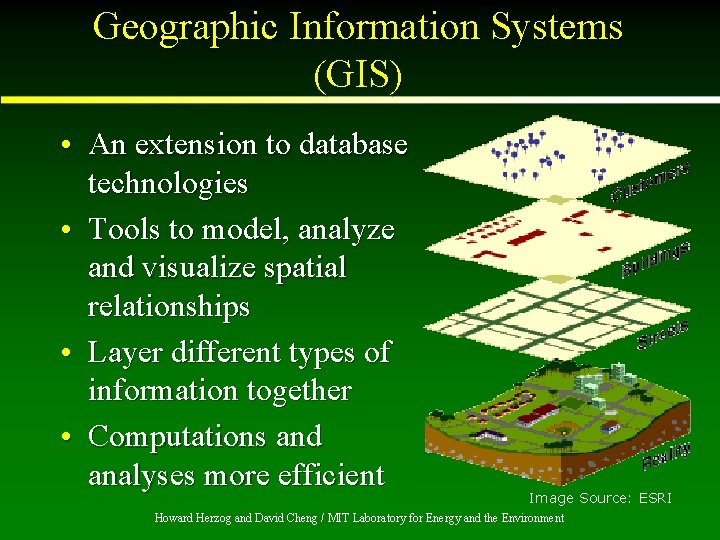
Geographic Information Systems (GIS) • An extension to database technologies • Tools to model, analyze and visualize spatial relationships • Layer different types of information together • Computations and analyses more efficient Image Source: ESRI Howard Herzog and David Cheng / MIT Laboratory for Energy and the Environment
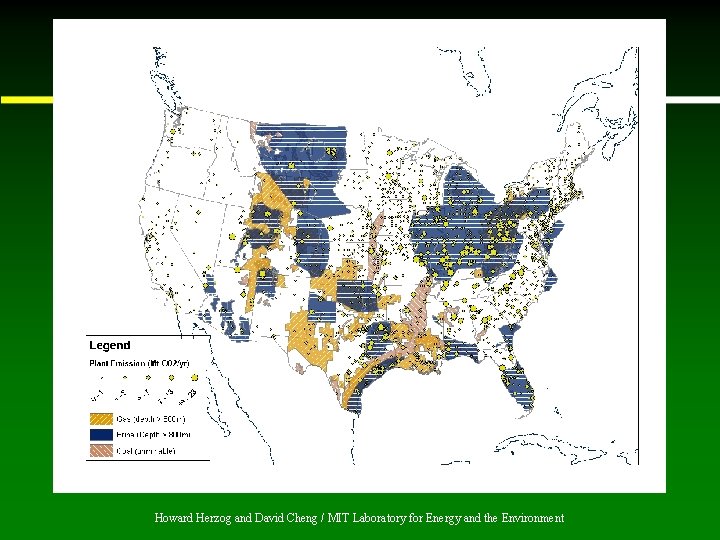
Carbon Management GIS • Distributed Information Management System (DIMS) § Integrate information from diverse sources § Data in various formats § Data providers at disparate locations • Inform and support policy decisions • Bridges assessment gap between data collection and policy planning Howard Herzog and David Cheng / MIT Laboratory for Energy and the Environment
Develop Core Data • Investigation of data relating to carbon dioxide capture and sequestration § Evaluate and enhance the quality of GIS data § Describe data gaps § Standardize data requirements § Integration of data Howard Herzog and David Cheng / MIT Laboratory for Energy and the Environment
Data Types • Data requirements for selecting sequestration options include: § Technical data » CO 2 infrastructure (sources, sinks, transport) » Topography (elevation, rivers, land type) § Political data (demographics, sensitive areas) § Economic data (cost algorithms) § Regulatory data (permitting) Howard Herzog and David Cheng / MIT Laboratory for Energy and the Environment
Howard Herzog and David Cheng / MIT Laboratory for Energy and the Environment
Data • Databases are still evolving § Data not always sufficient for robust analyses § Recognition of data issues is important for interpreting results Howard Herzog and David Cheng / MIT Laboratory for Energy and the Environment
Analysis Tools • Development of programs to automate basic carbon management analysis § Cost of transportation § Cost of injection § Viable source/sink pairings § Project screening Howard Herzog and David Cheng / MIT Laboratory for Energy and the Environment
Our Role in WCRCSP • Help integrate data § Store data on consistent basis § Easily display data in various combinations § Perform queries and simple manipulations • Perform analyses § e. g. , Cost estimation, source/sink matching § Initial screening to help identify potential projects Howard Herzog and David Cheng / MIT Laboratory for Energy and the Environment
Contact Information • Web Site - sequestration. mit. edu • Contact § Howard Herzog § Laboratory for Energy and the Environment (LFEE) § Room E 40 -447 § 617 -253 -0688 § hjherzog@mit. edu Howard Herzog and David Cheng / MIT Laboratory for Energy and the Environment
- Slides: 11