
Carbon Based Nanomaterials By Dr Raouf Mahmood Types
Carbon Based Nanomaterials By Dr. Raouf Mahmood
Types of Nanomaterials Most current nanomaterials could be organized into four types: • Carbon Based Materials • Metal Based Materials • Dendrimers • Composites
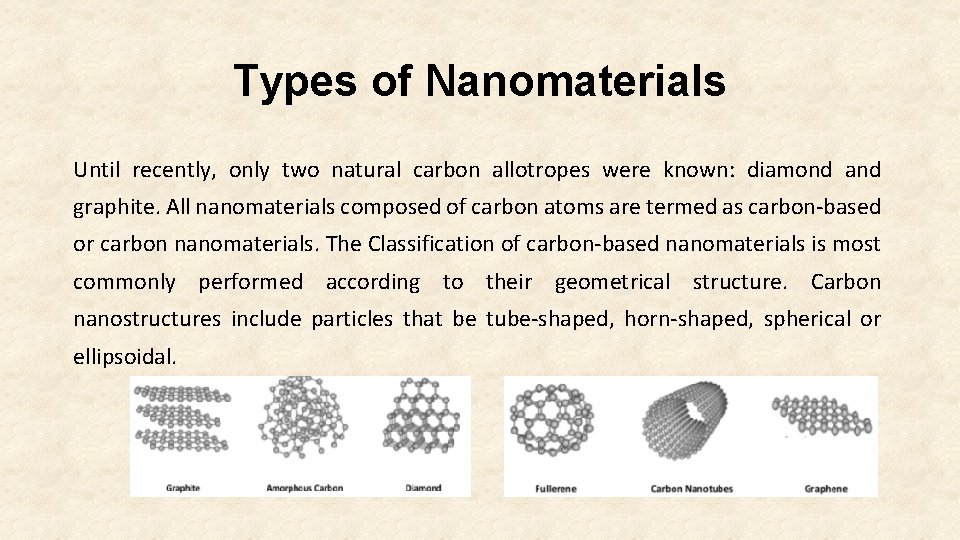
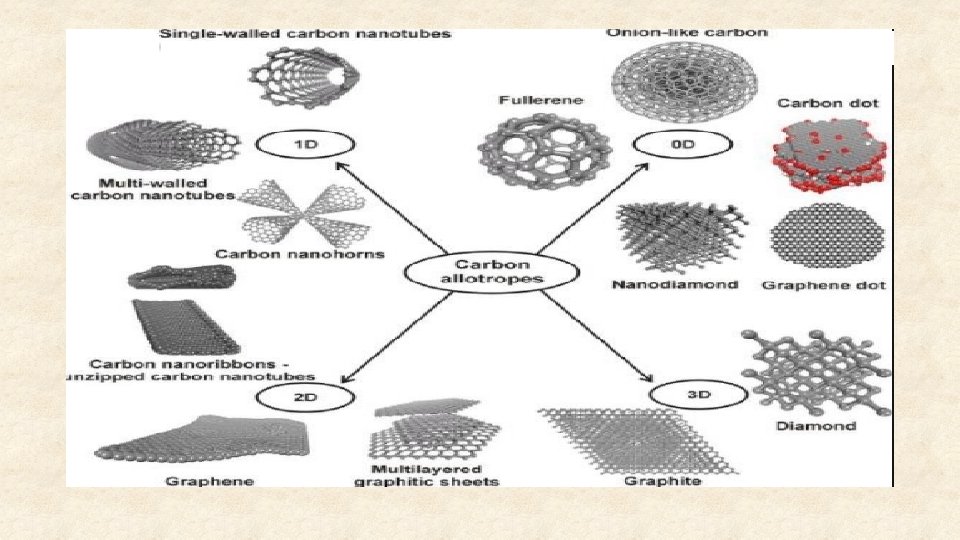
Types of Nanomaterials Until recently, only two natural carbon allotropes were known: diamond and graphite. All nanomaterials composed of carbon atoms are termed as carbon-based or carbon nanomaterials. The Classification of carbon-based nanomaterials is most commonly performed according to their geometrical structure. Carbon nanostructures include particles that be tube-shaped, horn-shaped, spherical or ellipsoidal.
Types of Nanomaterials In the meantime, carbon nanomaterials have numerous technical applications including micro- and nanoelectronics, gas storage, production of conductive plastics, composites, displays, antifouling paints, textiles, batteries with improved durability, gas biosensors and others.
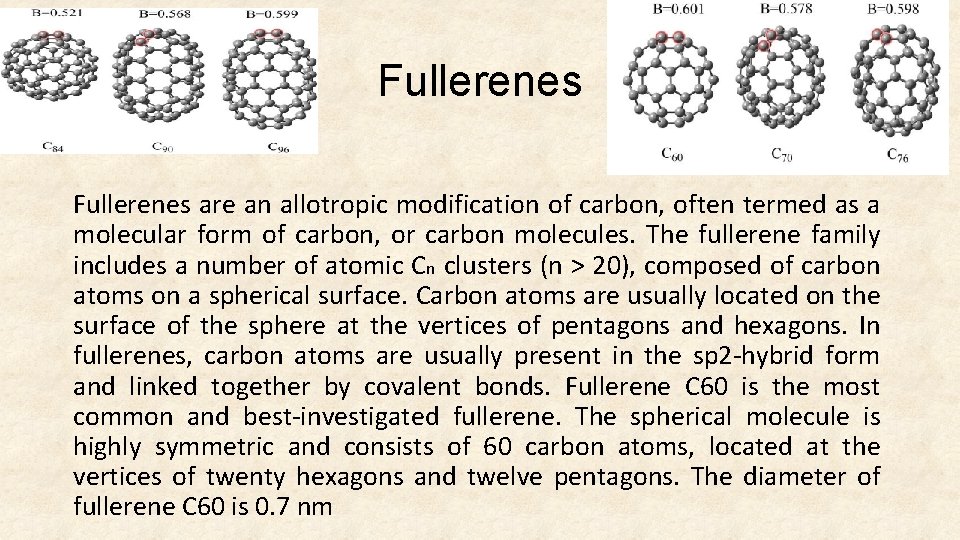
Fullerenes are an allotropic modification of carbon, often termed as a molecular form of carbon, or carbon molecules. The fullerene family includes a number of atomic Cn clusters (n > 20), composed of carbon atoms on a spherical surface. Carbon atoms are usually located on the surface of the sphere at the vertices of pentagons and hexagons. In fullerenes, carbon atoms are usually present in the sp 2 -hybrid form and linked together by covalent bonds. Fullerene C 60 is the most common and best-investigated fullerene. The spherical molecule is highly symmetric and consists of 60 carbon atoms, located at the vertices of twenty hexagons and twelve pentagons. The diameter of fullerene C 60 is 0. 7 nm
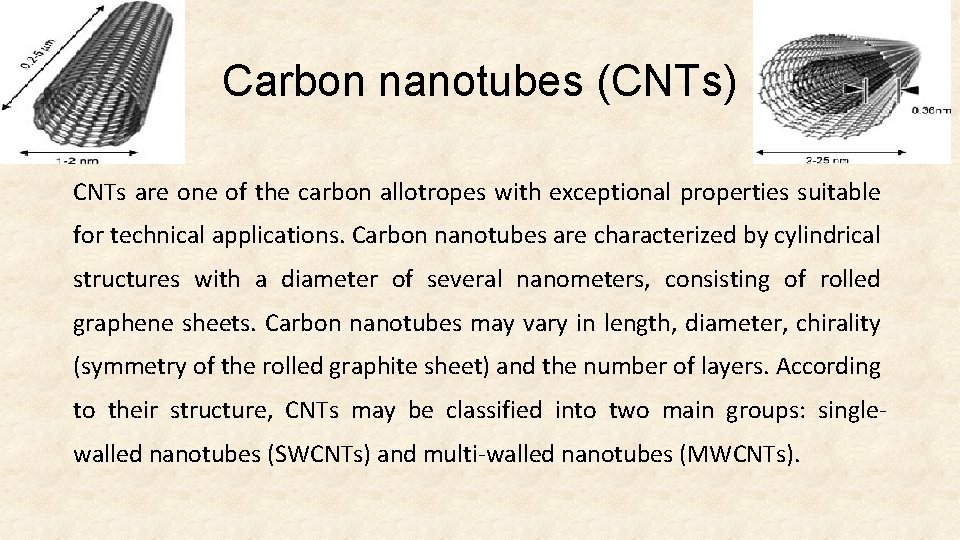
Carbon nanotubes (CNTs) CNTs are one of the carbon allotropes with exceptional properties suitable for technical applications. Carbon nanotubes are characterized by cylindrical structures with a diameter of several nanometers, consisting of rolled graphene sheets. Carbon nanotubes may vary in length, diameter, chirality (symmetry of the rolled graphite sheet) and the number of layers. According to their structure, CNTs may be classified into two main groups: singlewalled nanotubes (SWCNTs) and multi-walled nanotubes (MWCNTs).
Carbon nanotubes (CNTs) Generally SWCNTs have a diameter around 1– 3 nm and a length of a few micrometres. Multi-walled CNTs have a diameter of 5– 40 nm and a length around 10 μm. The structure of CNTs leads to excellent properties with a unique combination of rigidity, strength and elasticity compared with other fibrous materials. For instance, CNTs show high thermal and electrical conductivity compared to other conductive materials
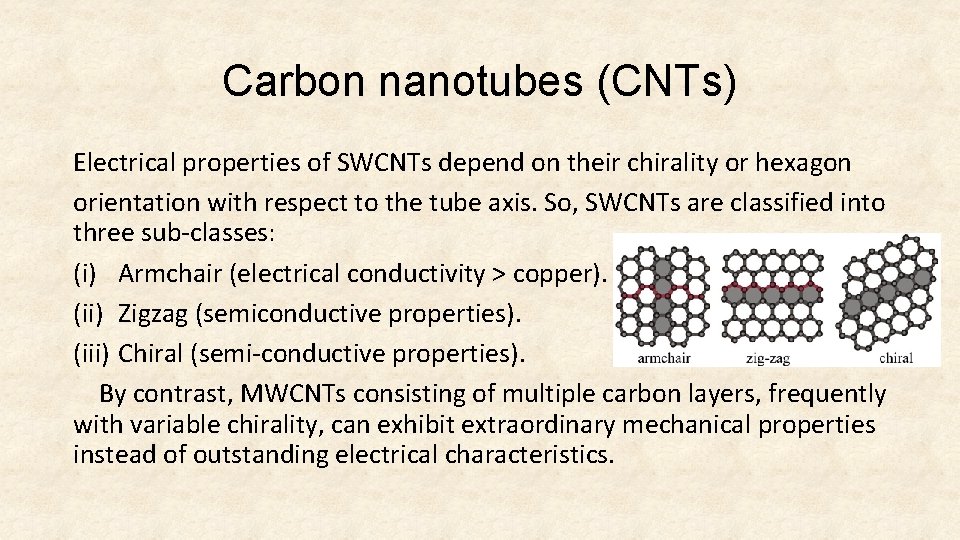
Carbon nanotubes (CNTs) Electrical properties of SWCNTs depend on their chirality or hexagon orientation with respect to the tube axis. So, SWCNTs are classified into three sub-classes: (i) Armchair (electrical conductivity > copper). (ii) Zigzag (semiconductive properties). (iii) Chiral (semi-conductive properties). By contrast, MWCNTs consisting of multiple carbon layers, frequently with variable chirality, can exhibit extraordinary mechanical properties instead of outstanding electrical characteristics.
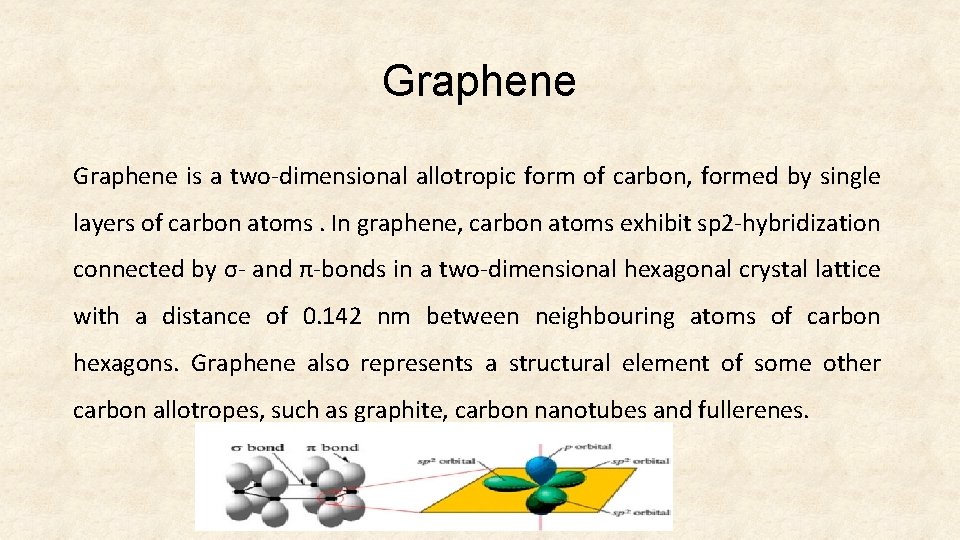
Graphene is a two-dimensional allotropic form of carbon, formed by single layers of carbon atoms. In graphene, carbon atoms exhibit sp 2 -hybridization connected by σ- and π-bonds in a two-dimensional hexagonal crystal lattice with a distance of 0. 142 nm between neighbouring atoms of carbon hexagons. Graphene also represents a structural element of some other carbon allotropes, such as graphite, carbon nanotubes and fullerenes.
Graphene has many unique physical properties, such as extremely high mechanical rigidity and a high thermal stability. Also the electric properties of this carbon allotrope are fundamentally different from the properties of three-dimensional materials.
References ØRoston E. The carbon age. How life’s core element has become civilization’s greatest threat. New York: Walker & Co. ; 2009. ØPeng Q, Dearden AK, Crean J, Han L, Liu S, Wen X, De S. New materials graphyne, graphdiyne, graphone, and graphane: review of properties, synthesis, and application in nanotechnology. Nanotechnol Sci Appl. 2014; 7: 1– 29. ØDe Volder MF, Tawfick SH, Baughman RH, Hart AJ. Carbon nanotubes: present and future commercial applications. Science. 2013; 339: 535– 9.
- Slides: 12