
Carbon and its Related Functional Groups Reference Campbell

Carbon and its Related Functional Groups Reference: Campbell Reece Biology 6 e, Pearson Education, Inc. , publishing as Benjamin Cummings (2002) SBI 4 U

Take up homework • Any questions?
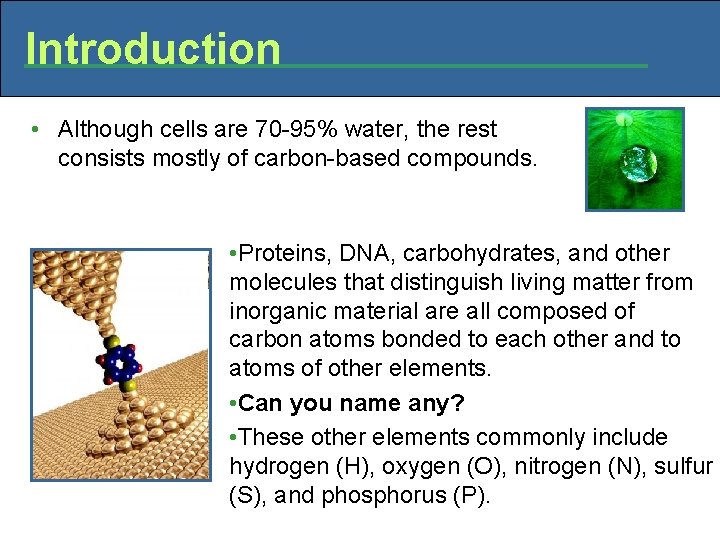
Introduction • Although cells are 70 -95% water, the rest consists mostly of carbon-based compounds. • Proteins, DNA, carbohydrates, and other molecules that distinguish living matter from inorganic material are all composed of carbon atoms bonded to each other and to atoms of other elements. • Can you name any? • These other elements commonly include hydrogen (H), oxygen (O), nitrogen (N), sulfur (S), and phosphorus (P).
Organic Chemistry • What is organic chemistry? • The study of carbon compounds, organic chemistry, focuses on any compound with carbon (organic compounds) –While the name, organic compounds, implies that these compounds can only come from biological processes, they can be synthesized by non-living reactions –Organic compounds can range from the simple (CO 2 or CH 4) to complex molecules, like proteins, that may weigh over 100, 000 daltons
Carbon atoms • Why is carbon so important to life? • With a total of 6 electrons, a carbon atom has 2 in the first shell and 4 in the second shell, carbon has the ability to make 4 bonds – Carbon has little tendency to form ionic bonds by loosing or gaining 4 electrons – Instead, carbon usually completes its valence shell by sharing electrons with other atoms in four covalent bonds – This tetravalence by carbon makes large, complex molecules possible
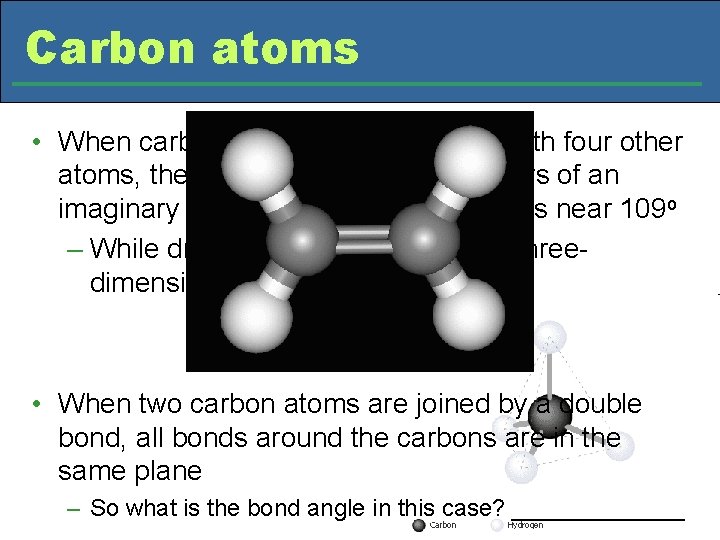
Carbon atoms • When carbon forms covalent bonds with four other atoms, they are arranged at the corners of an imaginary tetrahedron with bond angles near 109 o – While drawn flat, they are actually threedimensional • When two carbon atoms are joined by a double bond, all bonds around the carbons are in the same plane – So what is the bond angle in this case? _______
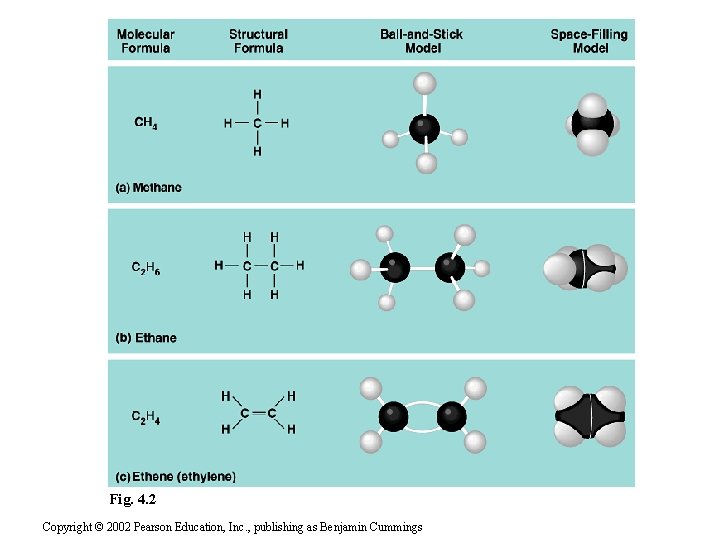
Fig. 4. 2 Copyright © 2002 Pearson Education, Inc. , publishing as Benjamin Cummings
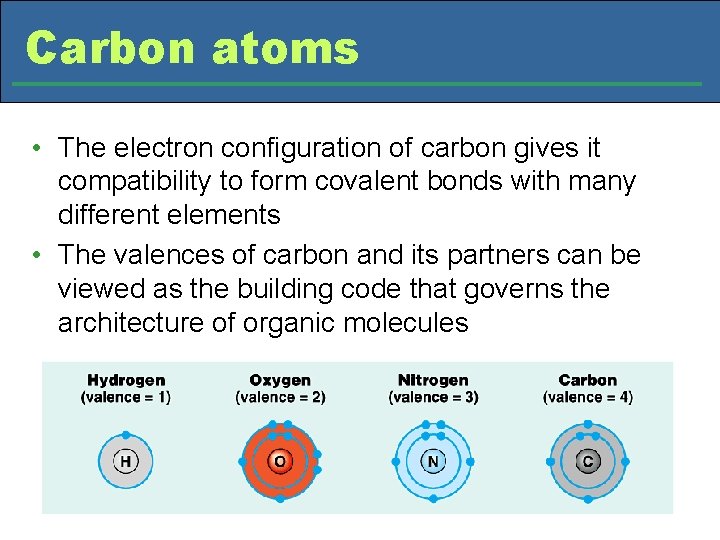
Carbon atoms • The electron configuration of carbon gives it compatibility to form covalent bonds with many different elements • The valences of carbon and its partners can be viewed as the building code that governs the architecture of organic molecules

Functional Groups • The components of organic molecules that are most commonly involved in chemical reactions are known as functional groups – Functional groups are attachments that replace one or more hydrogen atoms to the carbon skeleton of the hydrocarbon

Functional Groups • Each functional group behaves consistently from one organic molecule to another (i. e. the hydroxyl group almost always reacts the same way) • The number and arrangement of functional groups help give each molecule its unique properties (i. e. how it functions)

Functional Groups • There are six functional groups that are most important to the chemistry of life: – Hydroxyl – Carbonyl – Carboxyl – Amino – Sulfhydryl – Phosphate groups ***All are hydrophilic (water-liking) and increase solubility of organic compounds in water Why?

The Hydroxyl Group • In a hydroxyl group (-OH), a hydrogen atom forms a polar covalent bond with an oxygen which forms a polar covalent bond to the carbon skeleton – Because of these polar covalent bonds hydroxyl groups improve the solubility of organic molecules – Organic compounds with hydroxyl groups are alcohols and their names typically end in -ol
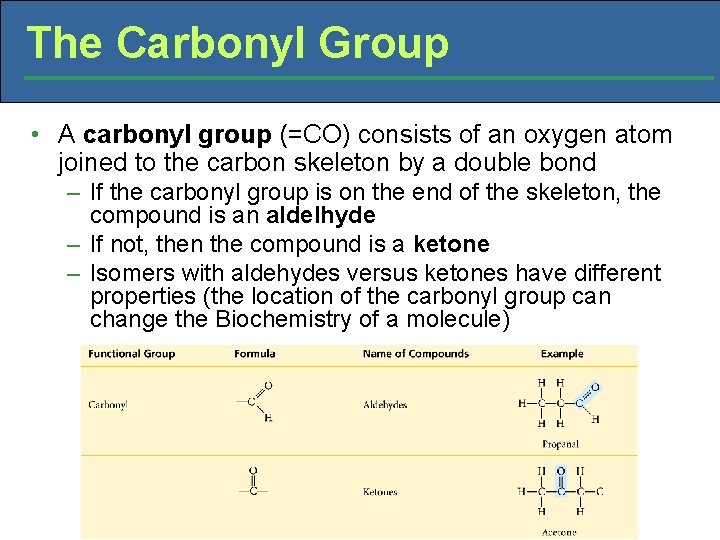
The Carbonyl Group • A carbonyl group (=CO) consists of an oxygen atom joined to the carbon skeleton by a double bond – If the carbonyl group is on the end of the skeleton, the compound is an aldelhyde – If not, then the compound is a ketone – Isomers with aldehydes versus ketones have different properties (the location of the carbonyl group can change the Biochemistry of a molecule)
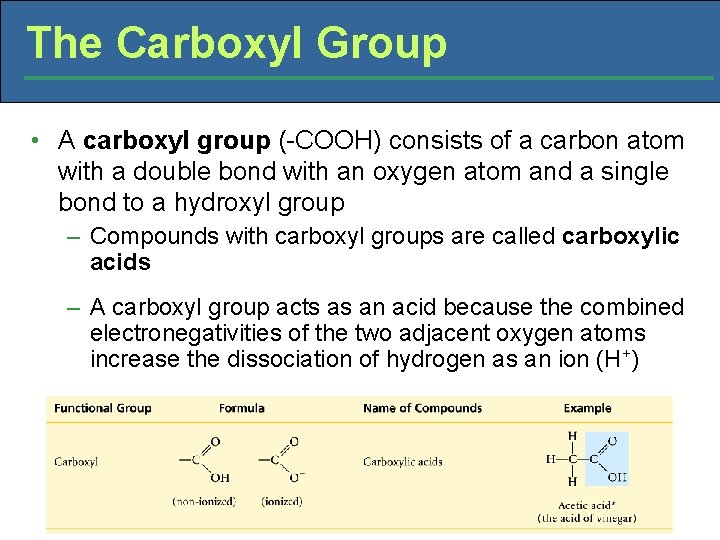
The Carboxyl Group • A carboxyl group (-COOH) consists of a carbon atom with a double bond with an oxygen atom and a single bond to a hydroxyl group – Compounds with carboxyl groups are called carboxylic acids – A carboxyl group acts as an acid because the combined electronegativities of the two adjacent oxygen atoms increase the dissociation of hydrogen as an ion (H+)
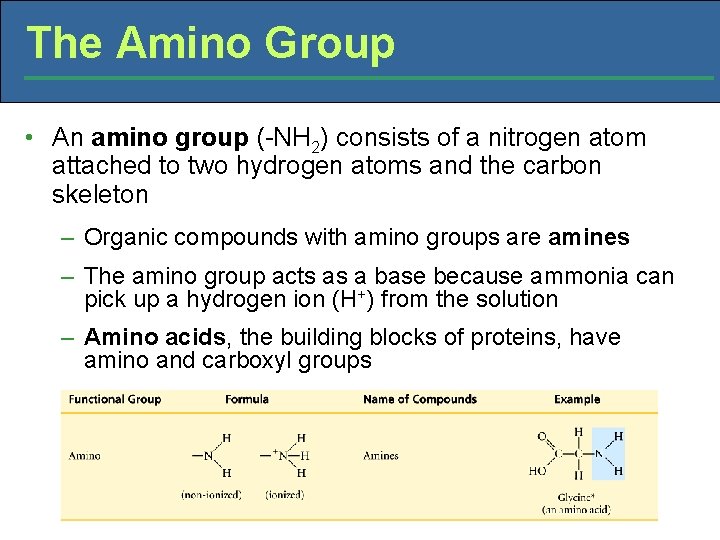
The Amino Group • An amino group (-NH 2) consists of a nitrogen atom attached to two hydrogen atoms and the carbon skeleton – Organic compounds with amino groups are amines – The amino group acts as a base because ammonia can pick up a hydrogen ion (H+) from the solution – Amino acids, the building blocks of proteins, have amino and carboxyl groups
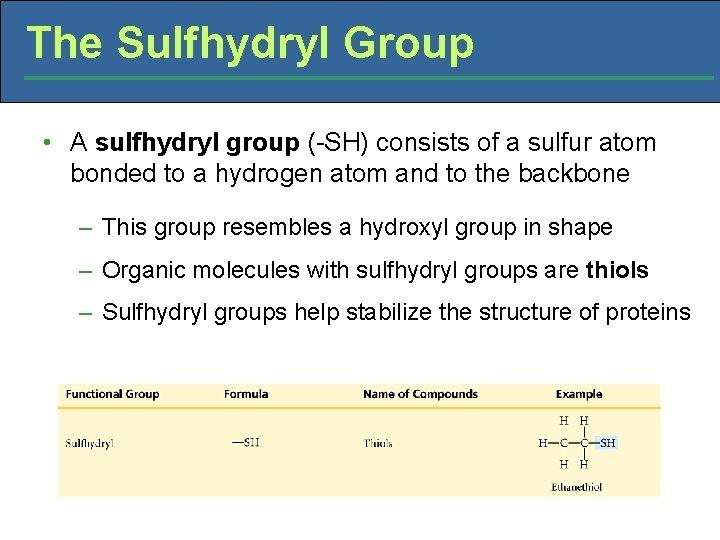
The Sulfhydryl Group • A sulfhydryl group (-SH) consists of a sulfur atom bonded to a hydrogen atom and to the backbone – This group resembles a hydroxyl group in shape – Organic molecules with sulfhydryl groups are thiols – Sulfhydryl groups help stabilize the structure of proteins
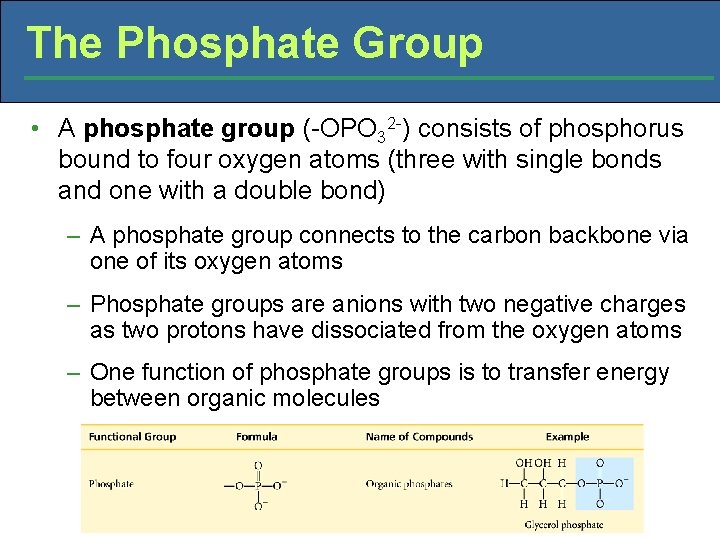
The Phosphate Group • A phosphate group (-OPO 32 -) consists of phosphorus bound to four oxygen atoms (three with single bonds and one with a double bond) – A phosphate group connects to the carbon backbone via one of its oxygen atoms – Phosphate groups are anions with two negative charges as two protons have dissociated from the oxygen atoms – One function of phosphate groups is to transfer energy between organic molecules
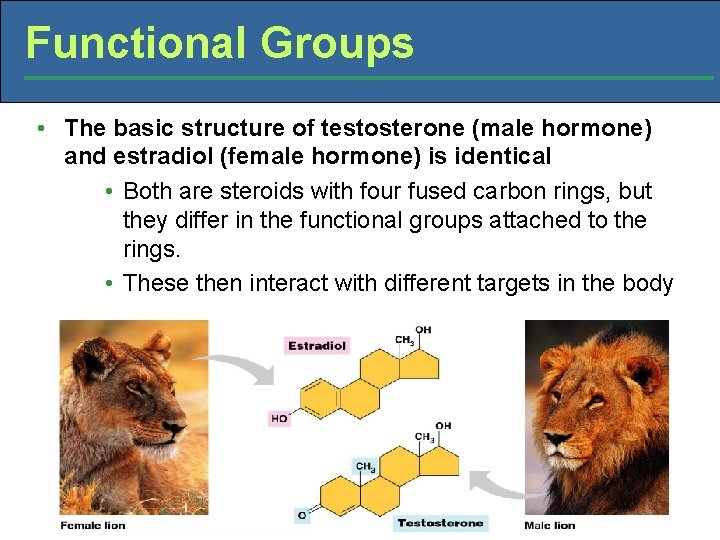
Functional Groups • The basic structure of testosterone (male hormone) and estradiol (female hormone) is identical • Both are steroids with four fused carbon rings, but they differ in the functional groups attached to the rings. • These then interact with different targets in the body
Recap • What elements do living matter mainly consist of? • What kind of bonds link these elements? • Why is carbon the element that is vital to living things? • What gives organic molecules their special function or properties?


Homework! • Read p 24 -28 and answer questions #4, 12, 14 on p 23 • Complete Chemistry Review Sheets
- Slides: 22