
Carbon Allotropes Fullerenes Carbon nanotubes Graphene Diamond Fullerenes
Carbon Allotropes • • Fullerenes Carbon nanotubes Graphene Diamond
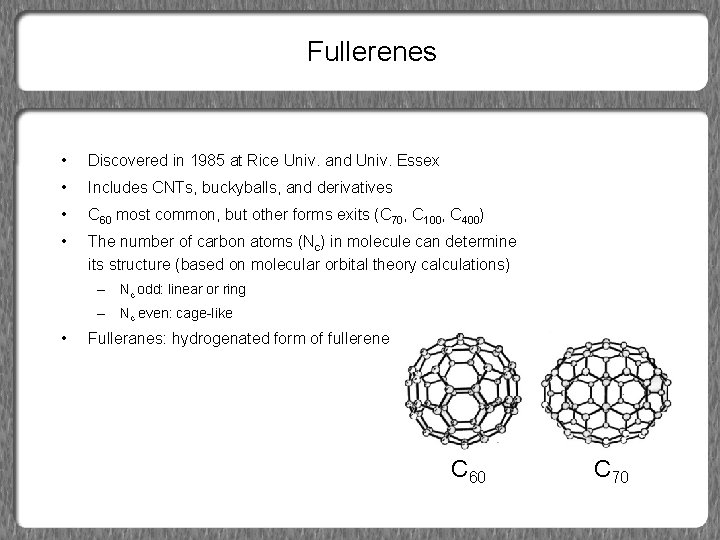
Fullerenes • Discovered in 1985 at Rice Univ. and Univ. Essex • Includes CNTs, buckyballs, and derivatives • C 60 most common, but other forms exits (C 70, C 100, C 400) • The number of carbon atoms (Nc) in molecule can determine its structure (based on molecular orbital theory calculations) – Nc odd: linear or ring – Nc even: cage-like • Fulleranes: hydrogenated form of fullerene C 60 C 70
Fullerene Properties (C 60) • Truncated icosahedron with 32 faces, 90 edges, 60 vertices – 20 hexagonal faces – 12 pentagonal faces • • • Diameter : 7. 10 Å Bonds in fullerenes: sp 2–sp 3 admixture Bonding between fullerenes – Noncovalent • van der Waals • - interactions – Covalent
Fullerene synthesis • Arc discharge plasma – High current applied between two graphite electrodes in He environment – Carbon vaporizes and fullerenes collects on cathode – CNTs form if metal catalyst included in graphite – Low purity: ~ 15% C 60 • Laser ablation – Graphite target exposed to extremely high temperatures – Produces higher order fullerenes • Combustion of hydrocarbon fuel under low pressure – Requires least amount of energy – Produces most pure products
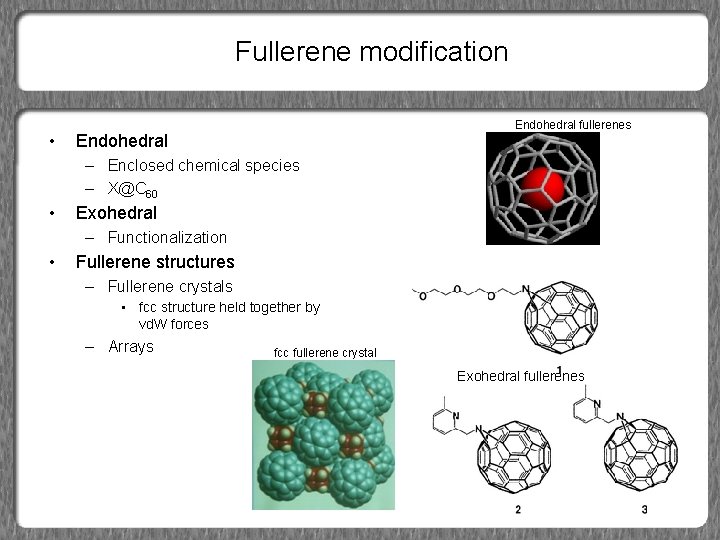
Fullerene modification • Endohedral fullerenes Endohedral – Enclosed chemical species – X@C 60 • Exohedral – Functionalization • Fullerene structures – Fullerene crystals • fcc structure held together by vd. W forces – Arrays fcc fullerene crystal Exohedral fullerenes
Recent Progress - Fullerenes • Fulleride superconductor: 38 K Tc Cs 3 C 60 – Physical Review Letters, v 101, n 13, 26 Sept. 2008, p 136404 (4 pp. ) • Electrospray deposition of C 60 – Journal of Physical Chemistry C, v 112, n 20, 22 May 2008, p 7706 -9 • Bottom-contact fullerene C 60 thin-film transistors with high field-effect mobilities – Applied Physics Letters, v 93, n 3, 21 July 2008, p 033313 -1 -3 • Mechanics of spheroidal fullerenes and carbon nanotubes for drug and gene delivery – Quarterly Journal of Mechanics and Applied Mathematics, v 60, pt. 2, May 2007, p 231 -48 • Applications of fullerene beams in analysis of thin layers – Vacuum, v 82, n 10, 3 June 2008, p 1120 -3
Carbon Nanotubes (CNTs) • Single-walled CNTs (SWCNTs) – Graphene sheet rolled into a tube • Forms of SWCNTs – Zigzag – Armchair – Chiral • Multiwalled CNTs (MWCNTs) – Series of concentric SWCNTs
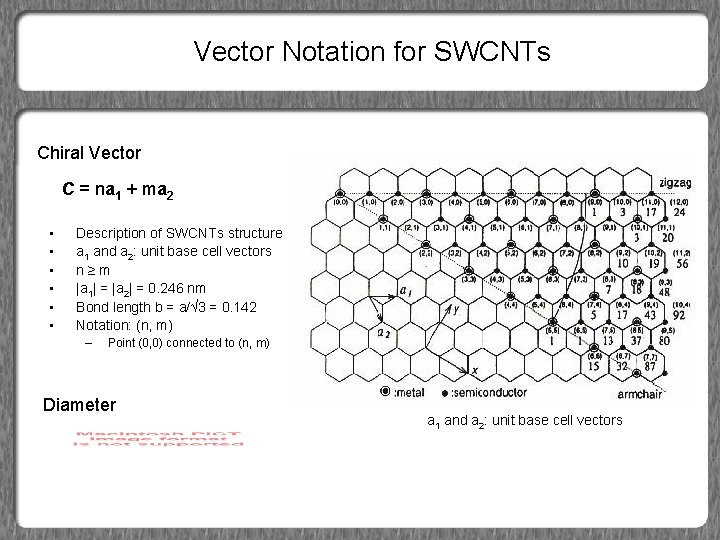
Vector Notation for SWCNTs Chiral Vector C = na 1 + ma 2 • • • Description of SWCNTs structure a 1 and a 2: unit base cell vectors n≥m |a 1| = |a 2| = 0. 246 nm Bond length b = a/√ 3 = 0. 142 Notation: (n, m) – Point (0, 0) connected to (n, m) Diameter a 1 and a 2: unit base cell vectors
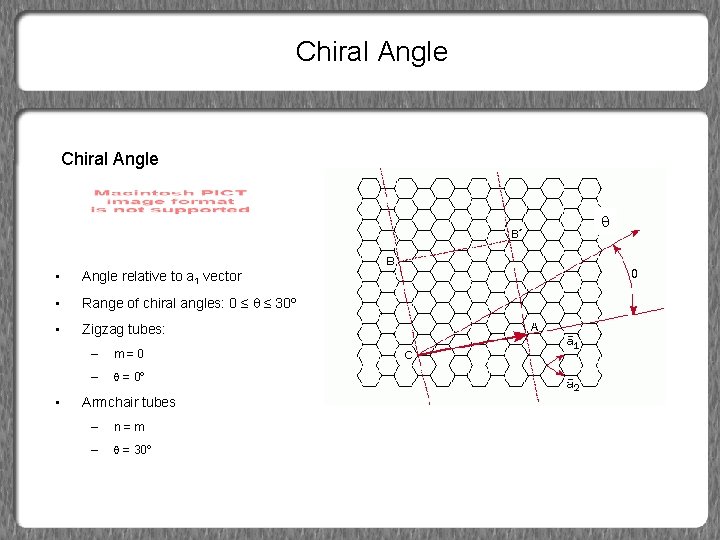
Chiral Angle • Angle relative to a 1 vector • Range of chiral angles: 0 ≤ ≤ 30º • Zigzag tubes: • – m=0 – = 0º Armchair tubes – n=m – = 30º
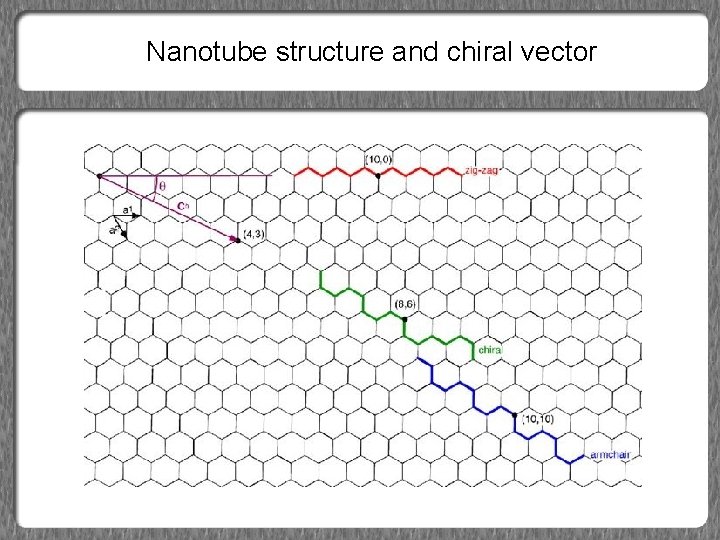
Nanotube structure and chiral vector
Electrical Properties • Metallic SWCNTs – Conduction is quantized (m. f. p. of electrons on order of dimensions of tubes – Ballistic transport (no scattering) – In theory can carry electrical current density 1000 x silver or copper – |(n-m)| = 3 q where q is an integer – Criteria for conduction: • All armchair tubes (n = m) • All zigzag with n multiple of 3 • Chiral tubes that meet above criteria • Semiconducting SWCNTs – |(n-m)|≠ 3 q
Other properties of SWCNTs • Thermal conductivity – Thermal conductivity along axis is greater than around circumference – ~ 6000 W/m • K along axis (Copper ~ 385 W/m • K) at room T • Optical – Band gap of semiconducting tubes (0. 4 to 0. 7 e. V) Eg ~ 5. 4 b/d. SWCNT b: bond length d: diameter
Synthesis of CNTs SWCNTs with chemical vapor deposition • • Regarded as the best method Requires little energy (T ~ 100 s ºC) Carbon source broken apart in presence of metal catalyst Carbon sources for CVD – – • Polydisperse products (bad!) – – • • Methane Acetylene Ethylene CO Diameter Chirality Length Orientation No one has been able to synthesize exactly one kind of nanotube at a time Synthesis of SWCNT vs. MWCNTs – Control deposition conditions (P, T, gas composition, catalyst composition and size)
Growth mechanism of CNTs • Base-growth – Typical of SWCNTs – Catalyst remains anchored to substrate (usually alumina) • Tip growth – SWCNTs and MWCNTs – Catalyst comes detached from substrate – Favored for silica type substrates • Limitations to growth – Increased vd. W forces between tube and substrate with tube length – Growth terminates when force becomes too great • Application of electric field can enhance growth – Transport of carbon source to catalyst • Diffusion to catalyst from bulk more difficult as tube length increases • Diffusion across catalyst surface inhibited by encapsulation
- Slides: 14