
Carbohydrates Simple Sugars and Complex Chains BIOL 103
Carbohydrates: Simple Sugars and Complex Chains BIOL 103, Chapter 5 (Part 1)
Today’s Topics • Simple Sugars: Mono and Disaccharides • Complex Carbohydrates • Carbohydrate Digestion and Absorption
Carbohydrates Capture Energy from the Sun • Carbohydrates include sugars, starches, and fibers • Major food sources: __________ – Produced during photosynthesis • Two main carbohydrate types: – ________________________________________
Simple Sugars • Monosaccharides and Disaccharides – Simple Carbohydrates • Monosaccharides – _______________________ • Disaccharides: – _______________________
Monosaccharides • Glucose/Dextrose – Most _________ – Gives food mildly sweet flavor – Usually joined to another sugar – Provides _________________ • Only fuel source used by _________ (unless not enough glucose left in your body) – Found in fruits, vegetables, honey
Monosaccharies • Fructose/Levulose – ____________ – Tastes the sweetest – Present ________ in fruits and vegetables – Found in fruits, honey, high fructose corn syrup • Galactose – Usually bond to glucose to form lactose • Primary sugar in ____________
High Fructose Corn Syrup • How is it made? 1. Convert glucose fructose 2. Add corn syrup, then a specific ratio of glucose – Examples: • Why do we use it? – Before 1970 s U. S. cane sugar too expensive – 1980 s, food companies switched to cheaper corn • Pepsi/Coke switched in 1984
Why is High Fructose Corn Syrup associated with weight gain? 1. ______________________________________ 2. Fructose does NOT release insulin (which normally helps control blood sugar) and leptin (feeling full) does not feel full drink more calories • However, note that overconsumption of any forms of sugar will contribute to weight gain.
Disaccharides • If you link two monosaccharies, they become disaccharides: – Sucrose: _________________ – Lactose: _________________ – Maltose: ________________
Disaccharides • Sucrose: glucose + fructose – ________________ – Made from sugar cane and sugar beets – Listed as _________ on food labels • Lactose: glucose + galactose – ______________ – Found in milk and milk products
Lactose Intolerance • Who has it? – Anyone who _______________, which normally converts (lactose glucose + galactose) • Why do you get it? – Genetics: does not have ______________________(can produce lactose into adulthood) – Acquired by low lactose diet or injury to intestine usually during infancy
Disaccharides • Maltose: glucose + glucose – _________________ – Seldom occurs naturally in foods, but usually forms whenever ___________________________________ – Found in germinating cereal grains – Fermented in beer • “Beer Belly”?

Complex Carbohydrates • Chains of ________ sugar molecules – Oligosaccharides • _____________________ • In breastfed infants, it plays a similar role to dietary fiber in adults (helps stools to pass by more easily) • Examples: dried beans, peas, lentils – Polysaccharides • _____________________ • Digestible (e. g. starch) or non-digestible (e. g. fiber)
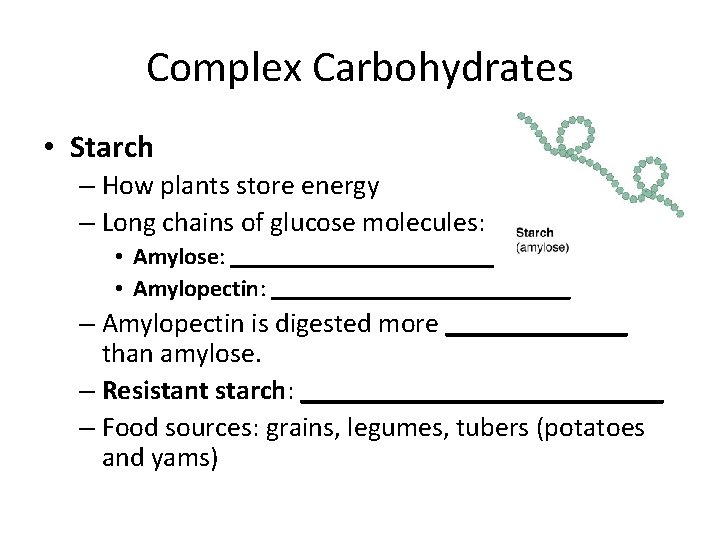
Complex Carbohydrates • Starch – How plants store energy – Long chains of glucose molecules: • Amylose: ___________ • Amylopectin: _____________ – Amylopectin is digested more _______ than amylose. – Resistant starch: _____________ – Food sources: grains, legumes, tubers (potatoes and yams)
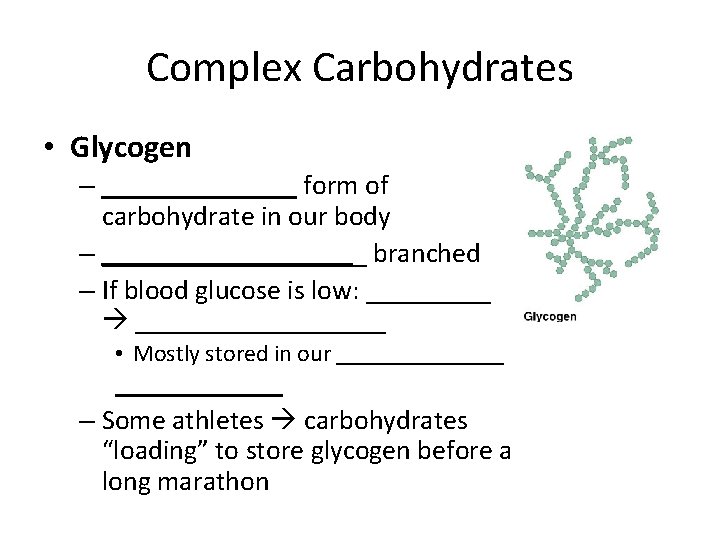
Complex Carbohydrates • Glycogen – _______ form of carbohydrate in our body – __________ branched – If blood glucose is low: _________ • Mostly stored in our ______________ – Some athletes carbohydrates “loading” to store glycogen before a long marathon
Complex Carbohydrates • Fiber: _______________________________________ – Dietary fiber: found in plants • fruits, vegetables, legumes, whole grains – Functional fiber: isolated and added to foods – Total fiber: _______________
Complex Carbohydrates • Types of fiber: 1. Cellulose: long, straight chains of ______ • ______________ in plants: forms the woody fibers in trees + strong plant cell walls 2. Hemicellulose: variety of monosaccharides with many branching side chains • Usually mixed in with cellulose in plants 3. Pectins: gel-forming polysaccharides • • Especially in fruits Pectins + acid + sugar = Jam
Complex Carbohydrates • Types of Fibers (cont. ) 4. Gums and cilages • • __________that hold plant cells together Examples: Xanthan gum, guar gum and carrageenan ___________________such as dressings, puddings, sauces, pie fillings, etc. 5. Lignins • • Nondigestible substances in vegetables and fruits Examples: strawberry seeds, woody parts of carrots and broccoli
Complex Carbohydrates • Types of fibers (cont. ) 6. Beta-glucans: ______________ • • Help decrease blood cholesterol levels Food sources: barley, oats 7. Chitin and chitosan • • Primarily consumed in _____________ Marked as weight-loss supplements May impair absorption of fat-soluble vitamins and some minerals Found in exoskeletons of crabs and lobsters
Carbohydrate Digestion: Carbohydrates to Single Sugars • Mouth: – Salivary amylase • Stomach: – HCl’s acidity stops the action of __________________ • Small intestine – Pancreatic amylase: continues starch digestion – Bruch border enzymes: digest _________ – Other digestive enzymes: • Maltase, sucrase, and lactase
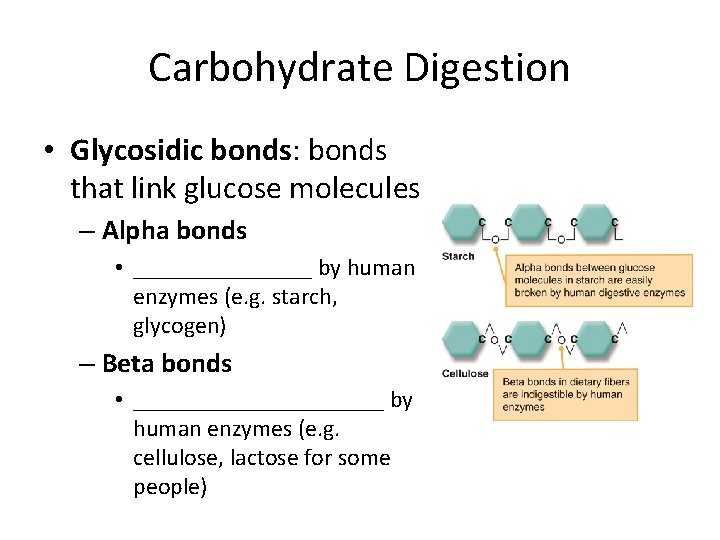
Carbohydrate Digestion • Glycosidic bonds: bonds that link glucose molecules – Alpha bonds • ________ by human enzymes (e. g. starch, glycogen) – Beta bonds • ___________ by human enzymes (e. g. cellulose, lactose for some people)
Carbohydrate Digestion and Absorption • Enzymes – Highly specific in working with certain reactions and specific molecules • Commercial product: __________ – Breaks down oligosaccharides in beans so it can be absorbed – Some carbohydrates remain intact, such as fiber and resistant starch • Bacteria in colon digests them to gas + few short chain fatty acids ________________
Carbohydrate Digestion and Absorption • Absorption: in the small intestine – End products of carbohydrate digestion: • (Travel to Liver through the Portal Vein): – Glucose – Galactose Glucose – Fructose Glucose – ______ stores and releases glucose to maintain _______________.
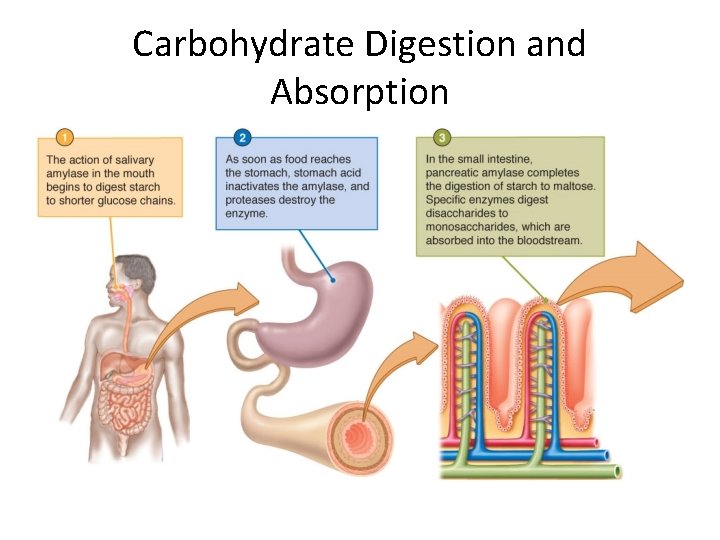
Carbohydrate Digestion and Absorption
- Slides: 24